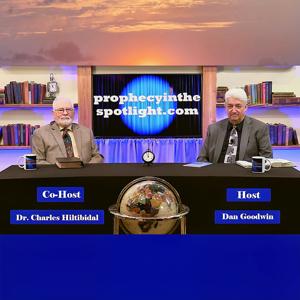
Prophecy in the Spotlight with Dan Goodwin

Prophecy in the Spotlight with Dan Goodwin

Download on the App Store

Prophecy in the Spotlight with Dan Goodwin episodes

  • Prophecy in the Spotlight, October 5, 2026
    Prophecy in the Spotlight with Dan Goodwin
    Prophecy Converging: Israel, Ezekiel 38, and the Roads Coming Together
    Dan Goodwin and Charles Hiltibidal describe the roads of prophecy converging on one main highway, from Israel and the Ezekiel 38 war to Daniel's kingdoms and the Laodicean church, and urge viewers to be ready for the Lord's return.
    Roads of Prophecy Converging on One Highway
    Dan Goodwin opens Prophecy in the Spotlight by announcing the theme, Prophecy Converging, and describing many roads of prophecy, including the church and Israel, as lanes of traffic merging into one main road toward a city. He says the world is at the very edge of the cliff and the trumpet is getting ready to sound. Goodwin acknowledges that some listeners were disappointed when the Feast of Trumpets passed without the Lord's return, but says he was never disappointed, because he never believed Jesus would come on that day. He points viewers to video number 275 on the show's YouTube channel, a presentation he made in the studio with a PowerPoint. Co-host Charles Hiltibidal, called Doc, supplied the highway picture. The two joke about keeping a bag packed, and trade lines about taking nothing to heaven except souls reached and works remembered at the judgment seat. Before the first break, Goodwin says the traffic is building and the lights of the city are already visible.
    Why Preachers Avoid Prophecy
    Back from the break, Goodwin and Hiltibidal joke about the work of preparing a program, and Hiltibidal says they need no notes because they have worked in this field for more than 40 years. Hiltibidal marvels that he has been in the ministry for 65 years, and Goodwin admits that during a recent live stream he got so carried away listing signs of the end that he never reached his topic. The men recall the 1988 book 88 Reasons Why '88 Is the Year of the Rapture, which Hiltibidal once answered with sermons in Dallas, and they agree that date setting is not what they do, though they admit some people take their remarks out of context. Hiltibidal then describes how many pastors seem unwilling to touch prophecy, even though their people are hungry for it. Goodwin says he thinks preachers stay away because they do not know the subject and feel embarrassed, and Hiltibidal recalls pastors admitting prophecy is not their strength.
    Israel, Ezekiel 38, and the Antichrist's Temple Offer
    Dan Goodwin names Israel as the biggest road of prophecy, because the tribulation is largely about Israel, and Hiltibidal recalls an article showing how interpreters' views of prophecy shifted from 1929 to 1944 to 1948. Goodwin credits M. R. DeHaan with seeing it early, and both men trace key moments: the Balfour agreements, which Goodwin dates to 1917, the 1948 founding of the nation, and the 1967 Six-Day War. Goodwin says he cannot prove it but has long felt the Antichrist will offer the Jews a third temple as a carrot for their allegiance, and Hiltibidal expects the Antichrist to be accepted as Messiah by Jews and as the Mahdi or 12th Imam by Muslims, the 'he' of Daniel 9:27 who confirms the covenant. Turning to Ezekiel 38, the men describe a coalition including Russia, Iran and Turkey, and Goodwin links a weapon that takes seven years to burn to the seven-year countdown, a point the transcript leaves unclear.
    Calendars, Creation Days, and Daniel's Beasts
    Hiltibidal says God does everything exactly on time and questions how near the 6,000th year is, since a day with the Lord is a thousand years and God would not be late for the Sabbath. Goodwin notes that six is the number of man and points to Genesis 6:3, where God says man's days shall be 120 years, which he divides by fifty to reach a 120th Jubilee, the number he links to the 6,000th year. Hiltibidal argues the 120 years had nothing to do with Noah, whose ark took about 98 years to build, and says that taken literally, the Millennial Reign is the seventh day, the Sabbath. Goodwin then turns to Daniel 2 and Daniel 7, which give the same four kingdoms, the statue showing man's view and the wild beasts of Daniel 7 showing God's view of every government, including America's, as beasts that must be restrained by law. Goodwin adds that the coming world empire is nearly ready, and Hiltibidal links it to the beasts of Revelation 13.
    Data Centers, Russia in Syria, and Iran
    Hiltibidal raises a proposed board of peace of figures outside national government, and Goodwin says Donald Trump would still lead it after leaving office. Goodwin calls the data centers going up across America and the world the heart of the mark-of-the-beast system, and warns they will track people. Hiltibidal says he is convinced Trump is not the Antichrist, and he describes passing a camera he calls a flock camera, part of what he calls the final control network. Goodwin points to Russia's build-up in Syria, and the two note that Russia has declared Mount Hermon and the Golan Heights belong to Syria, a move they read as preparing the world for an invasion through those mountains. Hiltibidal adds that Iran is part of the Ezekiel 38 picture and that no military campaign will change the hardline Islamist theology he says.
    Laodicean Church, Persecution, and a Call to Readiness
    Goodwin identifies the final church as the Laodicean church, and Hiltibidal says full-blown Laodiceanism is visible, insisting an old-fashioned, fire-breathing preacher will struggle to build a big church because most of Christianity is lukewarm. Goodwin says old-fashioned independent Baptists are being stigmatized, and both men link the digging up of long-dead pastors' faults to a warning Goodwin attributes to Matthew, that those who kill believers will think they do God a service. Goodwin says old-fashioned preachers are the salt that irritates, and says apostasy, the falling away from truth, is already here, noting how few still use the King James Bible. The men point to a groaning creation, with storm surges along the California coast from a storm out near Hawaii, and earthquakes unlike any before, which Hiltibidal expects to crescendo at the last vial of wrath in Revelation 16. Asked for a word of admonition, Hiltibidal says being ready means being saved, which begins with recognizing you were lost on your way to hell and receiving Christ, who paid the price on Calvary's cross.
    29 min
  • Prophecy in the Spotlight, September 28, 2026
    Prophecy in the Spotlight with Dan Goodwin
    Danger in the Last Days: 2 Timothy 3 and Why Self-Love Is the Root of Perilous Times
    Dan Goodwin and Dr. Charles Hiltibidal open 2 Timothy chapter 3 to argue that the perilous times Paul warned about describe the condition of the church rather than the world, walking through the self-love, compromise, and broken families they see marking Christianity today.
    Opening: Perilous Times Ahead
    Dan Goodwin opens Prophecy in the Spotlight alone, telling viewers the broadcast is titled "Danger in the Last Days" and grounding it in 2 Timothy chapter 3. He reads verse 1, "this know also, that in the last days perilous times shall come," and stresses to viewers that Paul is not describing some distant future but conditions Goodwin believes are already here. He explains that "perilous" comes from "peril," meaning danger, and reads ahead to verse 2, where Paul writes that men "shall be lovers of their own selves." Goodwin argues that self-love has become the defining mark of the modern Christian, pointing to how believers now build their lives, beliefs, and priorities entirely around themselves rather than God. He tells viewers that Dr. Charles Hiltibidal is waiting in the studio to dig deeper into the passage, promises the show will not be a lighthearted one, and sends the broadcast to its opening break.
    Setting the Scene: Christianity, Not the World
    Back from the break, Dan Goodwin tells viewers the discussion may feel more sober than usual, recalling the show's occasional lighter moments but noting this is "a time of mourning." He and Charles Hiltibidal work through the early verses of 2 Timothy 3 together, and Hiltibidal points to verse 5, "having a form of godliness, but denying the power thereof," arguing that the perilous times Paul describes are not a warning about the secular world but about "the condition of Christianity in those last days." Goodwin agrees, noting the world has always lived without Christ while the church was once set apart, with Bible reading, preaching, spiritual leadership, and parental discipline shaping believers' lives. Hiltibidal adds that even young parents in their twenties and thirties now treat church as optional, calling their pastors for advice they would have already heard had they attended the previous Sunday. Both men tie this decline to the "latter times" language of 1 Timothy 4:1 and the last church of Revelation chapter 3, the Laodicean church, which Hiltibidal insists describes Christianity rather than the world.
    Self-Love, Obsession, and Yielded Members
    Dan Goodwin returns to the phrase "lovers of their own selves," calling it the key statement of the passage and arguing that every trait Paul lists afterward flows out of that self-love. Charles Hiltibidal agrees, describing the list as character traits of someone who has let his "old man" become spiritualized while still living as before. The two address a common claim that a Christian cannot be influenced by demonic forces, with Hiltibidal clarifying that a believer cannot be possessed, since the Holy Spirit seals the inner man, but can still be "obsessed" through outside influence. Goodwin cites Paul's teaching, likely from Romans, that believers become servants to whatever they yield their members, whether eyes, hands, or thoughts, to. He argues Christians can yield themselves to demonic influence even while remaining saved. Hiltibidal broadens the point to responsibility, saying pastors, Sunday school teachers, deacons, and fathers must guard their households because scripture and preaching have been "watered down" to avoid confronting sin, with churches increasingly excusing compromise as simply belonging to "the Laodicean era."
    Natural Affection, Abortion, and Broken Walls
    The conversation turns to the phrase "without natural affection," and Goodwin asks why a woman would want to end her baby's life, answering that it requires the same self-love the passage describes. Hiltibidal points to a man running for the Senate in Texas who identifies as a preacher yet says abortion is acceptable, calling it proof that perilous times have reached Christian leadership itself. Goodwin then raises the old "doctrine of separation," illustrating it with the image of a wall meant to keep children, and especially sons, from wandering off like the prodigal son, and both men lament that courtship and chaperones, common in earlier generations, have largely disappeared because fathers will not enforce boundaries. Hiltibidal shares a personal memory from his pastorate in Dallas, recalling a respected evangelist who fell into adultery, lost his church and family, and wept at his desk confessing he believed God's blessing on his ministry meant the affair would be fine, an example Hiltibidal calls a clear picture of self overruling what a man already knows is true.
    Money, Debt, and Seducing Spirits
    Hiltibidal ties the list's word "covetous" to Paul's closing words in 1 Timothy 6:10, that the love of money is a root of evil that has caused some to err from the faith, and warns that Christian leaders today take advantage of their position for personal gain. Goodwin adds that many preachers avoid confronting certain sins because they fear offending the large donors who keep their churches running, and Hiltibidal suggests some leaders have built such debt through buildings and the appearance of success that they cannot risk losing that income. The men then return to 1 Timothy 4:1, where "the Spirit speaketh expressly" that in the latter times some will depart from the faith by giving heed to "seducing spirits" and doctrines of devils. Hiltibidal blames a lack of personal devotion, guessing that the vast majority of preachers, deacons, and Sunday school teachers never open their Bibles or spend quiet time with God before starting their day, leaving them vulnerable to whatever consumes their attention instead, a habit he says shapes much of what is wrong with Christianity today.
    Boasting, Pride, and a Call to Repent
    Working through the rest of Paul's list, Hiltibidal describes "boasters" as those who claim accomplishments and knowledge they do not truly have, and "proud" as those who consider themselves superior because of a larger congregation or following. He calls "blasphemous" not blasphemy against God directly but leaders who promote practices, which he says are unbiblical, while claiming spiritual authority, and ties "disobedient to parents" to fathers who refuse to set standards for their children's dress and conduct, warning that many preachers have lost their families by living one way in the pulpit and another at home. On "unthankful," Hiltibidal contrasts self-centered American believers with joyful Christians he has met in Uganda who own almost nothing, and a miserable millionaire he has also visited. He defines "unholy" as living by the old sinful nature while claiming spiritual justification. Goodwin closes by summarizing that self-love drives every trait on the list, urging viewers to be certain of their salvation and to walk with God, before signing off telling them to keep their eyes on the skies.
    29 min
  • Prophecy in the Spotlight, September 21, 2026
    Prophecy in the Spotlight with Dan Goodwin
    The Seven Days of Noah: The Ark as a Picture of the Rapture and God's Prophetic Number Patterns
    Dan Goodwin and Dr. Charles Hiltibidal examine the seven days Noah's family spends sealed inside the ark before the flood begins, tracing what they see as prophetic pictures of the rapture, the marriage supper, and recurring biblical patterns built around the numbers seven and forty.
    Reading Genesis 7 And The Seven Days
    Dan Goodwin opens Prophecy in the Spotlight alone, introducing himself as "Brother Goodwin" and previewing the day's topic, "The Seven Days of Noah." He reads from Genesis chapter 7, starting at verse 6, describing how Noah, his wife, his sons and their wives enter the ark at Noah's six hundredth year, followed by the animals two by two. He points to verse 10, which states that "it came to pass after seven days that the waters of the flood were upon the earth," and notes that Noah's family sits inside the sealed ark alone for seven full days before the rain begins. Goodwin tells viewers this detail is something "most of you probably have never heard" discussed, and promises a deeper look at what those seven days might mean once the broadcast returns from its opening break.
    Viewer Support Keeps The Ministry On Air
    Back from the break, Goodwin and Dr. Charles Hiltibidal open with some banter about the late-summer heat, correcting each other that it is September, not August, and recalling a temperature of 103 degrees the day before. Goodwin thanks the viewers who fund the broadcast through monthly offerings, checks, and recurring credit card gifts, noting the program has just passed six years on the air and started its seventh. He and Hiltibidal joke that they "started this thing with no money" and "still got no money," yet credit the audience with keeping it going. The two compare their modest set to polished Christian television productions, with Hiltibidal recalling a set that was "nothing but a warehouse" with bare walls, and both agreeing their own three-set studio and improved audio are a blessing. Goodwin mentions a viewer, Brother Stu, from Washington state, whom they hope to host in the studio soon.
    A Type Of The Rapture And Marriage Supper
    Turning to the text, Goodwin says a viewer had written in about the seven days, prompting him to look closer, and he tells Hiltibidal the passage seems to picture the rapture, with believers sealed by "the Holy Spirit of promise" the way Noah's family is sealed inside the ark. He suggests that once the door shuts, believers go to the marriage supper, and Hiltibidal adds that the judgment seat of Christ likely comes first, comparing it to the moment in a Jewish wedding when a groom praises his bride publicly, with no sins raised against her. Goodwin stresses that Calvary already covered every sin, so nothing can be brought up at the judgment seat, and that no believer can lose the gift of salvation. Hiltibidal agrees, noting Noah is sealed into the ark for seven days before "the fountains of the great deep are broken up," and says Bible readers should watch for prophetic pictures as well as literal and figurative meaning.
    No Real Door And Seven Appearing Seven Times
    Hiltibidal explains a detail from his own podcast, Walk Through Time with Doc, that the ark's door was not really a door at all: the vessel's walls were built of inner-laminated gopher wood, so thick that once the entrance section rose into place like a jigsaw piece, it fused solid and sealed Noah's family in completely, with no gap for sound or water. He notes that Genesis later records Noah having to cut his way out from the inside, prompting Goodwin to joke about Noah searching for a missing saw. Hiltibidal then reveals a study he has done, finding that the number seven, or "seventh," appears exactly seven times across the life of Noah in Genesis chapters 6 through 9, and that seven itself shows up thirty-nine times across the book of Genesis, a count Goodwin jokingly likens to the thirty-nine books of the Old Testament, with both men laughing that Michael Samuel Smith would surely find deeper meaning in it.
    Creation Days The Number Forty And The Calendar
    Hiltibidal lays out a day-for-a-thousand-years pattern, matching each day of creation to a thousand-year period of history: day one's forming of water parallels the fall of man, and day two's separating of the waters above from the waters beneath parallels the flood, when those same waters are reunited and the earth is remade with Noah as a kind of second Adam. He extends the pattern toward a future new heaven and new earth after the millennial reign's seven-thousandth year. The two then survey the number forty across scripture, the forty days of rain, Israel's forty years in the wilderness, the forty-year reigns of David and Solomon, and Christ's forty days in the wilderness and after the resurrection. Goodwin adds that Genesis records months by the pre-Exodus calendar, so the ark rests in the seventh month, later renamed Nisan after Exodus 12, on the seventeenth day, the same date, he notes, as Resurrection Sunday.
    Fossils A Brass Dog And A Personal Testimony
    The men discuss fossil concentrations near Mount Ararat and in parts of Texas and Illinois, which Hiltibidal attributes to animals fleeing toward higher, granite-rich ground ahead of the rising floodwaters. He describes a small brass artifact in their museum, a dog engraved with pairs of fleas, ferrets, birds, and snakes, found near an altar site on Ararat's slope. Hiltibidal calls the ark itself a picture of Christ, absorbing the water's pressure, the rain, and the lightning so that everyone inside "never felt a thing," just as Christ suffered on Calvary so believers would not have to. Asked whether the world is nearing the moment God "shuts the door," Hiltibidal points to 2 Thessalonians and warns that those who reject the truth will be left behind. Goodwin closes by recounting his own conversion on July 4, 1981, when he realized he was lost and trusted Christ, and signs off telling viewers to keep their eyes on the skies.
    29 min
  • Prophecy in the Spotlight, September 14, 2026
    Prophecy in the Spotlight with Dan Goodwin
    What Is In Genesis 6: The Sons Of God And The Truth About The Nephilim
    Dan Goodwin and Dr. Charles Hiltibidal spend the broadcast on Genesis 6, arguing from Matthew, Luke, Jude, and Ephesians that the "sons of God" are not fallen angels, and that the popular Nephilim theory is a modern distraction from the chapter's real message about man's wickedness, Noah's righteousness, and God's plan of redemption.
    Reading Genesis 6 And The Nephilim Distraction
    Dan Goodwin opens the broadcast alone, reading the opening verses of Genesis 6 and pointing out that the text says "men," plural, multiplying on the earth, not fallen angels or Nephilim. He tells viewers the passage contains nothing about angelic offspring or UFOs, calling that reading "nonsense" that is "not even possible." Goodwin introduces his book, The Great End Time Distraction, describing its three parts: what he calls the Nephilim crowd's teachings quoted from their own writings, a method for studying the question honestly, and what he believes the Bible actually says. He reads a passage from the book warning that confusion over the "sons of God" in Genesis 6 has spread through prophecy ministries for decades, with some teachers claiming that offspring of angels and human women cannot be saved. He previews the day's topic, "What Is In Genesis 6," promising slides from Dr. Charles Hiltibidal once the show returns from its opening break.
    A Ministry Kept On The Air By Viewers
    Back from the break, Goodwin thanks viewers for keeping the program on television and YouTube for more than six years, noting that neither he nor Dr. Charles Hiltibidal draws a salary from the ministry and that donations pay for staying on multiple networks. He walks through the ways to give, an 800 number, a website, a phone line staffed by "the ladies," and the option to talk with him or Hiltibidal directly before donating. The two men grow personal, with Hiltibidal describing the two-hour drive he makes each way to reach the studio, the technology his wife maintains, and the building and taxes he is still paying on, while Goodwin says he would quit if he did not believe the work was making a difference. Hiltibidal adds that a woman texts him weekly asking whether something she has heard "sounds right," proof, he says, that people genuinely want the truth. Goodwin lightens the mood by asking, half-joking, whether the angels supposedly flying UFOs use a steering wheel or a joystick.
    Debunking The Fallen Angel Theory
    Hiltibidal explains that the day's slides come from his weekly podcast, Walk Through Time with Doc, where he devoted an earlier session to what is not in Genesis 6 before turning to what is. He recaps that the chapter never mentions angels leaving their "first estate," developing physical bodies, or fathering children, and traces the popular fallen-angel reading to the book of Enoch, which he says arose during the four hundred silent years when God gave no open revelation. He and Goodwin walk through Matthew's and Luke's statement that the days before Christ's return will mirror the days of Noah, people eating, marrying, and building homes with no concern for God, and Luke's parallel reference to the days of Lot. Hiltibidal challenges the claim that Jude's "strange flesh" describes fallen angels, asking how a spirit being could create a body it was never given, and Goodwin cites Ephesians 6 that "we wrestle not against flesh and blood" since angels have neither. Hiltibidal notes that the Hebrew word rendered "giants" in Genesis 6 is nephel, not Nephilim, calling the substitution dishonest.
    Laws Of Interpretation And The Sons Of God
    Hiltibidal lays out what he calls the laws of Bible interpretation: keeping a verse in its context, the law of consistency, since he says God does not use a term differently in different places, and the law of first mention, how God's earliest use of a word or phrase governs its meaning throughout scripture. Goodwin compares the last principle to a courtroom lawyer citing an 1892 precedent to argue how a case should be decided today. Hiltibidal pushes back on the common claim that "sons of God" means angels in the Old Testament but believers in the New, insisting God would not use a phrase that inconsistently. Goodwin says his own book devotes a chapter to the exact phrase, counting eleven uses of "sons of God" in the Bible, ten referring to believers and one, in Job 38, functioning as a metaphor within a chapter he calls entirely figurative. Hiltibidal returns to Genesis 6:5, reading that every imagination of man's heart was "evil only continually," and calls it an exact description of today's world.
    From Eden's Accountability To Noah's Generations
    Goodwin turns to Genesis 3, recalling how God calls out to Adam after the fall, not because he does not know where Adam is, but to give him a chance to confess, and how Adam, Eve, and the serpent are each in turn held accountable for the sin. He contrasts that with Genesis 6, where no fallen angel is ever named or blamed, evidence, he argues, that none were involved. Hiltibidal turns to verse 9, "Noah was a just man and perfect in his generations," and ties it to chapters 4 and 5, which he says run together over roughly sixteen hundred years, chapter 4 tracing Cain's ungodly line and chapter 5 the line of Seth, from whom Noah descends. He argues the verse points less to Noah's ancestry than to his spiritual standing, since only God can declare a person just, and that no one is made righteous by covering, like Adam's fig-leaf apron, but only through faith in the shedding of innocent blood for a guilty sinner.
    The Ark, Redemption, And A Final Appeal
    Hiltibidal corrects a popular idea that Noah's ark pictures the Rapture, arguing that a true rapture picture would end in heaven, not back on the earth; instead he calls the ark a picture of Israel, preserved through judgment into the Millennial Reign. He traces the flood's purpose to the redemption promised in Genesis 3, carried through the covenants with Noah, Abraham, and David to Christ, quoting Galatians 4:4 that "in the fulness of time God sent forth his Son," and notes that Noah's grandfather Methuselah, also a preacher of righteousness, died the very year of the flood. Goodwin asks Hiltibidal about his podcast, Walk Through Time with Doc, produced with his grandson Jacob and currently working through Genesis 10 and 11, before turning the discussion toward salvation, asking listeners whether they have been "redeemed" and know for certain they are heaven bound. He closes the broadcast, thanking viewers for their support and sending them off with the program's familiar sign-off, telling them to keep their eyes on the skies.
    29 min
  • Prophecy in the Spotlight, September 7, 2026
    Prophecy in the Spotlight with Dan Goodwin
    The Antichrist and His Coming Kingdom: Names, Titles, and the Rise of a One-World System
    Dan Goodwin and Dr. Charles Hiltibidal use John 5:43, Daniel 7, and 2 Thessalonians 2 to walk through the Antichrist's many biblical names and argue that today's technology, politics, and lawlessness are setting the stage for his rise.
    John 5:43 And The Rejected Messiah
    Dan Goodwin opens the broadcast alone, previewing an episode he titles The Antichrist and His Coming Kingdom. He reads John 5:43, where Jesus tells the Jewish people that though they reject him now, they will one day receive "another" who comes in his own name rather than the Father's. Goodwin argues this rejected offer explains why a false messiah can later step forward and be embraced. He describes a future moment, in the middle of the Tribulation, when this figure enters the temple and declares himself God, an act Goodwin says opens the Great Tribulation. He frames the episode as a study of who this coming ruler is and what titles the Bible gives him, promising that Dr. Charles Hiltibidal will join him in the studio once the show returns from its opening theme.
    Debating The Beast As Man Or Machine
    Back from the break, Goodwin and Hiltibidal take up a debate common in prophecy circles over whether the Antichrist could be a computer system or an artificial intelligence rather than a person. Hiltibidal recalls that observers once nicknamed a large computer system "the Beast," but insists the Bible describes a man, noting that the Antichrist and the false prophet are the first two beings cast into the lake of fire, which requires a soul. Both agree technology still matters enormously: AI and computers, they say, are the tools that let one ruler track and control a global population. They point to data centers being built worldwide as the likely infrastructure behind a future system requiring a mark before anyone can buy or sell, comparing it to how many people already pay with a chip in a card or a phone held up to a scanner.
    Naming The Beast And The Little Horn
    The hosts move through several biblical titles for the coming ruler. Goodwin explains that Revelation 13 describes two beasts, one political and one religious, and recalls that older commentators sometimes called the Pope the Antichrist because of his authority and persecution of believers; Hiltibidal disagrees, calling the papacy at most a forerunner of the false prophet who will build a one-world church. They discuss the little horn of Daniel 7, rising among ten horns that Hiltibidal ties to current talk among "political elites" of dividing the world into ten governing segments, a structure he expects to appear only after the Rapture. Both stress that the Holy Spirit, working through born-again believers, restrains this system now, and that the one-world church is already largely in place except for that restraint, waiting for believers to be "taken out of the way."
    Babel, Nimrod, And The Assyrian
    Hiltibidal turns to a title he calls the Assyrian, tracing what he believes is an ages-long demonic plan to unite the world against God. He walks from Genesis 9, where God's covenant is given to Noah and his descendants, to Genesis 11 and the tower of Babel, arguing that the builders' fear of being "scattered abroad" defied God's command to spread out and worship him at an altar as Noah had done. Citing Isaiah 23:13, he identifies the Chaldean empire, later Babylon, as the place "the Assyrians founded," and argues the same spirit behind Nimrod's Babel will animate the final Antichrist. He adds that every religion in the world can be traced back to one of two sources, Babel or Jerusalem, and says the devil has spent centuries refining a one-world system that only needs believers removed to finally take hold.
    Reading 2 Thessalonians To The End
    Closing the hour, Goodwin reads through 2 Thessalonians chapter 2, verses he says cover the Antichrist from beginning to end. He highlights the man of sin and son of perdition being revealed after "the falling away," the end-time apostasy, and the warning that "that day," the second coming, will not arrive until this happens. Hiltibidal ties the passage's description of a self-exalting figure who sits "in the temple of God, showing himself that he is God" to Daniel 11 and to the label "willful king," and connects the chapter's "lying wonders" to modern holograms and light technology capable of making people believe almost anything. Goodwin reads the sobering conclusion that those who reject the truth will instead believe a lie and be damned, and the two agree the text leaves little room for doubt about what is coming.
    A Final Call To Be Ready
    In the program's closing moments, Hiltibidal turns the theological survey into a personal appeal, telling any listener who has rejected salvation that scripture, not his own opinion, warns their soul is at stake, and urging believers to work urgently on getting lost loved ones saved. Goodwin agrees and closes with the show's recurring warning that time is short, describing it as an hourglass nearly empty and telling the audience they need to act now rather than later. He thanks Hiltibidal for joining him in the studio and signs off with the program's familiar send-off, telling listeners to keep their eyes on the skies. The episode ends on the same urgent, evangelistic note that runs through the broadcast's discussion of the Antichrist's many names, closing out The Antichrist and His Coming Kingdom without resolving every question the hosts raise along the way.
    29 min
  • Prophecy In The Spotlight, August 31, 2026
    Ezekiel 38 at the Crossroads: Russia, Israel, Syria, and the Prophetic Battle Ahead
    Ezekiel 38 and the Coming Northern Invasion
    Brother Goodwin and Dr. Charles Philip Hill focus the episode on their interpretation of Ezekiel 38 and 39 as an unfulfilled prophecy concerning a future war against Israel. Brother Goodwin introduces Gog as the leader and Magog as the land, and both speakers identify the northern power in the prophecy with Russia. They discuss the Golan Heights and the territory north of Israel as central to their geographic reading of the passage. Brother Goodwin says current pressure on Russia may contribute to what he sees as the prophetic “hook” drawing Russia into the conflict. He and Dr. Hill also speculate about the possible relationship between the end of the battle and the Rapture.
    Identifying the Nations in the Prophecy
    Dr. Hill works through the biblical names he associates with the coalition described in Ezekiel 38, including Persia, Cush, Libya, Gomer, and Togarmah. He links those names with modern nations and regions such as Iran, Sudan, Somalia, Turkey, Armenia, and countries around the Black Sea, while identifying Russia as the military leader of the alliance. He explains his view that ancient prophecies given to particular peoples and geographic regions will ultimately be fulfilled through those same peoples and regions. He also connects the Scythian kingdom with Magog and uses that framework to discuss eastern Ukraine. Throughout this section, the speakers present these identifications as their prophetic and historical interpretation of the biblical text.
    Religion, Jerusalem, and the Motives of the Coalition
    The speakers discuss what they believe would motivate countries other than Russia to join a war against Israel. Dr. Hill emphasizes religious ideology and references Jerusalem, the Al-Aqsa Mosque, the Mahdi, and the Twelfth Imam while describing his understanding of Islamic end-times expectations. Brother Goodwin and Dr. Hill contrast those expectations with Christian beliefs about the Messiah, the Rapture, and the coming kingdom. They make broad and critical statements about Islam and its relationship to Judaism and Christianity, presenting those views as part of their theological analysis. The conversation treats competing religious expectations surrounding Jerusalem as one component of the geopolitical and prophetic conflict they anticipate.
    Syria, Turkey, Iran, and the Staging Ground
    Dr. Hill argues that Syria could become a staging ground for the Ezekiel 38 coalition because of its location adjacent to Israel and the Golan Heights. The speakers discuss current events involving Syria, Damascus, Iran, Turkey, Hezbollah, and Israel and interpret those developments through their prophetic framework. Dr. Hill says that a vacuum left by weakened Iranian influence could allow Turkey to play a larger role in Syria. Brother Goodwin connects statements attributed to Turkish officials about Israel becoming a burden with the biblical image of a “burdensome stone” in Zechariah. Both speakers repeatedly stress that, in their view, present developments may be setting the stage for the conflict they believe Ezekiel describes.
    Israel’s Isolation and the Nations That Stand Back
    The discussion later turns to Ezekiel 38:13 and the nations represented by Sheba, Dedan, and the merchants of Tarshish with their “young lions.” Dr. Hill interprets these as Saudi Arabia, Western maritime powers, Great Britain, the United States, Australia, Canada, and related nations that he believes will stand back rather than militarily defend Israel. The speakers connect that interpretation with the Abraham Accords, an initiative they call the Board of Peace, political developments in Western countries, and what they describe as increasing antisemitism and diplomatic pressure on Israel. They also raise concerns about American politics and urge viewers to remain engaged rather than assuming future elections will automatically resolve those concerns. Their central prophetic argument is that Israel will become increasingly isolated before the battle.
    The Battle’s Outcome and the Call to Be Ready
    Near the end, Dr. Hill emphasizes Syria’s geographic importance and says armies could assemble there close to the Golan Heights. He offers a hypothetical calculation involving the populations and military participation of the nations he has identified, contrasting a possible multinational force with Israel’s military numbers. According to his interpretation of Ezekiel, the attacking coalition will be overwhelmingly defeated by God, with only a fraction of its forces surviving. Brother Goodwin then shifts from geopolitical speculation to a direct spiritual appeal, telling believers that understanding prophecy matters even if they do not need to fear the coming battle. The episode closes by urging viewers to be ready to meet Jesus, support the program, and “keep your eyes on the sky.”
    SEO Keywords / Key Phrases
    Ezekiel 38 prophecy, Gog and Magog war, Russia and Israel prophecy, Golan Heights prophecy, end times Bible prophecy, Syria and Israel conflict, Gog Magog coalition, biblical prophecy Middle East, nations of Ezekiel 38, end times war against Israel
    29 min
  • Prophecy in the Spotlight, August 10, 2026
    Prophecy In The Spotlight with Daniel Goodwin and Dr. Charles Hiltibidal
    Time No Longer: The 6,000-Year Earth, the Kingdom Age, and the Urgency of Readiness
    Daniel Goodwin and Dr. Charles Hiltibidal host Prophecy in the Spotlight with a Bible prophecy discussion on Revelation 10:6, the belief that time is running out, the 6,000-year earth teaching, the 7,000-year biblical timeline, the rapture, the tribulation, Israel’s restoration, the Transfiguration, the millennial reign, and the urgent call to evangelism.
    Revelation 10:6 and the Question of Time
    This episode of Prophecy in the Spotlight, titled “Time No Longer,” features hosts Daniel Goodwin and Dr. Charles Hiltibidal in a discussion of biblical prophecy, time, creation, the rapture, the tribulation, and the kingdom age. Daniel opens by reading Revelation 10:6, focusing on the phrase “that there should be time no longer,” and frames the episode around the idea that time is a created part of the universe that will one day come to an end.
    The 6,000-Year Earth and the Seventh-Day Kingdom
    Daniel and Dr. Hiltibidal explain their belief that God structured human history around a 7,000-year pattern: 6,000 years of human history followed by a 1,000-year kingdom age. Daniel says he often calls this the 6,000-year earth because, in their interpretation, the seventh thousand-year period is not ordinary history but the restored earth under Christ’s millennial reign. They connect this to the creation week: six days of labor followed by a seventh day of rest. The hosts present the millennial reign as the great Sabbath, the seventh day in God’s prophetic order.
    2 Peter 3:8, Creation Week, and Prophetic Chronology
    A key proof text in the discussion is 2 Peter 3:8, where one day with the Lord is compared to a thousand years and a thousand years as one day. Daniel emphasizes that the verse begins with the warning, “beloved, be not ignorant of this one thing,” which he interprets as a signal that believers should pay close attention to the day-thousand-year pattern. Dr. Hiltibidal adds that the larger chapter is prophetic and reaches back to creation itself. Together, they argue that the seven days of creation form a prophetic outline of seven thousand years from creation through the millennial reign.
    Jubilee, Genesis 6, and the 120 Generations
    The hosts also connect their timeline to the Jubilee calendar. Dr. Hiltibidal argues that when God says in Genesis 6 that man’s days shall be 120 years, this may refer not simply to the time before the flood, but to 120 Jubilee periods of 50 years each. That calculation equals 6,000 years, which the hosts present as another support for the 6,000-year earth teaching. They also mention prophetic numbers such as 1,260 and 2,520 days, emphasizing that biblical time patterns repeatedly revolve around sevens and ordered prophetic structure.
    Hosea 6 and Israel’s Future Restoration
    Daniel then turns to Hosea 6:1-2, where Israel says the Lord has torn and will heal, has smitten and will bind up, and that after two days He will revive them and on the third day raise them up. Daniel stresses that the passage is about Israel, not the church, and interprets the “two days” as almost 2,000 years of Jewish scattering and suffering. The “third day,” in his view, points to the kingdom age when Israel will live in God’s sight. The hosts connect this to the rapture, the tribulation, the 144,000, and Israel’s future restoration.
    Matthew 17, the Transfiguration, and the Two Witnesses
    Matthew 17 becomes another major text because the Transfiguration account begins with the phrase “after six days.” Dr. Hiltibidal argues that this wording is intentional and prophetically significant. In their interpretation, Peter, James, and John being taken up the mountain pictures the saints being taken up, while Moses and Elijah appearing on the mountain points to the two witnesses who will appear during the tribulation. Daniel also connects Matthew 17 to the end of Matthew 16, where Jesus says some standing there will not taste death until they see the Son of Man coming in His kingdom. For the hosts, this sequence reinforces the idea of a prophetic event after six symbolic days, or 6,000 years.
    Creation, NASA Questions, and Biblical Authority
    The episode briefly addresses a question about a reported NASA-related signal from a star said to be approximately 15,000 light-years away. Dr. Hiltibidal answers from a young-earth biblical creation perspective, saying that God stretched out the heavens and that believers should allow the Bible to remain the authority on creation. Daniel and Dr. Hiltibidal reject evolutionary timelines and argue that the Bible’s creation account should be treated as the controlling framework for understanding time, space, and the age of the world. This section is presented as their theological and prophetic interpretation, not as independently verified scientific analysis.
    Evangelism, Readiness, and “Keep Your Eyes on the Skies”
    The episode closes with a strong appeal to spiritual readiness and evangelism. Daniel says prophecy is not meant to impress people with knowledge, but to motivate believers to live faithfully, share the gospel, and reach loved ones before the rapture and tribulation. The hosts argue that Israel’s position, Middle East conflict, the Laodicean church age, and world events show that the tribulation stage is being prepared. Daniel also explains why, in his view, the count of the church age may begin around the rending of the veil rather than at Christ’s birth, making 2030 significant in their proposed timeline. He closes by warning that time is very short and telling listeners to be ready and keep their eyes on the skies.

    29 min
  • Prophecy in the Spotlight, August 3, 2026
    Prophecy In The Spotlight with Daniel Goodwin and Dr. Charles Hiltibidal
    Government UFOs, Secret Aircraft, and the Great End-Time Distraction
    Brother Daniel Goodwin and Dr. Charles Hiltibidal examine UFO claims through the lens of secret military aviation, Roswell, Area 51, Cold War aircraft development, Hollywood influence, and Bible prophecy, arguing that many UFO narratives function as a government smokescreen and a spiritual distraction from Scripture.
    Government UFOs and the Flying-Wing Mystery
    In this episode of Prophecy in the Spotlight, Brother Daniel Goodwin introduces the topic as “government UFOs,” focusing on aircraft and secret technologies that may have appeared otherworldly to people who saw them before they understood what they were. He begins with a German World War II flying-wing aircraft, explaining that if someone in the 1940s had seen such a jet streak across the sky, they likely would have called it a UFO. The corrected transcript identifies Brother Daniel Goodwin as host, Dr. Charles Hiltibidal as co-host, and notes that the discussion’s order, theological framing, episode substance, and host claims were preserved.
    German Engineering, World War II, and the Roots of Misidentification
    Brother Goodwin and Dr. Hiltibidal discuss how advanced German engineering near the end of World War II could have changed the outcome of the war if certain aircraft technologies had reached mass production. They reflect on jet engines, flying-wing design, military experimentation, and the possibility that unfamiliar aircraft would have seemed impossible to ordinary observers at the time. This becomes their first major point: what many people interpret as extraterrestrial may instead be human engineering far beyond what the public knows or expects.
    UFO Language, Hollywood, and Science-Fiction Prophecy
    The hosts then trace how the language of UFOs developed after 1947, with Brother Goodwin explaining that the term “flying saucer” grew out of misinterpretation surrounding early sightings and newspaper reporting. He argues that Hollywood and science-fiction storytelling amplified that misunderstanding, turning unidentified aircraft into imagined visitors from outer space. From there, the discussion becomes theological, as Brother Goodwin criticizes prophecy teachers who, in his view, try to force science-fiction material into Bible prophecy instead of allowing Scripture to remain the superior text.
    Roswell, Project Mogul, and the Cold War Smokescreen
    Brother Goodwin and Dr. Hiltibidal revisit Roswell, Kenneth Arnold, mysterious wreckage, reports of flying saucers, weather-balloon explanations, dummy drops, and later references to Project Mogul. They present Roswell not as proof of alien life, but as an early Cold War episode involving military secrecy, experimental programs, and public confusion. The hosts repeatedly emphasize that they do not claim to know every detail, but they argue that secrecy around military projects helped fuel a public UFO mythology that government agencies could use as a convenient cover.
    Area 51, U-2 Flights, and Secret Military Research
    The conversation then moves to Area 51, which the hosts describe as a remote, secure site selected during the Cold War for secret testing by the CIA, Air Force, and Lockheed’s Skunk Works. Brother Goodwin discusses Project Aquatone, Kelly Johnson, and the U-2 Dragon Lady spy plane, emphasizing that early U-2 flights from the site contributed to widespread UFO sightings in the 1950s. He argues that many sightings involving actual mechanical objects in the sky were likely secret aircraft, advanced aviation programs, or experimental military technology rather than extraterrestrial craft.
    Stealth Aircraft, Human Ingenuity, and the Days of Noah
    Brother Goodwin and Dr. Hiltibidal expand the point through later aircraft, including the A-12 Oxcart, SR-71 Blackbird, stealth development, titanium construction, radar evasion, and high-speed aviation. They reject the idea that such technology came from alien research, arguing instead that God gave human beings minds capable of physics, mathematics, engineering, and innovation. Brother Goodwin connects this to the “days of Noah,” saying the biblical warning is not about returning aliens or fallen angels marrying women, but about human imagination, evil, and technology reaching dangerous levels while people live without regard for God.
    UFO Deception, Ministry Resources, and the Rapture
    In the closing section, the hosts return to the spiritual meaning of the topic. Brother Goodwin says government encouragement of UFO stories became a cover or “smokescreen” for secret research and may still distract people today. He promotes his books UFOs: Truth or Fable and The Great End-Time Distraction, urging listeners to keep science fiction in its proper place and Scripture at the center. The episode closes with ministry-support appeals, missionary-radio outreach, a gospel invitation, and Brother Goodwin’s statement that he believes UFOs will be blamed for the rapture as part of a final end-time deception.
    29 min

About Prophecy in the Spotlight with Dan Goodwin

From the publisher's feed

Prophecy in the Spotlight with Evangelist Dan Goodwin and Dr. Charles Hiltibidal "The most up to date study of prophetical events of our day!” Others have called it “a stunning and even chilling…