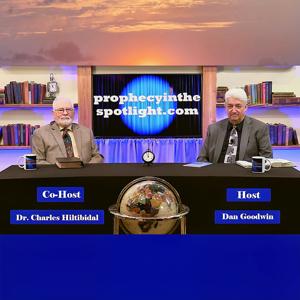
Prophecy in the Spotlight with Dan Goodwin

Prophecy in the Spotlight with Dan Goodwin

Download on the App Store

Prophecy in the Spotlight with Dan Goodwin episodes

  • Prophecy in the Spotlight, July 27, 2026
    Prophecy In The Spotlight with Daniel Goodwin and Dr. Charles Hiltibidal
    Christmas in July
    The Road to Bethlehem: Prophecy, Geography, and the Seed of Redemption
    Daniel Goodwin and Dr. Charles Hiltibidal celebrate “Christmas in July” by tracing the biblical road to Bethlehem through Genesis, Abraham, Ruth, David, the tower of the flock, the birth of Christ, and the promise of His return.
    Christmas in July and a New Look at Bethlehem
    In this special Prophecy in the Spotlight episode, Daniel Goodwin introduces a “Christmas in July” program with co-host and guest teacher Dr. Charles Hiltibidal. The discussion is built around Dr. Hiltibidal’s Christmas teaching materials and a forthcoming book tentatively described as The Road to Bethlehem. Rather than focusing only on the familiar nativity story, the hosts examine how prophecy, genealogy, geography, and Old Testament history point toward Bethlehem as the place where Christ would be born.
    The Truth of Christmas and the Tower of the Flock
    Goodwin begins by highlighting Dr. Hiltibidal’s existing Christmas book, The Truth of Christmas, and its focus on themes such as swaddling clothes, the taxing, the inn, the tower of the flock, shepherds, angels, the wise men, and the star. The hosts emphasize that the shepherds were not ordinary shepherds, but “sanctified shepherds” connected to the priesthood and the lambs used for sacrifice. This becomes central to their interpretation of Luke 2, because they argue the shepherds understood the angel’s sign and knew where to find the baby wrapped in swaddling clothes.
    Wise Men, Herod, and the Timing of the Visit
    The hosts also discuss the wise men, explaining that in their interpretation they did not arrive at the birth of Christ but came later, possibly around eighteen months afterward. Goodwin points to Herod’s order concerning male children two years old and under as evidence that the wise men’s visit came well after the manger scene. Dr. Hiltibidal adds that his book includes material he attributes to Roman archives involving Herod’s trial before the Senate in Rome and the political consequences of Herod’s actions. These historical claims are presented as part of the hosts’ teaching and should be verified before publication.
    Genesis 3:15 and the Seed of Redemption
    Dr. Hiltibidal then turns to the material he hopes to develop in The Road to Bethlehem. He says the story begins in Genesis 3:15 with the “seed” of redemption’s prophecy. Using agricultural imagery, he compares biblical prophecy to the growth of a seed: root, shoot, stalk, leaves, flowers, and fruit. In his teaching, the road to Bethlehem follows the line of God’s redemptive promise through Scripture, showing how the birth of Christ grows out of the earliest promise of a coming Redeemer.
    Seth, Noah, Shem, Abraham, and God’s Chosen Line
    The discussion follows the biblical line from Adam to Seth, Noah, Shem, and Abraham. Dr. Hiltibidal argues that God repeatedly chooses the branch through which the promise will continue. He rejects the idea that Genesis 6 is about fallen angels and instead presents it as the contrast between unrighteous society and the righteous line of Seth. He says that even when the world had fallen into deep corruption, God preserved His promise through Noah’s family, then through Shem and ultimately through Abraham.
    Genealogy Meets Geography in Abraham’s Land Purchase
    A major section of the episode focuses on Abraham purchasing a burial place after Sarah’s death. Dr. Hiltibidal explains that Abraham was living as a sojourner in the promised land and bought land at the city gate in the presence of local elders. He connects this purchase to the beginning of God’s geographic plan, arguing that the same area later becomes tied to Bethlehem, Rachel’s burial, and the tower of Edar. In the hosts’ view, this is where genealogy and geography begin to converge around the future place of Christ’s birth.
    Ruth, Boaz, David, and the City Gate of Bethlehem
    Dr. Hiltibidal then moves to the book of Ruth, explaining that Elimelech, Naomi, Mahlon, and Chilion were Ephrathites of Bethlehem Judah. He identifies the Ruth story as another major step in the same geographic and redemptive line. Ruth’s marriage to Boaz, the kinsman-redeemer theme, the birth of Obed, and the lineage leading to Jesse and David are all presented as part of the same biblical pattern. Dr. Hiltibidal emphasizes that this all centers around a small area connected to Bethlehem’s city gate.
    David, the Tower of the Flock, and the Lambs for Sacrifice
    The hosts connect David’s reign and the restoration of proper worship to the tower of Edar, which Dr. Hiltibidal says became the tower of the flock. He explains that after David brought the Ark of the Covenant back and reestablished worship, a steady supply of sacrificial lambs would have been needed. In his interpretation, the tower of the flock became the place where those lambs were born, which gives deeper meaning to the shepherds’ presence and the birth of Jesus as the Lamb of God at Bethlehem.
    Birth, Return, and the Closing Gospel Appeal
    The episode closes by tying Bethlehem not only to Christ’s birth but also to His future return and millennial reign. Goodwin says Jesus was born to be the Redeemer, born as the Lamb of God for Calvary’s cross, and will return to rule for a thousand years. Dr. Hiltibidal frames the convergence of genealogy and geography as evidence of God’s providence rather than chance. Goodwin then reminds viewers that the teaching will not matter personally if they miss heaven, urging listeners to trust in the “seed” who came into the world to pay their sin debt.
    29 min
  • Prophecy in the Spotlight, July 20, 2026
    Prophecy In The Spotlight with Daniel Goodwin and Dr. Charles Hiltibidal
    Genesis the Book of Beginnings
    Genesis as the Prophetic Foundation: Time, Creation, Israel, and the End From the Beginning
    Introducing Genesis as the Book of Beginnings
    In this episode of Prophecy in the Spotlight, host Daniel Goodwin, joined by co-host Dr. Charles Hiltibidal, introduces a program focused on Genesis and Daniel’s new book, Genesis: The Book of Beginnings. Daniel frames Genesis as essential for understanding the Bible’s foundation, quoting Isaiah 46:9–10 to emphasize that God declares “the end from the beginning.” He argues that the first 11 or 12 chapters of Genesis are among the most important Bible passages for understanding prophecy, doctrine, creation, Israel, and the structure of biblical truth.
    Why the First Chapters Matter
    Daniel reads from the back cover of his book and explains that readers cannot properly understand the Bible if they skip its beginning, just as they would misunderstand a novel by skipping the opening pages. He argues that many false doctrines and confusing prophecy teachings come from misunderstanding the first chapters of Genesis. Dr. Hiltibidal agrees, saying that errors involving Israel, the law of Moses, Genesis 6, and New Testament interpretation often trace back to misapplication or misunderstanding of Genesis.
    Two Parts of Genesis: All Things and the Jewish Nation
    Daniel explains that his book separates Genesis into two major parts: the beginning of all things in chapters 1–11, and the beginning of the Jewish nation beginning in chapter 12 with Abram, later Abraham. He says the first section covers creation, mankind as a triune being made in God’s image, sin and its consequences, the flood judgment, and the foundation of nations and globalism. The second section follows Abraham, Isaac, Jacob, and Joseph, tracing the family line that becomes the Jewish people and eventually a nation.
    Abraham, Moses, and the Cycle of Movements
    The conversation expands into the idea that God often begins major works through one man, such as Abraham or Moses. Daniel and Dr. Hiltibidal discuss how a man becomes a family, then a people, then a nation, while also reflecting on how ministries and movements can begin with conviction and later decay into machines or monuments. They connect that pattern to cycles in Baptist history, Christian history, and Israel’s development, noting that human sin often causes decline until truth seekers separate and begin again on the basis of what they believe is biblical truth.
    Moses, Revelation, and the Writing of Genesis
    Daniel raises an “interesting thought to ponder” about Moses seeing God’s “back parts” in Exodus 33. He suggests, without presenting it as certain, that this moment may have been connected to how God revealed Genesis to Moses, since Moses was not present for creation or early human history. Dr. Hiltibidal adds that although information may have been passed down through earlier generations, God clearly gave Moses specific insight and understanding as he wrote Genesis. They also note that Genesis is placed first because it is foundational, even though they identify Job as the oldest book.
    Genesis 1:1, Time, God, and Creation
    The hosts then focus on Genesis 1:1: “In the beginning God created the heaven and the earth.” Daniel identifies several major truths in the verse, beginning with time, then God, then creation. He describes time from humanity’s perspective as past, present, and future, but says that from God’s perspective there is only an eternal present. The hosts connect this to God’s omniscience and fulfilled prophecy. Daniel then emphasizes that “God” appears repeatedly in Genesis 1, saying the chapter makes clear that creation and Scripture are ultimately about God.
    Elohim, the Trinity, and the Universe
    Dr. Hiltibidal expands on the creation discussion by saying that the Hebrew name Elohim points to plurality and introduces the Godhead from the first verse of Scripture. He argues that Genesis 1:1 reveals time, space, and matter, and that these are inseparable within the created universe. He connects this to Revelation 22:13, where Jesus is called the Alpha and Omega, the beginning and the end, saying this makes sense within the realm of time. The episode closes with Daniel noting that they only had time to “whet” the audience’s appetite, asking viewers to support the ministry, and signing off with the phrase, “keep your eyes on the sky.”
    29 min
  • Prophecy in the Spotlight, July 13, 2026
    Prophecy In The Spotlight with Daniel Goodwin and Dr. Charles Hiltibidal
    The Abrahamic Covenant Part 2
    The Covenant God Alone Guarantees
    The Call of Abraham and the Meaning of an Unconditional Promise
    Daniel Goodwin opens the second part of the discussion by returning to Genesis 12:1–3, where Abram is called to leave his country, his relatives, and his father’s household for a land God would reveal. Goodwin distinguishes this calling from the covenant itself, explaining that the passage introduces Abraham’s new purpose and the promises that will later be formally established. Dr. Charles Hiltibidal briefly reviews the previous episode’s teaching about conditional and unconditional covenants, arguing that the Abrahamic Covenant must be unconditional because redemption and God’s promised blessing to the world cannot depend upon human reliability. He emphasizes that God may add to or further explain an unconditional covenant, but will never remove anything He has promised.
    The Promised Land and the Importance of Biblical History
    Hiltibidal continues with Genesis 13, where the promise of land is expanded after Lot separates from Abram. He interprets that separation as the completion of the third requirement in Abram’s original calling and as evidence that Abram had reached a new point of spiritual development. Referring to an on-screen map, the hosts compare the larger territory they believe was promised to Abraham with the much smaller area occupied by modern Israel. They maintain that Israel has never possessed the full territory but will do so during the millennial reign. The hosts also argue that distorting historical facts changes how people understand the present and can redirect their expectations concerning the prophetic future.
    A Blood Covenant Among the Divided Sacrifices
    The conversation moves into Genesis 15, where Abram is instructed to prepare a heifer, goat, ram, turtledove, and pigeon for a covenant ceremony. Hiltibidal describes the size of the animals and the physical labor involved in dividing and arranging them, presenting the scene as a solemn and graphic blood covenant rather than a symbolic handshake or informal agreement. He interprets the birds descending upon the sacrifices as a picture of satanic forces attempting to pollute the blood covenant and, more broadly, of efforts to weaken or diminish the gospel message. Drawing from Adam Clarke’s commentary, he also presents a symbolic interpretation in which the divided animals represent idolatrous nations, while the undivided birds suggest the continuing preservation of Israel.
    God Passes Through the Pieces Alone
    As the day ends, Abram becomes exhausted and falls asleep. Hiltibidal explains that covenant participants would ordinarily pass between the divided animals while declaring that the same fate should befall them if they broke their agreement. In Genesis 15, however, only the smoking furnace and burning lamp representing God pass between the pieces. Abram’s inability to participate because he had fallen asleep becomes central to their interpretation: God alone assumes responsibility for fulfilling the covenant. The hosts connect this act with the promise of territory extending from the river of Egypt to the Euphrates and describe it as a divine land grant that remains in force and will ultimately be fulfilled during the millennial reign.
    An Everlasting Covenant and the Future of Israel
    The hosts compare the word “everlasting” in Genesis 17 with its use in New Testament passages concerning eternal life. Hiltibidal argues that the word must carry the same essential meaning in both settings and therefore rejects the teaching that the church has permanently replaced Israel in God’s prophetic program. Turning to Ezekiel 36, he interprets Israel’s regathering as something God performs for the honor of His own name rather than because the nation has earned restoration. In their interpretation, God first regathers Israel while the nation remains spiritually unclean and later completes a process of cleansing, renewal, and restored obedience. The promised new heart and new spirit are therefore presented as future stages in God’s continuing work with Israel.
    Israel’s Unfaithfulness and God’s Continuing Faithfulness
    A central statement in the program is that the unfaithfulness of Israel does not cancel the faithfulness of God. Goodwin and Hiltibidal argue that modern Israel’s spiritual or moral condition should not be treated as evidence that the biblical promises have failed, because those promises depend upon God rather than upon the worthiness of their recipients. They connect this principle with Daniel’s prophecy concerning Israel and Jerusalem and with Paul’s question in Romans about whether God has permanently cast off Israel, answering with the biblical phrase, “God forbid.” The hosts encourage viewers to interpret present events according to what they believe God has promised to accomplish, rather than judging the entire prophetic program by Israel’s current condition.
    From the Abrahamic Covenant to Eternal Security
    The discussion broadens from Israel to the believer’s salvation. Goodwin and Hiltibidal present the Abrahamic Covenant as a picture of the security of redemption, arguing that a Christian’s failures do not nullify God’s saving promise. They apply this principle to eternal security, the sealing of believers by the Holy Spirit, and their rejection of a partial rapture in which only especially faithful or watchful Christians would be taken. Hiltibidal maintains that anyone whose name is written in the Lamb’s Book of Life is already under the blood covenant of redemption, although personal conduct may still affect future rewards. Using the image of a hand inside a glove, he argues that eschatology and evangelism should work together: prophecy gains people’s attention, while the gospel brings them to the message of salvation, restored fellowship with God, and personal faith in Christ.
    29 min
  • Prophecy in the Spotlight, July 6, 2026
    Prophecy In The Spotlight with Daniel Goodwin and Dr. Charles Hiltibidal
    The Abrahamic Covenant Part 1
    The Covenant That Still Stands: Abraham, Israel, and the Promises of God
    Israel, Prophecy, and the Abrahamic Covenant
    In this episode of Prophecy in the Spotlight, host Daniel Goodwin introduces the topic of the Abrahamic Covenant as a continuation of recent discussion around his book Is Israel Still Relevant Today? Goodwin frames Israel as increasingly central and increasingly opposed in the current generation, describing it through biblical language as a “trembling cup” and “burdensome stone.” He opens with Genesis 12:1–3, emphasizing God’s promises to Abram: a land, a great nation, blessing, a great name, and blessing or cursing tied to how others treat Abraham and his descendants.
    The Question: Is the Covenant Still in Force?
    Dr. Charles Hiltibidal explains that his teaching on the Abrahamic Covenant is foundational because it goes deeper than Abraham, his descendants, and Israel alone. He and Goodwin note that while the exact phrase “Abrahamic Covenant” may not appear in Scripture, the covenant itself is present because God made promises to Abraham. Hiltibidal distinguishes between conditional and unconditional covenants, arguing that the Abrahamic Covenant is ultimately unconditional because it rests on what God says He will do. At the same time, he explains that Abraham first had to respond to God’s call by leaving his country, kindred, and family.
    Abraham’s Journey as a Picture of Christian Growth
    Hiltibidal describes Abraham’s journey as a process of growth rather than instant completion. He imagines Abraham telling Sarah they must leave, even though he does not yet know where God is leading them. This becomes a picture of the Christian life: believers begin by responding to God, then learn and mature step by step. Hiltibidal points out that nearly 25 years pass before God formally broadens the land promise, using that delay to suggest that believers may miss some of God’s best blessings when they do not fully place themselves in the center of God’s will.
    Understanding the Future by Accepting the Biblical Past
    A major theme of the episode is that people cannot understand the present or future unless they accept the facts of the biblical past. Hiltibidal argues that the Old Testament is not irrelevant or discarded; it is fulfilled and remains necessary for understanding prophecy. Goodwin expands on this idea by discussing Genesis 6, the Nephilim controversy, the Apocrypha, the Book of Enoch, King James Bible issues, and what he sees as widespread confusion caused by relying on extra-biblical material rather than Scripture. Both men argue that history matters because prophecy is built on God’s earlier promises and actions.
    Redemption From Genesis 3 to Genesis 12
    Hiltibidal connects the Abrahamic Covenant to the larger story of redemption. He describes Genesis 3:15 as the seed of prophecy and redemption, with Genesis 12 as the germination of that seed. In his explanation, the promise to Abraham is not an isolated national promise, but part of God’s unfolding plan to bless all families of the earth. He highlights the repeated “I will” statements in Genesis 12, noting that God promises to show the land, make Abraham a great nation, bless him, make his name great, bless those who bless him, curse those who curse him, and bless all families of the earth through him.
    The Land Promise and Israel’s Future
    The discussion then moves to the land itself. Hiltibidal explains that after Lot separates from Abraham, God tells Abraham to look north, south, east, and west, promising the land to Abraham and his seed forever. He argues that this promise remains connected to Israel’s future, including Ezekiel 36–39 and the millennial reign. He also says Israel has never fully occupied all the land promised to Abraham, even under Solomon, and that in the future Israel will receive the land from God rather than merely taking it by force. Goodwin agrees that understanding Israel today requires accepting the biblical continuity of Israel’s past.
    Daniel 9, the Antichrist, and Part Two Ahead
    Near the close, Goodwin connects the Abrahamic Covenant to Daniel 9:27, where the Antichrist is said to confirm “the covenant.” Goodwin and Hiltibidal reject the idea that this is simply a peace treaty, suggesting instead that it may involve the Antichrist confirming land-related covenant claims connected to Abraham’s descendants. Hiltibidal says the covenant ultimately rests on God walking between the pieces Himself, making it unconditional and dependent on God’s promise. The episode ends with Goodwin acknowledging that they only made it through the first few slides and announcing that the discussion will continue in part two.
    29 min
  • Prophecy in the Spotlight, June 29, 2026
    Prophecy In The Spotlight with Daniel Goodwin and Dr. Charles Hiltibidal
    In That Day
    The Gathering Before the Storm: Rapture, Deception, and the Day of the Lord
    A Coming Gathering of the Saints
    In this episode of Prophecy in the Spotlight, hosts Daniel Goodwin and Dr. Charles Hiltibidal focus on the biblical idea of a coming “gathering” of believers unto Christ. Brother Dan opens by connecting that gathering to the rapture, describing it as the blessed hope of the church and the moment when the saints will be assembled in heaven for the marriage supper while end-times events unfold on Earth. The program centers especially on 2 Thessalonians 2, where Paul speaks of the coming of the Lord Jesus Christ and “our gathering together unto him.”
    Six Years of Prophecy Ministry
    Before moving deeply into the passage, the hosts thank their viewers and supporters, noting that June marks six years of their national television ministry. They describe Prophecy in the Spotlight as a prophecy-centered ministry that depends on donations and remains focused on the Lord’s coming. Their tone is personal and pastoral, expressing gratitude for people who watch, give, and help keep the program going, whether through television, YouTube, Rumble, or other platforms.
    The Rapture and the Jewish Wedding Pattern
    Daniel and Dr. Hiltibidal reflect on the joy of the coming heavenly gathering, including reunion with redeemed loved ones and, above all, seeing Jesus. They connect the rapture to the Jewish wedding pattern, explaining how a bridegroom would propose, the bride would prepare herself, and the groom would return at the father’s appointed time to take her to the father’s house. They use this as an illustration of Christ preparing a place for the church and returning when the Father determines the time.
    Sorting Out the Day of Christ and the Gathering
    Dr. Hiltibidal walks through 2 Thessalonians 2 as a sequence of prophetic events. He explains that Paul is addressing confusion among the Thessalonian believers, who had been shaken by false teaching, possibly even letters falsely attributed to Paul, suggesting that the day of Christ had already arrived or was immediately at hand. The hosts distinguish between the gathering of believers at the rapture and the later visible, bodily second coming of Christ, which they identify with “that day,” “the day of Christ,” and “the day of the Lord.”
    Falling Away, the Antichrist, and the Restrainer
    A major portion of the discussion centers on the falling away, the revealing of the man of sin, and the role of the restrainer. Dr. Hiltibidal teaches that the rapture is the trigger that begins the prophetic sequence leading toward the tribulation and the eventual second coming. He identifies the restrainer as the Holy Spirit working through born-again believers and argues that once the church is removed, the Antichrist can be officially revealed. The hosts connect this to the abomination of desolation and the Antichrist exalting himself as God.
    Strong Delusion and the Spirit of Antichrist
    The hosts also discuss 2 Thessalonians 2:11–12, where Paul says that those who reject the truth will believe a lie. Dr. Hiltibidal frames this as the strong delusion associated with the Antichrist, the false prophet, and the mark of the beast. He warns that deception is already visible in the world and even in some religious settings, arguing that once the restraining influence of the Holy Spirit through the church is removed, deception will intensify dramatically. He also compares modern moral and religious confusion to the spirit of Antichrist already at work.
    The Call to Be Ready
    The episode closes with the hosts directing viewers to Dr. Hiltibidal’s DVD teaching, which they say walks through 2 Thessalonians 2 and related prophetic passages in sequential order. Daniel returns to the image of an old-fashioned church gathering, comparing it to the coming heavenly marriage supper where all redeemed saints will be gathered together. He ends with an evangelistic appeal, asking viewers whether their names are written in the Lamb’s Book of Life, whether their sins have been washed away, and whether they are ready for the Lord’s coming.
    29 min
  • Prophecy in the Spotlight, June 22, 2026
    Prophecy In The Spotlight with Daniel Goodwin and Dr. Charles Hiltibidal
    Jerusalem The Focus of Prophecy
    Jerusalem, the Apple of God’s Eye, and the End-Time Battle for Israel
    Jerusalem at the Center of Prophecy
    In this episode of Prophecy in the Spotlight, hosts Daniel Goodwin and Dr. Charles Hiltibidal continue their discussion of Israel by focusing specifically on Jerusalem as the center of prophetic events. Goodwin introduces material from his new book, Why Is Israel Still Relevant Today?, especially the section titled “Jerusalem: The Focus of Prophetic Events.” He opens with Zechariah 2:8, emphasizing that Israel and Jerusalem are precious to God as “the apple of His eye,” and warns listeners that those who oppose or harm Israel are opposing something God Himself has declared valuable.
    Israel’s Everlasting Covenant and Continued Relevance
    Before turning fully to Jerusalem, the hosts briefly review why they believe Israel remains prophetically relevant today. Their first point is that God’s covenant with Abraham, Isaac, Jacob, and the nation of Israel is everlasting and not canceled by Israel’s failures or sins. They argue that if God could break His covenant with Israel, believers would have no basis for trusting His promises of salvation. They cite Psalm 105 and related covenant passages to support the view that the land promise and national identity of Israel remain part of God’s continuing plan.
    Regathering, Redemption, and the Final Purification of Israel
    Goodwin and Hiltibidal then discuss the regathering of Israel to the land, pointing to prophecies such as Ezekiel 36 and 37 and Amos 9 as evidence that Israel’s modern return is significant. They describe persecution as one of the forces that has historically driven Jewish people back toward their homeland and connect current anti-Israel sentiment to that same pattern. They also frame Israel’s return as part of God’s larger redemption plan, saying the nation is being gathered for future prophetic events, including tribulation, purification, and the millennial reign of Christ.
    Jerusalem as a Burdensome Stone for the Nations
    The main focus of the episode is Jerusalem’s prophetic role. The hosts turn to Zechariah 12 and describe Jerusalem as a “burdensome stone” for surrounding nations and eventually for the whole world. They explain the word “burdensome” as something heavy, grievous, oppressive, and troubling, arguing that Jerusalem has become exactly that in world affairs. They connect this prophecy to modern Islamic opposition to Israel, Palestinian hostility, Turkey’s interest in reestablishing Ottoman-style influence, and the broader international pressure placed on Israel over Jerusalem.
    The Nations Gather Against Jerusalem and the Lord Returns
    The hosts then move to Zechariah 14, which they describe as one of the Old Testament’s clearest descriptions of the final battle. They explain that God will gather the nations against Jerusalem, that the city will suffer, and that the Lord will then return visibly to fight against those nations. Hiltibidal connects this to Christ standing on the Mount of Olives and to the end of the tribulation, while both hosts distinguish this final battle from Ezekiel 38, which they suggest may occur earlier, possibly near the time of the rapture. They also discuss the seven years of weapon burning in Ezekiel as a clue that the event precedes the kingdom age.
    Dividing the Land and Praying for Jerusalem
    Goodwin and Hiltibidal next point to Joel 3, saying God will judge the nations for dividing His land. They connect this to modern diplomatic efforts that pressure Israel to give up land for peace, warning that nations involved in dividing Israel’s land place themselves under divine judgment. At the same time, they stress Psalm 122:6, which commands believers to pray for the peace of Jerusalem. They argue that supporting Israel does not necessarily mean sending money or endorsing everything the modern state does, but it does mean praying for Israel, recognizing God’s promises, and refusing anti-Semitism.
    Jesus, the Times of the Gentiles, and Israel Today
    The episode closes with Jesus’ words in Luke 21:24, where Jerusalem is said to be trodden down by Gentiles until the times of the Gentiles are fulfilled. Hiltibidal connects the times of the Gentiles to the period beginning with Nebuchadnezzar’s conquest and ending at Armageddon. The hosts conclude that modern Israel is the Israel of end-time prophecy and that Jerusalem is not just another city, but the place where God has chosen to put His name and where Messiah will return. Goodwin urges listeners to get his new book and Hiltibidal’s related work, while Hiltibidal closes by saying that many prophecies have been fulfilled since World War I and that Israel today is central to end-time Bible prophecy.
    29 min
  • Prophecy in the Spotlight, June 15, 2026
    Prophecy In The Spotlight with Daniel Goodwin and Dr. Charles Hiltibidal
    Is Israel Still Relevant Today?
    Israel, Covenant, and the End-Time Blueprint: Why Dan Goodwin and Dr. Charles Hiltibidal Say Israel Still Matters
    A Sober Question About Israel’s Relevance
    In this episode of Prophecy in the Spotlight, hosts Dan Goodwin and Dr. Charles Hiltibidal address the question, “Is Israel still relevant today?” Dan opens by saying that many Christians, pastors, and teachers are having second thoughts about modern Israel’s biblical importance. He argues that the Jewish people in the modern land of Israel are the same people connected to the promises of Scripture, and he begins the program by reading from Amos 9:14–15, which he interprets as God’s promise to bring Israel back to its land and never uproot them again.
    The Return of Israel as a Fulfilled Promise
    Dan emphasizes that the modern return of Jewish people to Israel is not accidental, but part of God’s prophetic plan. He says the phrase about bringing again “the captivity” of Israel means God would bring them out of captivity and restore them to their land after centuries of scattering. He connects this return to 1948, the rebirth of the modern nation of Israel, and to passages such as Ezekiel 36 and 37, where God restores the dry bones and brings Israel back to life as a nation.
    Abraham, the Covenant, and the Beginning of the Nation
    The conversation then moves into Dan’s book on Genesis, where he discusses the beginning of the Jewish nation through Abraham. Dan explains the progression from one man, Abraham, to his family, then to a people, and ultimately to the twelve tribes of Israel through Jacob. Dr. Hiltibidal adds that the promise was not only given to Abraham, but also came through Abraham to his descendants. Both hosts stress that the covenant is foundational for understanding Israel’s ongoing prophetic role.
    An Everlasting Covenant, Not a Temporary Arrangement
    One of the program’s central arguments is that God’s covenant with Abraham and Israel is everlasting. Dan reads and discusses Genesis 12:3, where God says He will bless those who bless Abraham and curse those who curse him, and that all families of the earth will be blessed through him. The hosts argue that if God cannot keep His promises to Abraham, then believers would have no basis for trusting God’s promises about salvation. For them, Israel’s continued relevance depends on God’s faithfulness, not Israel’s present spiritual condition.
    Redemption Through Israel
    Dr. Hiltibidal explains that the covenant with Abraham ultimately points to redemption. Through Israel came the Scriptures, the prophets, the law, and the human lineage through which Jesus Christ came into the world. Dan and Dr. Hiltibidal connect this back to Genesis 3:15, which they describe as the seed form of prophecy and redemption. The broader point is that Israel is not merely a political subject; in their view, Israel is part of God’s redemptive plan for the whole world.
    Israel’s Present Blindness and Future Restoration
    The hosts acknowledge that most Jewish people are not yet saved, though some are. Dan says Israel is still in spiritual blindness, but he believes their day is coming. He argues that God has not replaced Israel with the church and has not abandoned His promises. The program strongly rejects replacement theology and the idea that modern Israel is irrelevant or illegitimate. For Dan and Dr. Hiltibidal, Israel may not yet fully recognize Christ, but God’s plan for Israel is still moving forward.
    The Regathering in the Last Days
    Dan identifies the regathering of Israel as another major reason Israel remains relevant. He says the Bible prophesied both Israel’s scattering because of disobedience and Israel’s regathering in the latter days. The hosts mention Ezekiel 36–37, Isaiah 11, Jeremiah 31, and other prophetic passages as evidence. Dr. Hiltibidal suggests that the regathering process may have begun around World War I with the Balfour Declaration, while 1948 brought the visible national restoration.
    Jerusalem at the Center of End-Time Prophecy
    The program also emphasizes that Jerusalem and Israel are central to end-time prophecy. Dan references Zechariah 12, where Jerusalem becomes a burdensome stone for all people, along with Zechariah 14, Joel 3, Matthew 24, and Daniel’s seventieth week. The hosts argue that the world’s hostility toward Israel and the ongoing conflict over Jerusalem and the Temple Mount fit the prophetic picture. They see Israel’s current position in world affairs as another sign that biblical prophecy is unfolding.
    Spiritual Warfare and Global Opposition to Israel
    Dan and Dr. Hiltibidal interpret modern hostility toward Israel as part of spiritual warfare. They say the hatred of Israel around the world may push more Jewish people back to the land, accelerating the regathering. They also criticize Christians who, in their view, have been influenced by internet personalities or weak Bible study into turning against Israel. The hosts frame anti-Israel sentiment as more than politics; they see it as opposition to God’s covenant and prophetic plan.
    The Bible as the Final Authority
    Throughout the episode, both hosts return repeatedly to the authority of Scripture. They argue that modern believers must let the Bible define Israel’s place rather than political pressure, media narratives, or theological trends. Dan warns that removing Israel from prophecy damages a major building block of biblical interpretation. Dr. Hiltibidal adds that many end-time signs are converging at once: the church age, world culture, rising evil, and Israel’s restoration. Together, they present Israel as an essential piece of the prophetic puzzle.
    A Closing Call to Salvation
    The program closes by returning to redemption. Dr. Hiltibidal says the Bible’s prophetic line begins with Genesis 3:15 and moves through Abraham, Israel, geography, genealogy, Bethlehem, and ultimately Calvary. The hosts say the purpose of prophecy is not merely prediction, but salvation through Jesus Christ. They invite listeners who do not understand or have not experienced salvation to contact them for help, and Dan closes with his familiar exhortation to keep watching the skies.

    29 min
  • Prophecy in the Spotlight, June 1, 2026
    Prophecy In The Spotlight with Daniel Goodwin and Dr. Charles Hiltibidal
    The Bible and UFO's
    Dan Goodwin and Dr. Charles Hiltibidal on Deception, Prophecy, and the Rapture
    Dan Goodwin Frames the Episode Around UFO Deception
    In this episode of Prophecy in the Spotlight, hosts Dan Goodwin and Dr. Charles Hiltibidal discuss UFOs, UAPs, government disclosure, Nephilim theories, and what they view as spiritual deception. Dan opens by connecting the episode to the previous week’s discussion on apostasy and deception, arguing that the current UFO phenomenon may be part of a larger end-times deception. He says he believes UFOs may eventually be used to explain away the rapture, discredit God, and weaken people’s faith in the Bible.
    Science Fiction, Culture, and the UFO Generation
    The hosts begin with a humorous reference to science-fiction culture, describing the modern audience as the Star Trek, Battlestar Galactica, and Star Wars generation. Dan says he is not opposed to science fiction as entertainment, as long as people understand it is fiction. Dr. Hiltibidal adds that the problem is that many people now treat what once belonged to fiction as reality. The hosts argue that this cultural conditioning has made people more receptive to UFO claims, alien narratives, portals, and speculative interpretations of Scripture.
    Prophecy Teachers, Nephilim Theories, and Extra-Biblical Books
    Dan and Dr. Hiltibidal criticize what they describe as a major trend in the prophecy world toward Nephilim, UFO, and return-of-the-giants teaching. They argue that much of this teaching rests on a weak or fictional reading of Genesis 6 and on ideas inserted into the biblical text rather than clearly taught by it. They also warn against promoting books such as Enoch or other extra-biblical writings as if they were missing parts of Scripture. The hosts maintain that such material was never part of the biblical canon and should not be treated as authoritative.
    Government Files, UAPs, and Public Fascination
    The hosts then discuss articles connected to recent government UFO or UAP file releases. They note that officials now often use the term UAP, or unidentified anomalous phenomenon, rather than UFO. The discussion includes references to historical State Department cables, FBI records, NASA transcripts, and a Pentagon portal created for disclosure-related materials. Dan remains skeptical that these releases will reveal the truth, arguing that many sightings are likely military technology, misunderstood light, experimental aircraft, or other explainable phenomena rather than extraterrestrial or angelic craft.
    Lauren Boebert, Spiritual Dimensions, and Demonic Speculation
    A portion of the discussion centers on Representative Lauren Boebert’s comments suggesting that some UFO or UAP phenomena might be spiritual rather than extraterrestrial. Dan and Dr. Hiltibidal acknowledge that she is trying to frame the issue through a biblical worldview, but they disagree with her interpretation. They object to claims that the Bible teaches modern Nephilim/UFO ideas and push back against language about portals or spiritual dimensions. While they believe demonic deception is involved in the broader UFO narrative, they do not believe fallen angels are literally piloting spacecraft.
    Man-Made Technology and the Flying Wing Example
    Dan uses historical military aircraft to argue that unusual things in the sky are not necessarily otherworldly. He points to Germany’s World War II-era flying-wing technology as an example of something that would have seemed impossible or alien to ordinary observers at the time. He argues that if someone had seen such a craft in the 1940s, they might have concluded it was from another world simply because they had no frame of reference. For Dan, this illustrates how advanced military technology, secrecy, and public imagination can create UFO stories without requiring extraterrestrial explanations.
    The Rapture and a Possible Alien Explanation
    One of the central prophetic claims of the episode is Dan’s belief that UFO or alien narratives may be used after the rapture to explain why believers disappeared. He suggests that if the rapture occurs and people are left behind, a prepared UFO framework could allow the world to believe Christians were taken by extraterrestrial forces or removed because they were harmful to society. Dr. Hiltibidal adds that this kind of narrative could help people accept the Antichrist by obscuring the biblical meaning of the rapture.
    The Vatican, Telescopes, and Possible Future Claims
    Dan also discusses the Vatican’s telescope in Arizona and suggests that the Roman Catholic Church may eventually claim contact with beings from space. He worries that such a claim could be used to revise or challenge biblical teaching. The hosts speculate that if the Vatican or other authoritative institutions announced contact with extraterrestrial beings, many people would accept it. They connect this possibility to their larger concern that UFO disclosure narratives could undermine confidence in Scripture.
    Dangers of UFO Hype
    Dan lists several dangers he sees in UFO hype. He says it can draw believers away from the clear teachings of the Bible, cause discord among Christians, lead people into fables, waste time that should be spent doing what God has called believers to do, create rabbit holes of speculation, discredit Christians before the world, and make believers unwitting partners in deception if the narrative is satanic. Dr. Hiltibidal agrees that chasing such stories can pull people away from Scripture, salvation, and the practical work of evangelism.
    Closing Call to Stay Grounded in Scripture
    The episode closes with Dan urging listeners not to get caught up in UFO hype from prophecy ministries, government officials, or popular culture. Dr. Hiltibidal emphasizes the need to make sure one is truly born again and to spend life trying to win others to Christ rather than chasing what he calls fairy tales. The hosts end by reinforcing their main message: believers should remain grounded in the Bible, resist sensational deception, and keep their focus on salvation, Scripture, and the return of Christ.
    29 min

About Prophecy in the Spotlight with Dan Goodwin

From the publisher's feed

Prophecy in the Spotlight with Evangelist Dan Goodwin and Dr. Charles Hiltibidal "The most up to date study of prophetical events of our day!” Others have called it “a stunning and even chilling…