
Sign up to save your podcasts
Or



On Friday 18 September 2026 Cambridge Women in Law held this panel event as part of the Cambridge Alumni Festival.
AI is shaping all walks of life. This is particularly true in respect of the law. Litigants rely on ChatGPT to submit their complaints and lawyers have access to databases of precedents, search tools and the capacity for AI to manage vast numbers of documents, often better than humans. This raises the question whether there is still a need for lawyers and, for the Faculty of Law at Cambridge, what this means for the law degree.
In this session leading Cambridge academics and practitioners debate the challenges and opportunities for legal education posed by the ever-increasing availability and capacity of AI tools.
Speakers:
For more information and to sign up to the CWIL mailing list to receive information about future news and events, see https://www.law.cam.ac.uk/alumni-developmentalumni-events/cambridge-women-law-cwil
Speaker: Dr Luke Dimitrios Spieker, Humboldt University, Berlin
Abstract: The CJEU’s decision in Commission v Malta marks the summit of a long-standing, highly controversial debate in European legal scholarship. Considering the Maltese practice of “golden passports” incompatible with EU law, the Court expanded the reach of EU law and established constraints for the conferral of the Member States’ nationalities. At its heart, the decision developed a shared concept of nationality based on a “special relationship of solidarity and good faith”. To justify this bold step, the Court mobilized EU values: “Union citizenship” – we are told – “is based on the common values contained in Article 2 TEU”. In this talk, we will explore how EU values may require a shared concept of nationality and justify the genuine link-requirement established by the Court. At its centre are the notions of democracy and trust, solidarity and belonging. Ultimately, it seems that the Court embraced a communitarian understanding of citizenship – one that builds on belonging.
Biography: Dr Luke Dimitrios Spieker is a postdoctoral researcher at Humboldt University Berlin and a Senior Research Fellow at the Max Planck Institute for Comparative Public Law and International Law. His research explores EU law’s constitutional foundations, including its common values and structural principles as well as Union citizenship and fundamental rights. He has been awarded several prizes, such as the Heinz Meier-Leibnitz-Prize of the German Research Foundation, the UACES Best Book Prize, or the Common Market Law Review Prize for Young Academics.
For more information see:
https://www.cels.law.cam.ac.uk/weekly-seminar-series
In this episode, Janice chats to Jack, Nicholas and Mira about the realities of being a fresher and making the most of your first year at university.
Jack and Nicholas are third-year Law students, while Mira is a third-year History student, bringing together different perspectives and plenty of hard-earned wisdom.
The conversation covers three key areas:
Academic life: settling into lectures, seminars and independent study, finding what works for you, and managing the transition to university-level work.
Social life: making friends, finding your people, navigating Freshers’ Week, and dealing with the pressure to have the “perfect” university experience.
Extracurriculars and careers: getting involved in societies and events, making the most of opportunities, and starting to think about your career, whatever your degree.
Tune in for practical advice and honest reflections on making the most of your first year.
A special thanks to Jack, Mira, and Nicholas for sharing their thoughts and to Daniel Bates for his excellent pre- and post-podcast bants.
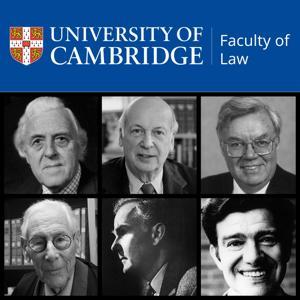
This is the second interview with Professor Philippe Sands. Professor Sands was interviewed for the second time on 25th June 2026 At his home in Hampstead.
For more information, see the Squire Law Library website at:
http://www.squire.law.cam.ac.uk/eminent-scholars-archive
This is the first interview with Professor Philippe Sands. Professor Sands was interviewed for the first time on 18th May 2026 At his home in Hampstead.
For more information, see the Squire Law Library website at:
http://www.squire.law.cam.ac.uk/eminent-scholars-archive
When the UK and the EU concluded the Trade and Cooperation Agreement at the end of 2020, Gibraltar was deliberately left outside its scope. After more than four years of negotiation between the UK, the EU and Spain, with the Government of Gibraltar advising the UK team, to agree the yet closest relationship of UK related territory with the EU. The negotiations benefited from a political agreement in June 2025, a finalised legal text in December 2025, and the draft Treaty jointly published by the UK and the EU on 26 February 2026. The Committee of Permanent Representatives unanimously greenlit the texts on 1 April 2026, and the Agreement is now expected to enter provisional application on 15 July 2026, with formal ratification under the UK Constitutional Reform and Governance Act 2010 and the parallel EU procedures to follow.
The Treaty is genuinely novel in EU external relations practice. It will remove routine physical checks at the land frontier with Spain, with full Schengen border controls relocated to Gibraltar's airport and port and operated under a tailored, dual-control architecture. Gibraltar, a British Overseas Territory that remains outside both the EU and Schengen, will simultaneously join the EU customs union and dynamically align with substantial parts of the EU acquis, including in goods, environment, energy, social and labour standards, transport and indirect taxation.
The CELS seminar examines the draft Treaty across three panels chaired by Professor Catherine Barnard with experts from both the University of Cambridge and beyond:
Panel I – Foundation: UK–EU Agreement in respect of GibraltarFor more information see: https://www.cels.law.cam.ac.uk/press/events/2026/05/cels-seminar-uk-eu-agreement-respect-gibraltar
In this episode, we explore the third year of the Cambridge Law Tripos.
We discuss the full papers in Competition Law, Conflict of Laws, Intellectual Property Law, Labour Law, Company Law, and Commercial Law, as well as a range of half papers, including Animal Rights Law, Landlord and Tenant Law, and Succession. Along the way, we share general advice on choosing papers, balancing workloads, and making the most of your final year at Cambridge.
Whether you're deciding which options to take or preparing for the year ahead, this episode offers an overview of the academic opportunities available in third year and practical insights to help you navigate them.
Many thanks to Jaysol Doy, Brandon Lim, Vladimir Genkovski, and Lottie Chambers for sharing their insights and experiences, and to Daniel Bates for his continued support.
Follow us on our socials to stay up to date with all things CULS:
📸 Instagram: @cambridgelawsoc
📘 Facebook: https://www.facebook.com/camlawsoc/?locale=en_GB
To find out more about CULS or to become a member, visit our website.
In this episode, we take a closer look at the Part IB year of the Cambridge Law Tripos.
We explore the compulsory papers, Contract Law and Land Law, as well as the optional papers of Administrative Law, Human Rights, and International Law. We also discuss the Year Abroad, examining the opportunities it offers for academic development, cultural immersion, and broadening legal perspectives.
The episode provides an overview of the content, structure, and challenges of each paper, offering insights into what students can expect from one of the most significant years of the Cambridge Law degree.
Many thanks to Jack Gower, Lizzie Mann, and Corey Tatum for their insights and friendship, and to Daniel Bates for the coffees that fuelled yours truly, as well as his support and encouragement along the way.
Follow us on our socials to stay up to date with all things CULS:
📸 Instagram: @cambridgelawsoc
📘 Facebook: https://www.facebook.com/camlawsoc/?locale=en_GB
To find out more about CULS or to become a member, visit our website.
In this episode, we explore the challenges, expectations, and strategies involved in writing a third-year law dissertation. From choosing a research topic and developing a strong argument to managing sources, this episode looks into what it takes to do a dissertation and whether that might be right for you!
A special thank you to Jaysol Doy, Brandon Lim, for their valuable contributions, insights, and to Daniel Bates for his support in making this happen.
Whether you are just beginning your dissertation journey or putting the finishing touches on your final draft, this episode offers useful guidance to help you approach the process with confidence.
The Hersch Lauterpacht Memorial Lecture is an annual three-part lecture series given in Cambridge to commemorate the unique contribution to the development of international law of Sir Hersch Lauterpacht. These lectures are given annually by a person of eminence in the field of international law. This year's lecture will be given by Professor Dapo Akande, Chichele Professor of Public International Law at the University of Oxford.
A sandwich lunch for lecture attendees will be held from 12.30 pm in the Old Library on all days.
Lecture 1: 1 pm Monday 8 June - 'International Law Immunities - Do we need them?'
Lecture 2: 1 pm Tuesday 9 June - 'Immunities and Prosecutions for International Crimes in Foreign Domestic Courts'
Lecture 3: 1 pm Wednesday 10 June - 'Immunities and International Criminal Tribunals'
From the publisher's feed

43,307 Listeners

7,579 Listeners
11 Listeners
19 Listeners
1 Listeners
0 Listeners
11 Listeners
16 Listeners
2 Listeners
5,743 Listeners
0 Listeners
1 Listeners
0 Listeners