Radioactive Show

Radioactive Show

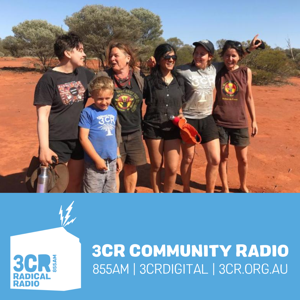
By Emma, Michaela, Sam, Johan, Manju, Reed & TJ.
Download on the App Store

Radioactive Show episodes

  • No Consent! Rally against rocket testing
    On 10 October West Mallee Protection held a 'No Consent!' rally and march in Adelaide to oppose a rocket testing range on Googatha country.  Googatha elder Aunty Sue Haseldine traveled from Ceduna in South Australia's far west to visit the Australian Space Agency and SA Parliament in Adelaide to build a metro campaign to shut down Southern Launch's Koonibba Rocket Testing range. “My Country is not a military zone. It is an important place - culturally, spiritually, and environmentally. We have been battling for a long time for the protection of Country, and this battle continues here today. Any company or Government agency that decides they're going to use my Country as their playground for warfare, for testing war materials - they're not welcome"Today we hear from Kaurna woman Bonnie Brody, Googatha elder Aunty Sue Haseldine, West Mallee Protection's Reed O'Loughlin & Dr. Kate Wylie from Doctors for the Environment.Support West Mallee Protection here.
    29 min
  • Introducing the Rad Show Archives with Eric Miller
    Sam conducts an interview with former producer of the Radioactive Show: Eric Miller. Eric wrote, produced, panelled and drove the Radioactive Show for an incredible 18 year period from 1988-2006.Eric transferred his archives of the show back to the Radioactive Show team , and we discussed the collection and Eric's history with the show.
    31 min
  • Nuclear Weapons and Survivors: Australian Nuclear Free Alliance 2025
    September 27 marks the anniversary of the first British atomic test at Maralinga in South Australia in 1956. Between 1952 -1957 three tests were carried out on the Monte Bello Islands off the coast of Western Australia followed by nine nuclear weapon tests at Emu Field and Maralinga in South Australia.  The British nuclear testing program was carried out with the full support of the Australian government and permission was not sought for the tests from Aboriginal people whose lands were used as sacrifice zones.The use of atomic weapons contaminated great tracts of land, displaced and forced Aboriginal people into Government and mission-controlled enclaves.  Many Aboriginal people were exposed to the fallout and died.  Survivors suffered radiation sickness and long term injury or illnesses and the intergenerational impacts affect family of survivors to this day.  This history informs the work of many of Australian Nuclear Free Alliance members to this day, having direct experience with nuclear weapons. We bring you some of the conversations from the Australian Nuclear Free Alliance gathering at Pichi Richi Park in South Australia over the weekend of 29th-31st of August.  We'll hear from speakers in the session titled 'Nuclear weapons and survivors: international solidarity and protocols': Dimity Hawkins from the Nuclear Truth Project; Karina Lester - Yangkunytjatjara Anangu woman; Roslyn Peters Anangu women from Yalata Community, Sister Michelle Maddigan - long time nuclear free campaigner based in Adelaide And Sue Haseldine - Googatha elder based in Ceduna, Far West South Australia.Read the ANFA 2025 meeting statement here.Weapons testing is continuing to threaten Aboriginal country and Aunty Sue Haseldine is seeking support to protect Googatha country from Southern Launch's rocket testing range.  There is a rally in Adelaide on October 10, go to @westmalleeprotection on Instagram to find out more.
    31 min
  • Cancel AUKUS: International Day of Peace
    On the 21 September you can join in the National Day of Action Against Miltarisation and AUKUS.We bring an update on AUKUS developments in the south west with Nuclear Free WA campaigner KA Garlick and recordings from an AUKUS session at the Australian Nuclear Free Alliance meeting held at Pichi Richi Park on Nukunu country in so called "South Australia" over the weekend of 29-31 August.  We'll hear from Dave Sweeney, Nuclear-free campaigner with the Australian Conservation Foundation, Derrick from Port Adelaide Community Opposing AUKUS and independent environmental campaigner David Noonan.
    0 min
  • Uranium: the scene of the crime. Australian Nuclear Free Alliance 2025
    We return to the Australian Nuclear Free Alliance meeting held over the weekend of 29-31 August at Pichi Richi Park in South Australia.  ANFA is an Aboriginal led grassroots alliance of people and organisations working for a nuclear free future.  The annual meeting is a place for multi-generational story telling. This week we turn to uranium mining and the destruction of sacred sites, water, animals, family and community relationships that occurs wherever it's imposed.  We'll hear from Mia Pepper and Vicky Abdullah in Western Australia, Kirsten Blair and Cat Beaton with updates from the Northern Territory, followed by Regina McKenzie and David Noonan on South Australia - the only state still mining uranium and as David Noonan puts it - the scene of the crime!Read the ANFA 2025 meeting statement here.
    0 min
  • Stories of Success: Australian Nuclear Free Alliance 2025
    From 29th - 31 August the Australian Nuclear Free Alliance meeting was held on Nukunu country, at Pitchi Richi Park in so called "South Australia".  Since 1997 this Aboriginal led alliance has brought people together from across the continent to share information, strategies for defeating corporate and government plans for nuclear developments and to build solidarity for a nuclear free future.  First up we'll hear from Dianne Stokes on the Muckaty waste dump campaign in Tennant Creek, NT that ran from 2007 when the site was nominated by the Northern Lands Council to late 2014 when their case in the Federal Court saw the Federal Government and the Lands Council forced to walk away from it.  We then hear from Regina McKenzie who took up the fight in 2015 when the nuclear waste dump proposal moved to Barndioota on Adnymathanha country near Hawker, SA until 2020.  Followed by some words from ANFA President Aunty Sue Haseldine who stood alongside the Kupa Piti Kungka Tjuta in the first success against the Federal Government's national radioactive waste dump plan.The next session was dedicated to celebrating the win against the Liberal Coalition's seven proposed nuclear reactors and we hear South Australia's NAIDOC Person of the Year 2025  'Stano' speak about taking a central role in the local campaign against nuclear power for Port Augusta.Read the ANFA 2025 meeting statement here.Please join the National Day of Action on AUKUS on the International Day For Peace Sunday 21 September. Details at antiaukuscoalition.org.
    0 min
  • British Nuclear Subs: Lessons for us
    Initially announced in September 2021, the AUKUS trilateral "security" partnership between Australia, the United Kingdom, and the United States, involves two lines of effort referred to as pillars. Pillar 1 focuses on Australia acquiring nuclear-powered attack submarines and the rotational basing of US and UK nuclear-powered attack submarines in Australia.This week we spoke with Tim Deere-Jones the author of a detailed new report released this month on the British nuclear submarine experience that has been written for Friends of the Earth Australia. Tim Deere-Jones has a B.Sc. degree in Maritime Studies and has operated a Marine Pollution Research Consultancy since the 1980s focusing on Nuclear and Radioactive Marine Pollution, causes/outcomes of hazardous cargos and shipping accidents, marine hydrocarbon, and chemical spills.Dr. Jim Green, National Nuclear Campaigner with Friends of the Earth Australia, said that “The report reveals disturbing patterns of unacceptable safety risks, an appalling lack of transparency, cost-blowouts and delays". Green calls for the Australian Government to "immediately initiate a thorough, independent review of the AUKUS submarine project and this report should be an important input into that inquiry.”The report also details deadly collisions between civilian vessels and nuclear submarines; radioactive discharges to the environment from Nuclear Sub bases; and highlights the eye-watering amounts of money involved in the building,  maintaining and then disposing of these vessels which have a fairly short shelf life. The estimated cost to the UK's ministry of defense to fully disposing of one submarine is £96 million or $200 million AUD.The full report, ‘The British experience with nuclear-powered submarines: lessons for Australia’, is available online at nuclear.foe.org.au/nuclear-subs.If what you have heard has concerned you, and you want to get involved, there are a number of ways to take action:IPAN has a petition on their website: Public Call to the Australian Government to cancel the AUKUS - find this at ipan.org.au.There is a National Anti-AUKUS Day of Action coming up on the September 21 on the International Day of Peace.  Find or promote a local event at antiaukuscoalition.org.

    31 min
  • The Fire Still Burns
    Recordings from the International Campaign to Abolish Nuclear Weapons Australia online event that brought together survivors, artists, campaigners and parliamentarians to reflect on Hiroshima’s legacy - and the urgent task of disarmament on the 80 th Anniversary of the US bombing of Hiroshima on Wednesday 6 August,  2025.Featuring MC Scott Ludlam - Writer, former Greens Senator and lifelong national and international campaigner for peace and climate justice; Isao Morimoto – Second-generation Hibakusha and son of the late author/illustrator Junko Morimoto, sharing personal reflections on his mother’s life and survival; and Gem Romuld – Director, ICAN Australia, leading national efforts to promote the UN Treaty on the Prohibition of Nuclear Weapons and challenge Australia’s support for nuclear militarism.
    0 min
  • Hiroshima Stories - 80 Years On
    Today we continue to commemorate the 80th anniversary of the first use of nuclear weapons in war. On August 6 1945 the US army dropped the first atomic bomb on the city of Hiroshima Japan with devastating effect. The intergenerational effects of the atomic bomb are ongoing and first up we'll hear from Kazuyo Yamane daughter of a Hibakusha speaking at speaking at a forum called Remembering Hiroshoma held by the Nuclear Truth Project last year.Next we delve into the Radioactive Show archives and bring you an interview with Jack Sennet who was based in Hiroshima with the Australian airforce just after the bombing. In March 1946, Australia was assigned to Hiroshima and the surrounding area as part the British Commonwealth Occupation Force (BCOF). The program was first broadcast on the Radioactive Show on August 6 1994.  Thanks to Eric Miller for the archives and Sam Gibbard for making those available to us.In Naarm Melbourne there is a 80 years since Hiroshima - day of commemoration: Morning vigil as part of a global week of action to commemorate the terrible atomic bombings in Japan and to collectively remember that something like this should never happen again.  8-9 am: In the morning of Wednesday August 6 there will be a silent vigil from 8-9am (8.15 am was the time of the actual bombing on the day) at St Paul's Catherdral for a time of commemoration.12-1 pm: The Peace Choir will be singing in front of the State Library Victoria.1-1.15  pm: procession to Trades hall1.15-1.30pm: Group photo in front of the huge ICAN banner at Trades Hall1.30-2 pm: Tea and snacks at Trades Hall with a speaker from the Japanese community.All the details can be found at melbournefoe.org.au/events.The International Campaign to Abolish Nuclear Weapons has webinar on Sunday 3rd of from 4-7pm 'Victims of Nuclear Weapons and Testing'.And from 7-8pm on Wednesday 6 August a webinar 'The Fire Still Burns, Hiroshima Disarmamanet and Resistance'.  You can find all the details and links to registar for these events at icanw.org.au/action.
    35 min
  • 80 Years of the Atomic Bomb!
    On the 16th of July, 1945 at 5.30am the US detonated the first atomic weapon in the Jornada del Muerto desert over the lands of the Pueblo, Navajo, and Apache peoples of what's now know as New Mexico.  No one was evacuated from the area and the people living downwind are still suffering to this day due to the intergenerational impacts of exposure to radiation. And whilst their campaigning has seen some compensation delivered it is still not sufficient.The atomic bomb had been developed by the US military at the secret scientific Los Alamos laboratory under the name the Manhattan Project.  Scientists had identified two fissile isotopes for potential use in bombs: uranium-235 and plutonium-239. Uranium-235 became the basis of the 'Little Boy' bomb, first used (without prior testing) in the bombing of Hiroshima on 6 August 1945; and the design used in the Trinity test, and eventually used in the 'Fat Man' bomb dropped on Nagasaki on 9 August 1945, was based on plutonium.There are now over 12,000 nuclear weapons around the world and with the doomsday clock set to 89 seconds to midnight, the closest its ever been, they threaten all our lives.For the last 80 year people around the world have been working to eliminate this terrible invention.  Today we speak with Dr. Margie Beavis from the Medical Association for the Prevention of War and the International Campaign to Abolish Nuclear Weapons (ICAN) about their current work and events planned to commemorate these horrific events.ICAN is holding a 'Week of Action for Abolition' from August 2-8 and you can find all the details and links to registar for events at icanw.org.au/action.We also bring you part of a speech from nuclear disarmament campaigner and Hibakusha, Setsuko Thurlow who was 13 year old school girl that survived the atomic bombing of Hiroshima on 6 August 1945. This was recorded at the ICAN Nobel Peace Prize celebrations in December 2017.
    30 min

About Radioactive Show

From the publisher's feed

Current news and information on nuclear, peace and energy issues.

More shows like Radioactive Show

Earth Matters by Bec Horridge, Claudia Craig, Mia Audrey & Keiran Stewart-Assheton.

Earth Matters

0 Listeners

YarraBUG by Chris, Faith, Val and Steve

YarraBUG

0 Listeners

Renegade Economists by Karl Fitzgerald

Renegade Economists

13 Listeners

Women on the Line by Cleis Hart, Kannagi Bhatt, Phuong Tran & Scheherazade Bloul.

Women on the Line

1 Listeners

Asia Pacific Currents by Australia Asia Worker Links

Asia Pacific Currents

2 Listeners

Anarchist World This Week by Dr Joe Toscano

Anarchist World This Week

14 Listeners

Beyond Zero - Science and Solutions by Members of Beyond Zero Emissions

Beyond Zero - Science and Solutions

0 Listeners

Tuesday Hometime by Jan Bartlett

Tuesday Hometime

1 Listeners

Out of the Pan by Sally Goldner

Out of the Pan

0 Listeners