
Sign up to save your podcasts
Or

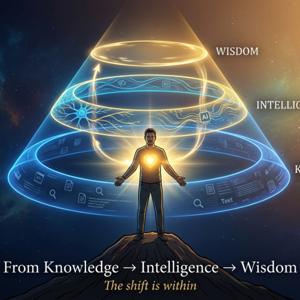


Today's conversation gives yesterday's Conscious Grid something it badly needed: a mechanism for the word Conscious.
Yesterday, the architecture was becoming:
Conscious = human direction
Grid = shared technological capability
But that leaves the question: How does a human actually become capable of consciously directing anything?
Morgane's answer is deceptively simple:
Slow down.
And I think that connects several RASHMI threads more deeply than it first appears.
Morgane says something particularly insightful:
AI takes something off her plate, and the immediate internal response is:
Great. Now I can do more.
That is almost a perfect description of the trap.
Suppose AI gives us 30% more capacity.
If we immediately fill that capacity with 30% more activity, we've achieved:
greater throughput
but not necessarily:
greater human freedom.
The industrial paradigm simply absorbs AI efficiency and says:
More. Faster. Next.
That could lead to a strange outcome where AI becomes extraordinarily productive and humans somehow feel even more hurried.
So perhaps:
AI can create capacity. Only humans can decide what that capacity is for.
And that is precisely where agency enters.
The most important idea may be: AI can give us capacity without giving us freedom
Today's Dose feels like an important scale transition.
For several days, you've been working upstream:
security → aliveness → integration → acceptance → purpose → life
Today you turn back outward and ask:
If we become clearer about what human and collective life should be in service of, what should we actually do with the extraordinary AI capability we are creating?
And Conscious Grid begins to look less like a phrase and more like an architecture.
Keep asking "Why?" long enough and eventually you have to confront what all the optimization is for.
Don't confuse capability with purpose.
Wisdom Thinking begins when Product Thinking follows "Why?" far enough that logic encounters the question of what ultimately matters.
Life is the Ultimate Product because every other product, metric, organization and technology is ultimately an instrument within life—not the other way around.
Today's Dose does something important: it connects (P-M)² back to the individual human, and in doing so exposes a common pattern at both levels.
At the human level, the question becomes:
Am I using my body and mind as instruments for living—or organizing my life primarily around serving the needs and constructs of body and mind?
At the organizational level:
Are we using product, market and money as instruments for what we care to create—or has money become the objective that everything else serves?
That symmetry is powerful. I think the deepest idea today is therefore less about “work versus co-creation” and more about an inversion of instrument and purpose.
Integrated Intelligence doesn't eliminate effort. It changes what the effort is in service of.
Purpose does not replace economics. It belongs upstream of economics.
The problem isn't the instruments—body, mind, products, markets, money or AI. The problem begins when the instrument becomes the purpose.
Purpose gives direction. Product gives purpose form. Market connects that creation with the world. Money enables its continuity.
Are you given room at your work to be you or you are a role that can be replaced?
First:
Integration asks: What is present within me? Alignment asks: Where do I consciously choose to direct it?
Second:
Energy is a signal, not an instruction.
Third:
Willingness is not saying yes to every circumstance. It is saying yes to your responsibility for how you consciously respond to the circumstance.
And the strongest synthesis:
Integration brings the whole human together. Alignment gives that integrated human direction. Leadership brings aligned humans together. Green Intelligence guides what their collective capability creates.
The September arc is becoming increasingly coherent
September 1 began with security.
Then:
Sep 2 — Wholeness: Develop the Whole Integrated YOU.
Sep 3 — Alignment & Integration: Bring distinctive humans into collective creation.
Sep 4 — Conscious Leadership: Separate observation from inference before directing capability.
Sep 5 — Attention: Recognize what determines where human energy goes.
Sep 6 — Signal vs Noise: Create enough inner space to perceive beyond accumulated narratives.
Sep 7 — Security: Don't spend your life endlessly protecting life.
Sep 8 — Aliveness: Use the capacity you've liberated to actually experience and create life.
And today's conversation gives a beautiful answer to something that could otherwise remain vague:
What energizes you?
There doesn't need to be one universal answer.
That's precisely the point.
The Secret Ingredient Is YOU.
Security is necessary. The endless pursuit of security is optional.
Economic security can be a foundation for creation without becoming the purpose of creation.
The goal is not to ask people to abandon security. It is to create enough real security that more human attention and energy can move from protecting life toward creating with it.
Recorded with Ruta
Humans have spent centuries building tools that amplify our physical capabilities.
Then computers amplified aspects of our cognitive capability.
Now AI dramatically amplifies cognitive creation and action.
But amplification makes direction more important, not less.
A weak capability pointed in a poor direction creates limited damage.
A tremendously powerful capability pointed in a poor direction creates tremendously powerful consequences.
So:
The more powerful our intelligence becomes, the more consequential our attention becomes.
AI can amplify human assumptions with extraordinary competence.
In the AI era, conscious leadership is no longer only an executive competency. It becomes a human competency.
A conscious leader knows the difference between what is observed, what is inferred, and what is intentionally chosen—and does not ask humans or AI to execute one as though it were another.
From the publisher's feed