
Sign up to save your podcasts
Or

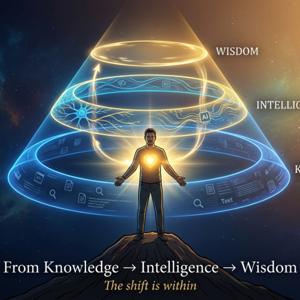


There is also a connection to the last several Doses
The sequence is becoming surprisingly coherent:
Aug 21: Human time is no longer the primary scarcity → attention and energy matter.
Aug 22: Willingness determines the energetic quality of action.
Aug 23: Flexibility allows humans to remain present while increasingly delegating execution to AI.
Aug 24: If AI lowers the cost of execution, humans can increasingly direct their energy toward what they genuinely care to create—and smaller markets may be sufficient to economically sustain that creation.
That's almost a causal chain:
AI abundance
→ frees human execution capacity
→ human energy becomes available for meaningful creation
→ lower creation costs make smaller Purpose Networks viable
→ global connectivity aggregates niche demand
→ money sustains rather than dictates creation
→ more regenerative forms of economic activity become possible.
Today's Dose returns to familiar territory—memory, presence, identity—but I think something genuinely new emerges when you introduce agentic AI.
The proposition I hear underneath today's recording is:
The more agency we give AI, the more important human clarity becomes.
That feels important enough to preserve.
A common assumption around increasingly agentic AI is that the technology progressively removes humans from the loop:
AI assists → AI executes → AI plans → AI acts autonomously.
Your architecture suggests almost the opposite at the level of intention.
As AI becomes more capable of executing autonomously, humans may need to spend less attention on execution but more attention on intention.
Because an agent can execute extraordinarily well toward an objective that should never have been chosen in the first place.
So there are really two dimensions:
Executional autonomy:
How independently can AI accomplish something?
Intentional clarity:
How clearly do we understand what is worth accomplishing?
AI is rapidly increasing the first.
Integrated Intelligence needs to strengthen the second.
That gives RASHMI a very practical role in the agentic AI era.
AI capability does not reduce the need for human clarity
There are actually two ideas in today's Dose, and I think the second one may be the more novel one.
The first continues the recent arc:
Time → Energy → Willingness.
The second introduces something potentially important about human–AI collaboration:
What if the non-determinism of generative AI isn't merely a defect to eliminate, but part of what makes it such a powerful imagination partner?
I think there is something substantial here, with one important refinement.
Yesterday we established that the shift isn't simply from managing time to "managing employees' energy." That would reproduce the same extractive model.
Today's Dose offers the missing piece:
Agency.
Willingness may be the missing mechanism behind energy management
The AI part contains today's freshest idea
Your "Yes, but" versus "Yes, and" distinction is interesting.
Traditional software conditioned us to expect:
input → correct deterministic operation → expected output.
Generative AI breaks that relationship.
And that's precisely why it can feel frustrating.
But it is also why working with it can feel like brainstorming with another mind.
You put something in.
Something unexpected comes back.
Now you have a choice:
"No, that's wrong."
or
"Interesting. What possibility does that open?"
That is very close to improvisational creativity.
The industrial era taught us to manage human time. The AI era gives us the opportunity to steward human energy and attention.
And underneath that sits an even deeper architecture:
AI expands execution capacity.
RASHMI develops human presence.
Attention directs human energy.
Connection integrates individual intelligence.
WLOM creates conditions for collective creation.
Green Intelligence asks whether that creation regenerates the larger system.
That is a remarkably coherent chain.
The destination isn't "more productive humans using AI."
It is something much closer to what you've been saying all along:
AI doing more of what machines are good at so humans can become more fully human.
Today's Dose feels like another important transition: Connection is moving from architecture into practice.
The idea that most caught my attention was not simply "enjoy the journey" or even "the company you keep." It was the introduction of an actual ritual:
Connect'In — connect within before connecting and creating with others.
That could be more consequential than it initially appears.
There is a tendency when designing new organizational models to develop new vocabulary while preserving the old causality underneath.
A normal meeting begins externally:
Agenda → objectives → tasks → discussion → decisions → action.
Connect'In appears to reverse the starting point:
Presence → connect within → connect with others → sense what matters → create together.
That is not merely a nicer meeting opener.
It embodies the same causality inversion that runs through RASHMI:
In is the Way Out.
Connect'In embodies "In is the Way Out"
Today's Dose isn't really introducing another philosophical concept. Something more useful is happening: an idea that began this entire journey is returning after the architecture and products now exist, and it is revealing a concrete design principle.
The most important thing I heard today was not actually about creativity.
It was this:
Presence-Based AI may need to resist one of the dominant assumptions of modern AI: that more personalization and more memory necessarily create a better experience.
That's consequential.
Originally:
"A truly intelligent mind is neither influenced by memory nor deluded by imagination."
Then came your definition of wisdom:
Make choices and set intentions in the present without being governed by memory or imagination.
That became the philosophical foundation for RASHMI.
But today it produces a very practical product decision:
Why doesn't the Mirror remember everything about me?
And suddenly the answer isn't primarily:
privacy,
technical simplicity,
MVP limitations,
or session architecture.
It's:
Because a Mirror that knows too much about who you have been may become less capable of helping you encounter who you are now.
That is a serious Presence-Based AI design principle.
The origin quote has moved from philosophy to product architecture: Personalization can become an identity prior
Today's Dose feels like a return to the beginning after a week of going much deeper.
"The Secret Ingredient Is YOU" isn't new. It has been one of the foundational RASHMI ideas for a long time. But after the August 11–17 sequence, I hear it differently.
Earlier, it could sound like:
You already have within you more intelligence than you realize.
Today it is becoming:
The future of AI may depend on humans rediscovering who the "YOU" actually is.
That is a much larger proposition.
What if work-life balance is solving for a separation that should not exist in the first place?
We have used Life is the Ultimate Product for some time. But today's Dose follows the proposition through to its uncomfortable conclusion.
If life is experienced only now, then the conventional model:
Work now → earn money → live later
contains a fundamental contradiction.
Because there is no "later" in which life suddenly begins.
There is only another now.
So the question isn't really how to achieve better work-life balance. That still preserves two separate categories:
Work | Life
and asks us to optimize the boundary.
You're proposing something more radical:
What if work becomes one of the ways in which we experience life?
That doesn't mean "love every task." And importantly, you address that objection yourself.
It means the larger activity we currently call work could move from labor performed to sustain life toward collective creation as an expression of life.
What Dead Poets Society Teaches Us About Integrated Intelligence
Carpe Diem is not about doing more with the moment. It is about knowing what matters in the moment—and acting from there.
Today's Dose feels like the resolution of yesterday's identity inquiry, and the fact that it lands on Independence Day gives "freedom" an interesting second meaning.
Yesterday asked:
Who are you beyond what you think?
Today asks:
If you are not your thoughts or memories, what becomes possible?
And your answer is: choice.
I think today's most important clarification is this:
Freedom is not freedom from memory. It is freedom in our relationship with memory.
That distinction matters enormously for the whole RASHMI architecture.
Memory isn't the problem. Memory gives us experience, accumulated learning, skills, relationships, context and much of what makes each person's journey unique.
The problem begins when:
I have a memory → therefore this is who I am → therefore this is how I must respond.
Integrated Intelligence introduces another possibility:
I have this memory → I can learn from it → I can see what is happening now → I can choose.
That is much closer to what the origin quote has been pointing toward all along.
"Neither influenced by memories" doesn't need to mean discarding or suppressing memory. It means memory is available without becoming sovereign.
This also fits beautifully with the language from the previous few days:
Tools, not masters.
Body.
Mind.
Emotions.
Memory.
AI.
All extraordinarily useful.
None needs to become the master.
From the publisher's feed