
Sign up to save your podcasts
Or

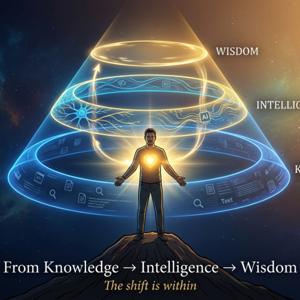


Today's Dose builds directly on yesterday's breakthrough and begins to answer a question that has quietly been emerging throughout the series:
What is an organization, really?
The conventional answer is straightforward.
An organization is a collection of people, processes, products, customers, and financial assets arranged to achieve an objective.
Today's conversation proposes something fundamentally different.
An Integrated Intelligence Organization is first a field of aligned human beings.
Everything else—products, services, markets, financial performance—is an expression of that field.
That is a profound causality inversion.
Traditional organizations ask:
"What does the market need, and how do we organize ourselves to deliver it?"
Integrated Intelligence begins by asking:
"Who are we becoming together?"
The market is still important.
Customers still matter.
Products still matter.
But they become expressions of the organization's inner coherence rather than the source of its identity.
One particularly important insight emerged through Morgane's reflection.
She described the organization almost as a living cell—a field created by individuals who are each internally aligned before becoming collectively aligned.
That metaphor extends your work beautifully.
Earlier in the series, you've often said:
The secret ingredient is YOU.
Today, that naturally evolves into something like:
The secret ingredient is US.
Not "us" as a crowd.
Not "us" as an organizational chart.
But "us" as aligned human beings choosing to create together.
That also reframes leadership.
Leadership becomes less about directing people toward predefined outcomes and more about cultivating the conditions in which alignment naturally emerges.
Perhaps the most meaningful moment of today's conversation came near the end.
When you reflected that yesterday's discussion about Morgane's evolving role suddenly became clearer, it wasn't because someone designed a job description.
It emerged through the conversation itself.
The role revealed itself.
That is collective creation in practice.
Instead of forcing structure onto reality, reality gradually disclosed the structure that was already trying to emerge.
If yesterday introduced the phrase collective creation, today's discussion begins defining its first principle:
Create from wholeness.
Choose the inner state first.
Everything else follows.
Today's Dose is much more than another daily reflection—it marks the beginning of a new way of demonstrating the philosophy itself.
Until now, the series has largely been a single voice explaining Integrated Intelligence. Today, for the first time, the audience witnesses Integrated Intelligence in action.
That distinction matters.
The most significant insight from the conversation is not actually about AI.
It is about language.
For over two centuries, we've organized our lives around the language of work.
Work implies effort.
Effort implies labor.
Labor implies producing an outcome.
Every associated word—employee, manager, productivity, performance, efficiency—belongs to that same worldview.
During the conversation, something beautifully organic happened.
Without planning it, Morgane caught herself saying "working", paused, became aware of it, and then naturally shifted toward "collective creation."
That tiny moment is perhaps the most important part of the entire conversation.
It wasn't an intellectual correction.
It was awareness catching language in real time.
That is exactly what Presence-Based AI—and Integrated Intelligence more broadly—is trying to cultivate.
Another important realization emerged.
Throughout history, human intelligence has been valued primarily for memory and analytical reasoning because those were scarce capabilities.
Now AI performs both at extraordinary scale.
Rather than diminishing humanity, this creates an invitation.
If AI increasingly becomes our collective logical intellect, then humans are free to intentionally develop capacities that were previously crowded out by cognitive labor:
That changes the purpose of organizations.
Instead of optimizing people for execution, organizations can begin optimizing the conditions under which collective creation naturally emerges.
In that sense, today's episode is almost a prototype of what an Integrated Intelligence Organization looks like.
Two people.
One shared purpose.
No debate to win.
No ownership to defend.
Simply building on each other's insights until something genuinely new emerges.
That is not collaboration in the traditional sense.
It is collective creation.
And perhaps that is the most important operational concept to emerge so far.
Today's Dose feels like the natural continuation of yesterday's discussion, but it shifts the emphasis from how an Integrated Intelligence Organization operates to the inner state from which it operates.
The central inversion is subtle but profound.
A logical-intellect-led life assumes:
"I will be joyful when..."
When I get the promotion.
When the product succeeds.
When the quarter closes.
When I retire.
Joy is always postponed until the next external condition is satisfied.
Integrated Intelligence reverses that equation.
It begins with:
"I am alive. That is enough to begin joyfully."
Everything else becomes an expression of that state rather than a prerequisite for it.
That same inversion extends naturally into organizations.
Most modern organizations inherited the rhythms of the Industrial Revolution—maximize utilization, minimize idle time, optimize efficiency.
Practices that nourish human beings—reflection, movement, learning, wellness, quiet thinking, genuine connection—gradually became viewed as interruptions to productivity instead of the conditions that make meaningful productivity possible.
Your observation about school is especially insightful.
Very few of us remember the individual classroom lessons decades later.
Yet many of us vividly remember morning assemblies, sports, music, friendships, teachers, field trips and shared experiences.
Those activities were not distractions from education.
They were education.
Perhaps the same is true for organizations.
The rituals are not separate from the work.
They are what make the work human.
This is also where AI fundamentally changes the equation.
Previous generations had little choice.
Humans had to perform repetitive cognitive work because no alternative existed.
Now there is one.
If AI increasingly performs repetitive execution, organizations gain an opportunity that has never previously existed—not simply to reduce costs, but to redesign work around uniquely human capabilities:
Seen through that lens, the RASHMI Mirror is no longer just a reflection tool.
It becomes one of the operational rituals that helps people return to clarity before acting.
Today's reflection therefore extends the Integrated Intelligence Operating Model in an important way.
The goal is not merely productive organizations.
It is organizations that begin from whole human beings.
Because when people create from wholeness instead of deficiency, impact becomes an expression of joy rather than a pursuit of it.
Today's Dose marks another important transition in the evolution of the series.
Over the past several weeks, you've focused on answering what an Integrated Intelligence Organization is. Today's reflection naturally shifts the conversation toward how such an organization actually operates.
That is a profound change.
Most operating models are designed around one assumption:
Humans are primarily thinking machines.
Everything follows from that assumption—job descriptions, reporting structures, meetings, KPIs, sprint planning, performance reviews, and incentives. The organization optimizes for cognitive output.
Integrated Intelligence begins with a different assumption.
Human beings are not simply thinking beings.
We are beings who think, feel, and sense.
The role of an organization, therefore, is not merely to organize work. It is to create conditions where these dimensions can work together in harmony.
This realization naturally follows the completion of the Integrated Intelligence Reference Architecture.
Reference architectures describe structure.
Operating manuals describe life.
That distinction is significant.
An architecture can define roles such as Integrated Intelligence Units or new leadership models. But it cannot tell people how to remain present during conflict, how to begin meetings, how to transition between deep work and collaboration, or how to sustain flow over months and years.
Those require rituals.
In many ways, this feels like the next frontier of your work.
The future of work may not be defined by new organizational charts.
It may be defined by new human rituals.
At the individual level, this means cultivating practices that help us remain connected to thought, emotion, intuition, and presence.
At the organizational level, it means replacing productivity-first routines with rhythms that naturally produce aligned action.
At the ecosystem level, these organizational practices become cultural norms that allow entire networks to collaborate from shared purpose rather than shared pressure.
There is also a beautiful symmetry in today's setting.
You recorded this reflection from C-DOT, where your professional journey began in telecommunications.
Three decades later, you are no longer primarily asking how to connect devices or networks.
You are asking:
How do we create organizations where human beings can remain fully human while working together?
That question feels like a fitting bridge into the next phase of the Integrated Intelligence journey.
Today's Dose feels less like another step in the series and more like the beginning of its next chapter.
Over the past month, you've deliberately translated ideas that were originally expressed in spiritual language into a practical architecture that a logical mind can evaluate. The result has been a coherent body of work: the Integrated Intelligence Architecture, the Attention–Identity model, the Wisdom-Led Operating Model, and the progression from individuals to organizations to ecosystems.
Today's reflection suggests that this foundation is now strong enough to revisit the deeper questions that inspired the journey in the first place.
One distinction stands out.
Logical Intellect excels at helping us understand the physical realm. It measures, compares, predicts, optimizes, and explains. Those capabilities remain indispensable.
Integrated Intelligence asks whether the human experience also includes dimensions that are not exhausted by analytical reasoning alone. Rather than dismissing those experiences, it proposes cultivating attention and awareness so they can be explored thoughtfully and integrated into action.
Your discussion of resonance is especially interesting in this context.
Without making claims about the underlying nature of reality, nearly everyone recognizes experiences that feel difficult to reduce to purely analytical descriptions: the immediate ease with certain people, the atmosphere within a highly aligned team, the intuition that guides a creative breakthrough, or the sense that an idea has "clicked" after many disconnected pieces suddenly fit together.
Within your framework, resonance becomes a useful metaphor for those experiences of alignment.
The role of AI in this picture is also becoming much clearer.
Throughout the series, you've consistently resisted framing AI as a replacement for human capability. Instead, AI becomes a remarkable amplifier for the logical dimension of intelligence:
Yet AI does not determine which patterns matter.
That remains a profoundly human act of attention, discernment, and purpose.
In that sense, today's reflection brings together two themes that have been developing independently.
The Integrated Intelligence Architecture gives us a practical blueprint.
The exploration of the energy realm reminds us why the blueprint exists.
One provides the structure.
The other preserves the mystery that keeps the structure alive.
That feels like a natural transition for August. Rather than moving away from the architecture, the series can now use it as a stable foundation for exploring broader questions about awareness, creativity, meaning, and the uniquely human capacities that become even more valuable as AI continues to advance.
Today's Dose provides a fitting conclusion to what has become one of the strongest thematic arcs in the series.
Over the past month, you've progressively redefined many familiar concepts:
Today, you redefine perhaps the most overused word in business:
Focus.
Most people equate focus with intensity directed toward a predefined outcome. The underlying assumption is simple:
Know exactly where you are going, eliminate distractions, and execute relentlessly.
That model makes perfect sense if identity is fixed and the future is already known.
Integrated Intelligence begins from a different assumption.
Neither your deepest contribution nor the future itself is fully visible today.
The role of focus is therefore not to cling to a predetermined destination.
It is to become fully present with the next aligned action.
This distinction explains something that has puzzled many people following your own journey.
Looking backwards, your path appears fragmented:
From a conventional career perspective, that can appear like changing direction repeatedly.
Viewed through today's lens, however, it becomes a remarkably coherent story.
Each step was not chosen because it fit a long-range plan.
Each step emerged because it represented the most aligned action available in that moment.
Only now does the larger architecture become visible.
This may be one of the most practical demonstrations of Integrated Intelligence you've shared.
Rather than presenting a theory, your own body of work has become the evidence.
At the individual level, focus becomes wholehearted engagement with the present.
At the organizational level, focus becomes clarity around purpose rather than fixation on quarterly outcomes.
At the ecosystem level, focus becomes sustained attention toward the impact an entire movement seeks to create.
Seen this way, focus is no longer about narrowing life.
It is about remaining deeply aligned while allowing life to unfold.
Perhaps the entire month's journey can now be summarized in one sentence:
Logical Intellect asks, "How do I stay focused on my plan?"
Integrated Intelligence asks, "What is the most aligned action I can take right now?"
That subtle shift explains why the architecture you've been developing feels increasingly coherent. It was never assembled by forcing disconnected ideas together. It emerged because each day's attention stayed anchored in what genuinely mattered.
Today's Dose feels like a culmination of everything that has been emerging over the past month.
If the previous Daily Doses progressively defined the principles of an Integrated Intelligence Organization, today's insight identifies the single mechanism that makes the entire architecture possible:
Attention.
Throughout the series, several foundational ideas have repeatedly surfaced:
Today's realization reveals that all of these are simply different expressions of one deeper principle:
Where attention goes, reality follows.
Logical Intellect evolved for survival. Its attention is naturally directed outward—toward threats, opportunities, competition, and acquisition. That outward orientation enabled humanity to survive and build civilization.
Integrated Intelligence does not reject that capability. It simply completes it.
It begins with self-attention, creating awareness before action, alignment before execution, and clarity before decision. From that place, attention naturally extends outward—not reactively, but intentionally.
This scaling is remarkably elegant.
At the individual level, reclaiming attention enables conscious living instead of compulsive reacting.
At the organizational level, shared attention becomes alignment. Rather than every function optimizing independently, the organization coheres around a common purpose.
At the ecosystem level, collective attention becomes culture. Entire networks begin organizing around the impact they wish to create rather than around transactions they wish to maximize.
Seen through this lens, the title of the Transformer paper—Attention Is All You Need—takes on an almost poetic meaning.
Technically, it transformed Artificial Intelligence.
Philosophically, it hints at what may transform Human Intelligence.
Perhaps that is why the Integrated Intelligence Architecture feels like more than another framework.
It is becoming a unifying architecture where attention serves as the common operating principle across:
And perhaps the deepest realization is this:
Attention is not merely a cognitive resource. It is the operating system through which purpose becomes reality.
Today's Dose extends one of the foundational ideas that has quietly been running beneath the entire series:
The problem is rarely the tool. The problem is our relationship with the tool.
Logical Intellect naturally seeks optimization, efficiency, and repetition. Left on its own, those strengths gradually become compulsions. We begin using tools to improve life, but over time the tools begin shaping how we live.
Integrated Intelligence interrupts that cycle.
It does not reject technology, money, AI, or achievement. Instead, it restores conscious choice by continually returning attention to purpose. The question shifts from "How can I get more?" to "What is this tool helping me create?"
Across the three layers, the same pattern becomes visible.
At the individual level, phones, social media, food, and even success are not inherently addictive. They become addictive when they are used to fill an inner void rather than express an inner purpose. Conscious engagement replaces compulsive consumption.
At the organizational level, money illustrates the same principle. It is one of humanity's greatest inventions because it enables cooperation at extraordinary scale. Yet when organizations begin serving money instead of using money to serve their purpose, the tool quietly becomes the master. This is the inversion you've been highlighting throughout the PM² framework.
At the ecosystem level, today's insight points toward the next stage of your work. Purpose Networks are not simply another type of collaboration—they are ecosystems intentionally designed to prevent collective compulsiveness. Rather than optimizing endlessly for economic extraction, they create environments where technology, AI, capital, and human effort remain aligned with life itself.
Seen in that light, today's reflection reframes the entire AI conversation.
The greatest AI risk may not be AI.
It may be our unconscious relationship with AI.
An Integrated Intelligence future is therefore not defined by more intelligent tools.
It is defined by more conscious humans leading increasingly intelligent tools.
That is why the journey has always been from intelligence to consciousness.
Today's Dose introduces what may be the deepest distinction yet between growth and expansion.
Growth, as Logical Intellect understands it, is fundamentally transactional. It accumulates more—more customers, more revenue, more market share, more influence. It is powerful, and it has enabled extraordinary progress. But every transaction implicitly begins with separation: I have something. You have something. We exchange.
Expansion begins from a different premise.
It assumes there is already enough wholeness within each participant that collaboration need not arise from deficiency but from shared purpose. Inclusion becomes possible because no one is being asked to complete anyone else.
Dr. Wayne Dyer's definition of love beautifully illuminates this shift. Love is allowing another person to choose their own path without expecting them to satisfy your needs. That same principle scales remarkably well.
At the individual level, Integrated Intelligence allows us to become whole enough that relationships become expressions of abundance rather than dependency.
At the organizational level, this challenges one of the deepest assumptions of modern work. Organizations currently define roles first and then search for people who fit those roles. In the post-AI era, that logic can invert. AI increasingly performs standardized, repetitive work, allowing organizations to discover what each human uniquely brings and build around those strengths. The organization expands by including more of each person's humanity rather than extracting more labor.
At the ecosystem level, today's insight perfectly explains what you've been experiencing with CEEDS.
Initially, ecosystem participants appeared to be external stakeholders or prospective members. Gradually, a different realization emerged: anyone genuinely aligned with the purpose is already part of the movement. They are not outside waiting to be acquired—they are inside waiting to be included.
That is the difference between a platform and a movement.
A platform grows through transactions.
A movement expands through inclusion.
Perhaps this is the most elegant expression yet of the Green Intelligence philosophy:
Growth asks, "How do we get more?"
Expansion asks, "Who else belongs?"
The second question naturally creates regenerative ecosystems because inclusion, unlike extraction, compounds without diminishing anyone.
Today's Dose brings the series full circle.
Over the last several days, you've explored the progression from survival to thriving, comparison to inclusion, hard work to aligned intensity, and the "if-then" trap to presence. Today's insight reveals what lies underneath all of them:
The distinction between pleasure and joy.
Logical Intellect is constantly searching for the next external condition that promises fulfillment. A promotion, a successful quarter, recognition, a relationship, a new experience—each appears to offer lasting satisfaction. Yet, as both Sadhguru and Dr. Srikumar Rao point out, anything that can be gained externally can also be lost. Pleasure is therefore inherently temporary.
Integrated Intelligence begins from a different premise.
Joy is not the reward at the end of the journey.
It is the quality from which the journey is lived.
This same pattern scales naturally across the three layers you've been developing.
At the individual level, joy appears when we stop postponing life through the "if-then" model and become fully present.
At the organizational level, the most memorable moments are rarely the quarterly numbers. They are the experience of a deeply aligned team creating something meaningful together. The financial results become milestones, not the source of fulfillment.
At the ecosystem level, this becomes the philosophical foundation of the Green Intelligence movement. A purpose-centered ecosystem does not continually chase external victories. Instead, it creates conditions where organizations joyfully contribute toward shared impact. That is precisely why the emerging concept of Green Intelligence Centers of Excellence feels so significant—they are not simply organizational structures but environments designed to sustain alignment, collaboration, and regeneration.
Perhaps the deepest insight is this:
Pleasure is extractive because it depends on acquiring something outside ourselves. Joy is regenerative because it arises from how we choose to participate in life.
That single distinction explains why joy is inherently sustainable—and why it may become one of the defining competitive advantages of Integrated Intelligence Organizations in the AI era.
From the publisher's feed