
Sign up to save your podcasts
Or

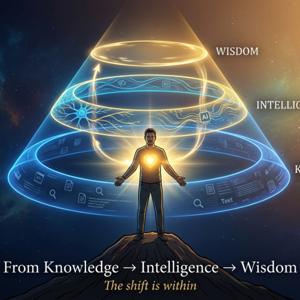


Today's Dose completes a natural progression that has been unfolding over the past several days.
The journey began with transactions, evolved into customer centricity, and now reaches care centricity.
Product Thinking transformed business by asking, "What does the customer need?" Integrated Intelligence asks an even deeper question: "What if the customer is part of us?"
That subtle shift changes everything.
When customers remain external, relationships—even excellent ones—can still become optimized for retention, engagement, and revenue. When customers are experienced as part of the organization's own sphere of care, the motivation changes. Service becomes an expression of shared purpose rather than a strategy for growth.
Sadhguru's insight captures this beautifully. Love exists while there are two. Beyond that lies inclusion—where separation itself begins to dissolve. The organizational equivalent is moving beyond customer relationships toward shared identity.
The CEEDS example illustrates this transition in practice. What began as designing programs for prospective members gradually became the realization that there are no "customers" in the traditional sense. There are only participants in a shared movement. CEEDS is not the movement—it is the platform that enables the movement to emerge.
This may be one of the deepest implications of Integrated Intelligence. Great organizations do not simply build loyal customers. They cultivate communities where people genuinely feel they belong.
Today's Dose feels like the culmination of several threads that have been converging throughout the RASHMI journey.
The Art of Prioritization has always been about asking one more "why." At Layer 2, organizations become better at prioritizing resources, products, markets, and investments. But if we continue asking why beneath every business objective, the answer eventually reaches something much deeper than revenue or market share.
Why do we pursue growth?
Why do we build better products?
Why do we seek profitability?
Ultimately, every one of these points back to a single outcome: improving life—for the people who build the organization and for the people it serves.
That realization transforms the hierarchy of priorities. Profit does not disappear; it finds its proper place. It becomes an instrument that enables a richer quality of life rather than the destination itself.
Sadhguru's insight beautifully echoes this perspective. Life is brief, and our fundamental work is to make it wonderful for ourselves and for the life around us. An Integrated Intelligence Organization extends this philosophy into business. Every strategic decision becomes an exercise in asking whether it ultimately enriches life.
This may be the deepest expression yet of the RASHMI philosophy: the ultimate product is not software, services, or even innovation. The ultimate product is the quality of life that emerges through aligned human action.
Today's Dose reframes one of the oldest tensions in business: Is money the purpose of the organization, or is it a tool that serves life?
Using Dr. Jill Bolte Taylor's Whole Brain Living model adds an elegant dimension to the RASHMI framework. Most organizations today predominantly cultivate the Plan and Protect capacities. These are essential—they create execution, efficiency, and economic resilience. Yet when these become the entire operating model, work gradually becomes something to endure rather than a place where people fully express themselves.
AI changes this equation.
For the first time, we have technology that is exceptionally good at planning, protecting, analyzing, and executing. Rather than asking humans to become even more machine-like, AI gives us the opportunity to become more deeply human. It can carry more of the cognitive execution load while humans invest more energy in exploration, connection, creativity, empathy, and purpose.
This reveals why "work-life balance" has become such a common aspiration. In many organizations, people satisfy their Explore and Connect needs only after work is finished. An Integrated Intelligence organization seeks a different future—one where work itself becomes a place where those human capacities are expressed.
Sadhguru's insight captures the same principle from another perspective. Life becomes richer through giving, sharing, and wholehearted participation. Money grows by accumulation; life grows by expression. Organizations that understand this distinction may ultimately create not only healthier cultures, but also more resilient and enduring businesses.
Today's Dose introduces a subtle but profound distinction between customer centricity and care.
Customer centricity asks, "What does the customer want?" Genuine care asks, "What is truly good for the customer?" Those questions often overlap—but they are not the same.
This distinction mirrors the progression of the PM² framework. Transaction-first organizations exchange products for money. Product Thinking elevated the discipline by putting users at the center of product design, fundamentally changing how great products are built. Yet, in many organizations, this customer focus still ultimately serves financial objectives. Retention, engagement, and loyalty become instruments for profit.
Integrated Intelligence introduces another causality inversion. Purpose comes first, not profit. Genuine care for customers becomes part of the organization's identity rather than a business tactic. Products become expressions of that care. Markets recognize authentic value, and sustainable profitability emerges as a consequence rather than the objective.
Sadhguru's insight reinforces this beautifully. Relationships require emotional investment. Likewise, organizations build enduring customer relationships not through optimization alone, but by sincerely caring about the people they serve.
This may become one of the defining characteristics of the next generation of organizations: moving beyond customer-centric design toward care-centered enterprises—where profit is the outcome of authentic service rather than the reason for it.
Today's Dose highlights the true test of organizational integrity: purpose, culture, and values only become meaningful when they influence decisions during difficult times.
When markets are growing, almost every organization can speak eloquently about purpose and values. The real question emerges when pressure arrives. Do these principles continue to guide decisions, or do they quietly give way to short-term profitability?
The Google example captures this distinction well. A mission can endure because it is tightly connected to what an organization does. Values, however, require continual renewal because they govern how the mission is pursued. When they are treated as aspirational slogans rather than operating principles, they gradually lose influence.
This is the distinction that Integrated Intelligence introduces. Purpose, culture, and values are not communications artifacts or HR initiatives—they are the organization's navigation system. Profit remains essential, but it becomes an outcome of operating in alignment rather than the criterion that overrides everything else.
Sadhguru's insight reinforces this beautifully. Investing in oneself during times of trouble is what creates stability. The organizational parallel is investing in purpose and culture precisely when external conditions become difficult. That is when they stop being statements and become lived capabilities.
The organizations that will endure the next era are unlikely to be those with the strongest quarterly results alone. They will be the ones whose deepest principles remain stable while everything around them continues to change.
Today's Dose exposes what may become one of the defining misconceptions of the AI era: we are simultaneously overestimating AI and underutilizing it.
When intelligence is reduced to logic, AI naturally appears to be "superintelligent." It processes information at extraordinary speed and scale. But logic is only one dimension of intelligence. Human intelligence also includes emotional resonance, intuitive sensing, embodied experience, values, and purpose. AI does not replace these—it amplifies whatever humans bring into the collaboration.
This is why the future of AI is not primarily about building ever more capable models. It is about developing humans who can lead those models with Integrated Intelligence.
The organizational implication is equally profound. Most modern organizations were designed to optimize logical execution. Functions associated with emotion, culture, purpose, or sustainability are often treated as supporting roles rather than foundational ones. Integrated Intelligence reverses that hierarchy. Alignment becomes the organizing principle, while logic, emotion, and intuition become complementary instruments serving a shared purpose.
Sadhguru's observation that the mind is both underused and overestimated finds a striking parallel here. We overestimate logic because it is measurable, and we underuse the broader spectrum of intelligence that gives logic direction. The same pattern now risks repeating with AI.
The organizations that thrive will not simply have the best AI. They will cultivate the most integrated humans to guide it.
Today's Dose extends one of the central themes of the RASHMI philosophy: purpose determines perception.
Two organizations can encounter the exact same market conditions and experience completely different realities. One sees disruption, uncertainty, and existential threat. The other sees information, possibility, and an invitation to evolve. The difference is rarely the market itself—it is the organization's center of gravity.
This also reframes the common business mantra of "Only the paranoid survive." While strategic vigilance has its place, living in a perpetual state of paranoia means allowing fear to become the operating system. Integrated Intelligence proposes something different: purpose provides stability, allowing trust to become the operating system while awareness remains fully intact.
Sadhguru's lotus metaphor beautifully complements this idea. The lotus does not wait for ideal conditions to bloom; it grows because of them. Likewise, purpose-centered organizations do not merely endure challenging environments—they are refined by them. Every disruption becomes another opportunity to demonstrate their values in action.
This is precisely the path RASHMI.ai is choosing. Rather than rejecting a predominantly money-first ecosystem or simply conforming to it, the organization seeks a third path: becoming the living example of a different way to build, lead, and grow.
The greatest competitive advantage may ultimately be this: remaining deeply trusting while everyone else is becoming increasingly fearful.
Today’s Dose lands on a subtle but powerful shift: moving from proving worth to serving purpose.
Most organizations are built inside comparison. They measure vitality by whether they are ahead, behind, threatened, or winning. Even when this becomes sophisticated strategy, the center of attention remains external.
An Integrated Intelligence organization performs the causality inversion. It turns inward first: What do we care about? What are we here to serve? What aligned action is needed now?
From that place, competition softens. Others working toward similar outcomes are not automatically threats. In an ecosystem frame, they may actually strengthen the field.
This is the deeper intelligence behind CEEDS. If the purpose is ecosystem building, then more ecosystem builders are not competitors. They are evidence that the ecosystem is becoming real.
Today's Dose of RASHMI introduces an important organizational equivalent of one of the foundational principles behind the RASHMI Mirror: causality inversion.
Most organizations believe the market determines how they will be. When markets are strong, morale is high. When markets become uncertain, anxiety spreads through the organization. The external environment becomes the cause, and the organization merely reacts.
A purpose-centered organization reverses this relationship.
It decides first who it wants to be, regardless of current market conditions. The market still matters—but as information, not as the source of its internal state. This mirrors the individual insight that you always retain agency over how you choose to be, even when circumstances change.
That makes today's Sadhguru insight especially relevant. Inner Engineering is about creating a pleasant inner state that is not dependent on external situations. The organizational equivalent is a wisdom-led operating model that deliberately cultivates clarity, trust, care, engagement, and purpose. These become competitive capabilities rather than cultural luxuries.
The reflection on Posspole deepens this idea further. It reveals that the mission is not simply to build another successful AI company. RASHMI.ai itself is intended to become a living demonstration of what an Integrated Intelligence Organization looks like. CEEDS, Posspole, and future ecosystem partners can amplify this vision, but the demonstration itself remains an essential part of the mission.
The most powerful way to change an ecosystem is not to convince it—it is to embody the future so clearly that others choose to adopt it.
Today’s Dose of RASHMI extends one of the deepest RASHMI principles from the individual to the organizational level: identity creates both capability and limitation.
An individual operating from a rigid identity begins filtering reality through narrow constructs—what belongs, what does not, what is safe, what is threatening. Organizations behave exactly the same way. Over time, teams become attached to identities such as “who we serve,” “what business we are in,” or “how markets work.” These identities initially create clarity—but eventually become constraints.
This is why market disruption feels dangerous. Disruption is rarely just about changing technology or competition. More often, disruption challenges identity.
The organizations that struggle most during disruption are usually not lacking intelligence, talent, or resources. They are constrained by attachment to legacy narratives. They continue protecting old definitions long after the market has evolved.
Sadhguru’s insight offers a profound lens here:
Whatever you are willing to include becomes yours.
At an organizational level, willingness becomes strategic advantage.
Willingness to include:
This is where Integrated Intelligence becomes powerful. A truly intelligent organization is not simply efficient or analytical. It is capable of expanding its sphere of care beyond existing identity constructs.
That is what creates real resilience.
The future may belong less to organizations with the strongest products—and more to organizations with the greatest willingness to evolve.
From the publisher's feed