
Sign up to save your podcasts
Or

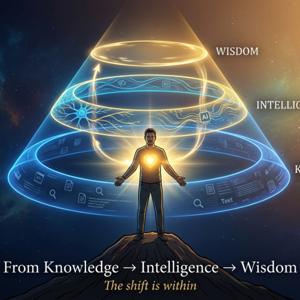


Today's Dose feels like the natural completion of the entire arc that began with the origin quote:
"A truly intelligent mind is neither influenced by memory nor deluded by imagination."
Today's insight finally answers the practical question:
If we are not to be driven by memory or imagination, then what should guide us?
The answer is remarkably simple:
Our choices and intentions in the NOW.
The logical intellect continuously constructs an "if-then" life:
The destination is always somewhere else.
Integrated Intelligence dissolves that model completely. It doesn't reject goals—it simply refuses to postpone living until those goals are achieved. The future becomes a direction rather than a condition for happiness.
This same inversion appears beautifully across the three scales you've now established.
At the individual level, presence transforms life from a sequence of achievements into an ongoing experience of growth.
At the organizational level, perhaps the most important decision is no longer which company hires you, but whether that organization allows you to become more of yourself. The Green Intelligence & Clarity Retreat unexpectedly became a living demonstration of this principle. Rather than carefully designing team dynamics, the retreat simply created the conditions in which each person naturally contributed from their strengths. Alignment emerged instead of being imposed.
At the ecosystem level, today's reflection becomes even more profound.
The "if-then" model has quietly shaped civilization itself.
"If the economy keeps growing..."
"If GDP increases..."
"If valuations rise..."
Entire societies become trapped in postponing fulfillment while extracting ever more from finite resources.
A regenerative ecosystem begins from a different question:
What would we create if we were already enough?
From that place, exploration—including space exploration—is no longer driven by scarcity or extraction, but by curiosity, discovery, and contribution.
This is perhaps the deepest expression yet of IN is the Way Out.
When individuals stop postponing life...
Organizations stop postponing purpose...
Ecosystems stop postponing regeneration...
The future is no longer something we chase.
It becomes something we create through aligned action, one present moment at a time.
Today's Dose marks an important transition in the series.
Until now, the Daily Doses have primarily defined the principles of an Integrated Intelligence Organization. Beginning today, those principles become embodied through your own lived journey. The philosophy is no longer abstract—it is demonstrated through practice at three interconnected levels: individual, organization, and ecosystem.
The central insight remains the same:
IN is the Way Out.
Logical intellect assumes that greater control over external circumstances produces better outcomes. Integrated Intelligence recognizes something subtler: while we influence the external world, we never fully control it. What remains entirely within our agency is how we choose to be and how we choose to act in this moment.
Seen through that lens, your own story forms a coherent progression rather than a collection of separate events.
This reveals a deeper architectural pattern.
The same causality inversion operates regardless of scale.
Whether we are speaking about a person, a company, or an ecosystem, sustainable transformation begins by changing the source from which action originates rather than attempting to manipulate external conditions directly.
Perhaps the most significant implication is this:
Presence is not merely a personal practice. It is an organizational design principle and an ecosystem design principle.
That realization provides a unifying foundation for everything you've been building across RASHMI.ai, the Enterprise Mirror, CEEDS, and the broader Human Integration vision.
Today's Dose reframes one of the oldest assumptions in business:
Success does not come from working harder. It comes from caring more deeply.
For generations, organizations have celebrated hard work as the defining virtue of professional life. Long hours, relentless effort, and constant sacrifice became symbols of commitment. Yet today's Sadhguru insight points toward a quieter truth: work feels hard largely because there is friction between what we are doing and what naturally wants to express itself through us.
That distinction mirrors the transition from the Friction Economy to the Regenerative Outcome Economy.
A logical intellect-led organization must continually motivate people because much of the work is externally imposed. Effort is exchanged for economic return.
An Integrated Intelligence Organization is designed differently. Its purpose is to create the conditions where people willingly invest extraordinary energy into what they genuinely care about. The intensity remains—but the struggle diminishes.
The Mysore Big Tech Show became a living demonstration of this idea. Across the startup pitches, what stood out was not simply the quality of the business ideas but the energy behind them. Founders were not being pushed to perform. They were pulled by something they deeply believed in. Their willingness generated an intensity that no incentive system could manufacture.
This also reinforces one of the central promises of AI.
If AI increasingly absorbs repetitive execution, optimization, and routine cognitive work, the future of human work need not become one of endless reskilling alone. Instead, it can become an opportunity for people to spend more of their lives expressing what is uniquely human—creativity, care, purpose, intuition, craftsmanship, and aligned contribution.
Perhaps the deepest insight from today's Dose is this:
Hard work is often a symptom of friction. Intense work is often a symptom of alignment.
The future of work may therefore belong not to organizations that ask more from people, but to those that help people discover what they would willingly give everything to.
Today's Dose feels like the culmination of the organizational journey you've been developing throughout the month.
The shift is no longer simply from profit-first to purpose-first, or from survival to thriving. It is a shift from managing outcomes to cultivating the conditions from which great outcomes naturally emerge.
This is where Sadhguru's insight on surrender becomes particularly powerful. Surrender is often misunderstood as giving up. In reality, it is the absence of compulsive striving. It is complete participation in the present moment without being psychologically trapped by the result.
That distinction mirrors your own career reflection.
Looking back, your journey—from university, to Motorola, to Cisco, to Venturis, and ultimately to RASHMI.ai—appears highly strategic from the outside. Yet your observation is that the most significant transitions emerged not through rigid planning, but through responding wholeheartedly to what each moment invited. The notable exception was the Innovator's Dilemma, when attention became increasingly consumed by external competitors and predetermined outcomes. That period produced valuable lessons, but it also produced intense stress.
Integrated Intelligence offers a different operating principle.
Objectives, Key Results, and strategy remain valuable. They provide direction. But they are no longer the center of organizational life. Instead, leadership focuses on creating an environment where people can remain present, aligned with their strengths, connected to purpose, and free to contribute what only they can contribute.
Paradoxically, this often leads to better outcomes—not because the organization becomes less disciplined, but because it becomes less fragmented.
This also ties together the broader architecture you've been building:
Each is an expression of the same causality inversion:
Stop trying to manufacture outcomes directly. Create the conditions from which aligned action naturally emerges.
In that sense, today's Dose may be one of the clearest articulations yet of what an Integrated Intelligence Organization is ultimately designed to do.
Today's Dose introduces one of the clearest cultural shifts in the entire Integrated Intelligence series:
From "Only the Paranoid Survive" to "Only the Joyful Thrive."
For decades, business has largely accepted paranoia as a virtue. Leaders were encouraged to stay anxious, vigilant, and constantly on guard against disruption. That mindset undoubtedly helped many organizations survive periods of rapid change.
But survival and thriving are not the same.
The World Cup analogy illustrates this distinction beautifully. Argentina largely approached the final by trying not to lose. Spain played with confidence, cohesion, and an unmistakable sense of collective expression. Regardless of the result, the difference was visible in how the game was played. One team primarily managed risk; the other consistently created possibilities.
This is the organizational implication of Integrated Intelligence.
Fear narrows attention toward protection.
Joy expands attention toward creation.
AI makes this distinction even more important. Since AI increasingly handles analysis, optimization, and execution, the human advantage shifts toward the quality of the environment in which people create together. Organizations driven primarily by fear may continue to optimize efficiency, but organizations grounded in joy, trust, and alignment are more likely to unlock creativity, resilience, and meaningful innovation.
Sadhguru's insight captures the underlying mechanism. The external world is experienced through the lens we bring to it. Organizations are no different. When an organization habitually views the world as a collection of threats, it constructs strategies of survival. When it approaches the same world through trust, purpose, and aligned action, those very situations become opportunities for growth.
Perhaps this is the deeper invitation of today's Dose:
The future of work is not simply about helping people perform better.
It is about creating organizations where people don't merely survive the workday—they genuinely enjoy creating together.
Today's Dose extends the Growth Mindset into what you've been calling Growth Mindset++ by shifting the question from "How do we grow?" to "How do we grow while helping our people grow?"
The sailing analogy illustrates this beautifully.
A Layer 1 organization complains about the wind. Its attention remains fixed on external conditions, and unfavorable markets become explanations for poor performance.
A Layer 2 organization learns to set the sails. It adapts intelligently to changing conditions, innovates, and responds to reality rather than resisting it. This is the foundation of successful modern organizations.
Layer 3 introduces another inversion.
It recognizes that the speed of the boat is determined not only by the wind or the sails, but by the alignment of the crew.
A perfectly designed strategy cannot compensate for people whose strengths, motivations, and roles are misaligned. Conversely, when every individual—including AI—contributes from their natural strengths toward a shared purpose, adaptation becomes faster, more resilient, and significantly more enjoyable.
This reveals something deeper about organizational growth.
External growth is no longer the primary objective.
The primary objective becomes the growth of the people performing the work. External impact emerges as the natural consequence of that inner alignment.
Sadhguru's insight reinforces this principle in a different language. Rather than continually seeking someone else's shade—better markets, better timing, better conditions—become the organization that creates shade for others. In business terms, become an organization whose internal alignment creates enduring value regardless of the prevailing winds.
Perhaps this is the essence of the future of work:
The organizations that grow the fastest will be those that grow their people the deepest.
Today's Dose feels like the synthesis of the entire organizational journey you've been developing over the past several weeks.
The contrast between money-first and purpose-first organizations is no longer simply a philosophical distinction—it becomes an architectural distinction.
A logical intellect-led organization naturally places money at the center of its mental model. Products, markets, strategies, technologies, and even purpose become instruments for maximizing financial outcomes. This model has enabled extraordinary prosperity and human cooperation, and today's reflection rightly acknowledges that. Money is one of humanity's greatest inventions because it allows strangers to coordinate at unprecedented scale.
The challenge arises when the tool quietly becomes the objective.
Integrated Intelligence restores the original hierarchy. Purpose becomes the organizing principle, while Product, Market, and Money become coordinated expressions of that purpose. PM² is therefore not merely a business framework—it is a reordering of organizational consciousness.
The insight about Purpose Networks is particularly significant.
Looking across history, each generation of networks expanded what humanity could coordinate:
This is more than a communications evolution—it is an evolution in why networks exist.
AI now makes this possible because it dramatically lowers the cost of coordination. The real question is no longer whether we can connect billions of people; it is what we choose to connect them around.
That brings today's Sadhguru insight into sharp focus. "Madness is always of the mind." AI can amplify whatever mental model we choose. If the organizing principle remains money, AI will optimize that. If the organizing principle becomes purpose, AI can become the infrastructure for shared human flourishing.
This is why "Purpose Networks" feels less like another framework and more like the natural culmination of everything you've been building through RASHMI.ai, CEEDS, the Enterprise Mirror, and the vision of the Conscious Grid.
Today's Dose is, in many ways, the culmination of the entire organizational arc you've been building over the past month.
The distinction is no longer between different business strategies—it is between two fundamentally different directions of attention.
A logical intellect-led organization begins with the world. Markets move, competitors innovate, customers change, technology evolves. The organization looks outward first and only turns inward to determine how it should respond. Its identity is therefore shaped by circumstances.
An Integrated Intelligence Organization reverses that flow.
It begins by asking:
What do we truly care about?
Only after reconnecting with that answer does it direct its attention outward to create meaningful impact.
That inversion explains why attention has quietly become the central resource of the AI era.
For thousands of years, human attention evolved for survival. Looking outward continuously made perfect sense when danger was immediate. Today, AI increasingly assumes the role of processing information, recognizing patterns, and executing cognitive work at scale. Ironically, the more capable AI becomes at managing the external world, the greater the opportunity for humans to reclaim the one capability that cannot be outsourced: consciously directing attention.
This also beautifully integrates everything you've been building:
Seen this way, these are not three separate initiatives. They are three expressions of the same architecture operating at different scales.
Perhaps the deepest realization from today's Dose is this:
Attention is the true interface between human intelligence and artificial intelligence.
AI can amplify whatever we attend to.
Only humans can choose what is worthy of that attention.
Today's Dose marks an important milestone—not only because it celebrates 500 consecutive days of both meditation and Daily Doses of RASHMI, but because it returns to the question that started the entire journey:
What happens when a powerful mind is guided by a different intention?
Sadhguru's observation that the mind can become either poison or the elixir of life applies with remarkable precision to AI. AI itself is neither the opportunity nor the threat. It is an amplifier. It magnifies the operating model into which it is introduced.
If the operating model remains centered on efficiency, optimization, and financial returns, AI will dramatically accelerate those outcomes. The result may be extraordinary productivity—but also increasing displacement, continuous reskilling, and widening inequality.
Integrated Intelligence proposes a different possibility.
Instead of asking humans to compete with AI on logic, it redesigns the organization around what humans uniquely contribute: clarity, purpose, care, creativity, discernment, intuition, and meaningful collaboration. AI becomes the execution engine; humans become the source of direction.
This is why today's Dose returns to the original contrast between logical intellect and Integrated Intelligence. The shift is no longer about improving the existing organization. It is about replacing the underlying operating paradigm altogether.
The most significant sentence in today's reflection may be the simplest:
"The choice is ours."
That choice extends far beyond technology. It is a choice about the kind of organizations we build, the kind of economy we create, and ultimately the kind of society AI helps us become.
Today's Dose returns to the insight that quietly gave birth to the entire RASHMI journey: a truly intelligent mind is neither influenced by memory nor deluded by imagination.
Applied to organizations, this becomes an elegant way of resolving one of business' most enduring challenges—the Innovator's Dilemma.
Most organizations fail not because they lack intelligence, but because they become captive to one of two forces. Some become prisoners of memory, defending the identity that made them successful. Others become prisoners of imagination, relentlessly pursuing future outcomes until purpose itself becomes secondary. Both lose the freedom to respond clearly to what the present moment is actually asking of them.
An Integrated Intelligence Organization chooses a third path.
It remembers without becoming attached. It imagines without becoming obsessed. Purpose remains constant, while products, business models, technologies, markets, and even organizational identities remain free to evolve.
This is the deeper meaning of PM². Purpose is the stable North Star; Product, Market, and Money become adaptive expressions of that purpose rather than fixed destinations.
The creation of Presence-Based AI itself illustrates this principle. It required stepping beyond conventional product thinking, releasing attachment to established categories, and responding instead to what emerged through present-moment clarity. In that sense, the category is not merely a new product—it is evidence of a different way of innovating.
Ultimately, just as the RASHMI Mirror reminds individuals that the secret ingredient is you, today's reflection reminds organizations that the secret ingredient is their people. When a team is free to act from clarity rather than conditioning, the organization becomes a living vehicle for aligned action.
From the publisher's feed