
Sign up to save your podcasts
Or

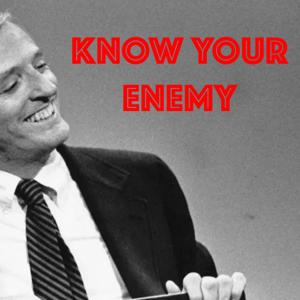

The late René Girard, former Stanford professor of literature and mentor to Peter Thiel, is having something of a moment on the right these days—as Sam Kriss recently put it in a Harper's essay, Girard's name is being "dropped on podcasts and shoved into reading lists," and "Girardianism has become a secret doctrine of a strange new frontier in reactionary thought." Why might that be the case? To unpack this question, Matt and Sam welcomed back John Ganz, whose four-part series on Girard is one of the best primers available. What does Girard have to say about who we are as human beings, why we want what we want, the origins of both violence and social order (and what they have to do with each others), the uniqueness of Christianity, and the nature of secular modernity? What use is all this to the right? And to what uses do they put it?
Also: please pre-order John's book, When the Clock Broke: Con Men, Conspiracists, and How America Cracked Up in the Early 1990s — it's sure to be excellent.
Sources:
John Ganz's Unpopular Front series on Girard: part 1, part 2, part 3, part 4
René Girard, Deceit, Desire, and the Novel: Self and Other in Literary Structure (1976)
Things Hidden Since the Foundation of the World (1987)
The Scapegoat (1989)
I See Satan Fall Like Lightning (1999)
Sam Kriss, "Overwhelming and Collective Murder: The Grand, Gruesome Theories of René Girard," Harper's, Nov 2023
Scott Cowdell, René Girard and Secular Modernity: Christ, Culture, and Crisis (2013)
...and don't forget to subscribe to Know Your Enemy on Patreon for access to all of our bonus episodes!
 View all episodes
 By Matthew Sitman

4.7
20192,019 ratings
The late René Girard, former Stanford professor of literature and mentor to Peter Thiel, is having something of a moment on the right these days—as Sam Kriss recently put it in a Harper's essay, Girard's name is being "dropped on podcasts and shoved into reading lists," and "Girardianism has become a secret doctrine of a strange new frontier in reactionary thought." Why might that be the case? To unpack this question, Matt and Sam welcomed back John Ganz, whose four-part series on Girard is one of the best primers available. What does Girard have to say about who we are as human beings, why we want what we want, the origins of both violence and social order (and what they have to do with each others), the uniqueness of Christianity, and the nature of secular modernity? What use is all this to the right? And to what uses do they put it?
Also: please pre-order John's book, When the Clock Broke: Con Men, Conspiracists, and How America Cracked Up in the Early 1990s — it's sure to be excellent.
Sources:
John Ganz's Unpopular Front series on Girard: part 1, part 2, part 3, part 4
René Girard, Deceit, Desire, and the Novel: Self and Other in Literary Structure (1976)
Things Hidden Since the Foundation of the World (1987)
The Scapegoat (1989)
I See Satan Fall Like Lightning (1999)
Sam Kriss, "Overwhelming and Collective Murder: The Grand, Gruesome Theories of René Girard," Harper's, Nov 2023
Scott Cowdell, René Girard and Secular Modernity: Christ, Culture, and Crisis (2013)
...and don't forget to subscribe to Know Your Enemy on Patreon for access to all of our bonus episodes!

1,461 Listeners
1,583 Listeners

8,849 Listeners

1,948 Listeners

3,909 Listeners
432 Listeners

3,343 Listeners
3,538 Listeners
287 Listeners

261 Listeners

1,066 Listeners

615 Listeners

9,431 Listeners
233 Listeners
567 Listeners