
Sign up to save your podcasts
Or



Two of the best options for realizing a substantial gain and eliminating capital gains tax on the sale of an investment property are through the sale of your personal residence or an installment sale.
A third option to help you save on taxes and grow your wealth is to take advantage of 1031 exchanges, or rollovers.
Listen in as Attorney Ted Gudorf breaks down the seven essential must-knows around like-kind exchanges set forth in Section 1031 of the Internal Revenue Code.
Key Topics:
Resources:
There’s often a lot of confusion between the different types of irrevocable trusts, even as more and more people are forming them today.
A trust is a relationship between a trust-maker and a trustee, and there are specific terms that the trustee is expected to follow. As a general rule, a trust can either be revocable or irrevocable.
A revocable trust is one in which the trust can be revoked within the lifetime of the trust-maker. An irrevocable trust is one that cannot be revoked, which means the trust-maker cannot directly take back the assets that they placed in the trust.
In this episode of Repair the Roof, Attorney Ted Gudorf explores the three types of irrevocable trusts: estate tax irrevocable trusts, asset protection trusts, and Medicaid asset protection trusts.
Key Topics:
Resources:
In 2018, the federal government collected over $170 billion in capital gains taxes. With all the economic turbulence we continue to experience in 2023, it’s more important than ever to understand the key concepts of capital gains tax to be better equipped to preserve our wealth.
In this episode of Repair the Roof, Attorney Ted Gudorf defines the term “capital asset,” when and how it is taxed, and what strategies we can employ in our estate planning to avoid the payment of capital gains tax in a legal and lawful manner.
Key Topics:
Resources:
If you give gifts on an annual basis, it’s important to know the rules to avoid ending up crossways with the Internal Revenue Service.
For those with large estates, there is an exciting opportunity to do some planning prior to the sunset provisions kicking in on January 1, 2026, which will substantially change the laws.
While today’s discussion focuses on federal law, it’s important to know what applies to you on the state level.
Each of our 50 states can, if they wish, impose their own estate tax, inheritance tax, or gift tax. In 2023, there are 12 states with an estate tax. This means when a person dies, the government levies a percentage tax on the assets that are owned at death.
Six states have an inheritance tax, which taxes the person receiving the inheritance rather than the actual estate. The good is that there is only one state, Connecticut, which has a gift tax.
With all that in mind, how can you navigate the often-confusing federal gift tax laws, particularly when it comes to the “annual exclusion gift” and the “lifetime exemption amount?” Finally, what planning opportunity can you take advantage of between now and December 31, 2025? Listen in and find out!
Key Topics:
Resources:
With the number of baby boomers rising, more men and women are struggling to find appropriate ways to provide for long-term care.
In Dayton, Ohio, it’s not unusual in 2023 to see assisted living care costs go as high as $8500 per month, and it’s not unusual to see nursing home costs exceed $12000 per month.
With a medical inflation rate that is above the already-high regular inflation rate, the cost of care is clearly going to double in as little as ten years.
In this episode of Repair the Roof, Attorney Ted Gudorf discusses everything you need to know about a little-known, but powerful option to navigate the rising cost of care.
It’s called asset-based long-term care, and it utilizes either a whole life insurance policy, a universal life insurance policy, or an annuity as its foundation.
Our goal at Gudorf Law Group is to have your asset-based long-term care policy pay for at least 50% of the cost of care.
How exactly can you make this unique option work for you? Listen in and find out!
Key Topics:
Resources:
In this episode of Repair the Roof, Attorney Ted Gudorf offers his best advice on navigating the rising costs of long-term custodial care by laying out the basics of crisis Medicaid planning.
Many of us across the country have had family members in need of long-term care. Over the last several years, there has been a rising cost for this care, whether it is at home, in assisted living, or at a nursing home.
Certain steps have been taken to expand Medicaid coverage in certain states, whereas other states are trying to restrict coverage.
Listen in as Ted talks about the basics of crisis Medicaid planning so that, if you find yourself in a crisis with respect to a family member, you will be able to protect assets while qualifying your loved one for payment through the Medicaid program.
Key Topics:
Resources:
In this episode of Repair the Roof, Attorney Ted Gudorf discusses four basic yet essential steps to protecting your assets.
It is becoming increasingly popular for estate planning clients to want to protect their assets from potential creditor claims, whether from lawsuits or other creditor-type actions including bankruptcy and nursing homes.
How lawyers advertise today is drastically different from how they advertised half a century ago. In 1977, the United States Supreme Court determined that lawyers should have the right to advertise—commercial speech—by virtue of the First Amendment. Since that time, the number of lawsuits filed in this country has significantly increased.
All of this has led to the so-called “lawsuit crisis.” Asset protection has become a popular strategy as a result.
Listen in as Ted explains what “asset protection” is and what it is not, the importance of getting clear on what a debtor/creditor can and cannot do in your particular jurisdiction, and the four steps you need to take to protect your hard-earned nest egg not just for your family today but for the next generation.
Ted also offers advice on successfully utilizing an LLC for asset protection, and how to decide on a legacy trust, whether domestic or international.
Key Topics:
Resources:
In this episode of Repair the Roof, Attorney Ted Gudorf discusses why asset alignment, or funding, is key to having an effective estate plan.
Asset alignment revolves around making sure that the assets you own are properly titled, whether in the name of your revocable trust, your irrevocable trust, your limited liability company (LLC), or your individual name with a designated beneficiary.
Before diving into asset alignment, it is important to first identify the assets you own and in whose name each is titled—often overlooked details. Once this is done, prepare the necessary paperwork needed to retitle the assets to the proper name.
Some of the primary benefits of properly funding your estate plan include avoiding both living and death probate, protecting your assets (for example: from lawsuits, nursing home costs, etc.), and ensuring that your assets get passed onto your grandchildren.
90% of the estate plans we see are not fully funded and, in fact, most are not even partially funded. At our law firm, we believe in fully funding your revocable trust.
Key Topics:
Resources:
In this episode of Repair the Roof, Attorney Ted Gudorf discusses the three legal documents you need to have to make sure your medical decisions are taken care of, whether you’re 18 years old and going off to college, or 95 years old and in a nursing home.
It is extremely important to be clear about whom you want to make medical decisions for you when you can’t, and also to give you some guidance about end-of-life decisions.
The first document is a HIPAA (Health Insurance Portability and Accountability Act of 1996) authorization, through which you designate other individuals to speak with your doctor for information relevant to your medical condition.
The second document is a healthcare power of attorney, through which you designate other individuals to make medical decisions for you if you cannot.
The third document is a living will, which lists your wishes with regard to end-of-life. The living will is different from a pour-over will, which lists the beneficiaries of your probate estate.
Key Topics:
Resources:
In this episode of Repair the Roof, Attorney Ted Gudorf discusses what to expect at your initial goals and responsibility (G&R) meeting. This is the second step in the process after you have completed and submitted the client organizer.
He unpacks the first conversation you will have with a member of our legal team: what questions you are going to be asked, what questions you should be asking, and what documentation you should bring to the meeting.
At the G&R meeting, you will go over two questions: 1) What are your goals?; 2) Who are you interested in putting in charge of your estate? As the meeting draws to a close, you will then be guided in preparing for the next two steps of this seven-step process: the design meeting and, after that, the delivery meeting.
Key Topics:
Resources:
From the publisher's feed
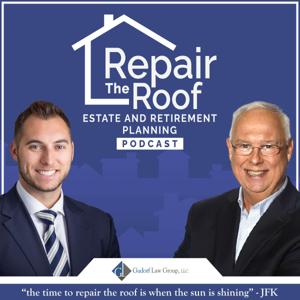
Repair The Roof is an estate and retirement planning podcast hosted by Ted and Danny Gudorf from Gudorf Law Group, LLC and Gudorf Financial Group, LLC in Dayton, Ohio. This insightful series zeroes…

227,392 Listeners

3,568 Listeners

801 Listeners

194 Listeners

927 Listeners

1,072 Listeners