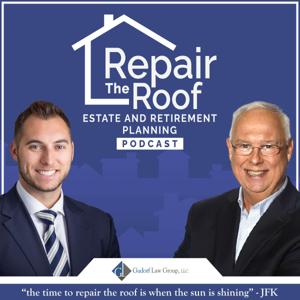
Repair The Roof - Estate & Retirement Planning Podcast

Repair The Roof - Estate & Retirement Planning Podcast

By Ted Gudorf, Danny Gudorf, Gudorf Law Group, Gudorf Financial GroupBusinessEducationInvesting
Download on the App Store

Repair The Roof - Estate & Retirement Planning Podcast episodes

  • Don't Waste Your 50's Because You Listen To The Wrong Retirement Advice! | The Limitless Retirement Podcast

    👉Get Your Free Retirement Assessment: https://visit.gudorffinancial.com/yt/advice-outdated

    Danny Gudorf, a financial planner, discusses the critical mistakes people make in their 50's regarding retirement planning. He highlights three common pieces of advice that can derail retirement: the max out myth, the risk reduction fallacy, and the deferred life trap. Gudorf emphasizes the importance of a 10-year impact strategy that balances current life satisfaction with future retirement security. He shares a real-life example of a couple who successfully navigated their 50's by implementing this strategy, ultimately transforming their approach to retirement planning.

    Key Takeaways

    • The decisions made in your 50s are crucial for retirement.
    • Maxing out retirement accounts can lead to financial inflexibility.
    • Transitional assets are essential for a smooth retirement transition.
    • Reducing investment risk too early can jeopardize retirement security.
    • Deferring life experiences until retirement can lead to missed opportunities.
    • Your 50s should be a decade of maximum impact, not just preparation.
    • A balanced approach to saving and spending is vital in your 50s.
    • Flexibility in financial planning allows for better life transitions.
    • Intentional transitions can lead to a more fulfilling retirement.
    • Avoid conventional wisdom that treats retirement as a cliff.

     Resources:

    • Gudorf Financial Group
    • Get Your Free Retirement Assessment
    • The Retire Ready Toolkit (free resource)
    • Subscribe on Youtube


    19 min
  • Why Your Roth Conversion Could Trigger an IRS Penalty? | The Limitless Retirement Podcast

     👉Get Your Free Retirement Assessment: https://gudorffinancial.com/get-started

    Danny Gudorf breaks down the complexities of Roth conversions, warning about the IRS pitfalls and penalties that can occur without proper planning. He highlights key advantages—tax-free growth and no required minimum distributions—and shares practical strategies like using the safe harbor rule and adjusting tax withholding to prevent underpayment penalties. Timing, he stresses, is essential for maximizing retirement tax efficiency. 

    Key Takeaways 

    • Roth conversions allow for tax-free growth in retirement.
    • The IRS penalizes underpayment even if taxes are paid on time.
    • Timing of tax payments is crucial when doing a Roth conversion.
    • Safe harbor rules can protect against underpayment penalties.
    • Withholding taxes from a conversion can reduce the amount in the Roth.
    • Filing IRS form 2210 can help show income timing to avoid penalties.
    • Quarterly estimated tax payments can be a strategy, but may create more work.
    • A 60-day rollover can help maintain full conversion amounts.
    • Understanding withdrawal strategies can save money in retirement.
    • Proper planning can maximize the benefits of Roth conversions.

     Resources:

    • Gudorf Financial Group
    • Get Your Free Retirement Assessment
    • The Retire Ready Toolkit (free resource)
    • Subscribe on Youtube


    16 min
  • Preparing for Medicare: Essential Tips from Laura Crouse | Repair The Roof Podcast

    👉Get started on your estate plan—watch our, on-demand workshop:  https://www.daytonestateplanninglaw.com/how-to-not-go-broke-in-a-nursing-home-even-if-you-think-its-too-late/

    In this conversation, Laura Crouse, a Medicare specialist, discusses the intricacies of Medicare, including eligibility, enrollment periods, and the differences between Original Medicare and Medicare Advantage plans. She emphasizes the importance of understanding the costs associated with each plan and the lack of long-term care coverage under Medicare. The discussion also touches on the future of Medicare plans and the potential changes in the healthcare landscape.

    Takeaways  

    • Medicare eligibility typically starts at age 65.
    • Part A covers hospital services, while Part B covers medical services.
    • Enrollment for Medicare has a seven-month window around your 65th birthday.
    • Original Medicare does not cover prescription drugs; that's Part D.
    • Medicare Advantage plans can offer additional benefits but may have network restrictions.
    • Costs for Medicare can vary significantly based on the plan chosen.
    • Medicare does not cover long-term custodial care.
    • Rehabilitation services may be covered under Medicare if skilled care is required.
    • Switching between Medicare plans is possible but may have restrictions.
    • The future of Medicare Advantage plans looks promising as they adapt to consumer needs.

     Resources:

    • Gudorf Law Group
    • The Ohio Estate Planning Guide - Free Book
    • Gudorf Law: What We Do and How We Help Webinar
    • Don't Go Broke in Nursing Home Workshop
    • When a Loved One Dies: A Legal Guide - Free Book
    • Subscribe on YouTube


    37 min
  • Why the 60/40 Portfolio Is Failing Retirees (And What Actually Works Now) | The Limitless Retirement Podcast

    👉Get Your Free Retirement Assessment: https://gudorffinancial.com/get-started

    Retirees often fall into the trap of using one-size-fits-all investment plans. Danny explains why understanding both risk capacity and risk tolerance is essential, and how the spending bucket approach helps protect against market downturns. His message is clear: a customized, well-structured investment strategy is key to generating reliable income for life.

    Key Takeaways

    • Retirees often start with generic investment strategies.
    • Retirement planning should not be a one-size-fits-all approach.
    • Understanding risk capacity is crucial for retirement planning.
    • A spending bucket can protect against market downturns.
    • Risk tolerance is about emotional responses to market changes.
    • Your 'freak out number' is key to understanding risk tolerance.
    • Combining risk capacity and tolerance creates a personalized strategy.
    • The best portfolio allows you to stay invested during downturns.
    • Investment strategies should be based on individual circumstances.
    • Structuring investments properly can ensure reliable retirement income.

     Resources:

    • Gudorf Financial Group
    • Get Your Free Retirement Assessment
    • The Retire Ready Toolkit (free resource)
    • Subscribe on Youtube
    15 min
  • Qualified Income Trust Spending Rules: What Medicaid Allows vs. What's Forbidden | Repair The Roof Podcast

    👉Get started on your estate plan—watch our, on-demand workshop:  https://www.daytonestateplanninglaw.com/how-to-not-go-broke-in-a-nursing-home-even-if-you-think-its-too-late/

    Attorney Ted Gudorf reveals how Qualified Income Trusts (QITs) can help families earning above Medicaid’s income limits still qualify for long-term care benefits. He breaks down the strict spending rules, smart strategies to enhance quality of care, and the importance of expert guidance to avoid costly mistakes.

    ======================= 

    Takeaways  

    • A Qualified Income Trust (QIT) helps qualify for Medicaid despite high income.
    • Funds in a QIT must be spent on health-related expenses only.
    • Medicaid has strict income limits for long-term care services.
    • Trust funds can cover health insurance premiums and dental expenses.
    • Prescription medications can be paid for using trust funds.
    • Alternative therapies and treatments qualify for trust fund spending.
    • Trust funds can be used for hiring additional home care assistants.
    • It's crucial to keep detailed records of all expenditures from trust funds.
    • Trust funds should be spent down regularly, not accumulated.
    • Professional guidance is essential for effective Medicaid planning.

     Resources:

    • Gudorf Law Group
    • The Ohio Estate Planning Guide - Free Book
    • Gudorf Law: What We Do and How We Help Webinar
    • Don't Go Broke in Nursing Home Workshop
    • When a Loved One Dies: A Legal Guide - Free Book
    • Subscribe on YouTube
    13 min
  • Can I Really Trust My Retirement Plan? (The Answer Will Surprise You) | The Limitless Retirement Podcast

    👉Get Your Free Retirement Assessment: https://gudorffinancial.com/get-started

    In this conversation, Danny Gudorf discusses the misconceptions surrounding retirement planning, emphasizing that trust in a retirement plan should not stem from its perfection or ability to predict the future. Instead, a trustworthy retirement plan is adaptable and resilient, allowing individuals to navigate uncertainties. He highlights the importance of dynamic withdrawal strategies, understanding different stages of retirement wealth, and the need for regular adjustments to plans based on changing circumstances. Ultimately, the conversation aims to empower retirees to focus on flexibility and adaptability in their financial planning.

    Key Takeaways

    • Trust in a retirement plan should focus on adaptability.
    • A good retirement plan is not about perfection.
    • Plans should prepare for uncertainty, not predict it.
    • Dynamic withdrawal strategies are more effective than static rules.
    • Regular adjustments to plans are essential for success.
    • Understanding different stages of retirement wealth is crucial.
    • Tax planning can significantly impact retirement savings.
    • Emotional decisions can derail retirement plans.
    • A framework for decision-making is vital in retirement.
    • Retirement planning should be an ongoing process, not a one-time event.

     Resources:

    • Gudorf Financial Group
    • Get Your Free Retirement Assessment
    • The Retire Ready Toolkit (free resource)
    • Subscribe on Youtube
    17 min
  • How to Legally Avoid Capital Gains Tax and Keep More Wealth in the Family

     👉Get started on your estate plan—watch our, on-demand workshop:  https://www.daytonestateplanninglaw.com/how-to-not-go-broke-in-a-nursing-home-even-if-you-think-its-too-late/

    Ted Gudorf, a certified estate planning attorney, highlights the crucial role of capital gains tax planning in protecting family wealth. He explains key concepts such as unrealized capital gains, the stepped-up basis rule, and advanced strategies like charitable remainder trusts and installment sales. Gudorf stresses that proper timing and a comprehensive estate plan are essential to reduce tax burdens and secure a lasting financial legacy. 

    ======================= 

    Takeaways   

    • Capital gains taxes can significantly impact family inheritances.
    • Proper planning can legally eliminate capital gains taxes.
    • The stepped-up basis rule allows heirs to inherit assets at current value.
    • Holding onto appreciated assets until death can save taxes.
    • Charitable remainder trusts can provide income while avoiding capital gains taxes.
    • Installment sales can spread capital gains tax over multiple years.
    • Opportunity zones can defer and reduce capital gains taxes.
    • Timing is critical for implementing tax strategies effectively.
    • Comprehensive estate planning is essential for preserving wealth.
    • Working with professionals is crucial to navigate complex tax laws.

     Resources:

    • Gudorf Law Group
    • The Ohio Estate Planning Guide - Free Book
    • Gudorf Law: What We Do and How We Help Webinar
    • Don't Go Broke in Nursing Home Workshop
    • When a Loved One Dies: A Legal Guide - Free Book
    • Subscribe on YouTube


    12 min
  • What Order Should I Pull Funds in Retirement? | The Limitless Retirement Podcast

    👉Get Your Free Retirement Assessment: https://gudorffinancial.com/get-started

    Many retirees unknowingly set themselves up for higher taxes by following outdated withdrawal advice. Danny Gudorf explains why focusing on tax brackets—not account order—is the smarter path. His three-bucket strategy, combined with careful management of RMDs and Social Security, offers a practical way to minimize taxes and maximize retirement income.

    Key Takeaways

    • The order of withdrawals in retirement affects lifetime taxes.
    • Filling tax brackets strategically can save significant money.
    • Roth IRAs should be preserved for as long as possible.
    • Required minimum distributions can push retirees into higher tax brackets.
    • Social Security benefits can be taxed based on other income.
    • Understanding tax brackets gives retirees control over their taxes.
    • Tax bracket arbitrage can optimize tax situations.
    • It's essential to manage overall income levels in retirement.
    • Working with a financial planner can enhance tax efficiency.
    • Long-term tax optimization is key to retirement planning.

     Resources:

    • Gudorf Financial Group
    • Get Your Free Retirement Assessment
    • The Retire Ready Toolkit (free resource)
    • Subscribe on Youtube
    17 min
  • Can You Really Get Professional Care at Home? Home Care Owner Answers! | Repair The Roof Podcast

     👉Get started on your estate plan—watch our, on-demand workshop:  https://www.daytonestateplanninglaw.com/how-to-not-go-broke-in-a-nursing-home-even-if-you-think-its-too-late/

    Mike Moyer, owner of First Light Home Care, shares his path from construction to caregiving, highlighting the services his team provides, the vital role of caregivers, industry challenges, and the payment options available to families. He underscores the rewarding nature of caregiving and First Light’s dedication to delivering compassionate, high-quality care for seniors and others in need.

    ======================= 

    Takeaways  

    • Mike transitioned from construction to home care in 2018.
    • First Light Home Care serves a diverse clientele, including seniors and college students.
    • Caregivers are trained in various areas, including dementia care and companionship.
    • Home care allows clients to stay in their own homes while receiving assistance.
    • The company has a centralized office and recruits local caregivers.
    • First Light has no minimum hours for service, making it flexible for clients.
    • They work closely with home health agencies for medical needs.
    • Hiring and retaining quality caregivers is a significant challenge in the industry.
    • The company has a good relationship with the VA for referrals.
    • Client care coordinators assess needs and match caregivers accordingly.

     Resources:

    • Gudorf Law Group
    • The Ohio Estate Planning Guide - Free Book
    • Gudorf Law: What We Do and How We Help Webinar
    • Don't Go Broke in Nursing Home Workshop
    • When a Loved One Dies: A Legal Guide - Free Book
    • Subscribe on YouTube
    24 min
  • The Hidden Cost of High Yield Savings in Retirement | The Limitless Retirement Podcast

    👉Get Your Free Retirement Assessment: https://gudorffinancial.com/get-started

    Danny Gudorf, a financial planner, warns against leaning too heavily on cash in retirement planning. He explains the crucial difference between nominal and real returns, showing how inflation quietly chips away at purchasing power. To safeguard long-term security, Gudorf recommends a balanced approach—keeping enough cash for short-term needs while investing in growth-oriented assets that can outpace inflation and preserve wealth over time.

    Key Takeaways

    • Keeping large amounts of cash can jeopardize your retirement.
    • Inflation can significantly reduce your real returns.
    • Nominal returns are misleading without considering inflation.
    • Cash does not increase buying power over the long term.
    • Investing in stocks and bonds is crucial for retirement growth.
    • A healthy cash balance is necessary for emergencies.
    • Cash should not replace bonds in a retirement portfolio.
    • Understanding risk is essential for investment success.
    • Chasing short-term yields can increase long-term risks.
    • Work with a financial planner for a balanced approach.

     Resources:

    • Gudorf Financial Group
    • Get Your Free Retirement Assessment
    • The Retire Ready Toolkit (free resource)
    • Subscribe on Youtube


    14 min

About Repair The Roof - Estate & Retirement Planning Podcast

From the publisher's feed

Repair The Roof is an estate and retirement planning podcast hosted by Ted and Danny Gudorf from Gudorf Law Group, LLC and Gudorf Financial Group, LLC in Dayton, Ohio. This insightful series zeroes…

More shows like Repair The Roof - Estate & Retirement Planning Podcast

The Joe Rogan Experience by Joe Rogan

The Joe Rogan Experience

227,479 Listeners

Afford Anything | Get Smarter With Money by Paula Pant, Personal Finance Expert

Afford Anything | Get Smarter With Money

3,564 Listeners

Your Money, Your Wealth by Your Money, Your Wealth

Your Money, Your Wealth

800 Listeners

The Boldin Your Money Podcast by Steve Chen

The Boldin Your Money Podcast

194 Listeners

The Long View by Morningstar, Christine Benz - Director of Personal Finance and Retirement Planning, Ben Johnson - Head of Client Solutions, Amy Arnott - Portfolio Strategist

The Long View

932 Listeners

Retirement Planning Education, with Andy Panko by Andy Panko

Retirement Planning Education, with Andy Panko

1,069 Listeners