
Sign up to save your podcasts
Or

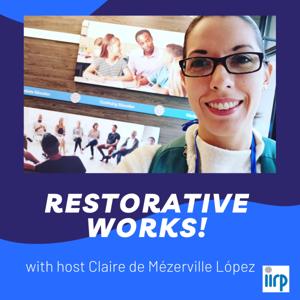


Claire de Mézerville López welcomes Dr. Ellen Skilton to the Restorative Works! Podcast. Dr. Skilton joins us as we explore how creative expression and restorative pedagogy open new pathways for repair, resilience, and transformation. She shares moving selections from her poetry manuscript Collateral Repair, weaving together themes of grief, love, and unexpected healing. She reflects on her personal journey of "unexpected repair," finding possibility for restoration in spaces shaped by loss. With honesty and depth, she invites listeners to consider how grief can be not only endured but transformed into an opening for connection and creativity. Dr. Skilton also discusses her work on restorative pedagogy. She emphasizes the importance of disrupting hierarchies in education, fostering "with" rather than "for" orientations, and cultivating classrooms where risk-taking and mistakes become essential parts of learning. Highlighting programs like Student Pedagogical Consultants, she demonstrates how shifting power dynamics in higher education empowers both faculty and students to thrive. Dr. Skilton is a professor at Arcadia University in the Department of Education and the faculty director of the Center for Teaching, Learning, and Mentoring. She is an educational anthropologist, applied linguist, teacher educator, and poet. She first encountered restorative practices embedded in Quaker decision-making processes as a student at Earlham College more than 35 years ago. Supported by her continued education with the IIRP, she now engages in restorative practices pedagogies in more thoroughly embedded ways and sees restorative processes and practices as a crucial element of addressing harm on campus. She and her students were past presenters at the IIRP's Restorative Practices in Higher Education Forum in December 2024, and she will be presenting her session at the IIRP World Conference, Artful Integration: The Art and Science of Restorative Practices, in October 2025 in Tennessee entitled "Poetry-writing, Online exhibit-building, and Image/Forum Theater-making as Restorative Pedagogical Tools for Addressing Individual and Structural Harm." Tune in to hear about poetry as a tool, teaching as a collaborative practice, and the courage it takes to lean into vulnerability.
Claire de Mézerville López welcomes back Dr. Nicholas Steffner to the Restorative Works! Podcast. Dr. Steffner shares compelling findings from his dissertation, Building Restorative School Communities: A Study on the Impact of Restorative Practices, including data from the five-year implementation of restorative practices at Ridgedale Middle School in Florham Park, New Jersey. His research documents measurable shifts in student behavior, relational trust, and the overall learning environment. The conversation highlights the importance of student voice, ongoing professional development, and embedding restorative approaches into daily routines. Dr. Steffner's vision extends beyond school walls, imagining communities where parents, coaches, and local organizations reinforce community values, creating a consistent culture of empathy and accountability. Principal of Ridgedale Middle School in Florham Park, New Jersey, Dr. Steffner has over 17 years of experience in education and nearly a decade in school leadership. He brings a deep commitment to relationship-centered practice, equitable access, and systems-level change. Dr. Steffner is the Founder and Chief Training Officer of Restorative Leadership Consulting LLC, where he specializes in restorative practices, behavioral interventions, behavioral threat assessment, master scheduling, mentoring, and mediation. With training through the International Institute for Restorative Practices (the IIRP), he facilitates professional development for educators and administrators across the country and has presented at state and national conferences on a range of topics. He earned his Doctorate in Educational Leadership from Saint Elizabeth University. Tune in for practical recommendations and a bold vision of restorative schools as restorative communities.
On this special episode of the Restorative Works! Podcast, host Claire de Mézerville López welcomes three leaders transforming school culture in Worcester County, Maryland: Dr. Jenifer Rayne, Principal of Pocomoke High School; Carlton Cartwright, Community School Liaison and Restorative Practices Coach; and Lauren Williams, Coordinator of School Health and Mental Health. Together, they share a decade-long journey of embedding restorative practices into daily school life—creating spaces where trust, connection, and accountability thrive.
From early district-wide training sessions to the creation of "Restorative Practice Champions," Worcester County Public Schools has built a living, evolving framework for fostering belonging. The team explains how conscious discipline, culturally responsive teaching, and adult-first self-regulation are equipping both educators and students with the skills to repair harm, navigate conflict, and sustain healthy relationships.
Jenifer Rayne is entering her eighth year as Principal of Pocomoke High School in Worcester County, Maryland. A dedicated and visionary educator, Dr. Rayne has led this small, diverse high school to national recognition, earning distinctions such as National School of Character, Gold School of Opportunity, and Apple Distinguished School under her leadership. Dr. Rayne holds a bachelor's degree in Elementary Education from Stevenson University, a K–12 Special Education certification from the College of Notre Dame of Maryland, a master's degree in School Administration from Wilmington University, and a Doctor of Education in Supervisory Leadership from the University of Maryland Eastern Shore.
Carlton Cartwright is a restorative leader and educator with over 26 years of experience supporting student success, access, and belonging on Maryland's Eastern Shore. In his current role he leads initiatives that embed restorative practices frameworks into daily practice and strengthen school-community partnerships. Having received training from the IIRP, Carlton facilitates professional learning and student support systems across Worcester County Public Schools. He believes transformation happens when we lead with rather than to others—building trust, connection, and shared responsibility. His leadership extends beyond the classroom through service in his church, mentoring, and community engagement.
Lauren Williams is a seasoned educational leader and licensed clinical social worker with over 15 years of experience advancing student mental health, family engagement, and restorative practices. As the Coordinator of School Health and Mental Health for Worcester County Public Schools, she leads district-wide initiatives that prioritize student well-being, inclusive leadership, and trauma-informed care. Her leadership philosophy is rooted in principle-centered values, collaboration, and the belief that lasting change happens with people, not to them. Currently pursuing her doctorate in Educational Leadership at the University of Maryland Eastern Shore, Lauren is a driving force behind restorative implementation, behavior reform, adult-first self-regulation practices, and community school transformation in Worcester County.
Tune in to hear practical strategies—like revising the district's code of conduct to reflect community-building values, integrating goals aligned with restorative practices into school improvement plans, and partnering with law enforcement for shared training.
In this special episode Claire de Mézerville López welcomes recent IIRP alumni, Matthew Leaf and Victoria Torres, to the Restorative Works! Podcast.
Matthew and Victoria are experienced professionals in education. They join us to share practical strategies and personal stories that highlight how restorative practices transform school culture. From greeting students at the door by name to creating intentional spaces for connection, Matt and Victoria reveal that fostering a sense of belonging isn't about one single action—it's "a restorative way of being." They discuss how mutual respect, authenticity, and empathy help both students and educators thrive, and why separating "the deed from the doer" is essential in addressing mistakes without shame.
The episode also explores how educators can become "the greatest cheerleaders" for their students, invite families into the process, and model lifelong learning. Both guests share advice for graduate students and education leaders: listen to understand, remain curious, and never underestimate your power to make a lasting impact.
Matthew is the assistant principal of Crew and Culture at Four Rivers Charter Public School in Greenfield, Massachusetts, where he is also a founding faculty member. He received his Master of Science in Restorative Practices with a specialization in Education from the IIRP this July. Matthew and his wife are recently empty nesters who enjoy time with their dog and spending time outdoors.
Victoria is a dedicated school counselor practicing in Pennsylvania and also maintains a private therapy practice. She holds a Bachelor of Arts in Psychology from Cedar Crest College and a Master of Education in School Counseling from Lehigh University. She recently completed her coursework for a Master of Science in Restorative Practices with a specialization in Education, along with a graduate certification in facilitation for healing trauma from the IIRP. She and her husband recently celebrated their 12-year wedding anniversary and have two children; they enjoy spending time outdoors and exploring the world around them.
Tune in to hear how proactive and responsive circles deepen relationships, how consistent processes build trust, and why curiosity can be the key to understanding behavior rather than reacting to it.
Claire de Mézerville López welcomes seasoned restorative justice practitioner and educator, Erin Dunlevy, to the Restorative Works! Podcast. In this series of episodes, we explore the use of restorative practices in higher education through various aspects of the college and university sphere.
We are joined by Erin as she delves into the power of culturally responsive pedagogy and restorative justice practices. Erin shares insightful stories from her work in secondary and higher education, illustrating how restorative circles and relationship-centered approaches foster inclusive, equitable learning environments. She discusses how these practices can address critical issues like student engagement, literacy, and the school-to-prison pipeline. Erin also discusses innovative methods for evaluating restorative practices, emphasizing group dynamics and community-building over punitive measures.
Erin is a New York City-based restorative justice practitioner and educator with nearly two decades of professional experience in schools and universities throughout the US, and she currently works on projects around the world training stakeholders from schools, districts, community organizations and for-profit companies who influence education. Her areas of focus include developing restorative justice models for peacemaking across lines of difference, truth and reconciliation, and critical consciousness. Her work has also focused on developing and implementing restorative justice models for addressing equity issues within secondary and higher education classrooms, specifically as an advocate for Culturally Responsive Pedagogy, Native Language Arts Education, and in-class restorative circles. Erin has written and presented extensively about evaluative measures for restorative practices in institutions cited for disproportionality and high incidences of violence. In addition to fieldwork, Erin is an adjunct professor at Columbia University, a visiting professor of restorative justice at the United Nations University for Peace, and serves as Vice President at the True North Center for Organizational Health. Erin is also the co-author of "Wisdom of the Circle: A Restorative Practitioner's Deck".
Tune in to hear more inspiring and relatable stories from the classroom with Erin and gain practical insights that you can apply in your classroom today.
Claire de Mézerville López welcomes Dr. Jasmine A. Lee and Dr. Ciara R. Christian to the Restorative Works! Podcast. Claire is joined again by co-host and IIRP Lecturer Kiyaana Cox Jones. In this series of episodes, we explore the use of restorative practices in higher education through various aspects of the college and university sphere. Dr. Christian and Dr. Lee share insights from their roles as co-directors of the Center for Social Justice Dialogue at the University of Maryland, Baltimore County, in the Division of Institutional Equity, highlighting the intersection of restorative practices and social justice education. They delve into the critical considerations for dignified intercultural and intergroup experiences, emphasizing the importance of identity, systemic awareness, and creating spaces for authentic dialogue across differences. As Dr. Lee eloquently states, "The goal is to widen the crack where we refuse to see each other as fundamentally opposed, fostering spaces for transformation and collective growth." Dr. Lee is a diversity, equity, inclusion, and justice scholar, practitioner, trainer, and coach. She has spent over 15 years in higher education, working with students, staff, and faculty to create inclusive campus environments through direct programming and strategic campus-wide leadership, and currently serves as the Associate Vice President for Community and Culture at UMBC. Beyond higher ed, Dr. Lee works with K-12 institutions, non-profit organizations, and faith-based communities to provide training, consulting, coaching, and organizational change services, partnering with clients to curate unique, engaging solutions that lead to sustainable, measurable change. Dr. Lee is a qualified administrator of the Intercultural Development Inventory® (IDI), a certified diversity trainer with the National Coalition Building Institute, a Restorative Practices trainer, and a certified Mental Health First Aid instructor, and uses these skills to ensure human dignity, love, truth, honesty, and empathy are a part of all approaches to organizational change. Dr. Christian has been professionally engaged in diversity, equity, inclusion, and social justice work for over a decade. Dr. Christian discovered her passion for this work as a result of her experiences in the Peace Corps, where she both noticed and experienced gaps in cultural competency within the organization. This experience served as a catalyst for her return to higher education, allowing her to more deeply explore identity development, social inequality, and social change. Ultimately, this led her to intergroup dialogue as a vehicle for helping others to engage deeply about and across differences. Her practice is rooted in an ethic of radical, revolutionary love and a commitment to helping others see and center our shared humanity. Tune in to explore how restorative practices embody revolutionary love, inviting us to wonder deeply about each other's humanity and to navigate conflict and grief with empathy and accountability.
Claire de Mézerville López welcomes Robin Riley-Casey to the Restorative Works! Podcast. Claire is joined again by co-host and IIRP Lecturer Kiyaana Cox Jones. In this series of episodes, we explore the use of restorative practices in higher education through various aspects of the college and university sphere. Join us as Robin shares insights on the power of face-to-face connection and its role in community building. She discusses how restorative practices reshape adult culture on college campuses, emphasizing the importance of seeing each person beyond their titles or roles. Discover Robin's journey through restorative practices, from creating transformative listening circles to fostering genuine connections among students and colleagues. Her wisdom on slowing down, embracing wonder, and accepting personal growth resonates deeply as she navigates the complexities of leadership and community engagement. Robin is the Associate Dean of Students and Director of College Life Community and Belonging at Muhlenberg College in Allentown, PA. Her work is the hub of cultural exchange, supporting 18 affinity groups, including community advocacy groups and ethnic/racial, gender/sexuality, and alternative arts communities. In her role, Robin utilizes dialogue, collaboration, and action to promote and facilitate cross-cultural learning communities. Robin serves on several Muhlenberg College committees: the President's Diversity Advisory Council, Health and Wellness, and the Athletic Diversity Council. Robin currently serves on two local boards, New Bethany Ministries and Allentown West End Alliance. Tune in to hear more about Robin's personal evolution and the soulful journey of restorative practices, as she inspires us all to listen deeply and build meaningful connections.
Claire de Mézerville López welcomes IIRP alumnus Joseph Iacona to the Restorative Works! Podcast.
We are joined by Joseph as he takes us behind the scenes of projects in schools, libraries, prisons, shelters, and behavioral health facilities, revealing how restorative practices create authentic collaboration between artists and communities. He shares powerful stories, including a mural co-created with youth aging out of the foster care system—a project that evolved into a living, breathing space of connection and care years after the paint dried.
As a featured speaker at the IIRP's upcoming World Conference on Artful Integration, Joseph offers a preview of his presentation on the parallels between successful public art projects and restorative leadership. He issues a call to action for more intentional partnerships between artists and restorative practitioners to use art as a tool for authentic collaboration and social change.
Joseph is a visual artist and restorative practitioner. He has initiated more than 100 community art projects in schools, libraries, museums, prisons, shelters, behavioral health facilities, and other public service centers. As the director of the Mural Arts Institute for Mural Arts Philadelphia, the United States' largest public art nonprofit, he develops resources on community driven mural-making for other artists and public art advocates around the world. Joseph holds a Master of Science in Restorative Practices with a specialization in Community Engagement from the IIRP and a Bachelor of Fine Art with concentrations in painting and art history from Kutztown University of Pennsylvania. He's an upcoming featured speaker at the IIRP's next World Conference on Artful Integration, Exploring the Art and Science of Restorative Practices.
Tune in to hear more from Joseph as he explores how defining "community" is an essential first step, and how tools like narrative mapping can uncover shared values and vision.
Claire de Mézerville López is joined by co-host, Professor Emanuela Biffi, for the "Powerful Intersection Between Restorative Justice and Art" podcast series, a special initiative by the IIRP together with the European Forum for Restorative Justice (EFRJ). Art has the unique ability to connect and facilitate dialogue, making it a powerful tool in restorative justice practices. Throughout the series, we examine how artists from different disciplines and cultural backgrounds use their creative expression to foster communication, build empathy, and potentially repair harm. Each episode highlights a different aspect of this intersection, featuring conversations with artists who have contributed to restorative justice We are joined by Dr. Clair Aldington as she discusses her research on integrating visual and movement-based languages into the restorative justice process. She co-founded Space to Face, an award-winning charity in Scotland, emphasizing how creative expression can facilitate healing dialogues and trauma articulation. Discover how Dr. Aldington's work extends beyond verbal communication, using art as a catalyst for emotional connections and solidarity between individuals involved in conflict. She reflects on pivotal moments where art objects symbolized reconciliation and inspired lasting change in both victims and offenders. Her research challenges traditional Western practices by advocating for more inclusive, visually oriented approaches to restorative justice. Dr. Aldington has authored several academic articles and book chapters regarding her practice and research. She is the co-founder of the award-winning Space2face restorative practices and arts charity in Shetland, Scotland, and a co-facilitator of an international restorative circle group, the Encounter of the Encounters, in cases of political violence. Her work has pioneered the use of art and design approaches within restorative practices. Specifically, how creative approaches can aid dialogue and the articulation of trauma, particularly in cases of serious crime, thereby improving the accessibility of restorative processes. Dr. Aldington holds a doctorate in Design and Restorative Justice and a master's in Contemporary Art and Music. She is a freelance researcher and practitioner with over twenty years of experience in the field of restorative practices. Dr. Aldington is a keynote speaker at the upcoming 2025 IIRP World Conference, Artful Integration: Exploring the Art and Science of Restorative Practices. Emanuela is the program coordinator at the EFRJ, an international network organization that brings together about 300 members dedicated to research, policy, and practice of restorative justice in the criminal justice system and beyond. She joined the EFRJ team in September 2013, working as a project officer in different EU-funded projects on access to restorative justice, justice and security in intercultural settings, restorative justice training, child victims, and arts. Among other responsibilities at the EFRJ, she organizes its main international events (conferences, seminars, webinars, and art festival), coordinates proposals for EU-funded and other projects, and guides the overall management of working groups and committees within the EFRJ membership. Originally from Italy, Emanuela studied Liberal Arts at the University College Maastricht (The Netherlands) and University of Gaborone (Botswana) with a focus on social psychology and criminal law and the Master program in Criminology at KU Leuven (Belgium). Tune in to explore the challenges and rewards of training artists and facilitators in restorative practices. By highlighting the potential of creative mediums to bridge cultural and linguistic divides, we uncover universal avenues for healing and understanding.
Claire de Mézerville López is joined by co-host, Professor Brunilda Pali, for the "Powerful Intersection Between Restorative Justice and Art" podcast series, a special initiative by the IIRP together with the European Forum for Restorative Justice (EFRJ). Art has the unique ability to connect and facilitate dialogue, making it a powerful tool in restorative justice practices. Throughout the series, we examine how artists from different disciplines and cultural backgrounds use their creative expression to foster communication, build empathy, and potentially repair harm. Each episode highlights a different aspect of this intersection, featuring conversations with artists who have contributed to restorative justice processes through various art forms — be it visual arts, music, theatre, film, or dance. We are joined by Kenneth Berth, a celebrated Belgian storyteller and radio maker, as he shares his journey from personal tragedy to artistic exploration and delves into the profound impact of storytelling on healing and justice. Kenneth's work, known for its depth and empathy, reflects on his own experience with a life-altering accident and his quest for understanding through restorative justice. Through theater and documentary, Kenneth bridges the gap between personal trauma and collective empathy. His projects, including the acclaimed podcast Born This Way, reveal the power of narratives to connect, heal, and provoke dialogue on complex societal issues. Brunilda serves as Assistant Professor of Conflict Dynamics and Governance at the Department of Political Science at the University of Amsterdam and Chair of the EFRJ. She researches, teaches, and publishes on gender and feminism, restorative, environmental, and social justice, cultural and critical criminology, and arts and justice. Kenneth is a Belgian radio, documentary, and theater maker. As a Belgian public broadcaster, he created the podcast Born This Way (Zo Geboren), in which he explores the history of homosexuality in Belgium. He has also produced podcasts for BBC Radio 3 on topics such as being stuck in traffic, and for the Dutch public broadcaster on the act of looking out the window. He is a host at the Belgian radio station Studio Brussel. Kenneth was awarded the prestigious title of Master Storyteller by the Dutch Narrative Journalism Foundation, Stichting Verhalende Journalistiek. His work has been nominated for three Prix Europa awards and the Prix Italia. Tune in to learn more about how art, empathy, and restorative justice intersect!
From the publisher's feed

91,003 Listeners

43,378 Listeners

56,445 Listeners
16,377 Listeners
57,581 Listeners
13,629 Listeners

12,480 Listeners