
Sign up to save your podcasts
Or

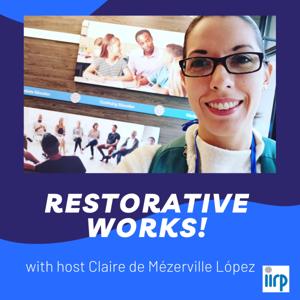


Claire de Mézerville López is joined by co-host, IIRP Associate Professor, Dr. Fernanda Fonseca Rosenblatt, for the "Powerful Intersection Between Restorative Justice and Art" podcast series, a special initiative by the IIRP together with the European Forum for Restorative Justice (EFRJ). Art has the unique ability to connect and facilitate dialogue, making it a powerful tool in restorative justice practices. Throughout the series, we will examine how artists from different disciplines and cultural backgrounds use their creative expression to foster communication, build empathy, and potentially repair harm. Each episode will highlight a different aspect of this intersection, featuring conversations with artists who have contributed to restorative justice processes through various art forms — be it visual arts, music, theatre, film, and dance. Geoff Power joins us to share his compelling journey integrating restorative justice into his creative works. From producing documentaries highlighting societal issues to crafting impactful plays like Stronger, Geoff's artistry explores complex themes of community, relationships, and personal transformation. Geoff reflects on his experience teaching creative writing at Midlands Prison, offering a unique perspective on how art can empower individuals within the justice system. His plays poignantly portray the human side of restorative justice, inspired by real-life stories of resilience and healing. Geoff is a playwright, documentary producer, print journalist, and sports reporter, with creativity having always been at the heart of his work. Based in Dublin, Geoff also works in Portlaoise prison, one of Ireland's maximum-security prisons, as a creative writing teacher. This work has helped to steer Geoff's documentary work with Midas Productions, as well as to inspire the writing of Stronger for Gúna Nua's production in the Dublin Theatre Festival and featured in the EFRJ's 2020 REstART Festival. Across a range of creative mediums including film, tv, theatre and literature, Geoff's skills as a creator and producer reveal consistent themes of social justice and inequality often expressed through the voices of the marginalized in society. Tune in as we uncover the profound impact of storytelling in advocating for restorative practices globally.
Claire de Mézerville López is joined by co-host Bálint Juhász, for the "Powerful Intersection Between Restorative Justice and Art" podcast series, a special initiative by the IIRP together with the European Forum for Restorative Justice (EFRJ).
Art has the unique ability to connect and facilitate dialogue, making it a powerful tool in restorative justice practices. Throughout the series, we will examine how artists from different disciplines and cultural backgrounds use their creative expression to foster communication, build empathy, and potentially repair harm. Each episode will highlight a different aspect of this intersection, featuring conversations with artists who have contributed to restorative justice processes through various art forms — be it visual arts, music, theatre, film, and dance. Olga Ziori joins us to discuss the crucial role of restorative justice in child protection. Olga, a seasoned lawyer and restorative justice mediator, shares her profound journey from working with unaccompanied minors in refugee settings to advocating for compassionate, community-based solutions. Through poignant storytelling and innovative approaches, Olga reveals how she integrates restorative practices into challenging environments, fostering empathy and cultural understanding among vulnerable populations. From using narrative therapy to empowering minors as peer mediators, Olga's work highlights the resilience and healing potential within restorative justice. Olga Ziori is a Child Protection Expert and a Lawyer of Kavala Bar Association in Greece. Olga holds an LLM in Human Rights and a master's in social policy. Since 2011, she has been working with unaccompanied minors and children in conflict with the law, in various refugee camps in Greece. As a restorative justice facilitator, she has applied restorative practices and community mediation as part of her work in the refugee camps. She is an Accredited Mediator (Greek Ministry of Justice) specializing in Child Inclusive Family Mediation and School Mediation. She uses folk tales as a restorative justice tool in her work with vulnerable communities. After attending her first folk tale storytelling festival, she fell in love with the art of storytelling. Her love of folk tales led to a diploma in "Folk Tale in Education: Creative Reading, Critical Literacy and Use" and the beginning of a lifelong journey in the world of storytelling. Bálint, a Hungary native, has been working extensively with education and training programs, cultural project management and theatre internationally. Previously, he was the educational program manager of the performing arts company, Krétakör. He led Krétakör Free School, a democracy awareness program for students. He has experience working with marginalized groups of society. In Brussels, he led community theatre workshops for vulnerable families. He holds a degree in Literature and Linguistics from ELTE University Budapest and completed a master's in education with a focus on drama at Trinity College Dublin. He joined the EFRJ in 2019 to contribute to the organization's training development and communication. Tune in to uncover the impact of storytelling in conflict resolution, its therapeutic value, and practical applications in educational settings and beyond.
Building Sociedades Más Justas: Youth Justice in Colombia
Claire de Mézerville López and cohost IIRP Lecturer A. Miguel Tello welcome Lina Hernández Nassif to the Restorative Works! Podcast. Lina brings a wealth of experience from her work implementing restorative justice programs, particularly with youth in Colombia. Her journey spans from coordinating conflict resolution programs in prisons to facilitating initiatives for vulnerable teenagers across diverse socio-cultural contexts. In this compelling conversation, Lina shares pivotal outcomes from her programs, emphasizing the crucial role of victims in the restorative justice process. By placing survivors at the heart of justice initiatives, Lina and her team create safe spaces where individuals can process trauma, find closure, and embark on paths to reconciliation. She highlights success stories of teenagers who, after engaging in restorative justice, have overcome adversity to pursue education, employment, and stable lives. Lina dispels myths about restorative justice, stressing its practical application beyond theory. She advocates for professionals to engage directly with communities, fostering understanding and support for youth facing complex challenges. Her insights challenge conventional punitive measures, advocating instead for collaborative efforts among institutions to maximize impact and promote societal healing. Lina has a wide range of experience implementing restorative justice processes. She coordinated programs focused on conflict resolution inside and outside prisons with adults. In recent years, her work has focused on caring for youth within the criminal responsibility system, specifically for teenagers from different socio-cultural contexts such as migrants, natives, LGBTIQ+ community, and more. In 2022, Lina had the opportunity to work for the World Food Program through the Corporation for Community Social Development in the registration of more than 60,000 Venezuelans in vulnerable conditions so they could have access to government benefits in the Antioquia territory. Recently, she has been in charge of the coordination of the judicial monetary program for drug treatment, which was developed in an agreement between the government of Antioquia and the prison fellowship of Colombia to develop restorative justice processes for teens who have committed crimes due to drug use and addiction. Tune in to learn more about Lina's work and the expansiveness of the impact restorative justice can have on youth and their communities.
Claire de Mézerville López welcomes Natalie Walters to the Restorative Works! Podcast. Natalie joins us to share her inspiring journey and innovative approaches to restorative practices integration in school settings. This includes the creation of Practice Academy—an initiative revolutionizing in-school suspensions by keeping students within the educational community, guiding them through reflection, learning, and reintegration. She discusses the pivotal role of emotional intelligence and proactive relationship-building through initiatives like Building Rocks, a program fostering classroom connections from day one. Through heartfelt anecdotes and practical insights, Natalie illuminates the impact of restorative practices on students, educators, and families alike. Discover how she navigates complex relationships with families, ensuring every interaction is rooted in understanding and support. Natalie has served as a Restorative Practices Specialist at Roxborough Road Elementary within the North Syracuse Central School District where she focused on supporting students' social emotional development, teacher well-being, and guiding the integration of restorative practices for the district. In this role, she collaborated with educators and staff to implement restorative practices towards greater community building, reflective conflict resolution, and heightened family engagement. A notable aspect of her approach included the involvement of her beloved dog, Sydney, who visited the school to assist in creating a welcoming and supportive environment for students and introduced the district to therapy dog partnership. Natalie also created and collaborated with staff on an actionable approach to the inclusion of restorative circles within the school day entitled Building Rocks. This workbook focuses on the concepts of relationship building in a classroom, focusing on the first 10 days of circle processes for teachers to engage. Building Rocks is a guiding companion for teachers to utilize throughout the school year with supportive lessons and community engagement activities. Through her work, Natalie has built strong meaningful relationships among students, staff, parents, and community leaders, striving to align the district's mission to create a supportive educational environment. Tune in to delve into Natalie's vision for supportive education and her ongoing mission to cultivate compassionate communities within educational settings.
Claire de Mézerville López welcomes IIRP alumnus, Gregg Scheiner, to the Restorative Works! Podcast. Gregg joins us and shares how his inclusive approach to mediation and conflict resolution empowers students and community members alike. He shares impactful stories, such as his work with a Nassau County high school where students and staff engaged in peer mediation sessions, leading to lasting resolutions and strengthened community bonds. He introduces us to the innovative Truancy Continuum of Care project, which utilizes restorative principles to reintegrate students into classrooms with supportive, non-punitive strategies. His initiatives have significantly reduced truancy rates and fostered a sense of belonging among students. Gregg is the director of restorative practices at the Long Island Dispute Resolution Center of the EAC Network (LIDRC). Gregg has been an integral part of this Resolution Center team for over a decade. He previously served as trainer and outreach coordinator, making significant contributions to advancing restorative practices across Long Island. As a circles and restrictive practices trainer, he has developed impactful programs in conflict resolution, peer mediation, and diversity training. His work has strengthened partnerships with schools, nonprofits, and government agencies, expanding LIDRC's reach and impact. Gregg holds a Master of Science in Restorative Practices from the IIRP, Master of Business Administration in Marketing from Adelphi University, as well as a leadership certificate, and a Bachelor of Arts from Hofstra University in Cultural Anthropology with a minor in Sociology. Tune in to hear more as Gregg discusses the future of restorative practices beyond educational settings, envisioning a society where these principles guide all interactions, fostering social-emotional intelligence and balanced relationships.
Claire de Mézerville López welcomes Margaret Clark to the Restorative Works! Podcast. Margaret shares her inspiring journey of integrating Indigenous wisdom into restorative practices, highlighting how these approaches foster healing, accountability, and community connection. Drawing on her Canadian roots and extensive experience, she explains why centering Indigenous voices and values strengthens restorative justice efforts across diverse settings. Margaret emphasizes that restorative practices are not just conflict resolution tools—they're pathways to building trust, repairing harm, and nurturing resilient relationships. Her insights illuminate the powerful role of storytelling, circle processes, and cultural humility in creating spaces where everyone feels heard and respected. Margaret is the manager of the Canadian Mental Health Association Vernon & District Restorative Justice Services. Her interest in restorative justice came about through her background of working in correctional centers as a life skills coach and treatment programs as a program coordinator/counselor. As a proud member of the Syilx Nation, Margaret is committed to sharing Indigenous knowledge in the North Okanagan. She is a respected voice on local committees and was recently honored with the King Charles III Coronation Medal for her leadership and service. With strong ties to the North Okanagan, Margaret carries a vision of learning and teaching about restorative justice principles and practices. Tune in to discover practical strategies and inspiring stories that demonstrate the difference restorative practices can make in healing individuals and communities.
Claire de Mézerville López welcomes Natasha Akery to the Restorative Works! Podcast. Natasha joins us and introduces her original framework, the "Restorative Compass," a forward-looking alternative to the Compass of Shame. Designed to help students and educators navigate difficult emotions and conversations, the Restorative Compass guides users from reactivity toward engagement, self-compassion, and acknowledgment of others. In the classroom, she repurposes restorative questions to examine literary conflict, inviting students to explore who is impacted, how relationships shift, and how characters might repair harm. The result? Deeper learning, more critical thought, and powerful public speaking skills. From circle time with 9th graders to one-on-one conversations with overwhelmed educators, Natasha models what it means to be restorative in every interaction. She shares practical insights, real classroom stories, and how building a culture of safety and curiosity helps students thrive. Natasha is a high school English language arts teacher and professional developer who brings a restorative lens to literary analysis, classroom culture, and continuing education for teachers. Passionate about ancient literature, mythology, and folklore, she explores how stories can help build empathy and community. Natasha is also conducting graduate research on the impact of restorative literary analysis in secondary education, and her "Restorative Compass" framework has been a resource for faculty members of the IIRP and teachers across the country. She believes that when students feel seen and heard, powerful learning can happen. Tune in to hear more from Natasha and her passion for mythology, folklore, and ancient texts. She uses restorative practices to help students connect emotionally and intellectually with stories, fostering empathy, deep analysis, and meaningful relationships.
Claire de Mézerville López welcomes Juan Martinez to the Restorative Works! Podcast. Juan joins us and shares his experience as a dedicated yoga instructor innovating with inclusive yoga practices in unconventional spaces. We explore how yoga and meditation foster compassion and wellbeing within challenging environments, including prisons and centers for vulnerable populations. Juan shares his journey from the corporate world to becoming an accredited teacher, spreading the healing benefits of yoga through programs like Yoga Inclusivo Costa Rica and collaborations across Central America. Through poignant anecdotes and reflections, Juan illustrates how yoga is more than physical exercise—it's a tool for empowerment, agency, and self-discovery. Learn how Juan navigates logistical challenges to bring yoga to prisons, creating safe spaces for inmates to find peace and inner strength. Juan is a seasoned advertising and design professional, with over a decade of experience in advertising agencies across Costa Rica. In 2001, he was introduced to the practice of yoga. Today, Juan is an accredited Yoga teacher with the Costa Rica Ashtanga Association, the European Yoga Institute, Yoga 10, AccessibleYoga.org, the Prison Yoga Project, and the Trauma Center. Juan has extensive experience as an instructor with a specialization in working with disabled and prison populations. His approach goes beyond postural practice and seeks to show a sanctuary, a laboratory, an opportunity, a place for contemplation and expression of compassion, and respect for ourselves as well as for life itself through yoga. Tune in to hear firsthand accounts of transformation and resilience as individuals find solace and hope through yoga, reshaping their lives amidst adversity.
Claire de Mézerville López welcomes Katherine Stanley Obando to the Restorative Works! Podcast. Katherine shares how restorative practices show up organically in her work as a journalist, particularly in rural areas where trust, voice, and relationships are essential. Through El Colectivo 506, a Costa Rican journalism collective rooted in community, collaboration, and care, Katherine and her team practice a relational approach to storytelling by listening first, amplifying community voices, and prioritizing local leadership. Their journalism isn't extractive—it's connective. Katherine is a journalist specializing in in-depth reporting on immigration, education, women's rights, and civil society initiatives. She is the co-founder of El Colectivo 506, an award-winning, bilingual media organization that's using solutions journalism to build a "library of what works" in Costa Rica and beyond. She's also the co-founder of the Latin American Solutions Journalism Fund, which is training and funding in-depth journalism throughout the region. Katherine lives in San José with her husband Adrián and daughter Emma, for whom she wrote Love in Translation: Letters to My Costa Rican Daughter, published in 2016. Tune in to hear as Katherine describes how this innovative model, including listening circles and relation-based editorial practices, helps strengthen civic engagement and social cohesion across Costa Rica.
Claire de Mézerville López welcomes Bianca Johnson to the Restorative Works! Podcast. Bianca joins us and shares her introduction to restorative justice through a pilot diversion program that instantly resonated with her values. Her story highlights how relationships built in the community can open the door for meaningful engagement and real change within institutions. Bianca shares a moving story of a stolen car, a juvenile offender, and a powerful moment of healing and accountability that shows what's possible when we center dialogue and compassion over punishment. This episode also explores the importance of proactive restorative work—building relationships before conflict arises. Bianca shares how students and staff in her schools now seek out restorative conferences and circles, showing the impact of cultivating a relational culture. Bianca is the family engagement and restorative justice coordinator at Charlottesville City Schools. She also works as a restorative justice facilitator with Central Virginia Community Justice, which provides a restorative justice diversion program. Through her work at City Schools and in the greater community, she helps create healing spaces for individuals and families impacted by harm. Bianca also completed professional development with the IIRP, informing her own training and facilitation to support both the school and greater community in relationship building and conflict resolution. Passionate about her work, Bianca is committed to strengthening relationships and promoting healing. Tune in to hear more of Bianca's insight into what true community engagement looks like and the signs that show it's working: trust, empowerment, and people stepping into hard conversations with openness.
From the publisher's feed

91,003 Listeners

43,378 Listeners

56,445 Listeners

16,377 Listeners
57,581 Listeners
13,629 Listeners

12,480 Listeners