
Sign up to save your podcasts
Or

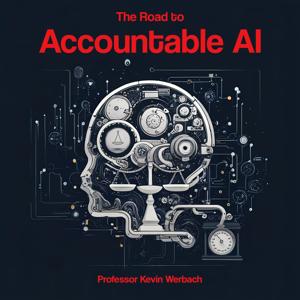

Kevin Werbach speaks with long-time responsible AI leader Rumman Chowdhury the current environment, in which substantive standards and oversight efforts for AI are taking shape amid a larger anti-regulation wave. Chowdhury distinguishes sharply between frontier labs, where the posture is largely "AI at all costs," and the non-tech enterprises she works with, who are wrestling with how to scale governance bodies that originally reviewed single AI implementations to hundreds of systems, third-party procurement questions, and agentic workloads. She describes the current evaluations market as immature on nearly every dimension, and explains why generic benchmarks rarely translate to enterprise contexts like insurance or auto manufacturing.
The conversation then turns to AI's impact on work and education. Her concern is that companies pursuing short-term efficiency by cutting entry-level hiring will face what MIT researchers Caosun and Aral call the "augmentation trap," in which workers' cognitive skills atrophy while new workers never develop them. She offers "discernment" as her 2026 word of the year, discribing the skill -- more than just critical thinking -- we must cultivate and defend. Her new podcast and forthcoming book, Thinking About Thinking, argues that our notion of intelligence was built for an Industrial Revolution workforce we are now automating away.
Dr. Rumman Chowdhury is the founder of Humane Intelligence PBC, building modular, tool-agnostic AI evaluation infrastructure for enterprise and real-world contexts. She co-founded the nonprofit Humane Intelligence in 2022 and served as its CEO until 2025. She previously was Director of the Machine Learning Ethics, Transparency, and Accountability team at Twitter, founder of the algorithmic audit platform Parity, and Global Lead of Responsible AI at Accenture, where she built one of the first enterprise-level bias detection tools. She has served as U.S. Science Envoy for AI and as a Responsible AI Fellow at Harvard's Berkman Klein Center, and holds a doctorate in political science from the University of California, San Diego.
Transcript
Virginia SB 384 / HB 797 — Independent Verification Organization legislation (Fathom)
The Augmentation Trap: AI Productivity and the Cost of Cognitive Offloading
Open to Debate: Will AI Make Work Obsolete?
Why AI evals need to reflect the real world (Transformer)
 View all episodes
 By Kevin Werbach
5
2424 ratings
Kevin Werbach speaks with long-time responsible AI leader Rumman Chowdhury the current environment, in which substantive standards and oversight efforts for AI are taking shape amid a larger anti-regulation wave. Chowdhury distinguishes sharply between frontier labs, where the posture is largely "AI at all costs," and the non-tech enterprises she works with, who are wrestling with how to scale governance bodies that originally reviewed single AI implementations to hundreds of systems, third-party procurement questions, and agentic workloads. She describes the current evaluations market as immature on nearly every dimension, and explains why generic benchmarks rarely translate to enterprise contexts like insurance or auto manufacturing.
The conversation then turns to AI's impact on work and education. Her concern is that companies pursuing short-term efficiency by cutting entry-level hiring will face what MIT researchers Caosun and Aral call the "augmentation trap," in which workers' cognitive skills atrophy while new workers never develop them. She offers "discernment" as her 2026 word of the year, discribing the skill -- more than just critical thinking -- we must cultivate and defend. Her new podcast and forthcoming book, Thinking About Thinking, argues that our notion of intelligence was built for an Industrial Revolution workforce we are now automating away.
Dr. Rumman Chowdhury is the founder of Humane Intelligence PBC, building modular, tool-agnostic AI evaluation infrastructure for enterprise and real-world contexts. She co-founded the nonprofit Humane Intelligence in 2022 and served as its CEO until 2025. She previously was Director of the Machine Learning Ethics, Transparency, and Accountability team at Twitter, founder of the algorithmic audit platform Parity, and Global Lead of Responsible AI at Accenture, where she built one of the first enterprise-level bias detection tools. She has served as U.S. Science Envoy for AI and as a Responsible AI Fellow at Harvard's Berkman Klein Center, and holds a doctorate in political science from the University of California, San Diego.
Transcript
Virginia SB 384 / HB 797 — Independent Verification Organization legislation (Fathom)
The Augmentation Trap: AI Productivity and the Cost of Cognitive Offloading
Open to Debate: Will AI Make Work Obsolete?
Why AI evals need to reflect the real world (Transformer)

4,351 Listeners

112,075 Listeners

56,533 Listeners
208 Listeners
7,228 Listeners
1,625 Listeners

60 Listeners

577 Listeners

507 Listeners

5,533 Listeners

16,096 Listeners

10,755 Listeners
691 Listeners
46 Listeners
38 Listeners