Sign up to save your podcastsEmail addressPasswordRegisterOrContinue with GoogleAlready have an account? Log in here.
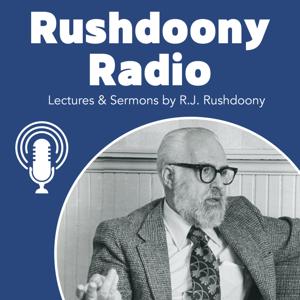
Welcome to Rushdoony Radio, your gateway to a wealth of wisdom and insight from the teachings of R.J. Rushdoony. ... more
FAQs about Rushdoony Radio:How many episodes does Rushdoony Radio have?The podcast currently has 134 episodes available.
March 05, 2026Questions and Answers (Remastered)Rushdoony’s core claim is that law flows from sovereignty: whoever is lord in a society defines its rule of life. When churches deny God’s law through antinomianism, they effectively confess, “We have no king but Caesar.” The early church refused Rome’s demand to say “Caesar is Lord” and instead confessed Christ’s universal lordship (Phil. 2:9–11). They did not seek change through protests but by bearing good fruit, trusting God’s judgment rather than expecting justice from evil men (Matt. 7:16–20).Obeying Scripture, especially 1 Corinthians 6, Christians built alternative institutions under God’s law. They established church courts to adjudicate disputes, so just that even pagans sought their rulings. Alongside these courts came schools, hospitals, and charities forming a genuine counter-government that Rome feared as “an empire within the empire.” Rushdoony contrasts this with modern states, where law increasingly reflects injustice and elections cannot cure moral collapse. Law works only when people are inwardly governed when it is written on the heart.At the center is atonement and authority. Believers are “bought with a price” (1 Cor. 6:19–20), redeemed from slavery to sin into service under Christ’s rule. Modern statism attempts to replace God as sovereign, leaving no higher court of appeal. Drawing on legal historians, Rushdoony argues that Western law arose from the juridical doctrine of the atonement and the reality of final judgment. Therefore, the regeneration of man requires the regeneration of society. Because God alone is Creator-King (Isa. 40; Ps. 2), only His law has a future, and the church’s calling is to live and rebuild under that law....more27minPlay
March 03, 2026Philosophy of Freud: Q&A (Remastered)In this wide-ranging Q&A, Rushdoony presses home that modern mental-health theory, medicine, and social policy are increasingly instruments of control rather than healing, whether in Soviet psychiatry, Freudian psychology, or Western technocracy. He contrasts Freud, Jung, and Adler while insisting Freud’s guilt-without-sin framework remains dominant, then applies the same critique to medical experimentation, birth control, and population-control narratives, warning that fabricated crises are used to justify totalitarian solutions. He links existentialism and neo-orthodoxy to the rejection of external law, urges Christians to stay on the offensive rather than defensively justifying themselves, and closes by emphasizing that history, education, and culture are battlegrounds where truth must be documented, challenged, and reclaimed under God’s law rather than surrendered to expert elites.#Rushdoony #ChristianWorldview #BiblicalLaw #MentalHealthState #Freud #Existentialism #NeoOrthodoxy #WorldviewWar #FaithAndCulture #TruthOverControl...more50minPlay
February 26, 2026Philosophy of Freud (Remastered)Rushdoony argues that the modern world’s inversion of justice celebrating crime while erasing responsibility flows from the legacy of Marx, Darwin, and Freud, who completed the Enlightenment’s turn from God to man and ultimately against man himself. Focusing on Freud, he warns that redefining guilt as a scientific problem rather than a moral one severs guilt from sin, abolishes true accountability, and makes salvation impossible. In its place arises the mental-health state, offering therapy, drugs, and control rather than repentance and redemption, and paving the way for rule by a scientific elite. The real issue is theological: either God governs man through His law, or men will play God over humanity.#ChristianWorldview #BiblicalTheology #Rushdoony #FaithAndCulture #MentalHealthState #GuiltAndGrace #LawAndGospel #ChristianThought #WorldviewMatters #GodsLaw...more46minPlay
February 24, 2026The Future of Law (Remastered)Rushdoony argues that Christianity’s future depends on remembering and applying past victories, not merely believing abstractly. Early Christians transformed society by practicing a total faith establishing justice, charity, education, and care for the poor so effectively that the church became an “empire within the empire.” When these victories were forgotten, Christianity retreated into private religion, losing cultural power and relevance.He insists that persecution is a sign of effectiveness, not failure. When Christian schools, homeschooling, and applied faith grew, hostility increased. Faith must be tested, refined by hardship, and lived out publicly; “salvation-only” or privatized Christianity has no future. Christ is not merely a means of personal security but Lord over every sphere of life, requiring obedience in money, work, justice, and culture.Rushdoony concludes that Christianity either governs all of life or withers. Tithing, freedom from debt, and active dominion are essential for renewal. Drawing on Calvin and the Reformation, he calls for a return to applied, militant faith one that confronts secularization, brings every area under Christ’s authority, and accepts conflict as inevitable. The real question, he says, is not whether a battle exists, but whether Christians are ready to fight it faithfully."...more32minPlay
February 19, 2026The Future of Politics (Remastered)Rushdoony’s theme is that forgotten victories become present defeats: the church has lost strength because it remembers Scripture but forgets how earlier Christians applied it. He cites 1 Corinthians 6: churches formed courts of arbitration so just that even pagans sought their rulings making Christianity an “empire within the empire” that Rome resented.He then sketches a long shift from Christianity to politics as society’s “savior”: Vatican I, the rise of the German Empire, nationalism after WWI, Marxism/democratic imperialism after WWII, and modern humanistic statism. Even though church numbers grew in the U.S., Christian influence declined because many believers became salvation- or church-centered rather than kingdom-centered (“seek first the kingdom,” Matt. 6:33).He warns that judgment begins at God’s house (1 Pet. 4; Heb. 12): persecution and legal pressure will increase, exposing lukewarmness. Yet he sees hope in Christian schools, homeschooling, and renewed hunger for serious theology, pointing to an approaching Reformation aimed at rebuilding society under Christ’s lordship, until “the kingdoms of this world” become Christ’s (Rev. 11:15)....more34minPlay
February 17, 2026The Future of Christianity (Remastered)Rushdoony argues that Christian reconstruction rests on God’s promise of victory: the meek shall inherit the earth. Scripture consistently teaches that God’s kingdom advances in history, fulfilled in Christ the true lawgiver and judge who inaugurates the new creation through His resurrection. Regenerated believers are therefore called to bring every area of life into obedience to Christ the King.He shows that the early church lived this out long before it had buildings or legal status: establishing courts, schools, charity, hospitality, hospitals, and disciplined welfare rooted in work and responsibility. In doing so, the church functioned as a government under God, an “empire within the empire,” which Rome rightly feared. This comprehensive obedience flowed from biblical law, not political ambition.The church’s later loss of influence, he contends, came from corrupt theology especially Greek dualism and spiritualization which despised history, law, and the material world. This produced an irrelevant church, retreating from culture and society. Christian reconstruction, grounded in creation and providence, restores the Bible as God’s governing Word for all of life. Because Christ is Lord of all creation, believers are not called to defeat but to victory through faith and obedience to every word of God....more45minPlay
February 12, 2026Condition of Christianity (Remastered)Rushdoony argues that the book of Acts shows persecution is inevitable wherever Christianity becomes effective. The real issue is always lordship by what power and by what name things are done. The early church was not persecuted for immorality or disorder, but because it manifested God’s power outside state control, making Christ a rival to Caesar. Any ruling order that sees itself as man’s savior will react with hostility to a gospel that offers salvation apart from the state.Tracing Acts, he shows how rulers and even religious leaders resisted the apostles because fallen man wants to define law and morality for himself. Rome treated the church as a rival government, responding first with bans and licensing, later with state control of the church, and eventually with “toleration” that allows Christianity only if it stays irrelevant. When relevance returns, persecution follows through defamation, lawsuits, and legal pressure. Paul’s sermon in Acts 17 provides the answer: God is Creator and sovereign, nations exist by His decree, and Christ’s resurrection guarantees judgment. That certainty provokes rage in the ungodly. Rushdoony concludes that persecution is not surprising; lukewarm faith is. Empires pass away, but Christ endures and the church must choose obedience under Christ rather than safety under Caesar....more45minPlay
February 05, 2026Who Shall Be Lord? - Challenge of the Book of Acts (Remastered)Rushdoony argues that the future of society rises or falls with the family. Scripture places the family not the church or the state at the center of social power, entrusting it with education, charity, inheritance, property, and the training of children. When these responsibilities shift to the state, freedom declines and statism grows. By contrast, when families reclaim these callings through Christian schooling, mutual care, and faithful stewardship (especially through the tithe), society is renewed from the ground up.He insists the family must be understood biblically, not through humanistic or evolutionary categories. Humanist thought assumes conflict, autonomy, and self-fulfillment, turning marriage into bondage and freedom into indulgence. Scripture teaches the opposite: true freedom is found in responsibility under God, where husband and wife are “heirs together of the grace of life.” The family is not biological accident or social convenience, but a God-ordained religious institution reflecting Christ and the Church.The Reformation proved that family reform reshapes civilization altering education, economics, charity, and even the church itself. Today’s revival of homeschooling and Christian family life signals real hope, even as secular families collapse under statism and moral decay. The call is not political but covenantal: re-Christianize the family, live out God’s law in daily life, and trust that faithful households small though they seem are God’s chosen instruments for commanding the future....more35minPlay
February 03, 2026Dynamic Christian Hospitality and Strangers (Remastered)Biblical law places the family at the center of society because God entrusts it with decisive powers: children (the future), property, inheritance, education, and welfare. When these are taken over by the state, society weakens. True renewal comes as families reclaim these responsibilities through Christian education, care for their own, and faithful stewardship.Rushdoony argues that this reclamation fails unless families are intellectually and spiritually grounded. Worldviews built on chance, evolution, or inevitable conflict make struggle metaphysical and unavoidable turning marriage, society, and economics into battlegrounds that require state control. By contrast, creationism affirms God’s sovereign order, so conflict is moral, not inevitable, and can be governed by God’s law.The family is therefore not merely biological or social but a religious institution, created to serve God’s kingdom. Husband and wife are “heirs together of the grace of life,” called to harmony and obedience. The future of society depends not on politics but on re-Christianizing the family, restoring its God-given authority, and living out covenant faithfulness....more27minPlay
January 29, 2026The Future of the Family (Christian Reconstruction and the Future)Rushdoony argues that only the Christian family has a future because it alone lives by God’s law rather than statist planning, making the family—not church or state—the primary engine of social renewal through its biblical duties of provision, education, charity, inheritance, discipline, and dominion; drawing from Scripture and history, he insists that neglect of family law hollows out faith, fuels statism, and erodes freedom, while practices like family-based care, homeschooling, tithing, and mutual responsibility reclaim power from the state and restore liberty under God; rejecting humanistic categories that redefine freedom as autonomy, he presents marriage and family as God-ordained spheres of responsibility that produce true freedom, arguing that the Reformation’s real revolution was family reform and that today’s revival of Christian households—small, faithful, and God-centered—is the decisive force that will shape the future and resist the culture of death. #ChristianFamily #BiblicalLaw #DominionMandate #FamilyGovernment #Homeschool #ChristianEducation #Tithing #AntiStatism #Rushdoony #Reformation #BiblicalWorldview #KingdomOfGod...more36minPlay
FAQs about Rushdoony Radio:How many episodes does Rushdoony Radio have?The podcast currently has 134 episodes available.