Sign up to save your podcastsEmail addressPasswordRegisterOrContinue with GoogleAlready have an account? Log in here.
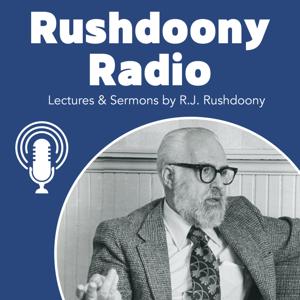
Welcome to Rushdoony Radio, your gateway to a wealth of wisdom and insight from the teachings of R.J. Rushdoony. ... more


FAQs about Rushdoony Radio:How many episodes does Rushdoony Radio have?The podcast currently has 144 episodes available.
January 27, 2026Biblical Importance of an Empowered Family (Christian Reconstruction and the Future)Rushdoony contends that biblical law makes the family the primary power-center of society—entrusted by God with children, property, inheritance, education, and welfare—and that modern statism systematically attacks and replaces these jurisdictions by denying creation, order, and harmony in favor of evolutionary conflict and centralized control; he argues that only belief in the sovereign Creator, predestination, and a God-ordained harmony of interests can empower families to function as history’s strongest social force, whereas Darwinism, Enlightenment humanism, and socialist planning inevitably produce anti-family ideologies, gender conflict, nihilism, and tyranny, making the re-Christianization of the family—not politics—the true key to reclaiming the future. #BiblicalLaw #FamilyGovernment #Theonomy #ChristianWorldview #Creationism #Dominion #Statism #Rushdoony #ChristianFamily #Education #Homeschool #KingdomOfGod...more38minPlay
January 22, 2026Resurrection, Communion, and the Family (Christian Reconstruction and the Future)Rushdoony argues that the removal of the Ten Commandments from public schools exposed a basic truth: all law is religious. While the courts rejected biblical law for fear students might obey it, schools freely promote Humanism as a state religion. He says decades of educational “reform” have failed because statist education is built on false premises; pouring in more money only deepens the collapse. Since man is made in God’s image, only Christian education can truly succeed.He calls for Christian reconstruction beginning with individuals and families reclaiming God-given responsibilities—education, welfare, property, inheritance, and child-training—using the tithe to fund Christian institutions rather than compromise. Through real examples (church-run schools, rescue missions, homeschooling families, community care for the needy), he shows how grassroots Christian obedience outperforms state systems. As believers obey God, power naturally shifts from the state back to the people under Christ, provoking resistance—but he ends confident that faithful action will prevail: “trust and obey,” for Christ overcomes the world....more1h 3minPlay
January 20, 2026Strategy for Christian Reconstruction (Christian Reconstruction and the Future)Rushdoony argues that only the Christian family has a future because it alone lives by God’s law rather than statist planning, making the family—not church or state—the primary engine of social renewal through its biblical duties of provision, education, charity, inheritance, discipline, and dominion; drawing from Scripture and history, he insists that neglect of family law hollows out faith, fuels statism, and erodes freedom, while practices like family-based care, homeschooling, tithing, and mutual responsibility reclaim power from the state and restore liberty under God; rejecting humanistic categories that redefine freedom as autonomy, he presents marriage and family as God-ordained spheres of responsibility that produce true freedom, arguing that the Reformation’s real revolution was family reform and that today’s revival of Christian households—small, faithful, and God-centered—is the decisive force that will shape the future and resist the culture of death. #ChristianFamily #BiblicalLaw #DominionMandate #FamilyGovernment #Homeschool #ChristianEducation #Tithing #AntiStatism #Rushdoony #Reformation #BiblicalWorldview #KingdomOfGod...more28minPlay
January 15, 2026Homeschooling (Christian Education: Christian Schools)Rushdoony, Blumenfeld, and Otto Scott argue that homeschooling works so well because it’s essentially one-on-one tutoring: parents know their children, can hold them accountable, and can move faster without the time-wasting and peer-driven dynamics of institutional schooling. They say homeschoolers tend to become strong readers, good conversationalists, and adult-oriented, while public schools prioritize socialization and conformity.They also stress that homeschooling strengthens families and even improves parents, since teaching pushes adults to keep learning. Legally and politically, they warn that the education establishment will try to regulate or restrict homeschooling, so parents must organize and defend their rights. Their conclusion: Christian schools and homeschools cultivate a more independent, capable generation with real leadership potential....more59minPlay
January 13, 2026Dangers Inherent in Public Education (Christian Education: Christian Schools)Rushdoony and Blumenfeld warn that public schooling is a means of controlling the future by shaping children away from Christian faith. Blumenfeld says students face four major risks: academic (functional illiteracy), spiritual (humanist/anti-Christian influences), moral (drugs, promiscuity, blasphemy), and physical (violence). They argue parents are mistaken to assume their child will be unharmed or serve as an effective “witness” without being damaged.Their proposed response is to remove children to Christian schools or homeschooling and then withdraw financial support from the public system, even through legal action if needed. They close by urging Christians to accept real sacrifice to preserve faith, freedom, and strong families."...more57minPlay
January 10, 2026The Biblical Basis for Christian Reconstruction (Remastered)Rushdoony argues that hospitality and charity are moral institutions, commanded by God and central to biblical faith not optional niceties. From Israel to the early church, caring for strangers and fellow believers was essential to covenant life and survival, especially under persecution. Scripture commands hospitality, but also sets clear boundaries: charity is not unconditional and must honor discipline, doctrine, and responsibility.Because Christian hospitality creates a real community outside the state, it has always provoked hostility. Just as Rome persecuted the early church for its independent charity, modern governments increasingly regulate, restrict, or criminalize Christian care whether feeding the poor, disciplining members, or educating children claiming exclusive authority over welfare, morality, and judgment. Legal persecution, he warns, is often meticulous and “lawful.”At root is a conflict between two kingdoms: the kingdom of God and the kingdom of man. Biblical freedom flows from Christ’s atonement and self-government under God’s law; statist “freedom” relies on coercion and control. The choice before Christians is stark: conversion or coercion. Either society is re-Christianized through faith and action, or the church will increasingly be pressured into silence and submission....more34minPlay
January 08, 2026Relationship of the Look-Say Teaching to Idolatry (Christian Education: Christian Schools)Rushdoony and Samuel Blumenfeld argue that progressive public education—especially John Dewey’s “look-say”/whole-word approach—functions as a modern form of idolatry by replacing the primacy of God’s Word with the primacy of the image, training children to guess meaning from pictures rather than read words accurately. Blumenfeld contends this shift is not neutral pedagogy but a deliberate program to “dumb down” literacy so a managerial elite can rule a collectivist society: high literacy produces independent thinkers, while look-say produces functional illiteracy, inaccurate reading, and a weakened ability to reason, speak precisely, and even pray coherently. They connect alphabetic literacy to God’s providence in history—language exists because God communicates with man, Scripture is written Word (not “comic-book” images), and propositional truth in words points to a created universe with real meaning; therefore efforts to dissolve precision in language (whether in reading, journalism, or “new math” relativism) are ultimately efforts to dissolve meaning itself and with it Christianity, absolutes, and order. The conversation broadens to the cultural fruits of this program—loss of poetry and cadence, garbled public speech, broken chronology in “social studies,” and youth reduced toward animal appetites under evolutionary/humanist premises—while insisting that man uniquely seeks meaning because he is made in God’s image, and when God is discarded, human evil becomes truly satanic in a way animals never do. Their practical conclusion is a call to resistance through Christian schools and homeschooling, recovering phonics, accurate reading, rich language, and a Word-centered education that refuses the image-idol and restores disciplined thought, truth, and godly dominion. #ChristianEducation #BiblicalWorldview #Rushdoony #SamuelBlumenfeld #JohnDewey #LookSay #WholeWord #Phonics #Literacy #Idolatry #WordOfGod #MeaningAndTruth #Homeschool #ChristianSchools...more57minPlay
January 06, 2026Christian Discipline: Need for Training in the Home, School, and Church (Christian Education: Christian Schools)True Christian discipline is not about punishment, but about living under Christ’s authority. Rooted in the word disciple, discipline shapes character through self-control, ordered homes, faithful churches, and purposeful schools. When authority is grounded in God’s Word—not personalities—discipline brings freedom, clarity, and growth. In the home, school, and church, discipline trains hearts and minds to live responsibly before God, cultivating inner obedience that lasts far beyond external rules....more40minPlay
January 01, 2026The Bible in the Curriculum: A Separate Subject or Foundation for Each Subject? (Christian Education: Christian Schools)The Bible in the Curriculum: A Separate Subject or Foundation for Each Subject? (Christian Education: Christian Schools)Rushdoony argues that the Bible must be taught as a subject and function as the integrating foundation for every subject, because Scripture is not a “devotional add-on” but God’s authoritative “command-word” that alone gives meaning, coherence, and true knowledge in a created, law-governed world. Drawing on Van Til, he insists that without the God of Scripture facts become “brute” and ultimately meaningless, so education that treats God as optional collapses into relativism, autonomy, and cultural barbarism—“every man doing what is right in his own eyes.” He contrasts theonomy (God’s rule) with autonomy (self-rule), warns that atheism logically ends in anarchy (as even Marx feared in debating Stirner), and concludes that a Christian curriculum must move in a single, unified direction under Christ’s kingship: we do not “prove” God or the Bible as if we were judges over Him; rather, we teach from the presupposition that the Triune God is Lord of all truth, so mathematics, history, law, and every discipline are properly understood only in submission to His revealed Word. #ChristianEducation #ChristianSchools #BiblicalWorldview #VanTil #PresuppositionalApologetics #Theonomy #Curriculum #ChristIsKing #ScriptureAlone #FaithAndLearning #KingdomOfGod #Rushdoony...more40minPlay
December 30, 2025Religious Nature of Education or Can Education Be Neutral? (Remastered)Rushdoony argues that education can never be neutral because creation itself is not neutral: everything is made by God, given purpose and boundaries, so there are no “brute facts” detached from meaning. The myth of neutrality, he says, is really the logic of the Fall (Gen. 3:5)—man claiming autonomy (self-law) over against theonomy (God’s law)—and it shows up in modern humanistic, state-run schooling through pragmatism, “anything goes” relativism, and child-centered progressivism that resists fixed truth (even down to dates, grammar, and moral standards). By excluding God from the classroom, education doesn’t become objective; it becomes a rival religion that trains students to act as little gods and judges, producing egoism and cultural decay. Christian education, by contrast, begins with “the fear of the Lord” as the foundation of knowledge and wisdom (Ps. 111:10; Prov. 1:7) and aims at loving God and neighbor (Deut. 10; Matt. 22), insisting that every curriculum is an act of faith—and that removing Christ is not neutrality but warfare, because humanistic education becomes an institutional love of death, while Christ-centered education is the love of life (Prov. 8:35–36; John 14:6). #ChristianEducation #NoNeutrality #BiblicalWorldview #Theonomy #Autonomy #Genesis3 #FaithAndLearning #Worldview #CultureWar #ProgressiveEducation #Humanism #ScriptureFirst #FearOfTheLord #Rushdoony #KingdomLiving...more33minPlay
FAQs about Rushdoony Radio:How many episodes does Rushdoony Radio have?The podcast currently has 144 episodes available.