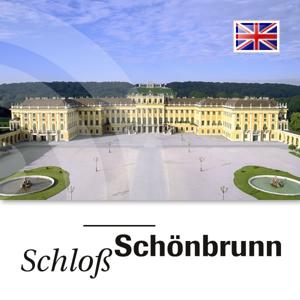
Schloß Schönbrunn - The State Rooms and Imperial Apartments on the piano nobile

Schloß Schönbrunn - The State Rooms and Imperial Apartments on the piano nobile

By Schloß Schönbrunn Kultur- und Betriebsges.m.b.H.Society & CultureEducationArtsHistory
Download on the App Store

Schloß Schönbrunn - The State Rooms and Imperial Apartments on the piano nobile episodes

  • 16 - Hall of Mirrors
    The Mirrors Room was used for family celebrations during Maria Theresa’s reign, among other occasions for small concerts. In 1762 this room saw the first concert given by the six-year-old Mozart to the empress. After the performance, according to his proud father, “Wolferl jumped onto her majesty‘s lap, threw his arms around her neck and smothered her with kisses”.
    1 min
  • 17 - Rosa Rooms
    Like the two following rooms, this room is named after Joseph Rosa, the painter of the landscapes that hang here. The first painting to the left of the door you have just come through depicts the Habichtsburg in Aargau in Switzerland, which is the ancestral seat of the Habsburg dynasty. Here you can see the portrait of Maria Theresa by the court painter Martin van Meytens. Maria Theresa was an unusually energetic woman; after the death of her father, she succeeded in defending her Habsburg inheritance against half of Europe in the War of the Austrian Succession. She ruled over the Habsburg Hereditary Lands, while her consort, Franz Stephan of Lorraine, was Emperor of the Holy Roman Empire. Franz Stephan devoted himself to his private interests, which included natural sciences and economy, leaving political affairs to his wife.
    2 min
  • 21 - Great and Small Galleries
    You are now in the Great Gallery, which was used by the imperial family for balls, receptions and banquets. More than 40 metres long and almost ten metres wide, the Great Gallery formed the ideal setting for festive events at court. Decorated with crystal glass mirrors, gilt stuccowork and ceiling frescos, it represents a sumptuous example of Rococo art. The frescos are by the Italian painter Gregorio Guglielmi and represent a glorification of Maria Theresa’s rule. In the central fresco we see Franz Stephan and Maria Theresa enthroned and surrounded by the personifications of a ruler’s virtues together with Allegories of the Crown Lands of the monarchy. The two large carved and gilded wooden chandeliers used to take 70 candles each before the palace was electrified in 1901. Since the end of the monarchy the Great Gallery has been used for concerts. In 1961 it was also the setting for the historic encounter between President Kennedy and the Soviet premier Khrushchev. The Small Gallery lies on the side of the palace facing the gardens. It was used for name day and birthday celebrations and offers a wonderful view of the park and the Gloriette, which was built during Maria Theresa’s reign on the crest of the rise opposite the palace. During recent restoration work the Small Gallery had its original glossy white finish dating from the 19th century restored.
    3 min
  • 23 - Chinese Round and Oval Cabinets
    Rooms known as the Chinese Cabinets flank the Small Gallery: on the left is the Oval Chinese Cabinet and on the right, the Round Chinese Cabinet. Maria Theresa was extremely fond of the contemporary fashion for Chinese and Japanese art. In both cabinets precious Chinese lacquer panels are set into the white wooden wainscoting. Their gilt frames develop into little consoles or brackets supporting examples of blue and white porcelain. The parquet flooring of both rooms with its ornate inlay work is also remarkable. The two cabinets served as rooms for playing cards and as conference rooms. Maria Theresa used the Round Chinese Cabinet for secret state conferences and meetings with her state chancellor, Prince Kaunitz.
    1 min
  • 25 - Carousel Room
    The Carousel Room owes its name to the large oil painting hanging on the left. It depicts the Ladies‘ Carousel held by Maria Theresa in the Winter Riding School of the Hofburg in 1743 to mark the recapturing of Prague in the War of the Austrian Succession. This Winter Riding School, today known as the Spanish Riding School, is still the setting for performances by the famous Lipizzan stallions. Here Maria Theresa rides on a Lipizzaner at the centre of the picture, followed by her ladies-in-waiting. To the left is a portrait of Maria Theresa’s father, Emperor Charles VI, wearing a sumptuous Spanish coat-dress.
    1 min
  • 26 - Hall of Ceremonies
    During the reign of Maria Theresa the Hall of Ceremonies was used for smaller ceremonial festivities and to celebrate occasions such as christenings or weddings. The cycle of paintings hanging in this room depicts the wedding celebrations held on the occasion of the marriage of Maria Theresa’s eldest son and heir, Joseph, to the Bourbon princess Isabella of Parma. The cycle includes what is probably the most well-known portrait of the monarch depicting her as the “First Lady of Europe” in a sumptuous gown of Brabant bobbin lace. To the left, the largest of these paintings shows the bridal procession with a train of 98 carriages. All the wedding guests, which included the entire high aristocracy of Europe, can be identified by the coats of arms on their carriages.
    2 min
  • 28 - Blue Chinese Salon
    The Blue Chinese Salon was decorated with these 18th-century hand-painted rice-paper wall hangings at the beginning of the 19th century. This room was the setting for the historic negotiations that culminated in the renunciation by Karl I, the last emperor of Austria, of participation in the affairs of government on November 11th 1918. The following day saw the proclamation of the Republic of Austria, marking the end of more than six centuries of Habsburg rule. However, since Karl refused to abdicate from the throne, he and his family were forced to go into exile. He died on the island of Madeira in 1922, aged only 35; his wife Zita lived until 1989 and was buried in the imperial crypt as the last empress of Austria.
    1 min
  • 29 - Vieux-Laque Room
    The Vieux-Laque Room was remodelled by Maria Theresa as a memorial room to her beloved husband, Franz Stephan, who died unexpectedly in 1765. Black lacquer panels from Peking were set into the walnut wainscoting and embellished with gold frames. After Franz Stephan‘s death, Maria Theresa wore mourning for the rest of her life. A note was found in the empress’s prayer book after her death on which she had noted the length of her happy marriage, right down to the precise number of hours. Maria Theresa also commissioned three paintings for this room: in the middle is a portrait of Franz Stephan by Pompeo Batoni, who also painted the double portrait of Joseph II and his brother Leopold which was done in Rome in 1769. On the table in front of Joseph, who is standing on the right, lies a copy of Montesquieu’s Esprit des lois, one of the key works of the Enlightenment. The ideas of the Enlightenment underlay all the young emperor’s endeavours and reforms.
    2 min
  • 30 - Napoleon Room
    The Napoleon Room recalls the French emperor, who resided in this room – once the bedroom of Maria Theresa – both times he occupied Vienna, in 1805 and 1809. The marriage of Napoleon to Marie Louise, daughter of Emperor Franz II in 1810 was intended to cement the peace between the two rulers. After the fall of Napoleon, Marie Louise returned with her son to the court at Vienna for the time being. As a result of the Congress of Vienna held from 1814 to 1815 she was eventually given the Duchy of Parma – but only on condition that she leave her son, the Duke of Reichstadt, in Vienna. The European powers insisted that, as the only son of Napoleon, little “Prince Franzi”, as he was called at court, was to remain politically insignificant and to grow up in isolation at the Viennese court under the guardianship of his grandfather. Like all male Habsburgs, following a family tradition he learnt a trade. The painting in front of you shows him as a little gardener. On the console table you can see his beloved pet, a crested lark. Napoleon’s son died from a lung disease in 1832, aged only 21. The bust shows him on his deathbed. In the Porcelain Room (Room 31) that follows we again return to the time of Maria Theresa, who used this small room as a study and for playing games of cards. The carved wooden framing, painted blue and white to imitate porcelain, covers the walls entirely up to the ceiling. Set into this carving is a total of 213 pen-and-ink drawings which were executed by Franz Stephan and some of his children, including Marie Christine, who is portrayed in one of the portrait medallions. She was the empress’s favourite daughter and was the only one of her children who was allowed to marry the man she loved, Duke Albert of Saxony-Teschen.

    3 min
  • 32 - Millions Room
    You are now in one of the most valuable rooms in the palace, known as the Millions Room. It owes its name to the wall panelling made of an extremely rare type of rosewood into which are set Indo-Persian miniatures. Depicting scenes from the private and court life of the Mogul rulers in 16th-century India, they were cut up by members of the imperial family and reassembled to form new images in a sort of collage. The Millions Room also features a typical example of the playful spirit of the Baroque age, when optical illusions were very popular: crystal mirrors are hung on both sides of the room, reflecting one another and creating the illusion of infinite space.
    1 min

About Schloß Schönbrunn - The State Rooms and Imperial Apartments on the piano nobile

From the publisher's feed

Back in the 17th century, the Habsburgs had a small summer palace on this site. However, this was destroyed during the second Turkish siege of Vienna in 1683. After the defeat of the Turks, Emperor…