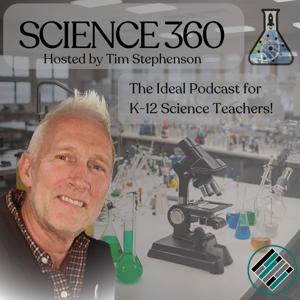
Science 360

Science 360

By Tim StephensonScience
Download on the App Store

Science 360 episodes

  • Ep. 98 - The Best of Season 5: Highlights from Science 360
    That's a wrap for season 5 on Science 360. I'm sharing with you today some highlights from 7 of the 19 episodes of the season. Of course, there could have been many more, but I had to consider time limitations. Plus, this forces you to click on these episodes and all the others to hear more!

    Today you will hear from:
    1. Dr. Greg Hammer, MD,  a mindfulness expert who talks about modulating the effects of the vagus nerve on your parasympathetic nervous system. Do you get stressed? Listen to Dr. Hammer!
    2. Dr. Tim Dasey, an expert on AI and author of the book Wisdom Factories. Have you wondered about how AI will factor into your world? Check out my episode with Tim and find him on LinkedIn as well for lots of blogs on AI and education.
    3. Mr. Peter Phillips-Johnston, a former student of mine who has become an expert in linguistics. Peter talks about how learning anything is possible, with the right mindset.
    4. Dr. Marcelo Gleiser, Templeton Prize Winner. Dr. Gleiser is a deep thinker on all things science and philosophy, an intellectual who emphasizes the need for creativity and art.
    5. Dr. Ross Laird, a professor who promotes a mindful change in the education system. Ross will push the way you consider the traditional classroom.
    6. Dr. Sarika Cullis-Suzuki, the host of CBC's The Nature of Things. You might recognize her name, but Sarika brings all the knowledge and enthusiasm for learning science as her father did.
    7. Dr. Julia Huggins, an expert on the microscopic world of microbes, the very thing that sustains all life on the planet! Julia was so interesting, I had her on for a two-part series!
    1 hr 19 min
  • Ep. 97 - Discovering Pluto and Beyond: Insights from the Lowell Observatory with Todd Gonzales
    Hello, and welcome to another episode of "Science 360" the podcast where we explore the wonders of the universe, all aspects of science (360 degrees...full circle...get it?) and the brilliant minds that bring them to light. 

    I'm your host, Tim Stephenson, and today I have a very special guest joining us from the Lowell Observatory in Flagstaff, Arizona. Our guest today is Todd Gonzales, the Director of Education at the observatory. Todd is here to share with us the rich history and groundbreaking discoveries made at Lowell Observatory. We'll delve into the story of Percival Lowell, the visionary who founded the observatory, driven by his fascination with Mars and his desire to determine if there was any life there.

    We'll also discuss the construction and significance of the iconic Clarke Telescope, and the fascinating tales of how Uranus, Neptune, and Pluto were discovered.

    Additionally, we'll touch on the incredible contributions of Vesto Slipher, whose work provided the first evidence that our universe is expanding.

    For any teachers tuning in, get ready for a wealth of information about our solar system that you can bring back to your classrooms. So, without further ado, let's welcome Todd Gonzales to the show.
    1 hr 15 min
  • Ep. 96 - Exploring Ocean Microbes: Dr. Julia Huggins On the Climate Effects of Warming, Acidification and Deoxygenation of the Oceans
    Dr. Julia Huggins Part 2

    In this episode, we welcome back Dr. Julia Huggins to dive into the world of ocean microbes and their critical role in our planet's health. Dr. Huggins shares her research on how ocean warming, acidification, and deoxygenation are impacting these essential microorganisms. She explains that maintaining healthy ocean circulation is crucial for balancing microbes, nutrients, and energy, which in turn affects global weather patterns and climate stability.

    Dr. Huggins delves into the consequences of disrupted oceanic conditions, highlighting how changes in temperature, pH levels, and oxygen availability can lead to significant shifts in microbial populations. These shifts can have cascading effects on marine ecosystems, from the smallest plankton to the largest marine mammals. By understanding these connections, we can better appreciate the importance of preserving ocean health in the face of climate change.

    Additionally, Dr. Huggins emphasizes the need for robust scientific research and global cooperation to mitigate these issues. She discusses potential strategies for protecting ocean circulation and maintaining microbial balance, ensuring a sustainable future for our oceans and, by extension, our planet. This episode offers valuable insights into the intricate web of life beneath the waves and underscores the urgent need to address environmental challenges affecting our seas.

    Please rate, review and share this episode and this podcast with your friends and colleagues.
    1 hr 41 min
  • Ep. 95 - Exploring Forest Microbes: Dr. Julia Huggins on Nature's Hidden Networks and Educational Insights
    This is part 1 of a 2-part series with Dr. Julia Huggins. In this episode, I sit down with Julia, a recent PhD graduate in biogeochemistry, to explore the fascinating world of forest microbes. Julia explains how these microscopic organisms create intricate networks that connect plants and trees, playing a crucial role in the ecosystem.

    She emphasizes that understanding these connections can serve as a valuable lesson for junior science students, illustrating the interconnectedness of all life forms and the foundational role microbes play in nature.

    Julia also shares her educational journey, recounting her path from high school through undergraduate studies and eventually to her PhD. Her story is one of determination and curiosity, as she carved out her unique path in the field of biogeochemistry. Her passion for microbes developed over time, and she now sees them as the cornerstone of natural processes, highlighting their importance not just in forests but in the broader context of environmental and biological sciences.

    Joining the discussion is Chris Janzen, our school librarian, who helps set the stage for the episode by discussing the educational value of long-form podcasts for teachers. Chris points out that such in-depth discussions can provide teachers with a rich resource for enhancing their curriculum and engaging students with real-world scientific concepts.

    This episode not only delves into the science of microbes but also offers insights into how educators can utilize podcasts as a dynamic tool for learning and inspiration.

    Please take the time to rate, review and share this podcast with your friends and colleagues
    1 hr 39 min
  • Ep. 94 - Breaking Barriers: Dr. Helene Hill on Gender Discrimination in Mid-20th Century Science
    Dr. Helene Hill was a research scientist who did excellent work. What was working against her though was that she was doing her work at a time when men dominated the field and discriminated against women.

    Now at the age of 95 and working on writing her second book, Dr. Hill plans to release her memoir titled The Crying Window, to tell her story of purpose and persistence in the face of prejudice. Already a published author, Helene released a book (available on Amazon) titled Hidden Data: The Blind Eye of Science, telling the story of becoming a whistle-blower when she noticed falsified data in government-funded research

    This is a story that can inspire women in science to stay the course, and a wake-up call to men to recognize the significant contributions to science that women make every day.

    Within this conversation are stories of idealistic naivete, fond remembrance of teachers who inspired and life experiences that altered the course of Helene's career. Hers was a life of a dedicated love of science, a high sense of justice and a pursuit of truth within research. 

    This is a reminder of the special privilege we have to listen to the wisdom that can only come from experience. And in this case, it was the experience of doing what was right in the massive face of opposition. 

    Read more about Dr. Helene Hill's story at http://www.helenezhill.com/
    1 hr 5 min
  • Ep. 93 - Roots So Deep with Peter Byck: How Rotational Grazing Boosts Soil Health, Biodiversity and Carbon Sequestering
    Welcome to today’s episode, where we have an extraordinary guest, Peter Byck, the director of the upcoming documentary "Roots So Deep." Peter’s journey from Kentucky to California, where he attended Cal Arts for film school and spent over 15 years in the Los Angeles film industry, is nothing short of inspiring.

    His work took a pivotal turn after witnessing the impact of "An Inconvenient Truth," which led him to explore solutions to climate change through his documentary "Carbon Nation."

    Peter dives deep into the realm of regenerative agriculture in his latest project. He vividly recalls the early days of his research, where he realized that while there was significant focus on the destruction caused by conventional farming practices—like soil erosion from growing corn and the environmental toll of feedlots—no one was studying the potential of healthy, regenerative systems. This epiphany set him on a path to investigate how adaptive grazing can restore soil health rapidly, much faster than traditional methods suggest.

    In 2013, a series of meetings with various scientists—rangeland specialists, bird ecologists, entomologists, and microbiologists—led Peter to Arizona State University. Here, he received a grant to unite these experts in a collaborative effort to study sustainable farming practices. The enthusiasm and eagerness of these scientists to break away from their institutional silos was palpable. Their collective research laid the foundation for "Roots So Deep," which examines the profound impact of adaptive grazing on farms in the Southeastern United States.

    If you enjoyed this episode, please subscribe and leave us a review on your favorite podcast platform.

    Watch the documentary at rootssodeep.org
    Follow on Instagram @carboncowboys
    1 hr 14 min
  • Ep. 93 - Roots So Deep with Peter Byck
    Welcome to today’s episode, where we have an extraordinary guest, Peter Byck, the director of the upcoming documentary "Roots So Deep." Peter’s journey from Kentucky to California, where he attended Cal Arts for film school and spent over 15 years in the Los Angeles film industry, is nothing short of inspiring.

    His work took a pivotal turn after witnessing the impact of "An Inconvenient Truth," which led him to explore solutions to climate change through his documentary "Carbon Nation."

    Peter dives deep into the realm of regenerative agriculture in his latest project. He vividly recalls the early days of his research, where he realized that while there was significant focus on the destruction caused by conventional farming practices—like soil erosion from growing corn and the environmental toll of feedlots—no one was studying the potential of healthy, regenerative systems. This epiphany set him on a path to investigate how adaptive grazing can restore soil health rapidly, much faster than traditional methods suggest.

    In 2013, a series of meetings with various scientists—rangeland specialists, bird ecologists, entomologists, and microbiologists—led Peter to Arizona State University. Here, he received a grant to unite these experts in a collaborative effort to study sustainable farming practices. The enthusiasm and eagerness of these scientists to break away from their institutional silos was palpable. Their collective research laid the foundation for "Roots So Deep," which examines the profound impact of adaptive grazing on farms in the Southeastern United States.

    If you enjoyed this episode, please subscribe and leave us a review on your favorite podcast platform.

    Watch the documentary at rootssodeep.org
    Follow on Instagram @carboncowboys
    1 hr 14 min
  • Ep. 92 - My Take on Wellness, AI and Electric Cars
    Recently, I've been approached by colleagues about various issues they've found or heard about. I appreciate that they come to me to see what I think. This is what a collegial workplace should look like.

    One came and brought up the topic of wellness through cold plunging. Another brought up concerns about how AI will affect our classes. I constantly get challenged over the debate between electric and gas-powered cars. Still, another brought up the issue of cloud seeding.

    I decided to share some thoughts around these topics (although I left out the cloud seeding part of the recording...maybe another time). I've always said that as teachers, we need to be ready with informed answers because we want to encourage our students to ask questions. I never want to shut down a good question nor placate it with a minimalist answer or simply tell them to go find out for themselves. I like to employ the "teach" part of my job title.

    So here is a brief rundown on three of these topics from my point of view. I hope you think through YOUR answer to these issues. If you have opinions or knowledge that differs from mine, please reach out at [email protected] and let's dialogue and allow me to learn from you.
    47 min
  • Ep. 91 - Teaching Sheryl a Few Things About the Moon
    My greatest desire for this podcast is to show you, the teacher, how teaching can be. In its purest sense and in the light of First People's Principles of Learning, there is generally one in the room who is about to lead a discussion on a particular topic. But it is not shared without great respect for the ones listening, offering up the opportunity to differ, interpret, analyze and question.

    And when it comes to space, inevitably there will be questions asked that you don't know the answer to. But every time this happens, allow it to add to your knowledge bank so that if it comes up again in the future, you're ready.

    So this may be a discussion about the Moon, but it is more than that. It is as teaching should be: multiple people involved in a respectable conversation, delving deeper and deeper into a topic. I hope you notice and can think of ways that this conversation could lead into activities of inquiry, presentation by the students, group-lead gallery walks involving art and science and history, filled with opportunities to express a newfound and, indeed, profound understanding of this heavenly body we call the Moon.

    Where could your lesson go next? What planet or star or galaxy do you want to learn about to lead further lessons and explorations of space? If you allow the teacher mind to go wild, the possibilities are endless.

    26 min
  • Ep. 90 - Talking Teaching with my Wife, Sheryl!
    Here are two new twists...firstly, I'm the one getting interviewed on this episode, and secondly, it's my wife asking the questions!

    Yes, I invited Sheryl to turn the mic on me after I was inspired to do so when my guest from episode 88 said she was curious about why I got into teaching. That was Marika Cullis-Suzuki so be sure to check that episode out.

    This episode is a bit of an experiment. I hypothesize that behind every great podcaster is an even greater spouse. I'd love to do this sort of episode regularly. I'm not oblivious to the fact that there have been many times when I thought I was saying something intelligent, only to have Sheryl shed so much more light on it! I guess we all need someone in our lives to point out that we don't know it all.

    Please connect with me to let me know if you want Sheryl to come on with me regularly. You can email me and give me some feedback on this:

    [email protected]

    As usual, please rate, review and subscribe on Apple or Spotify to help with the algorithms.
    23 min

About Science 360

From the publisher's feed

Are you a science teacher seeking inspiration for teaching? Whether it's space, the climate, chemistry, biology, physics or educational theories, Science 360 explores science from all angles, offering…