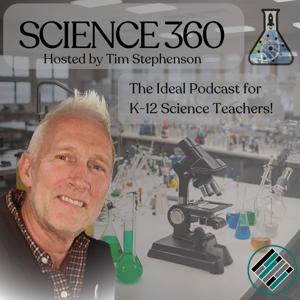
Science 360

Science 360

By Tim StephensonScience
Download on the App Store

Science 360 episodes

  • Ep. 59 - Soundscapes with Tara-Lynn Kozma-Perrin
    This was a really neat discussion as it centred on something that I’ve never directly thought about. However, it is something that I’ve noticed and that is soundscapes. I’ve never referred to sounds as a soundscape, but after talking with Tara-Lynne, it makes total sense. The sounds that make up our surroundings, coming from both nature and urban settings, constitute the sonic diversity that makes up our soundscape.

    Tara-Lynne blends her academic training with art, being influenced by what she calls her indigineity. Her research into the acoustic ecology highlights our relationship to sound: sounds that bring people together, that tell a story of their history, sounds that draw us into a relationship with the land.

    Having received a degree in Fine Arts from the University of the Fraser Valley, followed by a second degree in Global Development, Tara-Lynne was dissatisfied with what she saw in western culture, placing so much emphasis on economic gain and colonialism at the expense of the land. So she set off to Nairobi with the hopes of a cultural experience that would allow her to continue her research into the significance of sounds and the wholistic wellness that it can bring.

    We discuss soundscapes as it relates to school. She describes soundwalking, and I love the way she points out the difference in sounds of feet on pavement versus feet on grass. It demands an ability to use descriptive language, but most importantly it requires an awareness of your present space, something those in a busy culture don’t allow time for. She theorizes on the modern sensory input of a fast-paced, 15 second sound byte TikTok world to the structure of school, which can’t keep up to that frenzied and eclectic online world. Are sounds used as a crutch to calm to mind, do students feel anxiety if forced to endure sensory deprivation?

    Speaking from Nairobi, listen for the sounds of the birds singing outside Tara-Lynn’s window. I felt that they were teaching us their own lesson with their words of wisdom, asking us to listen carefully.

    What’s the soundscape in your classroom? Do you intentionally bring your students to a place to notice the sounds? Is there acoustic complexity in your teaching practice and have you allowed it to be part of your students experience? These are interesting questions that I’ve not thought a lot about in the past, but as we spoke, I realized how much I had thought about sounds without realizing it.

    Connect with Tara-Lynn:
    Instagram, YouTube and TikTok: @sinewaves.and.sunsets
    Website: www.flythekite.com
    1 hr 2 min
  • Ep. 58 - From Ocean Anxiety to Agency with Scott Bohachyk
    I had the chance recently to sit down with Scott Bohachyk. He’s the Youth Director at Oceanwise which is a non-profit conservation organization inspiring action to conserve our oceans. They describe themselves as an organization whose vision is a world in which oceans are healthy and flourishing, bearing in mind of course that its the ocean that gives us the air we breathe and the wonder of life.

    Scott has built a global network that includes governments, industry, universities and non-profits all in the name of solutions to the complex environmental challenges of our time. His focus areas recently have been an ocean free of plastic, sea forestation and the changing arctic. His work within these teams is creating programs that have empowered over 500,000 people each year to protect and restore the ocean.

    Scott is directing an Oceanwise program called Waves of Change which includes a travelling presentation with an inflatable dome that students go in and get an immersive visual experience of the under water world.

    I’m so glad that there are people like Scott who are bringing this critical information to students. At one point in this discussion, I raise the point that when a teacher finds themself saying that a particular lesson is so important or that students need to know this or that, my challenge is to ask themself with critical care…is it really that important or do they really need to know that? There are aspects of science that I believe ARE in the category of NEED to know, and ARE so important. The science of ocean chemistry and the atmospheric changes brought on by energy production require education and awareness if in fact we want our students to be equipped with the knowledge and skills that can bring us back into an equilibrium with nature.

    The traditional science curriculum should reflect the changing world we live in and there are wonderful ways to adapt it to a more modern application. One of the first things teachers should do then is equip themselves with the knowledge and understand what’s going on. And Scott Bohachyk may be your starting point. This is what I would call a “mindset” discussion. There is lots here to get you thinking and hopefully spur your teaching on to include lessons about the health and potential future state of our oceans.

    Find Oceanwise at https://ocean.org
    56 min
  • Ep. 58 - Ocean Anxiety to Agency with Scott Bohachyk
    I had the chance recently to sit down with Scott Bohachyk. He’s the Youth Director at Oceanwise which is a non-profit conservation organization inspiring action to conserve our oceans. They describe themselves as an organization whose vision is a world in which oceans are healthy and flourishing, bearing in mind of course that its the ocean that gives us the air we breathe and the wonder of life.

    Scott has built a global network that includes governments, industry, universities and non-profits all in the name of solutions to the complex environmental challenges of our time. His focus areas recently have been an ocean free of plastic, sea forestation and the changing arctic. His work within these teams is creating programs that have empowered over 500,000 people each year to protect and restore the ocean.

    Scott is directing an Oceanwise program called Waves of Change which includes a travelling presentation with an inflatable dome that students go in and get an immersive visual experience of the under water world.

    I’m so glad that there are people like Scott who are bringing this critical information to students. At one point in this discussion, I raise the point that when a teacher finds themself saying that a particular lesson is so important or that students need to know this or that, my challenge is to ask themself with critical care…is it really that important or do they really need to know that? There are aspects of science that I believe ARE in the category of NEED to know, and ARE so important. The science of ocean chemistry and the atmospheric changes brought on by energy production require education and awareness if in fact we want our students to be equipped with the knowledge and skills that can bring us back into an equilibrium with nature.

    The traditional science curriculum should reflect the changing world we live in and there are wonderful ways to adapt it to a more modern application. One of the first things teachers should do then is equip themselves with the knowledge and understand what’s going on. And Scott Bohachyk may be your starting point. This is what I would call a “mindset” discussion. There is lots here to get you thinking and hopefully spur your teaching on to include lessons about the health and potential future state of our oceans.

    Find Oceanwise at https://ocean.org
    56 min
  • Ep. 57 - Everything Space with Bill Burnyeat
    Wow! This one has a lot of information in it. We get into all kinds of things about space and teaching astronomy. You may want to take notes!! If you like space, want to learn more OR if you teach science with an astronomy unit, then this one is for you!

    There was enough in here that I felt it would be a good idea to include a vocabulary list so that you could reference it, as I'm sure Bill or I used words that might be unfamiliar.

    So here's the list:
    Synodic Period - the time it takes to complete one orbit or revolution relative to the position of the Sun
    Ecliptic - the line that connect the Earth and the Sun. All planets orbit the Sun approximately on the plane of the ecliptic
    Spectrometer - an instrument that measures a wavelength of light emitted by any source
    Mare - the latin word for sea. Used to describe the dark areas on the Moon because ancient astronomers thought they were oceans (Plural: Maria)
    Occultation - when one celestial body crosses in front of or behind another
    Homogeneous - used to describe anything that is the same throughout
    La Grangian Point - a point between two objects where their respective gravities cancel out and you don't fall towards either
    Infrared - the radiation responsible for heat. Has a wavelength slightly longer than visible light
    Redshift - the optical observation whereby lightwaves are stretched to a longer wavelength because the light source is moving away from you
    Sidereal Period - the time to rotate or orbit relative to the background stars. Generally it is shorter than synodic time because the Sun is moving and the stars don't appear to, simply because they are so far away
    Elliptical orbit - all objects orbit the Sun in an orbit slightly non-circular. An Ellipse is like a circle that is flattened somewhat
    Regolith - this is what we call Moon dirt
    Artemis - the mission that is responsible for returning humans to the Moon and then eventually to Mars
    Planisphere - a tool used by astronomers to identify stars and constellations above Earth. Click the link to make one and/or check your phone's App Store and download an interactive version
    https://in-the-sky.org/planisphere/pdfs/planisphere_50N_en.pdf

    Connect with Bill by email for class visits, either virtual or in person, at
    [email protected]

    Find lots of astronomy resources on my YouTube channel:
    Science360-Beyond the Sky

    1 hr 5 min
  • Ep. 56 - Being Intentional About Wellness
    In this episode, rather than interviewing a teacher from our school, I read a blog I wrote for the Teach Better Team. I'm sharing it as a word of encouragement and maybe a touch of "I needed that". I hope you have a wonderful summer and here's a few thoughts to kick it off.

    Science 360 Episode 54 - Burning Bright, Not Out
    https://open.spotify.com/episode/4Ua8IGz2INiLStxp6EwBPJ?si=1eb7c518951e4eaa
    Earthy Chats Episode 13
    https://open.spotify.com/episode/6f8I4ehCN6Q0aZRWmotrm2?si=85c74ac841ae4d7e
    Teach Better Team
    https://www.teachbetter.com/blog/
    9 min
  • Ep. 55 - Talking Science Education with Becky Schnekser and Holly Stuart
    One of the wonderful things about the PLN is getting to expand your horizons and meet teachers from all sorts of places. It was through connections, largely coming out of my work with the Teach Better Team, that I "met" Becky and Holly. Being super impressed by their work, as viewed through Twitter and Teach Better blogs and Becky's book, they seemed like a natural fit to have on the podcast.

    But speaking to them for selfish reasons and my own personal enjoyment were not the only reasons I set this up. I wanted to hold this conversation up as an example of how teaching ought to be. Full of love for the subject, getting a thrill out of learning new things yourself, and finding joy in bringing the relevance and meaning and purpose to our students. I knew that these would take centre stage in a conversation with Becky and Holly and I was not disappointed.

    Let me encourage everyone to find your "team". Being strong on your own in the classroom is not a sign of strength and reaching out to find energy from others is not a sign of weakness. I love listening to these two and speaking with them and finding commonalities in the way we teach. I hope you can relate to our conversation and that this episode helps you where you are at. And reach out to any of us, because we would actually love to have you join us in more of this sort of stimulating conversation.

    Find Becky's book here: https://www.amazon.com/Expedition-Science-Empowering-Learners-Exploration/dp/1951600827/ref=sr_1_1?crid=1NZX9STYONJNI&keywords=expedition+science&qid=1652056830&sprefix=expedition+science%2Caps%2C154&sr=8-1

    Becky is on Twitter at @schnekser
    Holly is on Twitter at @hollyastuart
    1 hr 7 min
  • Ep. 54 - Burning Bright (not out) with Jess LeBlanc
    One thing we can all use right now is a comforting conversation about stress (is that an oxymoron?) and stress management strategies. The comforting part is that the strategies are not actually that difficult. Jess LeBlanc explains why.

    The world we live in can be very stressful. From locally born issues such as family and work, our students and school settings...to global issues of politics, conflict, pandemics and climate change. But we are in this together and through community, Jess points out that great comfort will come. Her motto is Let's Burn Bright, Not Out.

    Here are some of the links you need to check out:
    Jess's website: https://www.jessleblanc.com
    Her course offerings: http://www.embodiedliving.ca/stressecourse
    Jess's work with Dr. George Slavich: www.lifestresstest.com
    Ross Reid's work: https://www.youtube.com/c/NerdyAboutNature
    Ross's latest podchat venture: https://podcasts.apple.com/podcast/nerdy-about-nature/id1616723640
    1 hr 10 min
  • Ep. 53 - Reimagining Education with Grade 12 Student Callum Neily
    In this episode, I discuss the highs and the lows, the pros and the cons, the areas for growth for schools with my guest, Callum Neily. Callum is a grade 12 student in my school and if you listen long enough, you will hear that he is an asset to our building. Likely he could be an asset win any building.

    Once we establish our conversation and theme, we really get to thinking about what school could be like. We realize that every aspect of society is changing at light speed, but schools are lagging behind. We decide that there may be legitimate reasons for that, but those shouldn't stop us from being agents of change.

    We also see that schools have changed during the pandemic, but it's the rate of change compared to other aspects of society that is most noticeable. I hope this episode challenges the way we "do" school. Thanks Callum for being part of the driving force towards a better education for all of us.

    Find Callum on his YouTube channel: https://www.youtube.com/channel/UCk_vcsTMb97FRDgaiUGJllg/featured

    And check out his latest venture to connect like-minded youth: https://wecoapp.org/Home
    1 hr
  • Ep. 52 - Salmon Talk with Chris Hall
    This is a re-run of my first interview on Science360, from back in the spring of 2020. I've been re-listening to a few of these and I really feel they hold a lot of value, but most of my listeners won't have heard the older episodes.

    In this talk, Chris explains the whole life cycle of the salmon, an integral species to the Pacific Northwest. He describes their relationship to the whole ecosystem and how human interactions have had a negative effect on their viability.

    I am a strong believer that education should be highly relevant, informative and worth remembering. This topic, explained by Chris, is all of that. It's what I try to provide on this podcast. You've heard of salmon, probably eaten some, but can you speak confidently about it with your students? I hope after listening to this, you will be able to.
    37 min
  • Ep. 51 - Why I Create Content (and you should too!)
    Recently, I have been creating a YouTube channel called Science360 - Beyond the Sky. This comes on the heels of my podcast Science360 (this one obviously), a book I wrote called Beyond the Classroom and many, many blog posts found on the Teach Better website.

    Why do I do these things? That's what this episode is about. But it's also about why everybody should be adding to the body of knowledge so we can all benefit from your expertise.

    Here are the podcasts that I mention in the episode. I'm not linking to them because not everyone uses Apple and/or Spotify and they are all easy to find with a simple search:

    The Rich Roll podcast
    The Tim Ferris Show
    The Jordan Harbinger Show
    Singularity Radio
    Future Positive
    Exponential Wisdom
    Gravity Assist
    A Bit of Optimism
    The Dave Burgess Show
    The Adam Welcome Podcast
    Lasting Learning
    Fresh Air at Five
    Teachers on Fire
    The Chey and Pav Show
    The Good News, Brad News Podcast

    Others not mentioned but worth listening to:
    The Science Pawdcast
    From Earning to Learning

    My YouTube channel: https://www.youtube.com/channel/UCAn8Je8wqnTYGj6GNvai02g
    My Blogs: https://astrostephenson11.wixsite.com/beyond-the-sky/resources-1
    My Patreon: https://www.patreon.com/bePatron?u=65073927
    23 min

About Science 360

From the publisher's feed

Are you a science teacher seeking inspiration for teaching? Whether it's space, the climate, chemistry, biology, physics or educational theories, Science 360 explores science from all angles, offering…