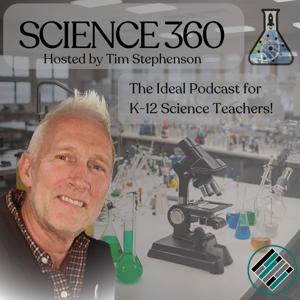
Science 360

Science 360

By Tim StephensonScience
Download on the App Store

Science 360 episodes

  • Ep. 40 - Amazon Conservation with Paul Rosolie: Protecting Rainforest Ecosystems and Wildlife
    Paul Rosolie is an Amazon conservationist, author and rain forest educator. His story found in his book "Mother of God" is a must read, but if you like to get to know the author first, then check this out. Paul and I talk about how he got his education in spite of the school system and now is the author of two books. He operates an eco-tourism company in the upper Amazon of Peru called Tamandua Expeditions. Want to experience the Amazonian rainforest firsthand? Now you know who to call!

    Paul swims with piranhas, hunts anacondas, has spent multiple nights alone in the jungle and is now on my podcast to talk about it. His message is clear...we know what to do to stop the destruction of Earth's ecosystems, so we just need to do it!

    In this episode we mention several resources and I'll list them here:
    Instagram accounts connected to Paul: @paulrosolie, @junglekeepers, @ageofunion, @tamanduaexpeditions, @darkgreen_film
    Instagram accounts mentioned in the podcast: @johnemarriott, @therealcraigleeson, @tjwatt
    Videos mentioned in the podcast: A Plastic Ocean (Netflix), In the Cross Hairs: The Road to Recovery for Alberta's Threatened Grizzly Bears by John E Marriott (YouTube)

    1 hr 26 min
  • Ep. 39 - The Bear Necessities with Bob Hansen
    In this episode, you will hear from Bob Hansen, who is the pacific rim coordinator of WildSafeBC. Bob was described to me as the "bear expert" of the west coast of Vancouver Island and as I spoke with him, I found this to be true. If you find yourself fearful of wildlife encounters, you should listen to Bob in this episode.

    I wanted to bring this episode because as a resident of this magnificent west coast wilderness, I commonly hear people asking questions about bears in the mountains. Wanting to equip myself with a greater understanding, I started to ask questions of anyone I could find who knew more than me about bears. The result is that the more I learned, the less fear I had. Not that anyone wants to be face to face with a bear, but at least I understood their behaviour better, and this understanding will guide my behaviour when I encounter one.

    Bob talks about WARP (Wildlife Alert Reporting Program) and encourages all back-country travellers to report any sightings of bear, cougar, or wolf. You can do so at 1-877-952-7277 or on your cell phone at #7277

    The following links are mentioned in the podcast:
    https://wildsafebc.com
    https://warp.wildsafebc.com
    https://www.pc.gc.ca/en/pn-np/bc/pacificrim
    57 min
  • Ep. 38 - Summer Sky Star Hopping
    If you've ever wondered what you're seeing in the night sky as you lie on the dock or in a hammock in the backyard, then this episode is for you! I take you on a summer sky star-hopping adventure, as we identify stars and constellations, starting in the northern sky then swinging around to the south.

    After listening carefully to this episode, you will be able to identify the major stars and constellations. Once you feel confident, my advice is to go share your new knowledge with someone else. Knowledge is meant to be shared, and knowing the stars is something everyone is interested in.

    So get comfy in a reclining chair, grab a blanket and a cup of hot chocolate...plug in the headphones, and let me walk you through the stars.

    If you have further questions about other space-related themes, or would like to suggest a topic for a future podcast, please connect with me via any of the following:

    Twitter: @astrostephenson
    Email: [email protected]
    Website: www.astrostephenson.ca
    33 min
  • Ep. 37 - Nutrition, Exercise and Education with Katie Muller
    Katie is a wholistic nutritionist and a personal trainer. Her approach to wellness does not mean eliminating entire food groups or spending hours on the tread mill. She trains her clients to lead balanced lives, to eat whole foods and to exercise because they love to, not because of guilt.

    I like Katie's approach and I wondered what her thoughts were on how proper nutrition and movement affects performance in school. So I asked her to talk about these things as they relate to students in school.

    Katie has evidence to suggest that students coming out of school are not equipped with the knowledge to lead them to a healthy and energized life. Many of her clients are unaware of what good eating habits are or how to exercise in a gym or on their own (other than some cardio). I tried to get her to talk about some recent research on epigenetics as it relates to nutrition and I loved her answer, which was don't over-complicate things.

    In school, do we over-complicate things because we think that makes for good education? Or do we omit things that we shouldn't because we as teachers don't have a good grasp of it? Whatever the case may be, a brain won't work well in an unhealthy body.

    Connect with Katie
    Instagram: @katiemuller.pt

    Listen to her podcast Strong and Beautiful on Apple Podcasts and Spotify
    1 hr 5 min
  • Ep. 36 - An Economic Analysis of Covid Lockdown with Dr. Doug Allen
    Dr. Doug Allen is an economist at Simon Fraser University in Burnaby, BC. He has done an extensive analysis of the research from around the world on the policy of lockdown during the pandemic. His conclusions are startling.

    It may seem obvious that the benefit of lockdown is the prevention of death due to the virus. The cost may be felt in the economy, but it will be short-lived. Except neither of the those things are true, particularly on the cost side of the ledger. In this podcast, one of my longer episodes, Dr. Allen will highlight some costs that many will not have considered and that seems to include our political leaders.

    Some may find this episode controversial, others may find it enlightening. However, it is important that in the world of education, we are willing to question, discuss and analyze based on facts. Sometimes this seems empirical, calculated and perhaps cold. But decisions like the ones we have lived with since March of 2020 can't be based on emotion and our society only advances when we listen, learn, think and grow.

    Doug mentions a website and some other papers linked here:
    https://ourworldindata.org/coronavirus
    https://www.nber.org/system/files/working_papers/w27719/w27719.pdf
    http://www.sfu.ca/~allen/LockdownReport.pdf

    Contact Dr. Allen:
    [email protected]
    1 hr
  • Ep. 35 - A Lesson for World Ocean Week
    Back in the summer of 2018, I was kayaking in Johnstone Strait on the north coast of Vancouver Island. Being passionate about education and the oceans, I took the chance to teach my fellow kayakers about the plight of the oceans.

    I edited it and am using it for this week's podcast. This is World Ocean Week and I'd like anyone with the opportunity to teach, to use some of what you might learn here about the oceans and share with your students. This is critical information and as teachers, we have to be willing to inform and share what we learn in order to have a positive impact on the future.

    I hope what you hear in this episode will help you teach your student about this critical topic...the health of our oceans.
    21 min
  • Ep. 34 - Calculating the Power of the Sun
    One of my goals for this podcast is to give teachers some material that they can use in their classroom. This episode will teach you how to run an experiment where your students can calculate the power of the Sun. It's a simple procedure but with huge and fascinating results.

    You will definitely want a pad of paper and you may need to hit the pause button a time or two. But once you have it worked out, this will become one of your favourite experiments to do with your science class. Also, it can be adapted to any level or grade.

    Have fun and go measure the Sun!
    23 min
  • Ep. 33 - International Women's Day with Britt Buirs
    This is a recording I did in the spring of 2020. I chose to replay it because Britt Buirs is one of my favourite scientists who deserves a spotlight on International Women's Day. Reality is she deserves the spotlight any day: a former student of mine, Britt went on to study at the University of Victoria and now lives and works in Ucluelet, BC where she is doing research into micro plastic pollution.

    This is a great episode for young girls to listen to and be inspired to study the sciences just like Britt. Equally, it's a great episode for teachers to gain current and relevant science knowledge on a topic that is crucial to the future health of our oceans.

    Connect with Britt on Instagram: @britt_buirs
    Find her products on www.etsy.com/ca/shop/theoceangypsea
    47 min
  • Ep.32 - An Experiment with Music and Learning
    In this episode, I attempt to demonstrate the relationship between music and learning by teaching a lesson while switching up the background music. The challenge for the listener is to determine the effect these music styles had on your ability to focus, listen and learn from the "lesson".

    This topic has been an interest of mine for years, going back to when my wife and I used music to help our own kids learn their school lessons. That was in the days of the Mozart effect.

    Since then there has been a lot of research done and there is truly a connection between music and learning. I give some examples and even sing on old song that I still remember the lyrics to!

    Also featured is music by Koresma. I got permission to use this music because I find it puts me in a mood where I'm relaxed and open to learning. I wonder if others may feel the same way.

    Find Koresma on Apple Music and Spotify and on the website:
    https://www.koresmamusic.com
    23 min
  • Ep. 31 - All About Mars
    This is a jam-packed episode, all about Mars! So you better be ready with a notepad or just enjoy listening. I hit a lot of stuff here!

    If you are a student who studies astronomy, maybe a person who just enjoys learning about space OR A TEACHER who could use some information to bring to class, then this is the podcast for you.

    Mars will always be in the news because it is our next great destination. And with a fascinating history filled with discoveries that point to the possibility of life, I think we will be learning about this planet for a long time yet.

    This is one episode and there could easily have been three just on this topic. If you have questions about Mars or want to here more about it, email me a question at www.astrostephenson.ca
    23 min

About Science 360

From the publisher's feed

Are you a science teacher seeking inspiration for teaching? Whether it's space, the climate, chemistry, biology, physics or educational theories, Science 360 explores science from all angles, offering…