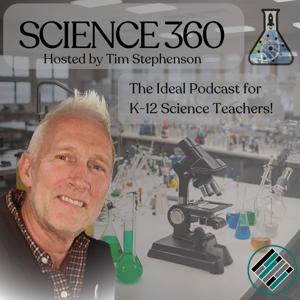
Science 360

Science 360

By Tim StephensonScience
Download on the App Store

Science 360 episodes

  • Danika Strecko of Oceanwise speaks on education and the oceans
    Danika Strecko is the education coordinator for Oceanwise, a branch of the Vancouver Aquarium. Her main goal is to raise ocean literacy among students so that they can be part of the solution to the issues facing the oceans. Danika uses both online resources/virtual meetings as well as tour groups that visit the aquarium to educate the public. The resources referred to are available at www.ocean.org. Danika also refers to the importance of citizen science and uses the example of a series of underwater cameras set up by the Ocean Network (www.oceannetworks.ca) where anyone can monitor the sealife and contribute to the scientific work. This episode will inspire any student to want to study the oceans more, and any teacher to give them that opportunity!
    39 min
  • Britt Buirs - Marine Biologist, Artist, Conservationist
    Britt, one of my former high school students, now a marine biologist is the living blueprint of my ideal human. Using her world travels to really find her true passions in life, Britt returned to university to get a degree in marine biology and now uses her love of science and art to raise awareness about plastic pollution, specifically microfibres.

    See Britt's art at brittbuirs.com, follow her Vancouver Island lifestyle on Instagram at @theoceangypsea. Britt also references a solution to microfibres called the Lint LUV-R By environmentalenhancements.ca, an invention of Nova Scotian Blair Jollimore. She will also be doing research with exxpedition.com.
    46 min
  • Dr. Dave Clements Speaks about Invasive Species
    Dr. Clements teaches at Trinity Western University in Langley, BC. He is an expert in invasive species, and a wealth of knowledge on all topics concerning the health of our natural world. In this episode, Dr. Clements speaks about invasive plants and animals in the Pacific Northwest, in Hawaii and why it matters. This very interesting talk will leave you noticing the plants in your surroundings and help you realize why interfering with nature by our ruthless invasion of land and sea, leaves us vulnerable to loss of species and viral pandemics.
    39 min
  • Drawing the Solar System to scale
    Today's episode was recorded for the Covid19Ed podcast, designed for younger students to learning new things during a time of social distancing. But this one involves a lot of math! You will also need supplies including a pencil, some paper, a ruler, a calculator, some pencil crayons and even a measuring tape. Listen carefully how mathematics describes the solar system, how we used math to discover two major objects (a planet and the largest asteroid). For fun, I also threw in a mini lesson on the Goldilocks zone, where planets are not too hot and not too cold, but just right! Enjoy...this one will make you work for it!!

    36 min
  • Talking space with Canadian astronomer Bill Burnyeat
    In this episode, I interview Bill Burnyeat. Bill is a wealth of knowledge as you will hear. There is really no topic of space that Bill can't speak to. From star clusters, to the Moon, a historical perspective of astronomy...he even relates the Sun's activity to climate change. This is 42 minutes of non-stop astro-geeking and you're going to find it very interesting. This won't be the last time I have Bill on the show.
    43 min
  • Ep. 5 - Tim Stephenson discusses education with Conservationist Adrian Midwood
    In this episode, I sit down with Adrian Midwood and we discuss the role of education in everything from plastic pollution, oceans, climate, covid and more. I highlight some of my most valued educational theories and give examples of some of the great work done by my students. The key take away is the missional approach today's students have towards their education. If it means something, they will change the world!
    36 min
  • Ocean Acidification - A Lesson from Johnstone Strait
    This episode was recorded on the shores of Johnstone Strait, on the coast of British Columbia. Throughout, you can hear the waves of the ocean lapping up as I teach a group of kayakers about the link between climate change and ocean acidification. This lesson delves into some chemistry, some consequences of an acidifying ocean, but as always, I will leave you with an element of hope.
    13 min
  • Climate Change - Basics for young minds
    In this episode, also pre-recorded for my colleagues podcast called Covid19Ed, I teach young people about the story behind the environmental movement, I link it to the Apollo era, and I describe some activities that middle school or younger audience members can do. I finish by describing some actions that we can all take when dealing with the health of Earth. I play a short excerpt from Greta Thunberg's TED talk which is available at https://www.ted.com/talks/greta_thunberg_the_disarming_case_to_act_right_now_on_climate_change?utm_campaign=tedspread&utm_medium=referral&utm_source=tedcomshare
    31 min
  • Salmon talk with Chris Hall
    In this episode, I interview Chris Hall, a naturalist/conservationist, working at Trinity Western University. Chris describes the life cycle of the salmon, the connection of the salmon to the ecosystem of the Pacific Northwest and how climate change is affecting it's behaviour.
    28 min
  • Northern Sky Star Mapping
    In this episode, I describe how I got interested in space as a young boy. Then I give a description of how to draw a basic star map for the Northern Sky in March. This was recorded for a friend's podcast (Covid19Ed Podcast) intended for a younger audience isolated at home during the Covid crisis. I sum up with a reference to Carl Sagan's story of Contact and where we can find intelligent life.
    19 min

About Science 360

From the publisher's feed

Are you a science teacher seeking inspiration for teaching? Whether it's space, the climate, chemistry, biology, physics or educational theories, Science 360 explores science from all angles, offering…