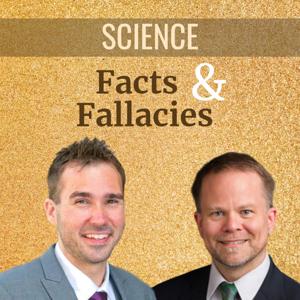
Science Facts & Fallacies

Science Facts & Fallacies

By Cameron EnglishNewsScienceEducation
Download on the App Store

Science Facts & Fallacies episodes

  • Podcast: Retracted hydroxychloroquine-COVID studies backlash; Obesity cancer drugs? ‘Unbiased’ Guardian takes animal rights money
    Two major studies which found that the anti-malaria drug hydroxychloroquine doesn't treat COVID-19 have been retracted. What does that mean for the drug—and the peer-review process? UK newspaper the Guardian accepted more than $800,000 to publish an anti-farming investigation, which two biologists say is filled with inaccuracies. Has the coronavirus pandemic killed the public's interest in fad diets and junk science? Cancer drugs that target an "obesity" gene might help us stay slim without exercising or dieting.


    Join geneticist Kevin Folta and GLP editor Cameron English on this episode of Science Facts and Fallacies as they break down these latest news stories:

    * Is hydroxychloroquine useless and dangerous, or not? Major study released last week dissing therapy now under scrutiny

    Based on the conclusions of two large studies published in the Lancet and the New England Journal of Medicine, experts have chastised President Donald Trump and a relative handful of physicians for claiming that hydroxychoroquine could treat COVID-19. Those papers have now been retracted following revelations that they were based on possibly manipulated (or even fabricated) data.

    Surgisphere, the company that supplied data for the studies, has so far refused to let independent investigators see the raw numbers.  Although other research indicates that the anti-malaria drug is still unlikely to be effective against the novel coronavirus, the retractions raise awkward questions about why the peer-review process didn't catch obvious problems with the two studies in the first place.

    * Viewpoint: News or propaganda? UK newspaper the Guardian paid over $800k to publish anti-farming ‘investigation’

    Describing itself as a source of "open, honest, fearless journalism," UK newspaper the Guardian claims it's beholden to no "shareholders, advertisers or billionaire owners."  Nonetheless, the paper recently ran a series of stories attacking animal agriculture, which it was paid well over $800,000 to do by a non-profit with ties to the animal rights movement. Biologists Henry Miller and Rob Wager took notice, pointing out that the stories contained blatant scientific mistakes and presented a misleading analysis of modern food production.

    * Has coronavirus killed consumer interest in food fads and junk science?

    Consumer interest in "natural" cleaning products, gluten-free foods and other health and wellness fads has waned in the wake of the coronavirus pandemic. But as the public slowly returns to normal life, the more important question to answer is: Will this pro-science change of heart last? We may have cause to be optimistic.

    * ‘Thinness gene’ could offer genetically engineered weight control strategy

    Some people are naturally prone to weight gain. Others, meanwhile, stay slim no matter how little they exercise and how much they eat. A new study investigating the biological basis of this phenomenon has uncovered a gene...

    38 min
  • Podcast: Pesticides prevent cancer. Growing drugs in GMO plants; battling diabetes with CRISPR
    Rapid advances in biotechnology could help prevent hundreds of thousands of diabetes deaths every year. Growing drugs in GMO plants is poised to cut prescription costs and make medicine more accessible to people all over the world. Archaeologists say they may have identified when and how humans evolved self-control. And Greenpeace wants to ban fungicides that prevent cancer-causing toxins from entering the food supply.


    Join geneticist Kevin Folta and GLP editor Cameron English on this episode of Science Facts and Fallacies as they break down these latest news stories:

    * ‘Sugar is the villain’: Biohacking and synthetic biology do battle against diabetes and heart disease

    Fueled largely by poor lifestyle choices, diabetes kills almost 100,000 Americans every year, and by 2030, the US may be looking at an annual death toll of 400,000. But rapid treatment advances in the next decade, and maybe sooner, could reverse this deadly trend. Using the tools of modern biotechnology, researchers are developing refined continuous glucose monitoring (CGM) devices that help type 1 and type 2 diabetics accurately track their blood sugar levels, genetically engineered insulin that responds to those levels and, perhaps most importantly, synthetic sweeteners that would replace sugar in the diets of people at risk for diabetes.

    * Tracking down the evolution of an essential human skill: self-control

    We all know the importance of self-control, a vital skill that helps us mitigate the difficult situations we inevitably face throughout life, like staying at home during a pandemic. But how did it evolve? According to new archaeological research, our ancestors may have acquired self-control as they learned to make more sophisticated tools. The advances in craftsmanship necessary to build a collection of 500,000-year-old flint axes unearthed in a gravel quarry in England suggest that early hominins acquired "a combination of cognitive abilities including inhibition and the conscious regulation of emotions" sometime between 1.8 million and 500,000 years ago.

    * Drug factories: GMOs and gene editing are poised to transform medicine. Here’s how.

    Instead of getting an annual shot, imagine eating a tomato that would immunize you against the flu every year. Such a scenario is less science fiction than you may think. Scientists are beginning to grow biologic drugs, those derived from living organisms (like vaccines), in genetically engineered plants. This approach eliminates or minimizes a number of logistical problems that keeps prescription prices high and life-saving medicines inaccessible to millions of people around the world.

    * Viewpoint: Greenpeace lobbies to ban fungicides that kill cancer-causing mycotoxins

    The plants we eat are under constant attack from all kinds of microbes, some of which can be deadly to humans if they make it into our food supply. Farmers prevent this by treating their fields with pesticides, but environmental activists led by Greenpeace want many of these chemicals banned. SDHI fungicides,
    39 min
  • Podcast: Fungi destroy $60 billion worth of food each year. Are natural biopesticides the answer?
    Food waste plagues both farmers and consumers. Americans throw out much of what we buy at the grocery store—roughly 133 billion pounds of food each year, or $161 billion worth, according to the USDA, often because it spoils before we eat it.  And farmers regularly lose their crops to harmful pests and pathogens, anywhere from eight to nearly 30 percent of their yields depending on the crop they grow, a 2019 study found.

    Synthetic pesticides are the obvious solution to pests in the field and post-harvest food spoilage caused by microbes. But with consumers always concerned about pesticide exposure and strict regulations governing the use of these chemicals, farmers and food packagers are increasingly turning to a suite of natural products known as biopesticides, pest control tools derived from plants and microorganisms the EPA considers inherently less risky.

    Jamie Bacher

    On this episode of Science Facts and Fallacies, Jamie Bacher, molecular biologist and co-founder of biotech startup Boost Biomes, joins GLP editor Cameron English to discuss his company's novel approach to battling pests and promoting sustainable agriculture. Boost's first product is a biofungicide made from a pair of microbes designed to control a wide variety of fungi that can damage fruits and vegetables in the field, and in your fridge.

    Early tests indicate the product could help put a dent in the $60 billion worth of food we lose to fungal disease each year, and Bacher anticipates that regulators and consumers will have little objection to its use as biopesticides start to play an ever-larger role in food production in the coming years.


    Jamie Bacher holds a Ph.D. in molecular biology from the University of Texas at Austin and co-founded Boost Biomes in October 2016. Follow him on LinkedIn 

    Cameron J. English is the GLP’s senior agricultural genetics and special projects editor. Follow him on Twitter @camjenglish

     
    27 min
  • Podcast: Cancer-causing baby powder? USDA cuts GMO rules; plant-based meat less healthy than you think
    In an effort to keep up with rapidly evolving technology, the USDA has revamped its biotech crop rules, sparking a new debate over how GMO and gene-edited plants should be regulated. Opioids: What are they, where did they come from and why are they so addictive? Consumers have eagerly embraced plant-based meat, but it appears they overestimate its nutritional benefits. Johnson & Johnson is pulling its talc-based baby powder out of US stores following billion-dollar lawsuits alleging it causes ovarian cancer. Is there any science behind these claims?


    Join geneticist Kevin Folta and GLP editor Cameron English on this episode of Science Facts and Fallacies as they break down these latest news stories:

    * USDA’s relaxed biotech crop rules could speed plant development, but are regulations still too strict?

    The USDA has streamlined its 30-year-old biotech crop regulations, a move the agency says will foster innovation as tools like CRISPR-Cas9 enable plant breeders to produce new plant varieties with qualities desirable to both consumers and farmers. Critics of the new rules claim biotech seed companies can now commercialize almost any crop they want without oversight from the federal government, while many scientists say the rules are still too strict. So, which is it?

    * How the halo effect around plant-based meat leads us to exaggerate its nutritional benefits

    Plant-based burgers are perfectly safe to consume and, depending on whom you ask, may alleviate the environmental impacts of animal agriculture. But none of that makes Impossible and Beyond Burgers more nutritious than meat, which a comparison of their nutrition labels will confirm. Nonetheless, consumers consistently overestimate the healthfulness of meat alternatives, because our brain plays tricks on us. How does this happen, and what can we do to become more critical consumers of food—and information?

    * Video: What makes opioids so addictive

    America's opioid epidemic has killed thousands of people. Everybody knows that these powerful pain killers are addictive, but few people understand the science of how they work, why they can be so deadly and what society can do to prevent unnecessary death and suffering. Here's a short course to catch you up on what you need to know.

    * Johnson & Johnson halts talcum powder sales in the US and Canada, citing declining demand in the face of cancer lawsuits

    Following a string of expensive lawsuits, pharmaceutical giant Johnson & Johnson has pulled its talc-based baby powder out of US stores. Together with investigations published by the New York Times and
    45 min
  • Podcast: Ban ‘factory farming’? GMO mosquitoes coming this summer; anti-biotech groups aren’t ‘grassroots’
    As clinical trials begin of several candidate coronavirus vaccines, a former FDA scientist says the agency could speed up its approval process and get a safe vaccine to market much faster. The EPA has approved a summer release date for disease-fighting GMO mosquitoes. Is this a public health victory or an impending disaster? Anti-GMO groups claim they are grassroots watchdogs, David taking on the biotech industry Goliath. New evidence gathered by the GLP raises serious doubts about this Bible-inspired narrative. Finally, two US senators want to ban 'factory farming.' How would their proposal impact food production?


    Join geneticist Kevin Folta and GLP editor Cameron English on this episode of Science Facts and Fallacies as they break down these latest news stories:

    * Viewpoint: ‘We can’t afford miscommunication or bureaucratic foot-dragging’ in the quest for a coronavirus vaccine

    Experts have said a COVID-19 vaccine won't be ready for at least 12-24 months, and will probably take much longer to reach consumers. Former FDA scientist Henry Miller argues his ex-agency could shorten that timeline by eliminating certain regulations and testing procedures, without putting public health at risk. "Covid-19 is a genuine emergency," Miller writes. "Drug and biotech companies and academic institutions are doing their part, and regulators need to, as well."

    * EPA approves GM mosquito trial in Florida Keys to combat zika virus and dengue fever

    The EPA has approved the release of a genetically engineered Aedes aegypti mosquito designed to suppress its disease-vectoring wild relatives. The modified insect carries a self-limiting gene that prevents its female offspring (the ones that spread diseases) from surviving. Over time, this approach crashes the invasive mosquito populations that spread Zika and dengue, both of which can be very harmful.

    But critics allege GMO mosquitoes pose a serious ecological risk we may not be able to control once they're released. What does the science say?

    * Anti-GMO Advocacy Funding Tracker: Vast network of donors and NGOs seed doubt about crop biotechnology

    Anti-GMO groups present themselves as 'grassroots' activists blowing the whistle on unethical biotech companies. A year-long investigation by the Genetic Literacy Project confirms that this story is an exaggeration, to say the least. Activist groups, it turns out, have received nearly a billion dollars in recent years from organic food companies and wealthy foundations, which finances their carefully orchestrated campaigns to demonize mainstream scientists who teach the public about crop biotechnology.

    * Sens. Elizabeth Warren, Cory Booker propose phased in ‘factory farming’ ban to clamp down on ‘Big Ag’

    With the US facing ...
    40 min

About Science Facts & Fallacies

From the publisher's feed

From CRISPR gene-edited embryos to GMO crops, biotechnology is revolutionizing medicine and farming. Scientists are increasingly able to make targeted genetic tweaks to humans, plants and animals to…