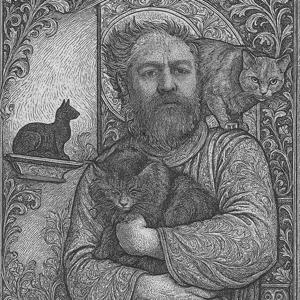
This text comes from a 19th-century Spiritualist publication titled The Relation of the Spiritual to the Material Universe; The Law of Control (1881), attributed to the “dictation” of Michael Faraday from the afterlife to a Spiritualist medium. It offers a key example of the interpenetration of material science and spiritual science in the 19th century.
Michael Faraday (1791–1867) was one of the most important experimental scientists of the 19th century. His work in electromagnetism laid the foundation for modern electrical engineering, and his experimental rigor helped shape the very idea of what we now call “modern physics.” He is not known in any historical sense to have supported spiritualist communication after death. This text is a key example of how spirit communication helped Spiritualists redefine scientific and religious authority.
This Substack is reader-supported. To receive new posts and support my work, consider becoming a free or paid subscriber.
The ghost of Faraday expounds a metaphysical reinterpretation of his scientific career. Material forces and spiritual forces are continuous, interacting fields of influence, connected by transmissible “forces” that bind the visible and invisible worlds together. Communication between realms is a natural extension of nature, like a kind of cosmic circuitry.
The key tension it reveals is not between science and spirituality, but between different interpretations of material causality itself. On one hand, classical scientific materialism tends to reduce reality to inert matter governed by mechanical laws. On the other hand, Spiritualist readings like this one re-enchant matter by treating it as already permeated by intelligence, agency, and transmissive force.
Critical enchanted materialism tries to hold both insights without collapsing into either naive supernaturalism or reductive materialism. It treats “enchantment” not as a violation of nature, but as a feature of how material systems are experienced, interpreted, and organized by consciousness.
THE RELATION OF THE SPIRITUAL TO THE MATERIAL UNIVERSE
The connection of invisible forces with visible matter brings the entire realm of organized existence into the domain of the scientist. Since he studies matter in all its conditions—both in the invisible atom and in the largest planetary systems—he ought, in principle, to be able to discover the true relationship between the spiritual (invisible) and the material (visible) universe.
Such discoveries would not be less valid simply because they appear to conflict with the opinions of a given age, for materialistic theories have not yet been demonstrated upon the basis of absolute knowledge of the great forces that produce observable organization. True science never ignores cause while observing effect. When the investigator sees apparently lifeless masses of material composing a planet yet exhibiting motion, transformation, and integration into living organisms, he is compelled to acknowledge that behind these visible appearances there must be an operative power responsible for such changes—subtle, yet accessible to analysis when the intellect is properly directed.
The field now entered has often been considered exempt from scientific inquiry and too sacred for investigation. Yet if behind the material universe there exists another universe, and if these two realms act and react upon each other, then no subject could be more important to science or more valuable to humanity than a true understanding of the spiritual universe.
To obtain such knowledge, the scientist must analyze matter, observe chemical action upon atomic combinations, determine the forces required to disorganize and reorganize compounds, and examine the principles by which such transformations occur. He must apply the same precision to living organisms that he applies to mineral and metallic substances. In doing so, he will be led to the conclusion that matter is connected with a formative power beyond visible manifestation—what some call the “unknown” or “unknowable,” but which may be understood as the reflex action of the invisible or spirit universe upon the visible or material universe.
Our inquiry begins at the level of elemental chemistry, where matter exists in the atomic condition. Here we reach the limits of material scientific analysis, for atoms are invisible and indivisible, existing in a state that cannot be directly compared or measured in ordinary terms. Yet we are compelled to conclude that matter does exist in this condition, since no chemical process has ever succeeded in destroying a single particle of substance. Chemical action alters relationships between elements but does not annihilate matter itself.
This principle underlies all manifestations of life and physical existence. The proper path of inquiry into both material and spiritual conditions lies in understanding chemical law and its application to all forms of matter in both visible and invisible states. Matter can be shown to pass through combinations and separations without loss of substance; its elements persist, capable of recombination when conditions permit.
For example, paper is composed of elements that once existed in vegetable form through a vitochemical process. When burned, oxygen from the atmosphere—whose atoms are in rapid motion—enters the combination, restoring equilibrium, and the paper disappears. Its elements are returned to invisible states, leaving only ash as residue. Every chemical transformation follows this principle of atomic equilibrium: while form changes, matter itself is never lost.
It is therefore a fundamental principle that not one particle of matter or impulse of force can be destroyed. Elements retain the capacity to recombine whenever conditions allow.
The term spirit originally referred to air. In early thought, all invisible or subtle phenomena were described as spiritual, as in the air itself. Ancient alchemists and philosophers often had a more developed sense of spiritualized matter than modern thinkers, recognizing the importance of the atmosphere as a vitalizing principle. Life, then, is not sustained by oxygen alone, but by subtle invisible forces associated with it.
If spirit is understood as invisible matter, we can now observe its effects upon visible matter. A piece of granite, for example, may appear lifeless and incapable of supporting life. Yet the Earth itself was once composed entirely of such mineral substance, and it now sustains abundant life. Through processes such as fire, water, ice, and erosion, the surface of the Earth was transformed. Yet these physical forces alone cannot account for the emergence of life. Another force must have been liberated—one that activated the elements into increasingly complex organization.
Through progressive molecular activity, matter entered proto-plasmic conditions capable of supporting organization. This intermediate state exists between inert matter and highly active invisible matter. From this arises the paradox of chemical combination: when atomic motion reaches equilibrium at a low vibrational rate, visible inorganic structure appears; when motion increases beyond perception, invisible conditions result.
This invisible condition of matter—what may be called spirit material—is identical in substance to visible matter, differing only in degree of atomic motion. It is therefore scientifically reasonable to affirm the existence of an invisible world and to recognize its intimate relationship with the visible one. Both consist of matter, both operate under similar elemental laws, and both interpenetrate each other as complementary aspects of a single reality.
Matter cannot be annihilated, nor can its properties be destroyed. Therefore, if matter becomes organized into living form, that organization must persist in some condition after apparent dissolution. The material body returns to elemental states, but the forces that organized it do not cease to exist. Since force cannot be lost, it must persist in the invisible or spiritual condition.
Thus, spirit organization continues after physical dissolution. The physical body represents a compromise between highly active spiritual matter and more inert physical matter. It is not self-originating but a reflection of the forces composing it. Mental and physical qualities alike express the ratio of this combination.
It is therefore impossible for mentality to originate outside physical organization; rather, it continues after dissolution because it is part of the organizing principle itself. A spirit form is still material in nature, though operating at a higher degree of atomic motion and possessing greater responsiveness to will and intelligence.
Wherever matter is raised to a state of full atomic activity, it enters the realm of spirit material. Every living organism thus contains a corresponding spiritual structure, and human behavior reflects the activity of this internal organizing power. This is observable in the way nervous and muscular systems respond to mental impulse, as if crystallization were occurring under invisible law.
From this perspective, the spiritual and material worlds are counterparts of one another. The spiritual is not separate from the real, but rather constitutes the deeper order of reality. Life continues beyond physical dissolution because the organizing forces remain intact and capable of recombination.
In this sense, the so-called “death” of the body represents only the withdrawal of visible form, not the destruction of organizing principle. Force persists, and therefore intelligence associated with force persists as well.
Finally, communication between visible and invisible realms may be understood through principles analogous to electricity and vibration. Just as electrical systems transmit signals through conductive media, nervous systems transmit impressions through vibratory activity. The same principle allows interaction between physical organisms and spiritual intelligences operating at compatible rates of motion.
In this way, the invisible and visible realms are not separate domains but interrelated conditions of a single continuum of matter and force.
— M. Faraday
This Substack is reader-supported. To receive new posts and support my work, consider becoming a free or paid subscriber.
This is a public episode. If you'd like to discuss this with other subscribers or get access to bonus episodes, visit mitchellkjones.substack.com/subscribe