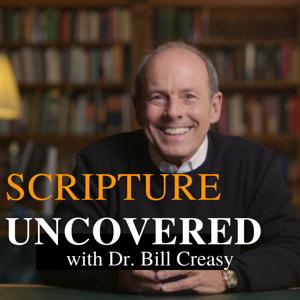
Scripture Uncovered

Scripture Uncovered

By Logos Bible StudyReligion & Spirituality
Download on the App Store

Scripture Uncovered episodes

  • Bonus Episode: Introducing the Psalms
    In this bonus episode, we're airing Dr. Creasy's introduction to the Psalms, part of his new release, The Psalms: A Journey through the Poetry of Experience - available now at www.logosbiblestudy.com/psalms
    42 min
  • On the Road with Logos, Pt. 2 - Thessaloniki & Athens
    Dr. Creasy and his intrepid Logos students arrive in Thessaloniki, the second largest city in Greece, where St. Paul had little success. St. Paul spent only three Sabbath days there . . . and he was chased out of town. Not to be discouraged, St. Paul, Silas, Timothy and Dr. Luke continue west across Macedonia, about 45 miles to Berea, a much smaller town. Here, the Bereans are much more accepting of St. Paul’s message, although, being more noble than the Thessalonians, they “checked the Scriptures every day to see if what St. Paul said was true.” And then the Thessalonian trouble makers show up . . .
    Dr. Creasy teaches live at St. Paul’s Square in Berea!
    After the Thessalonian mob caught up with St. Paul in Berea, Silas and Timothy put Paul on board a ship bound for Athens to save him from being stoned. Athens was well past its golden age of the 5th and 4th centuries B.C., but the patina of culture and learning still clung to its somewhat worn and faded image. When St. Paul entered the city, he took a tour, noting its many temples, and he realized what a challenge it would be to Christianize his Greco-Roman world. Standing at the foot of the Acropolis, several Epicurean and Stoic philosophers invited St. Paul to speak at the Areopagus—what Dr. Creasy calls the “faculty club” of Athens—and he does so . . . with surprising results.
    Join Dr. Creasy and his Logos adventurers as he teaches live from
    “Mars Hill,” in the shadow of the Parthenon!

    33 min
  • On the Road with Logos, Pt. 1 - “St. Paul Meets Lydia and her Friends”
    Dr. Creasy just arrived in Greece with his intrepid Logos students, traveling “In the Footsteps of St. Paul.” Their first stop is Philippi, where St. Paul, Silas, Timothy and Luke set foot on the continent of Europe for the first time. In St. Paul’s day, Philippi was a Roman Garrison town, and there were not even ten Jewish men there to form a synagogue, St. Paul’s typical starting place for his missionary work in a new city. So, what to do? Ah, ha! Go down by the Zyagtis River on the Sabbath, and perhaps there will be some god-fearing people there praying. And sure enough, St. Paul meets Lydia and her friends “down by the riverside,” and they become St. Paul’s first converts on the continent of Europe!
    In the second segment of the Podcast, Dr. Creasy and his adventurers continue exploring Philippi, including the 5,000-seat Greco-Roman theater, the Agora and the prison where St. Paul and Silas cooled their heels after being arrested and flogged!
    This podcast was recorded live in Philippi, Greece!
    30 min
  • In the Footsteps of St. Paul
    Dr. Creasy is leaving this week with 38 of his intrepid Logos students on a teaching tour of Greece, walking (and sailing) “in the footsteps of St. Paul.” Teaching tours to the Holy Land and the Mediterranean world are an integral part of the “Logos experience,” for teaching Scripture onsite, where the stories actually occur, adds color, tone and texture to the narratives. When you read the Bible today, you read it in black-and-white—black letters on a white page—but after traveling with Dr. Creasy to the sites where the stories take place, you’ll read the Bible in Technicolor!
    This week’s Podcast is an introduction to St. Paul and to some of the sites Dr. Creasy and his students will be visiting. At each site Dr. Creasy will record his teaching, and you’ll hear it right here on Scripture Uncovered over the next several weeks!
    So, stay tuned . . . and tell a friend!
    20 min
  • Introducing Revelation, Part 2
    This week, we bring you part two of Dr. Creasy's Introduction to Revelation. We'll be back next week with the regular programme, when Dr. Creasy will discuss our latest Logos teaching tour, In the Footsteps of St. Paul - in Greece!
    Podcast listeners can get 30% off enrollment in Dr. Creasy's course on Revelation in the Logos Online Classroom. Visit logosbiblestudy.com and enter coupon code "patmos2018" at checkout.
    48 min
  • Introducing Revelation
    This week, Dr. Creasy is preparing for the upcoming Logos Teaching Tour, "In the Footsteps of St. Paul - in Greece". Fifty Logos students are traveling with Dr. Creasy, and one of the places they will visit is the Island of Patmos, where the Book of Revelation was written. So we're bringing you something different on the podcast this week: Dr. Creasy's introductory lecture from his course on Revelation.
    The course is available in the Logos Online Classroom, and podcast listeners will get 30% off enrollment in Revelation by entering coupon code "patmos2018" at checkout.
    Next week, we will be back with our regular format. Blessings to all!
    49 min
  • Reflections on Death
    As we moved through Holy Week and Good Friday, Jesus’ impending death and crucifixion loomed large, casting a deep, dark shadow, only to explode into a burst of light on Easter morning. Jesus’ death, burial and resurrection set the pattern for all who follow him. But what will it be like, to walk through the valley of the shadow of death? And what is our final destination?
    Plus, listener questions:
    1) The bible says the Holy Family fled to Egypt after Joseph was warned in a dream. Herod then has all male children under two killed. I have heard they were in Egypt for seven years, but Jesus is presented at the temple as an infant when we hear of Simeon and Anna. My question is how long were they in Egypt, did they present Jesus before going?
    2) What does the Catholic bible say about the rapture?
    30 min
  • Denial, Guilt and Regret: Thoughts on St. Peter
    Last week Dr. Creasy explored Judas and his betrayal of Christ. This week he turns the lens on St. Peter. When Jesus and his disciples end the Passover meal, leave the upper room and head toward the Garden of Gethsemane, Jesus tells Peter that Satan is about to sift him “like wheat,” but Jesus prays that Peter’s faith not fail. Peter immediately objects, saying, “Lord, I am prepared to go to prison and to die with you” (Luke 22: 33). Yet, we know that in the courtyard of the high priest, Peter denies Jesus not once, but three times.
    Judas had betrayed Jesus, and as a consequence hanged himself. But what of Peter?
    Plus, listener questions:
    I'm a parishioner at Mission San Diego and I have 2 boys. My youngest son who has gone to Nazareth school from pre-school to the 8th grade is now in high school, and he says evolution makes more sense to him than people all coming from the same two people, Adam and Eve. How would you explain Adam and Eve vs evolution to him? Thank you and I love your classes!
    Do you believe that non-believers who die are given an opportunity to accept Christ and to find salvation? Is this what the Church means by 'purgatory'?
    29 min
  • Judas, the Betrayer (A Closer Look)
    On Good Friday, we read the story of Judas betraying Jesus, of Jesus’ arrest in the Garden of Gethsemane, of his trial and of his crucifixion and death. Judas played a central role in the drama. Historically, Judas has been portrayed as the archetypical betrayer, a loyal follower who sold out his Lord for thirty pieces of silver. In the Divine Comedy, Dante places Judas in the very jaws of Satan in the ninth circle of hell.
    Yet, Judas was with Jesus for his entire three-year public ministry; he shared meals with Jesus; he witnessed Jesus’ teaching and preaching; and he saw the miracles Jesus performed.
    So, why would Judas betray Jesus? Thirty pieces of silver is mere pocket change. There must be more to it than that . . .
    Plus, Dr. Creasy answers listeners' questions:
    1) I find the Holy Spirit to be a difficult concept to explain. Is the Holy Spirit an expression of God’s love for his Son and for us? Or is the Holy Spirit something else? Could you enlighten us on this?
    2) Who compiled the Bible, and how can we be sure that he or she included the correct books or left something out?
    31 min
  • Easter Special: Reflections on Jesus’ Resurrection
    As Holy Week is the pinnacle of the liturgical year, Easter is the pinnacle of Holy Week. Easter remembers and celebrates Jesus’ resurrection from the dead. The resurrection is the central event of Christianity, for without Jesus’ physical, bodily resurrection, Christianity is a fraud, either a deliberate lie or a naïve delusion. Christianity stands or falls on the literal, physical, bodily resurrection of Christ. So, what evidence do we have that Jesus’ resurrection actually occurred?
    And Dr. Creasy answers listeners' questions:
    Who do you think wrote Revelation? Is there evidence that John the gospel writer wrote it? Is there evidence that the writer knew Jesus personally? What do you think the writer of Revelation would think about today’s readings, interpretations and applications of his/her book?
    In your teaching of Exodus you say that the “golden calf” is an image or icon of the Egyptian goddess Hathor. In another place you refer to the golden calf as Apis. Which is it?
    29 min

About Scripture Uncovered

From the publisher's feed

Former UCLA professor Dr. Bill Creasy has been called a “bible teacher extraordinaire.” For over twenty years, Dr. Creasy was consistently ranked among the top 2% of all UCLA teaching faculty. His…