Search for a Cure

Search for a Cure

By Ludwig-Maximilians-Universität MünchenMedicineEducationNatural Sciences
Download on the App Store

Search for a Cure episodes

  • A long way
    What will help to stop cell death? The idea is to prevent the agglutination of the amyloid, or Tau, protein from occurring in the first place. There are already chemicals that should reduce the agglutination of the Tau protein: one of them is methylene blue. In the test tube it has already been proved that the substance can prevent Tau agglutinations. The researchers first have to find out whether this also works in an animal model: Both the healthy fishes and the Tau fishes are treated with different concentrations of methylene blue. Can this be used to reduce the number of dead cells?
    0 min
  • Coloured Fish
    Dominik has actually succeeded in implanting the zebra fish with the human Alzheimer’s gene. But how will the fish larvae react to the new gene and the illness? Will the fish show symptoms of the disease, such as agglutinations of the Tau protein in nerve cells? Only then can the researchers use the fish to test medicines which could eventually also help people.
    0 min
  • Larvae-Lights
    How do you make an Alzheimer's fish? To do this, first the "Tau" Alzheimer's gene must be injected into the fish larvae. In order for the egg to accept the foreign DNA into its genetic material and thereby allow the Alzheimer's gene to form, it must first be prepared—a difficult task. Because, in order to do this, a piece of the human DNA must be cloned into a so-called vector and marked with a dye. When the nerve cells of the injected fish illuminate red under the laser microscope, the researchers know that they've succeeded!

    0 min
  • More than just pretty
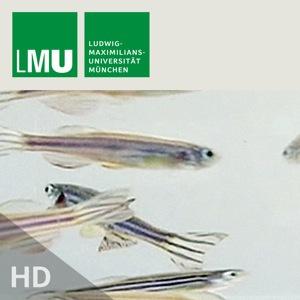
    Only the best for the little one: the zebra fish is nurtured and cared for. Because only when the fish is healthy, does it produce many eggs — and these are the basis for the Alzheimer's research. They will be genetically changed in such a way that the fish will later develop the same symptoms as an Alzheimer's patient. This is possible for a reason one might not suspect at first glance: fish have an internal blueprint similar to that of humans. Among other things, the nerve cells in a zebra fish function in the same way as they do in a human brain. Will there soon be more fish darting about in the zebra fish tank?
    0 min
  • The nerve killer
    Amyloid – a protein which plays a key role in the pathogenesis of Alzheimer’s disease. Everyone has it in their body, but not everyone develops the disease. But why? And why does the risk increase with age?
    0 min
  • A look into the brain
    Alzheimer's: no longer knowing where you are, who you are or what you were going to do... To find an agent that counters this most frequent form of dementia, the researchers have bred thousands of zebra fish, which, through the use of genetic methods, now develop symptoms of the disease. The researchers are able to look directly into the brains of their transparent research subjects...
    0 min

About Search for a Cure

From the publisher's feed

More than one hundred years ago, Alois Alzheimer described for the first time the disease that now bears his name. In spite of intense research, there is still no medication that can cure Alzheimer's.…

More shows like Search for a Cure

Hegel lectures by Robert Brandom, LMU Munich by Robert Brandom, Axel Hutter

Hegel lectures by Robert Brandom, LMU Munich

7 Listeners

MCMP – Philosophy of Science by MCMP Team

MCMP – Philosophy of Science

1 Listeners

MCMP – Mathematical Philosophy (Archive 2011/12) by MCMP Team

MCMP – Mathematical Philosophy (Archive 2011/12)

6 Listeners

LMU Physik 2 für Chemiker (PN2) SS2016 by Prof. Dr. Jan Lipfert

LMU Physik 2 für Chemiker (PN2) SS2016

0 Listeners

MCMP by MCMP Team

MCMP

2 Listeners

Institut für Produktionswirtschaft und Controlling (LMU) by Prof. Dr. Dr. h.c. Hans-Ulrich Küpper

Institut für Produktionswirtschaft und Controlling (LMU)

0 Listeners

MCMP – Philosophy of Mathematics by MCMP Team

MCMP – Philosophy of Mathematics

2 Listeners

MCMP – Philosophy of Physics by MCMP Team

MCMP – Philosophy of Physics

3 Listeners

Fakultät für Mathematik, Informatik und Statistik - Digitale Hochschulschriften der LMU - Teil 01/02 by Ludwig-Maximilians-Universität München

Fakultät für Mathematik, Informatik und Statistik - Digitale Hochschulschriften der LMU - Teil 01/02

1 Listeners

Epistemology and Philosophy of Science: Prof. Dr. Stephan Hartmann – HD by Ludwig-Maximilians-Universität München

Epistemology and Philosophy of Science: Prof. Dr. Stephan Hartmann – HD

1 Listeners