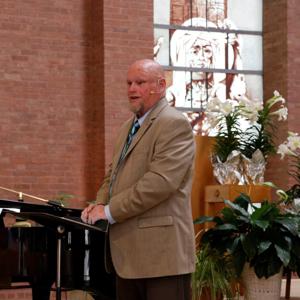
Second Baptist

Second Baptist

By Pastor Steve MechemReligion & SpiritualityChristianity
Download on the App Store

Second Baptist episodes

  • Advent Family Album - Joseph & Mary
    Luke 1:26-34 Common English Bible
    When Elizabeth was six months pregnant, God sent the angel Gabriel to Nazareth, a city in Galilee, to a virgin who was engaged to a man named Joseph, a descendant of David’s house. The virgin’s name was Mary.
    When the angel came to her, he said, “Rejoice, favored one! The Lord is with you!” She was confused by these words and wondered what kind of greeting this might be.
    The angel said, “Don’t be afraid, Mary. God is honoring you. Look! You will conceive and give birth to a son, and you will name him Jesus. He will be great and he will be called the Son of the Most High. The Lord God will give him the throne of David his father. He will rule over Jacob’s house forever, and there will be no end to his kingdom.”
    Then Mary said to the angel, “How will this happen since I haven’t had sexual relations with a man?”
    Matthew 1:18-21, 24
    This is how the birth of Jesus Christ took place. When Mary his mother was engaged to Joseph, before they were married, she became pregnant by the Holy Spirit.
    Joseph her husband was a righteous man. Because he didn’t want to humiliate her, he decided to call off their engagement quietly.
    As he was thinking about this, an angel from the Lord appeared to him in a dream and said, “Joseph son of David, don’t be afraid to take Mary as your wife, because the child she carries was conceived by the Holy Spirit. She will give birth to a son, and you will call him Jesus, because he will save his people from their sins.”
    When Joseph woke up, he did just as an angel from God commanded and took Mary as his wife.
    ____
    Pastoral Prayer
    O Lord,
    May this holiday season to be filled with light instead of darkness.
    The light that comes from unconditional love.
    The light that comes from genuine graciousness.
    The light that comes from kindness and mercy.
    The light that comes from engagement.
    The light that bends the moral arch of history toward justice.
    Let there be light.
    In Christ’s light we pray,
    Amen
    43 min
  • Advent Family Album - Elizabeth & Zachariah
    Luke 1:5-18 (Common English Bible)
    Following the customs of priestly service, he was chosen by lottery to go into the Lord’s sanctuary and burn incense. All the people who gathered to worship were praying outside during this hour of incense offering.
    An angel from the Lord appeared to him, standing to the right of the altar of incense. When Zechariah saw the angel, he was startled and overcome with fear. The angel said, “Don’t be afraid, Zechariah. Your prayers have been heard. Your wife Elizabeth will give birth to your son and you must name him John. He will be a joy and delight to you, and many people will rejoice at his birth, for he will be great in the Lord’s eyes. He must not drink wine and liquor. He will be filled with the Holy Spirit even before his birth.
    He will bring many Israelites back to the Lord their God. He will go forth before the Lord, equipped with the spirit and power of Elijah. He will turn the hearts of fathers back to their children, and he will turn the disobedient to righteous patterns of thinking. He will make ready a people prepared for the Lord.”
    Zechariah said to the angel, “How can I be sure of this? My wife and I are very old.”
    ___
    Pastoral Prayer
    Dear Heavenly Father,
    On this second Sunday of Advent:
    A one word prayer: PEACE.
    You are Prince of Peace who brings peace.
    You have told us not to be afraid, because you give us your peace.
    But we confess that we are afraid,
    Because, we can’t see ahead. Often, we don’t know what to do.
    Here are our fears and questions…
    (A time of silence to express your fears to God)
    We desire to experience your perfect peace in the midst of the unknown.
    Let it be with us Just as you say.
    Hold us, God, so we can hear you whisper, "You don't have to know the way. I do."
    In Jesus' name, Amen
    47 min
  • Coming to save, but when?
    Psalm 80:1-7 (Common English Bible)
    Shepherd of Israel, listen! You, the one who leads Joseph as if he were a sheep. You, who are enthroned upon the winged heavenly creatures. Show yourself before Ephraim, Benjamin, and Manasseh!
    Wake up your power! Come to save us! Restore us, God! Make your face shine so that we can be saved!
    Lord God of heavenly forces, how long will you fume against your people’s prayer? You’ve fed them bread made of tears; you’ve given them tears to drink three times over! You’ve put us at odds with our neighbors; our enemies make fun of us.
    Restore us, God of heavenly forces! Make your face shine so that we can be saved!
    ___
    Pastoral Prayer
    Lord God, we adore you because you have come to us in the past.
    You have spoken to us in the Torah.
    You have challenged us in the words of the prophets.
    You have shown us in Jesus what you are really like.
    Lord God, we adore you because you still come to us now.
    You come to us through other people and their love and concern for us.
    You come to us through men and women who need our help.
    You come to us as we worship you with your people.
    Lord God, we adore you because you will come to us at the end.
    You will be with us at the hour of death.
    You will still reign supreme when all human institutions fail.
    You will still be God when our history has run its course.
    We welcome you, the God who comes.
    Come to us now in the power of Jesus Christ our Lord.
    Amen
    40 min
  • Why SIng?
    Psalm 95:1 -7 Common English Bible
    Come, let’s sing out loud to the Lord! Let’s raise a joyful shout to the rock of our salvation! Let’s come before him with thanks! Let’s shout songs of joy to him! The Lord is a great God, the great king over all other gods.
    The earth’s depths are in his hands; the mountain heights belong to him; the sea, which he made, is his along with the dry ground, which his own hands formed. Come, let’s worship and bow down! Let’s kneel before the Lord, our maker! He is our God, and we are the people of his pasture, the sheep in his hands.
    ____
    I took a couple of years of voice lessons in my mid 30s. It all began in a music store in Madison, Indiana and a conversation I had with Archie Coons. Archie owned the store, was the Music Director at Trinity Methodist Church in town and taught music classes at a Bible College in Cincinnati.
    During our conversation, I mentioned to him that I was tone deaf.
    Archie told me that I wasn’t really tone deaf. He told me that, like many boys of my generation, I was embarrassed to sing in my early teens and thereby lost my ability to distinguish music notes. What I needed, was to re-acquaint myself to that natural ability.
    So, Once a week for over two years, I met with Archie in his shop and he gave me voice lessons.
    Some weeks we made progress. Other works we went backward. Archie was amazingly patient, encouraging and kind. He celebrated every step forward, and found reasons for every step back.
    But, after about 2 years, Archie said to me, “You are right. You are tone deaf,” and I became an illustration in his voice class at the Bible College.
    What lead me on the failed journey to become a singer (in my mid 30s)?
    Well, I love to sing. Always have. But between my crippling self consciousness and less than stellar reviews of my singing, I count among these reviews the “D” I got in music class in sixth grade and the admonition from my kids as we did family sing alongs in the car together, “Hey dad, don’t sing, you should concentrate on driving,” I don’t sing- out loud, where I can be heard.
    Still, I love to sing. I sing as I walk alone in the woods, I used to sing to my children when they were small before they became music critics, I sing to my dogs, I sing in the car as I drive. I love to sing worship songs, but if anybody is around I sing them at a whisper. As I think about it, I have to conclude that when I am alone, I spend considerable time singing!
    Which leads me to a question. I should ask the question and then turn the microphone over to Brad to answer, because I am sure he can give a much better answer than me, but since its my job I will do the best I can to answer this question, which is, “Why do we sing?”
    We sing to Celebrate!
    when we win
    In 1982, many will remember, the Cool and the Gang song, Celebration was adopted by Saint Louis Cardinals fans as their team won the World Series. For me, as a Cubs fan, it is the annoying little ditty sung after a win, Go Cubs Go.
    Moses and Miriam sang a song when the Israelites, and not the Egyptians, made it through the Red Sea.
    Tent peg wielding Deborah sang a song at the defeat of the Canaanite army.
    Huge crowds sang songs of victory after David bounced one off Goliath’s head.
    when we win
    when we’re happy. Songs break out as smiles break out.
    when we feel blessed and thankful.
    We are right now, as part of our Daily Bible Reading challenge reading some of the powerful thanksgiving psalms, expressing gratitude that comes from grateful hearts.
    Jesus and his disciples sang a tune as they left the room after the Supper. Makes me wonder how often Jesus and his followers sat around singing songs together- in thanksgiving.
    Conversely, as we sing to celebrate, we also sing to lament. When our hearts break, we sing.
    Have you noticed that within the Thanksgiving Psalms that we are reading daily, there is often lament paralleled in the same song. Lament highlights the struggles, the disadvantages, the broken hearted-ness that is what it means to be human.
    From the
    biblical laments, to
    African American Spirituals, to
    the Blues, to
    Punk Rock, to
    Country Music wherein my baby left me behind and drove away in my pick up truck with my dog and my last case of beer,
    lament is a reason we sing.
    One of my favorite psalms describes the despair of those who have been deported to Babylon:
    By the waters of Babylon,
    there we sat down and wept,
    when we remembered Zion.
    On the willows there
    we hung up our lyres.
    For there our captors required of us songs, and our tormentors, mirth,
    saying, “Sing us one of the songs of Zion!”
    How shall we sing the Lord’s song in a foreign land?”
    Understand that while the writer of the song says we cannot sing because of our heartbreak, he writing lyrics to a song to be sung- because we sing to lament.
    We sing to feel. Sometimes we sing because we feel something and sometimes we sing hoping to feel something.
    Am I right is assuming, Brad, that you are more likely to sing with passion and conviction if the message of the song feels like it has eternal value, like a call for justice rather than, say, a jingle for beer.
    And sometimes, we sing, hoping to be inspired in a way we are not as we begin. In the Television show, Buffy the Vampire Slayer, Buffy sings a line that I think is telling. She sings, “Don’t give me songs, give me something to sing about.”
    We sing to communicate something that simple prose can’t. The song in the Bible named the Song of Solomon is a romantic declaration of love that, I’m telling you, when young Solomon or whoever, sang it to their beloved, hearts were melted and tears were shed.
    We sing to be heard. Some of us grew singing the hymn, “We’ve a story to tell to the nations.” Singing is a way of proclaiming. “Listen to me, I’ve got something to say.”
    We sing to tell a story. I think my favorite songs are songs that tell stories. So many of the psalms are a recounting of the story of God at work in history.
    While Ron Chernow’s 800 page book, Alexander Hamilton is good reading, telling the story through song turns out to be a phenomenon.
    Judi and I recently watched a documentary titled the Ballad of John Henry. I always thought John Henry was a myth, but research has shown the man and the feat to be rooted in history. A story we would not know without the song. Singing can help a story stay current forever.
    We sing to encourage. Paul would remind his readers, “speak to each other with psalms, hymns, and spiritual songs; sing and make music to the Lord in your hearts.”
    We sing to pray.
    We sing to entertain.
    There are a million other reasons why we sing, but let me finish by saying,
    We sing to acknowledge that there is something above and beyond us.
    It is in this spirit the Psalmist sings,
    “Come, let’s sing out loud to the Lord!
    Let’s raise a joyful shout to the rock of our salvation!
    Let’s come before God with thanks!
    Let’s shout songs of joy!
    The Lord is a great God,
    the great king over all other gods.
    The earth’s depths are in God’s hands;
    the mountain heights belong to God;
    the sea, which God made,
    along with the dry ground,
    which God’s own hands formed.
    Come, let’s worship and bow down!
    Let’s kneel before the Lord, our maker! The Lord is our God, and we are the people of God’s pasture, the sheep in his hands.
    Amen.
    ____
    Pastoral Prayer/ Lectio Divina
    Psalm 100
    Shout triumphantly to the Lord, all the earth! Serve the Lord with celebration! Come before him with shouts of joy! Know that the Lord is God— he made us; we belong to him. We are his people, the sheep of his own pasture. Enter his gates with thanks; enter his courtyards with praise! Thank him! Bless his name! Because the Lord is good, his loyal love lasts forever; his faithfulness lasts generation after generation.
    33 min
  • Longtime
    Psalm 90:1 - 4 Common English Bible
    Lord, you have been our help, generation after generation. Before the mountains were born, before you birthed the earth and the inhabited world— from forever in the past to forever in the future, you are God. You return people to dust, saying, “Go back, humans,” because in your perspective a thousand years are like yesterday past, like a short period during the night watch.
    _____
    Pastoral Prayer
    Dear Lord,
    Our hearts are crowded with gratitude as we celebrate this season of Thanksgiving. We have come with great joy and eagerness, for we are truly grateful to you, our God, for all we have been given.
    We pause now and, in silent prayer, we thank you for the great generosity of your gifts. We also thank one another for gifts - especially for the gifts of love and affection that we have freely shared.
    We are thankful for all who are present in our lives as well as for those who have labored in love on our behalf, without even knowing us.
    In your Holy Name.
    Amen.
    46 min
  • Delivery
    Psalm 70 Common English Bible
    Hurry, God, to deliver me; hurry, Lord, to help me!
    Let those who seek my life be ashamed and humiliated! Let them fall back and be disgraced— those people who delight in my downfall! Let those who say, “Aha! Aha!” stop because of their shameful behavior.
    But let all who seek you rejoice and be glad in you, and let those who love your saving help say again and again: “God is great!”
    But me? I’m poor and needy. Hurry to me, God! You are my helper and my deliverer. Oh, Lord, don’t delay!
    ___
    A week or so ago, I ordered the book, “The Mr. Rogers Effect,” through a popular on-line store. I thought a good dose of Mister Rogers’ sensibilities might come in handy right about now.
    I ordered the book on a Friday evening and it arrived at my house Monday morning. 2 1/2 days later.
    That is the norm these days. Almost anything I order, books, supplies, our all-in-one communion cups complete with juice and wafer, usually come within 3 days of my order.
    This speed of delivery is actually a fairly recent phenomenon. There was a time when you ordered something, you knew you would be waiting weeks, if not months, to receive it in the mail.
    My primary source for ordering stuff when I was a kid were comic books. Quite often, the back page of my comic book was an advertising page.
    Everything a kid could possibly want was listed for sale on the back page of the comic book- whoopee cushions, pepper flavored gum, sea monkeys, clacking teeth, x-ray glasses, skateboards, cap guns, rockets, even gas masks.
    I saw an advertisement for a 6 foot tall Frankenstein monster with glowing red eyes on the back of a comic book. I imagined Frank standing in the corner of my room, scaring my friends as they entered, and I knew I had to have it. And what a bargain. 6 foot tall Frankenstein for only .99.
    I clipped out the order form from the back of the comic book and ordered Frank.
    And I waited. The order form said “allow 6 - 8 weeks for delivery” but I started looking for it the second week.
    I would run home from Grant Wood Elementary School every day to check the mail. And every day, I was disappointed.
    I waited. I imagined how big the box would have to be to hold a 6 foot tall Frankenstein. I hoped the box would fit through the front door.
    Every day I ran hoping, anticipating, waiting, being disappointed, but then turning my attention to tomorrow- it might come tomorrow.
    Finally, after eight weeks of eternity, my package arrived. I was surprised that in came in a cardboard tube that wasn’t a foot long. How did they fit Frank in there?
    I discovered that what I had ordered was not a stand up 6 foot tall Frankenstein mannequin that would stand in the corner of my room, but was a 6 foot tall, 10 inch wide, paper thin, poorly silk screened poster of Frankenstein, with red, but certainly not glowing eyes. For this I waited 8 weeks.
    Waiting. And waiting some more. For what?
    Waiting is indeed a way of life.
    We can’t wait to grow up.
    We can’t wait to go off to college.
    We can’t wait to get a job.
    We can’t wait for the baby to arrive.
    We can’t wait to buy a new car.
    We can’t wait for shut-downs to be lifted.
    We can’t wait for election results to be finalized.
    We can’t wait for the traffic light at the intersection of Watson and Laclede Station Road to turn green.
    We can’t wait until we can retire.
    We wait. And wait. And wait.
    If you think about it, the Bible is a book about waiting.
    The first bible book written, Job, is about a guy who is waiting for God to heal him or kill him, he is not sure which. The last book in the Bible, Revelation, is written while the church is anxiously awaiting the return of Christ.
    The story of biblical Israel is a story of waiting,
    Waiting 400 years while enslaved in Egypt,
    Waiting 40 years in the desert to cross into the promised land.
    Waiting 70 years in exile to return to Judah,
    Waiting, without ceasing, for liberation as one army after another occupied the Holy Land,
    Waiting with anticipation that the Messiah would come and set things right.
    Several Psalms focus on waiting. One is Psalm 70 which begins, “Hurry, God, to deliver me; hurry, Lord, to help me!” And ends with “Hurry to me, God! You are my helper and my deliverer. Oh, Lord, don’t delay!"
    While the Psalmist is waiting, the Psalmist appears to be impatient, "Hurry, up God. Deliver me."
    In our waiting, especially in tough times, in struggles, in disruptive periods, we tend to frame our prayers around "hurry up, God. I’m waiting"
    But if there is something to be learned from the Scripture about waiting, it is that deliverance will come when it comes.
    And so an important question for us as we wait, and as we pray for God to show up, is what might we learn as we wait.
    What do we learn while we wait for healing to come?
    What do we learn while we wait for troubles to pass?
    What do we learn while we wait for change, for justice, for deliverance?
    Dr. King famously quoted the abolitionist,
    Theodore Parker when he said, “the arc of the moral universe is long, but it bends toward justice,” - a vital reminder that
    change does come,
    justice is realized,
    deliverance does arrive,
    troubles do pass,
    healing does take place,
    but the trajectory of our waiting is long and often hard.
    So, as we wait for God to intervene, for justice to roll down, for every valley to be lifted up, what can we learn?
    As we wait, we learn to adjust our priorities.
    There is an old preacher joke. It’s not very funny, but Jerry, and Hari, and Larry, and Fred, and Carey and Mirian and Kara will appreciate the sentiment. A Pastor, looking back at his career at retirement says, “When I was young I wanted to save the world. And when I a was bit more seasoned, I wanted to save some. As I got older, I just wanted to save a few. And now I just hope I didn’t lose too many.”
    During struggles, as our priorities shift, a good day is celebrated as a blessing, a moment of joy is seen as a gift, a kind interaction is irreplaceable. We learn to look for the good stuff while we wait!
    The Apostle Paul says it like this, “you’ll do best by filling your minds and meditating on things true, noble, reputable, authentic, compelling, gracious—the best, not the worst; the beautiful, not the ugly.”
    As we wait in the midst of the struggles, we learn to be real. It is a great lesson to learn that just because I have faith, I don’t have to act like everything is great all the time. I really don’t have to say “Praise Jesus” when I hit my thumb with a hammer!
    The Bible story of Job is fascinating. Job is struggling. Life has gone completely wrong. He has lost almost everything. He sits, covered in sores on the ash heap of his life.
    Job is frustrated. And he learns to be real with God. A little fist shaking- “Why? How? What did I do to deserve this?”
    Job has friends who show up to tell him he shouldn’t think that way or talk to God like that. But Job is just being real, and is vindicated for it.
    Imagine Job’s friends coming to him, sitting on the ash heap with him, validating his feelings in the midst of his terrible struggle.
    Mr. Rogers once said, “People have said “don’t cry” to other people for years and years, and all it has ever meant is “I’m too uncomfortable when you show your feelings, so don’t cry.” I’d rather say to them, “go ahead and cry I’m here to be with you.”
    We learn to pray, really pray, as we wait.
    And we just might learn
    that prayer isn’t just talking,
    But singing is also prayer
    and writing is prayer
    and walking is prayer
    and silence is prayer
    and eating together is prayer
    and serving is prayer.
    Prayer becomes any activity that connects us to God and to each other while we are waiting.
    While we wait, we learn that what matters is what we can do for others. They say that one of the best ways to move through times of struggle, personal or societal, is to focus on bringing justice, joy, comfort and peace to other people.
    As we focus on serving others, our time of waiting is not lessened, but it sure may feel like it as we invest ourselves in others.
    I am betting that in this very moment, there is something on which you are waiting. And you are saying in your prayers, “hurry up God, deliver me.”
    Isaiah declares that
    “Those who wait upon the Lord will renew their strength;
    they will fly with wings like eagles;
    they will run and not be tired;
    they will walk and not be weary.”
    Note that there is no flying without the waiting. May God bless you as your learn the lessons of waiting.
    Amen.
    ___
    Pastoral Prayer/ Lectio Divina
    Matthew 11 & Isaiah 40
    “Come to me, all you who are struggling hard and carrying heavy loads, and I will give you rest. Put on my yoke, and learn from me. I’m gentle and humble. And you will find rest for yourselves. My yoke is easy to bear, and my burden is light.”
    “Haven’t you heard? The Lord is the everlasting God, the creator of the ends of the earth. He doesn’t grow tired or weary. His understanding is beyond human reach, giving power to the tired and reviving the exhausted.
    “Youths will become tired and weary, young men will certainly stumble; but those who hope in the Lord will renew their strength; they will fly up on wings like eagles; they will run and not be tired; they will walk and not be weary.”
    In the name of the One who never tires in lifting us up,
    Amen.

    53 min
  • The Exhaustive List of Things Jesus Had to Say About Gay People
    Matthew 5:21-24 Common English Bible
    “You have heard that it was said to those who lived long ago, Don’t commit murder, and all who commit murder will be in danger of judgment. But I say to you that everyone who is angry with their brother or sister will be in danger of judgment.
    If they say to their brother or sister, ‘You idiot,’ they will be in danger of being condemned by the governing council.
    And if they say, ‘You fool,’ they will be in danger of fiery hell.
    Therefore, if you bring your gift to the altar and there remember that your brother or sister has something against you, leave your gift at the altar and go. First make things right with your brother or sister and then come back and offer your gift.
    ___
    So, over the past four weeks we have looked at six scriptures that are sometimes called the “clobber” passages. These verses are routinely used by people who believe that same sex attraction, same gender intimacy, and any derivation from the perceived heterosexual norm is sinful.
    My contention throughout the series is that these Bible verses don’t talk about LGBTQ people at all, but rather address moral issues like violence, rape, the sexual exploitation of minors, and the practice of idolatry that includes human sacrifice and prostitution.
    Genesis 19- the story of Sodom is about a culture of violence, and dominance, and a vicious disdain for people who are outsiders.
    Leviticus 18:22 and 20:13 are about idolatry and gang rape.
    Romans 1:26 and 27, included in its larger context, is about the need for us to set aside judging, and to embrace our common yearning for grace.
    1 Corinthians 6:9 and first Timothy 1:10 are about the sinfulness of the prevalent practice of pederasty, the sexual exploitation of children.
    Now, some people accuse me, and others who interpret these passages in a like manner, of doing hermeneutical gymnastics to arrive at conclusions that favor our personal perspective.
    Maybe.
    But I’m convinced that most of us practice hermeneutical gymnastics when it comes to interpreting scripture, and I would point out that to perform at a high level in gymnastics,
    it takes commitment,
    hard work,
    a dedication to learning to do things correctly,
    and the willingness to change based on what you have learned.
    Now, let us turn to Jesus. What does Jesus have to say about LGBTQ people? In what parables or sermons does Jesus address same sex attraction, or same gender intimacy, or sexual identity?
    Let’s look specifically at the negative things that Jesus says about gay people, words of judgement, words of warning.
    Here we go.
    [silence]
    Now that we’ve covered the negative things that Jesus says about gay people, let’s turn to other things that Jesus says that relate to the gay people as well the hetero people in Jesus’ audience.
    Jesus is speaking to Nicodemus when he says, “For God so loved the world that he gave his one and only υιος.”
    Do you see any disqualifiers in the description of God’s love for the world? Does it say that God only loves part of the world? Does God’s love only go to certain people? No, for God so loved the world.
    That includes all of us, regardless of orientation. When you see supposedly Christian groups carrying placard’s that say “God hates gay people,” you can know with certainty that these groups don’t speak for God because “God so loved the world.”
    When Jesus is speaking to his disciples on the very last night of his life, he admonishes, “A new commandment I give to you, love one another.” Jesus seems to be quite inclusive with this commandment. He doesn’t say love people under certain conditions. He doesn’t say love people who love the people you think they should love, he says “love one another.”
    And then he goes on to say, “and you know how people will know you love one another, when you lay down your life for each other.” It is essential to our Christian walk that we stand up for one another even if it costs us something, even if it costs us everything.
    I am afraid I know too many of us who believe in the full equality of people and yet choose to not stand up because we are afraid it will get uncomfortable or that it will be costly.
    Jesus is speaking to a crowd one day when he says “Come to me, everyone who is worn out, heavy laden, and I will give you rest.” Jesus doesn’t say come to me, everyone, except gay folks, except trans people. Jesus simply says “come to me, everyone.”
    In the Sermon on the Mount Jesus says “Treat other people the way you want to be treated.”
    If You don’t want to be judged, don’t judge.
    If You don’t want to be rejected, don’t reject.
    If You want to be loved, love.
    If you want to be respected, respect.
    If You want to be accepted, accept.
    Ok, If Jesus doesn’t condemn LGBTQ people, and if the original intent of the
    Scriptures we have looked at was not to condemn LGBTQ people, and if the reason so many church folks condemn LGBTQ people is that they claim they are just following what the Bible says, then, at what point do we admit that we, the church, have been wrong and have done incredible damage to the lives of LGBTQ people and their families? When do we repent?
    Which brings me to one last scripture passage.
    “Therefore, if you bring your gift to the altar and there remember that your brother or sister has something against you, leave your gift at the altar and go. First make things right with your brother or sister and then come back and offer your gift.”
    I have included this scripture in this morning‘s message because we, as individuals and the church community, have sadly been duped by homophobia and in course,
    have mistreated,
    or gossiped about,
    or judged,
    or made light of,
    or remained silent in the face of discrimination against LGBTQ folks (often in the name of God) and it is time to make it right.
    Jesus says our refusal to make things right disrupts our ability to worship. In other words, our broken relationships with people create a broken relationship with God. And Jesus says “fix it, make it right, now.”
    How might we, as individuals, as church, fix it? Fix us? Fix our relationships, in particular, our relationships with gay people and with the LGBTQ community as a whole.
    For me, the journey to “making it right” begins by saying “I’m sorry.”
    A church group carried a banner at a Pride Parade. In big letters at the top of the banner were the words “I’m sorry.” Next to that phrase were the words “We’re here to apologize for the ways that we as Christians have harmed the LGBTQ community.”
    I will add “I am so sorry” that I once bought into (what I thought was) a “progressive” evangelical notion that I could love you without accepting and affirming who your are, that I could refrain from judging you while in fact judging you.
    I am sorry that as my understanding changed, my fear of criticism, and my need for approval kept me from speaking out more definitively on your behalf.
    I’m sorry for my silence - I have heard demeaning words, callous jokes and hateful comments, even in the classrooms and parking lots at churches, but have at times chosen to not speak up and speak out as a true friend and ally.
    I am so sorry.
    What begins with I’m sorry leads to “I am thankful.”
    I am thankful to gay and trans people that I have met along the way,
    with whom I have broken bread,
    with whom I have laughed, and cried, and prayed,
    who have embraced me,
    who have shared their lives with me,
    who have taught me,
    who have helped me unlearn some ridiculous notions,
    and who have challenged me to confront my misperceptions and misunderstandings.
    And thankfulness leads to action.
    I will act out by standing for inclusion and equality and against prejudice and fear.
    And I will act out by continuing to embrace LGBTQ individuals as friends,
    as faith siblings,
    as allies on the journey,
    as the beloved of God.
    I will act out by praying, speaking out, and working for a transformation of love and affirmation within the church.
    I will act out by refusing to be silent when LGBTQ people are disparaged or shamed or made fun of or persecuted because of who they love or how they identify.
    I will act out by striving together with heterosexual people, LGBTQ people, people of color, immigrants, refugees, the otherly abled, the wealthy, the poor, the young, the old, and those in between to envision a world where the in-breaking Kingdom of God is taking root.
    Will you act out with me?
    Let us pray,
    Lord Jesus,
    We repent for where we have failed you as we have have failed our lesbian, gay, bi-sexual, transgendered, and queer siblings.
    You taught us to love.
    You taught us to accept.
    You taught us to embrace.
    You taught us to encourage.
    Now teach us to live lives of love and graciousness as we celebrate the amazing diversity of your people and as we celebrate love in all its incarnations.
    In the name of Jesus who commanded us to love one another,
    Amen.
    ___
    Pastoral Prayer
    One cup, One bread, One body–we have, here and at home, partaken of your love. We have focused on the Oneness that you create in us.
    When division rises in our hearts over issues that fracture us apart, help us to remember the table. Help us to look at the person with whom we disagree and picture them around the beautiful table of your grace and mercy. Help us to imagine the love that makes us one.
    In Your precious name we pray,
    Amen
    1 hr
  • 1946
    Philippians 4:4-9 Common English Bible
    Be glad in the Lord always! Again I say, be glad!
    Let your gentleness show in your treatment of all people. The Lord is near.
    Don’t be anxious about anything; rather, bring up all of your requests to God in your prayers and petitions, along with giving thanks. Then the peace of God that exceeds all understanding will keep your hearts and minds safe in Christ Jesus.
    From now on, brothers and sisters, if anything is excellent and if anything is admirable, focus your thoughts on these things: all that is true, all that is holy, all that is just, all that is pure, all that is lovely, and all that is worthy of praise. Practice these things: whatever you learned, received, heard, or saw in us. The God of peace will be with you.
    _____
    Things are not always as they seem.
    I have a tattoo of a cross on my right upper arm.
    I actually planned for a different cross than the one that is there. The cross I wanted I had seen on the arm of a young woman at a Christian music festival in Bushnell, Illinois. I asked her if I could take a photo of her tattooed arm and I took that photo with me to the tattoo parlor.
    Arriving at Tattoo Charlie’s in Louisville, Ky, we were met by a tattoo artist. We chatted cordially for a few minutes before I showed him the photo.
    Once he took a glimpse at the picture, his demeanor completely changed. It was as if he wanted nothing to do with me. He told me he didn’t have time for me and walked away.
    I was befuddled. I had no idea what I had done to upset him. So, we talked to another artist and that’s when I learned a valuable lesson.
    The tattoo I had admired on the woman’s arm was a simple depiction of Jesus on the cross- not elaborate at all, basically an outline, the face was an oval with no features, no hair, but a crown of thorns. I loved the quaintness of it.
    The tattooist told me that the other guy blew me off because the tattoo I liked was actually a tattoo worn by skinheads and white supremacists. Imagine me, big guy, shaved head, earrings, goatee, asking for a white supremacist tattoo. I freaked out the guy at the tattoo parlor.
    I was shocked as well. There was nothing obviously nefarious about the tattoo. It just looked like a very simple, very innocent, kinda cool image and I had no idea with what it was associated. So, word of advice- do thorough research, things aren’t always as they seem.
    Perhaps you have listened to my last few sermons and you have heard me interpret some verses of the bible differently than you have heard before. You have heard me claim that the Scripture does not speak against LGBTQ people or condemn homosexuality, but that the passages often used to disparage same sex relationships actually address concerns like rape, idol worship, or the sexual exploitation of children.
    Perhaps you have been wondering how I’m gonna work my way around 1 Corinthians 6:9 and 1 Timothy 1:10 as the actual word “homosexuals” is used in those verses, and in a negative way.
    1 Corinthians 6:9,10 from the Revised Standard Version, “Do not be deceived; neither the immoral, nor idolaters, nor adulterers, nor homosexuals, nor thieves, nor the greedy, nor drunkards, nor revilers, nor robbers will inherit the kingdom of God. And such were some of you.” (Thank you Bev for letting me use the Revised Standard Version you received at your baptism to look this up).
    In 1946, the Revised Standard Version of the New Testament was published. A panel of 22 scholars, lead by Yale Divinity School Dean Dr. Luther Weigle, had worked for ten years on what would become the gold standard of translations.
    In 1946, with its publication, the word “homosexuals” was printed in the Bible for the first time, ever. The word “homosexuals” had never been used in an English bible and the words that might translate “homosexuals” in other languages had never been printed in a Bible before 1946.
    Several Translations that came out after the RSV piggybacked off its work and so, the word “homosexuals” is now found in several translations. Ironically, one translation where it is not found is in the Revised Standard Version which was revised in 1971 and the word “homosexuals” was dropped from the text.
    Before 1946, the two Greek words that the Revised Standard Version combined to translate “homosexuals” were translated in a variety of ways. In older versions, one or the other of these Greek words were translated wantons, lechers, and buggerers. Newer translations included words and phrases like effeminate, those who make women of themselves, masturbators, abusers of themselves with men, and sodomites (just to be clear, sodomite is not a synonym for homosexual. By definition, a sodomite is anyone, male or female, who has sex without the possibility of procreation).
    It might help us if we examine the two Greek words that the Revised Standard Version combined to create the word “homosexuals.”
    The first word is μαλακοι. Μαλακοι is a very common Greek word which means “soft.” It is the word used to describe a nice coat or blanket. When referring to people, μαλακoι is translated weak, weakling, coward, lazy, even dishonest.
    The second word, αρσενοκοιταi, is trickier because it is rarely used. In fact, there is no evidence of the word anywhere in Greek documents before Paul uses it in 1 Corinthians 6:9 and then again in 1 Timothy 1:10. This has lead some to believe that Paul coined the word. It is actually the combination of two Greek words, αρσεν, which means “male” and κοιτε which is translated “bed.”
    In Greek usage after Paul, αρσενοκοιται is used to describe both sexual and financial exploitation, basically it is a word used to describe someone who takes advantage of others.
    In other languages, the words used in translation for αρσενοκοιται, often reflect the idea of sexual exploitation, and specifically, the sexual exploitation of boys, which makes sense as pederasty, the practice wherein male slave owners would force a younger male slaves, often teenagers, to be their sex partners appears to have been a pervasive social reality in both Greek and Roman Empires.
    A lexicon published in 1483 equated αρσενοκοιται with the Latin “paedico,” “child molester.”
    When Martin Luther translated the New Testament in 1522, he translated αρσενοκοιται with the German word “knabenschander” which means “boy molester.”
    In foreign language translations before 1946, the translation of αρσενοκοιται often reflected the idea of illicit sexual relationships with minors.
    As English translations were first produced, the two Greek words were translated separately with μαλακοι translated as “weak, or effeminate” and αρσενοκοιται translated as “one who abuses himself or others.”
    The translation team for the Revised Standard Version decided to combine the two words μαλακοι (soft) and αρσενοκοιται(male bed) and translated them as the word “homosexuals.”
    A rationale for the translators’ decision for combining these two Greek words seems to be a mystery, and since the conjunction ούτε (nor) is inserted between the words in the Greek μαλακοι ούτε αρσενοκοιται, it certainly appears that the two words were not written to be connected.
    And how the translation team landed on the word “homosexuals,” a word that did not exist until 1869, leaves one scratching one’s head. It has left some scholars believing that it was a ideological and cultural choice, rather than a theological or linguistic decision.
    Later, The translating team removed the word “homosexuals” from the Revised Standard Version, but by then other English translations had followed suit and voila “homosexual” had become a bible word.
    I assume the word μalakoi probably refers to the morally weak and I am confident that the word αρσενοκοιταi refers to a pederast, a sexual abuser of boys. It makes sense to me from historical, contextual, and cultural perspectives that as Paul writes to churches located in the heart of the Roman Empire, that this empire-wide sanctioned pedophilia would garner his comment and condemnation.
    And so, I contend that 1 Corinthians 6:9 and 1 Timothy 1:10 don’t refer to same sex attraction, or same gender intimacy, or sexual identity, but rather, the sexual exploitation of children by adults.
    Interestingly, 13 years after the Revised Standard Version was first published, and 11 years before a revision would remove the word “homosexuals” from the text, a seminary student wrote a letter to the translating team that is now in the translation archives at Yale.
    In the letter he challenged the translation. He believed the combining of the two words μαλακοι and αρσενοκοιται and translating them “homosexuals” was without merit and a grievous mistake.
    He received a return letter from Dr. Weigle himself, the head of the Translation team. Dr. Weigle agreed that the team would consider a different term in its next revision.
    The word was changed to a more appropriate translation based on the history of the Greek words, and “sexual perverts” replaced “homosexuals” in the Revised Standard Version in 1971.
    In his initial letter, the Seminarian wrote, “I write… because of my deep concern for those who are wronged and slandered by the incorrect usage of this word. Since this is a Holy Book of Scripture, sacred to the Christian, I am the more deeply concerned because well-meaning and sincere, but misinformed and misguided people may use this Revised Standard Version translation as a sacred weapon, not for the purification of the Church, but in fact for injustice against a defenseless minority group.”
    Perhaps, more prophetic words have never been spoken!
    Amen
    _____
    Pastoral Prayer/ Lectio Divina
    Romans 5
    Therefore, since we have been made righteous through his faithfulness, we have peace with God through our Lord Jesus Christ.
    We have access by faith into this grace in which we stand through him, and we boast in the hope of God’s glory.
    But not only that! We even take pride in our problems, because we know that trouble produces endurance, endurance produces character, and character produces hope. This hope doesn’t put us to shame, because the love of God has been poured out in our hearts through the Holy Spirit, who has been given to us.
    57 min
  • What's the point?
    So every single one of you who judge others is without any excuse. You condemn yourself when you judge another person because the one who is judging is doing the same things. We know that God’s judgment agrees with the truth, and his judgment is against those who do these kinds of things. If you judge those who do these kinds of things while you do the same things yourself, think about this: Do you believe that you will escape God’s judgment? Or do you have contempt for the riches of God’s generosity, tolerance, and patience? Don’t you realize that God’s kindness is supposed to lead you to change your heart and life? You are storing up wrath for yourself because of your stubbornness and your heart that refuses to change. God’s just judgment will be revealed on the day of wrath.
    ___
    Seven verses. When people say that the Bible condemns homosexuality, they are referring to seven verses out of a total of 31,102.
    Two of the seven verses are found together in the first chapter of the Apostle Paul’s letter to the Church in Rome, a letter which many consider Paul’s opus on Salvation. Unfortunately, for many lesbian, gay, bisexual, transgender, and queer folks, Romans feels less like a statement about salvation, and more like a proclamation of condemnation.
    Romans 1:26-27 reads “That’s why God abandoned them to degrading lust. Their females traded natural sexual relations for unnatural sexual relations. Also, in the same way, the males traded natural sexual relations with females, and burned with lust for each other.”
    Sounds harsh! I can hear condemnation in those words. But what if we learned that these verses have been misunderstood and misapplied.
    I want to share with you two ways to interpret these verses - interpretations that fit well into a healthy biblical hermeneutic that pays attention to language and history and context.
    First, according to Romans, males and females, “traded the natural for the unnatural.”
    Many assert that these words mean
    that same sex attraction is unnatural,
    that sexual identity is determined solely by birth gender,
    that same gender love is forbidden.
    But is that really what it says?
    Let me ask you a question,
    Suppose I am a gay man, and I am naturally attracted to men. How is it unnatural if I am naturally attracted?
    By definition, a gay person being attracted to someone of the same sex is natural, whereas society compelling a gay person to couple with somebody of the opposite sex for appearance sake would be unnatural.
    What would be unnatural is a person’s internal recognition of who they are being forcibly squelched because of heteronormative prejudices.
    For me, as a heterosexual person, it is completely natural that I would be attracted to somebody of the opposite gender, but if I am not heterosexual, but find myself somewhere under the LGBTQ+ umbrella, what would be unnatural for me would be to feel forced to be someone I am not.
    What is natural and what is unnatural is relative to one’s sexual orientation!
    I believe the natural/unnatural comparison in Romans 1 can actually compel us to recognize that LGBTQ folks are completely natural in who they are just as heterosexuals are natural in who they are.
    As Gaga reminds us,
    “I'm beautiful in my way
    'Cause God makes no mistakes”
    The second interpretation is a tad more complicated as it is built upon both the history and the internal context of the passage. It takes a bit of time to unpack, so hang with me.
    History,
    The church in Rome began as first Jews, and then Gentiles (a gentile is anybody who isn’t Jewish), became Christians.
    Empower Claudius falsely blamed the Jews for mischief in Rome, and by decree, expelled them in CE 49.
    And so, the founding members of the Roman church had to leave the city with their fellow Jews. They were exiled for five years.
    In their absence, the church continued to grow, but it’s growth was predominantly among Gentiles.
    When the Jews returned to Rome, frictions along ethnic lines erupted between Jewish and Gentile believers.
    While Paul’s letter to the Romans is considered by many to be a masterpiece in theology, it is first and foremost an existential plea for harmony between Jewish and Gentile members of the Roman Church.
    What’s this got to do with LGBTQ people? Follow along.
    Context
    In a odd twist, as Paul urges reconciliation, he confronts his Jewish readers by sharing the argument they often make against Gentile, now their brothers and sisters in the faith.
    It may seem strange that Paul would strive to broker reconciliation by making accusations against these Gentiles; but there is a “method to the madness.” We’ll get there.
    There’s a thing that is important to understand about Paul and his writing, and it is a thing easily missed.
    Paul, as he wrote, would include quotes and sayings and lyrics that would have been quite apparent to the original readers, but are lost on us now.
    Paul would sometimes attribute these quotes and sometimes not.
    Because of this, Paul appears, at times, to contradict himself when he is actually quoting somebody else and then arguing against them, kind a like when Jesus says, “you have heard it said, but I say.”
    I have learned that whenever Paul seems to contradict himself, I need to dig into the original language and to scope out commentators because there is a chance that Paul is expressing the thought of somebody else so that he can refute it.
    One can read the last half of Romans 1, beginning at verse 18, and compare it to what comes in Romans 2 and discern that there is a startling contradiction of tone and teaching. It has been suggested that what Paul is doing in Romans chapter 1 is making commonly made arguments against Gentiles so that he can dismiss them in his counter-argument in chapter 2.
    The argument made against Gentiles as expressed in Romans 1:
    -Gentiles knew about God through nature and yet ignored God’s natural law.
    -In opposition to God, Gentiles began to make and worship idols,
    -So God let them go as they participated in idolatrous sexual practices. The condemnation isn’t aimed at same gender attraction, or same sex intimacy or sexual identity, the condemnation is directed at persons practicing the sexual excesses found in idolatrous cultic religions.
    -Such behaviors lead to a complete breakdown in civil society including, according to Romans 1, “injustice, greed, wicked behavior, Jealousy, murder, fighting, deception, malice, gossip, slander, a hatred of God, Rudeness, pride, boastfulness disobedience to parents, disloyalty, hate, and a lack of mercy.” (I’m kinda surprised they didn’t include kicking the family dog on the list).
    Some scholars suggest that this polemic against the Gentiles,
    from the rejection of God,
    to idolatry,
    to sexual practices tied to that idolatry,
    to a catalogue of detestable sins
    is the standard diatribe against Gentiles in the first century and Paul is merely borrowing that argument to make a point.
    After cataloguing everything that was wrong with the Gentiles, Paul makes a sharp turn at chapter 2.
    Imagine the Jewish readers of Paul’s Roman letter as he lays out what’s wrong with these Gentiles.
    Now imagine the Gentiles in complete exasperation “here we go again” as Paul writes line after line of vitriol towards the gentile usurpers.
    And then they, the Jews and the Gentiles, turn the page, or roll the scroll, and read
    Romans 2:1- “So every single one of you who judge others is without any excuse. You condemn yourself when you judge another person because the one who is judging is doing the same things.”
    Boom! There it is!
    This verse, and actually the next couple chapters, make sense as you realize Paul has set a trap in chapter 1 so that he could make this point in chapter 2.
    Rather than one group lording it over the other as being more righteous, both groups are simultaneously moved into the same space- the “people in need of grace” together space!
    The verses found in Romans 1, in which Paul makes the popular argument against the Gentiles is simply a set up for Paul to declare that Gentiles and Jews are not so different.
    To our point.
    What does this have to do LGBTQ folks? Absolutely nothing. And that’s the point!
    The last half of Romans 1, including the clobber verses, is a straw-man that Paul has set up so that he can forcefully proclaim to his readers “let’s quit judging each other and let’s find our place in the grace of God.”
    “Let’s quit judging each other,” is pretty ironic in light of the way these verses are misused today.
    Sadly, many of us have taken the words meant to free us from judging, and used those very words to judge and condemn.
    For centuries, people in churches have used the Scripture to justify their fear of people who are not like them. They have quoted passages that they haven’t even understood to condemn others.
    And what we have missed through it all is that Christ, through his love, grace, and acceptance has made us ONE-
    We are Jews and Gentiles together,
    We are male and female together,
    We are black and brown and white together,
    We are hetero, gay, trans, queer together,
    together in Christ who loves us and invites us to be participants in the Kingdom of love and grace.
    Amen.
    ___
    Pastoral Prayer/ Lectio Divina
    Jeremiah 30:18-22
    The Lord proclaims: I will restore Jacob’s tents and have pity on their birthplace.
    Their city will be rebuilt on its ruins and the palace in its rightful place. There will be laughter and songs of thanks. I will add to their numbers so they don’t dwindle away. I will honor them so they aren’t humiliated. Their children will thrive as they did long ago, and their community will be established before me. I will punish their oppressors.
    They will have their own leader; their ruler will come from among them. I will let him approach me, and he will draw near. Who would dare approach me unless I let them come? declares the Lord.
    You will be my people, and I will be your God.
    53 min
  • Abominating in Sodom and Gomorrah
    Romans 12:9-18 Common English Bible
    Love should be shown without pretending. Hate evil, and hold on to what is good. Love each other like the members of your family. Be the best at showing honor to each other. Don’t hesitate to be enthusiastic—be on fire in the Spirit as you serve the Lord! Be happy in your hope, stand your ground when you’re in trouble, and devote yourselves to prayer. Contribute to the needs of God’s people, and welcome strangers into your home. Bless people who harass you—bless and don’t curse them. Be happy with those who are happy, and cry with those who are crying. Consider everyone as equal, and don’t think that you’re better than anyone else. Instead, associate with people who have no status. Don’t think that you’re so smart. Don’t pay back anyone for their evil actions with evil actions, but show respect for what everyone else believes is good.
    If possible, to the best of your ability, live at peace with all people.
    ___
    You shall not lie with a male as with a woman; it is an abomination. Leviticus 18:22
    Is anybody here or at home a fan of the television show “The West Wing?”
    One of my favorite moments of the entire series is the one in which president Bartlett has a confrontation with a radio talk show host named Jenna Jacobs.
    President Bartlett notes that Ms. Jacobs calls homosexuality an abomination.
    She responds by saying “I don't say homosexuality is an abomination, Mr. President. The Bible does.”
    To which President Bartlett responds,
    “Let me ask you a couple of questions while I have you here.
    I'm interested in selling my youngest daughter into slavery as sanctioned in Exodus 21:7. She's a Georgetown sophomore, speaks fluent Italian, and always does her chores. What would be a good price for her?
    My Chief of Staff insists on working on the Sabbath. Exodus 35:2 clearly says he should be put to death. Am I morally obligated to kill him myself or can I get somebody else to do it?
    Touching the skin of a dead pig makes us unclean, Leviticus 11:7. If they promise to wear gloves, can the Washington Football Team still play football?
    Does the whole town really have to be there to stone my brother for planting different crops side by side?
    Can I keep the crowd small when I burn my mother for wearing garments made from two different threads?
    The point that President Bartlett is obviously making is that while people pick out a verse or two in the bible to use against Gay people, there are many other verses that people ignore.
    And since there are so few passages that deal with same sex issues, and so many that deal with justice, compassion, truthfulness, and kindness, it all seems out of wack.
    As Hebrew scholar Susan Piggot observes “We might note that, without the 2 Leviticus verses, no biblical law bans or even addresses same-sex intimacy. It’s not like it’s in the Ten Commandments—though, growing up (in church), you might think it was all ten.”
    Which brings us to one of the peculiarities of the Christian faith. While we believe we are people of the book, and take seriously the words in the book, we have concluded that many of the words don’t apply, like not eating shrimp (I like mine deep fried) or not getting tattoos (I have 3) or not eating meat and dairy together (I love me a cheeseburger).
    We justify this blatant disregard for the Law of the Torah by claiming that the New Testament has rendered them non-binding.
    Paul writes, “But now we are discharged from the law.”
    and again, “For Christ is the end of the law,”
    and again, “if you are led by the Spirit, you are not subject to the law.”
    and still again, “He has abolished the law with its commandments and ordinances.”
    This is how you, as a person of the book, claim faithfulness to the book while eating Bacon with your breakfast this morning,
    And why you could take a long walk Yesterday (on the Sabbath).
    You say, based on New Testament words, that the dictates found in the law are not requirements you have to follow.
    But even if you are inclined to believe that the Leviticus verses are for some reason binding while others verses are not, you are still in a bit of a pickle as you try to understand what the verses actually say.
    A multitude of interesting and legitimate interpretations have been suggested for both Leviticus 18:22 and 20:13. I will highlight three different interpretations, but I encourage you to look more deeply, especially helpful is the work of Jewish scholars as they give insight on these verses which at first glance seem straightforward, but are not.
    One interpretation,
    The English Bible translation is an interpretation.
    We read in the NRSV “You shall not lie with a male as with a woman; it is an abomination.” Leviticus 20:13 indicates the punishment, “If a man lies with a male as with a woman, both of them have committed an abomination; they shall be put to death.” Yikes!
    That’s pretty straightforward.
    But is it? When you look into the original language, it gets a bit tricky, but we will get there.
    A second interpretation is based on context. The 18th chapter of Leviticus includes a fairly long list of sexual prohibitions.
    But the passage takes an interesting turn at verse 21 as it reads “Don’t give any of your children to be burned in sacrifice to the god Molech.”
    Molech was a Canaanite God whose religion, for a period, influenced Israelite religious practices. Among the most abhorrent deeds in the worship of Molech was the sacrifice of children.
    With the admonition against Molech in mind, be reminded that in many ancient religious cultures same sex prostitutes engaged in what has been called “sacred sex” as religious ritual.
    The placing of verses 21 and 22 together has lead some scholars to see verse 22 as a prohibition against same sex acts as part of religious ceremony. This makes sense as a significant motivation behind the holiness code was the eschewing of foreign religions and their practices. So, rather than addressing same sex intimacy, or same gender attraction, or sexual identity, the verse might actually addresses the use of sex in religious rituals.
    A third interpretation, based on the original language, is truly extraordinary. We read in English translation “you shall not lie with a male as with a woman.” The actual Hebrew translated word for word says “And with a male you shall not lie down the lyings of woman.” Huh?
    Notice that the connector “as with a” “You shall not lie with a male as with a woman.” is not in the original language at all. It is assumed.
    And note the strange phrase “the lyings of woman.” This phrase has created a translation kerfuffle. Many Hebrew scholars have concluded that the lyings of woman means a woman’s bed. So, “and with a male, you shall not lie down in the bed of a woman.”
    This, and a syntactical change in the word “lyings” to plural, has lead some commentators to rethink and re-translate the words to go something like,
    ”When one man
    joins with another man
    forcing sexual intercourse with a woman then both [the men] are guilty of committing an abomination.”
    The image in this interpretation is two men forcing their way into a woman’s bed so they can both have sex with her.
    In this interpretation of the original language, the passage is not about same sex intimacy, but rather it is a prohibition against gang rape, a clear and present danger for both men and women in ancient cultures as is witnessed in the threatened gang rape in Sodom and the actual gang rape in Judges 19.
    So, beyond the question of whether the words of Leviticus are even binding, it is quite possible that the way the verses have been translated has lead us to understand them very differently than they were meant to be understood.
    And now we turn our attention for a moment to the story of Sodom. It has long been used as a cautionary tale by people who say God’s judgement comes on account of homosexuality.
    Very few scholars and interpreters give credence to this notion, because it doesn’t make sense. And yet, this interpretation is still used by preachers and religious leaders to stoke the flames.
    The tale of Genesis 19 and the destruction of Sodom and Gomorrah has nothing to do with same sex attraction, or sexual identity. The holy outrage against Sodom is its brutality, it’s viciousness, and its complete lack of humanity and compassion.
    These people were evil, hell-bent on controlling, terrorizing, torturing, raping, and ultimately killing their victims.
    The biblical story of Sodom is indeed a cautionary tale but it has nothing to do with LGBTQ people, or sexual identity or same-sex attraction. It is a cautionary tale about the way we treat people especially strangers. As Ezekiel states, “this was the guilt of your sister Sodom: she and her daughters had pride, excess of food, and prosperous ease, but did not aid the poor and needy. They were haughty, and did abominable things before me; therefore I removed them when I saw it.”
    So that’s it. These are the passages that people generally use, from the Hebrew Bible, to castigate people in same-sex relationships. What I have tried to share with you is that there are more ways to interpret the scripture then we are often taught, Interpretations that are based in integrity, scholarship, cultural context, and original languages. As I read these passages in the Hebrew Bible, I understand that they are about violence and cruelty, and idolatry, and not about two people of the same sex who are attracted to each other or two people of the same gender who love each other, or a person whose gender expression is different than their birth sex.
    It is long past time for people to stop using the Bible as a club to beat up Gay people, or trans people, or queer people. The Bible is a doorway offering all of us, regardless of sexual identity or orientation, a pathway to wholeness, peace, and love. And it is imperative that we lay the club down so that we can open the door.
    Amen.
    49 min

About Second Baptist

From the publisher's feed

These are the sermons from Second Baptist Church in St Louis. We are an American Baptist Churches USA. Tune in for some spiritual wisdom.