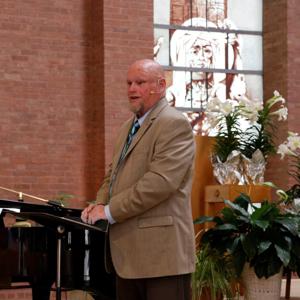
Second Baptist

Second Baptist

By Pastor Steve MechemReligion & SpiritualityChristianity
Download on the App Store

Second Baptist episodes

  • Not Me
    Matthew 26:33-35 New International Version (NIV)
    Peter replied, “Even if all fall away on account of you, I never will.”
    “Truly I tell you,” Jesus answered, “this very night, before the rooster crows, you will disown me three times.”
    Hey everybody. Hoping you are well. In this weird time, be safe, wash your hands, and protect the vulnerable.
    The quote in the bulletin for today comes from Woody Guthrie, “ all my words, if not well put or well taken, are well meant.”
    What I need you to do as we talk about this event in the saga of Peter and Jesus is to forget that you know the rest of the story. I need you to hear the story in the present, you can’t look ahead to the hours that will follow and the events of those hours. You need to hear the story as it unfolds in the present moment. The present moment is this:
    Jesus and his followers have just finished a pre-Passover meal. They move out from where they were eating and are entering the garden of Gethsemane. The meal, In the minds of the friends of Jesus, is a celebration meal. They have just experienced the most extraordinary week, well couple of weeks.
    We go back just a few days as Jesus stands outside the tomb of dead Lazarus and cries out, “Lazarus get out of there.”
    And sure enough, Now alive Lazarus walks out of the tomb. This event happens in Bethany, just a couple miles from Jerusalem.
    Word of the miracle of Lazarus spreads quickly, and Jesus recruits a slew of new followers just as he is about to begin his ministry in the holy city. Along with new followers, Jesus also attracts a new set of critics, enemies and haters.
    Soon after the Lazarus event, Jesus and his band of followers parade into Jerusalem amidst cheering and palm waving and singing. Jesus has been teaching every day in Jerusalem since that parade. With each sermon preached, and parable told, and aphorism pronounced, Jesus’ followers are more amazed with him, while his enemies’ hatred grows more and more intense.
    Jesus would teach his followers, argue with his dissenters, and prove himself to be head and shoulders above the detractors in intellect, spirit, and passion.
    And so, at the celebration dinner on Thursday night, Jesus’ friends were excited and celebrating what was happening.
    But now, in this moment, Jesus changes the subject and the sense of the evening. He gets very serious as he says to his assembled friends, “Before the night’s over, you are going to fall to pieces because of what happens to me.”
    And Peter responds, “Even if everyone else falls to pieces on account of you, I won’t.”
    “Don’t be so sure,” Jesus says. “Tonight, before the rooster crows up the dawn, you will deny me three times.”
    Peter protests, “Even if I have to die with you, I will never deny you.”
    According to the scripture, all the others join in and say the same thing.
    Here is where it’s really important that you forget the rest of the story for a few minutes.
    Let’s think about Peter’s response to Jesus.
    Some say he’s being braggy, or boastful, or cocky.
    Some claim he is naive.
    Others describe him as impulsive.
    I think he is being amazing.
    Peter has been the leader among the disciples since the beginning of Jesus’ ministry.
    Peter was among the first, perhaps was the first, person to say yes to Jesus when Jesus was just starting, and gathering together his band of willing followers.
    It appears that Peter’s home, or at least his wife’s families home, was Jesus’ headquarters when he stayed in Capernaum.
    It was Peter, when seeing Jesus walking on the water, and hoping to calm the fears of the other disciples, asks Jesus if he can walk on the water as well.
    It was Peter who responded to Jesus when asked “who am I?” with the answer, “You are the Christ, the Son of the living God.”
    It was Peter who declared, as Jesus’ followers were leaving him left and right, “We are with you, where else would we go? You have the words of eternal life!”
    It was Peter who volunteered to erect tents for Moses and Elijah on the mountain when they met with Jesus.
    It was Peter who had the courage to challenge Jesus when Jesus said things that he didn’t understand.
    It was Peter, just moments before this moment, who tried to prevent Jesus from dirtying his hands by washing Peter’s feet.
    Peter was the leader of this crew, and so it is Peter, when Jesus starts talking about the disciples falling away, who declares, “Not me. I’m not going anywhere. Even if the rest, everybody else, fails you, I’m here with you.”
    Even when Jesus’ points out that Peter will indeed let him down, Peter pushes back, “No! No! No! I am with you to the end.”
    Now be sure to note what happens next. The rest of the disciples don’t dismiss Peter, but rather, take up his rallying cry, “we are with you to the end.”
    Peter’s courage, Peter’s pluck, is simply amazing. In this moment when the leader of the band seems to dismiss his followers, Peter stands tall. And then as Peter stands, the other disciples gain courage as well.
    Now, for those of you who have not forgotten the rest of the story, you know what’s going to happen in the next few hours. You know that courage is going to melt away. You know that fear is going to take over. You know the disciples will flee and Peter will deny Jesus.
    But in this moment, there is courage. And actually, as Jesus is being arrested in just a bit, there is an initial surge of courage and protectiveness that comes from Peter and the rest of Jesus’ friends. It may be short-lived, but it is there. And I think it comes because Peter has shown the way, the way of courage.
    I think courage counts for something, even if courage is followed up with failure and weakness.
    To be faithful to Christ in our lives is often an act of courage.
    It is courageous to walk alongside the bullied.
    It is courageous to turn the other cheek.
    It is courageous to love one another.
    It is courageous us to pray for your enemy.
    It is courageous to be kind.
    It is courageous to stand up, to speak out, to hold strong.
    And it is courageous to recognize that amazing courage can be fleeting in a moment. After Peter’s spectacular failure of courage, it is Peter who is back once again leading the disciples behind those closed doors on Saturday after crucifixion. It is Peter running to the tomb after Mary’s announcement that Jesus is alive. It is Peter who stands up on the day of Pentecost and declares the love and grace of God through Jesus Christ.
    Courage isn’t a straight line. There is an ebb and flow to it. And the important thing, it seems to me, is that when we fall short, that we are always welcomed back through the love of the Savior, and invited to stand courageously again.
    Thank you Peter for teaching us courage.
    Amen.
    But Peter declared, “Even if I have to die with you, I will never disown you.” And all the other disciples said the same.
    36 min
  • Why?
    Matthew 26:14-16 New Revised Standard Version (NRSV)
    Judas Agrees to Betray Jesus
    14 Then one of the twelve, who was called Judas Iscariot, went to the chief priests 15 and said, “What will you give me if I betray him to you?” They paid him thirty pieces of silver. 16 And from that moment he began to look for an opportunity to betray him.
    13 min
  • Real
    John 11:16 New Revised Standard Version
    Thomas, who was called the Twin, said to his fellow disciples, “Let us also go, that we may die with him.”
    -----
    May I direct your attention to the cover of the bulletin. I took this photo at Green Lake Conference Center during a week at quest a few years back. The photo is of the climbing wall that is part of the ropes course there. I’m quite confident that the person climbing the wall is Wah Gay Moo.
    The way this climbing wall works is that you are connected to a rope for safety and climb the wall using the hand and foot holds. It is a team building exercise and that the people holding the rope keep you secure as your climb. Once you have made it to the top you zip line down to the ground.
    For many students, it is one of the favorite activities of the week.
    I have never done a climbing wall. I’ve watched, I have cheered and encouraged, I’ve taken pictures, but I’ve never done the climb myself.
    I don’t remember climbing walls when I was a kid. Wikipedia says they’ve been around since the 1930s but I certainly don’t remember them.
    But when I was younger, I loved to climb. I was a tree climber. Most of you have heard the story of my first date with Judi which consisted of climbing a tree by the tennis courts at Milligan College. There are several trees on that campus that I liked to climb. In fact there was one tree, just outside Sutton Hall that I would climb, sit up on one of the branches, and read.
    While I was in college I also really enjoyed bouldering and free rock climbing, which is climbing up rock faces without ropes.
    I have a picture of me climbing up the outside of the college chapel using the large corner bricks as hand and foot holds.
    I used to dig climbing.
    When one is determining how to climb a tree or a rock face, one stands at the bottom and looks up. One decides if the climb is worth the risk of falling. And a plan is made. One thinks about where the feet are going, and where the hands are grabbing and one plans out a process for climbing.
    Of course once you’re actually climbing, things happen. A toehold might not be where you thought it was or a branch of a tree may be too weak to hoist your body and so you adjust along the way. From the bottom looking up, you make a decision that the climb is worth any risk, you make a plan, and based on the plan, you climb.
    The scripture lesson today is a single verse.
    “And Thomas said, “Let us also go, that we may die with him.”
    It is a verse taken out of a larger section that tells the story of Jesus and his friend Lazarus.
    Lazarus lives in Bethany, a mile and a half or two miles east of Jerusalem, past the Mount of Olives. Lazarus gets sick, very sick. His sisters, Mary and Martha, send a message through a messenger to Jesus that their brother is very ill. The message travels the 80 or 90 miles to wherever Jesus is in Galilee at the time.
    In addition to being his home region, there are reasons why Jesus does much of his ministry in Galilee. For one, It is safer in Galilee for a revolutionary Messiah to speak up and speak out. In Judea and especially around Jerusalem, the military presence of the Romans, and the sometimes overzealous local authorities could wreck havoc on would be messiahs and misunderstood revolutionaries. The pages of history are littered with the deaths of inspired insurgents who tried to stand up against the Roman oppressors.
    In Galilee, with the Mediterranean on its west border, the sea of Galilee on its east border, and the region of Samaria forming its southern border, there was a sense of isolation without a lot of interference from the Judean political regime.
    So, While Jesus was confronted on a daily basis by those who disagreed with him and challenged his allusions to Messiahship, the heavy hand of Rome was a fairly distant threat.
    The message from Mary and Martha present a quandary for Jesus and his disciples. While his popularity remains strong among the peasant class and true believers, the reaction against Jesus is growing stronger and stronger. The idea of leaving the relative safety of Galilee to venture into the more inhospitable territory of Judea is daunting.
    Jesus knows this, his disciples know this, but now there is a request from dear friends for Jesus to travel south to the heart of Judaea, two miles outside the capital of Jerusalem to see an old friend who is sick, sick to death.
    Jesus hesitates for a couple of days.
    Perhaps because he’s afraid,
    Or perhaps because he is making a plan, a plan for safe travel and an undercover visit,
    Or perhaps he waits because he knows that once he goes, he is going to be exposed and plans the biggest splash possible.
    After a couple days, Jesus says to his disciples, “let’s go south. Let’s go see my friend Lazarus. He needs our help.”
    The disciples, to the person, try to reason with Jesus about the danger of going to Judea. There is talk about stoning and murder and suffering. Surprisingly, there is no talk about crucifixion, because that seems like a ludicrous over the top notion.
    Jesus just listens to their arguments. And then responds, “It’s time. It’s time to go to Jerusalem. It’s time to turn up the light.”
    In Luke’s Gospel, while there’s no Lazarus story, when Jesus makes this decision to head to Judea, the Greek of the gospel says that Jesus “sets his face toward Jerusalem.”
    If you think in terms of a old western show down, Jesus has decided that now is the time. It is high noon at the OK corral and Jesus is willing to experience the heat and the pain and the struggle that he has known would come in response to his message of love and forgiveness and the incoming kingdom of God.
    And once Jesus comes to Bethany, and calls Lazarus, now dead Lazarus, out of the tomb, Jesus’ fate is insured. A messiah who preachers hope is one thing, but one who also raises people from the dead is not a messiah that the political leadership can abide.
    Jesus, by going south to Bethany, and then by raising from the dead his dear friend Lazarus, is setting in motion what will happen in the coming days in Jerusalem, in Gethsemane, at the Pilate’s palace, on the cross.
    I am making an assumption here, but I am assuming that Jesus has given his disciples an out, telling them that he is going but if they choose not to go, they can remain behind.
    There’s something about Thomas’ words that caused me to think this. I am imagining grumbling and consternation from the disciples, and then Thomas speaks up and says “let’s go as well that we might die with him.”
    Some think Thomas is being sarcastic
    Some think Thomas is being fatalistic.
    Some think Thomas is being pessimistic.
    Some think Thomas is showing his doubting personality.
    I think Thomas is standing at the base of the tree, looking up and determining that it’s worth the climb. I think Thomas is being real. No blather. No piety. Simple truth- we should follow Jesus, even if it entails sacrifice and leads to struggle.
    May we all have the determination and courage to step out and step forward as Jesus calls us to climb out of our places of comfort and into the fray, as Jesus calls us to love unconditionally, to seek justice for those who are mistreated, to walk beside the bullied and the underdog, to stand up to those who would diminish the personhood of those whom God loves dearly.
    It’s worth the climb.
    Amen.
    13 min
  • Children
    Matthew 19:13-15 New International Version (NIV)
    Then people brought little children to Jesus for him to place his hands on them and pray for them. But the disciples rebuked them.
    Jesus said, “Let the little children come to me, and do not hinder them, for the kingdom of heaven belongs to such as these.” When he had placed his hands on them, he went on from there.
    15 min
  • In or Out
    Mark 9:38-41 New Revised Standard Version (NRSV)
    38 John said to him, “Teacher, we saw someone casting out demons in your name, and we tried to stop him, because he was not following us.” 39 But Jesus said, “Do not stop him; for no one who does a deed of power in my name will be able soon afterward to speak evil of me. 40 Whoever is not against us is for us. 41 For truly I tell you, whoever gives you a cup of water to drink because you bear the name of Christ will by no means lose the reward.
    -----
    Have you ever been working a jigsaw puzzle- the card table is up, puzzle pieces are in a pile on the table, the outside border is complete, a few sections within are coming together, the box cover which shows what the completed puzzle will look like sits on the table - and you pick up one puzzle piece, and it confuses you. The colors are wrong, the shape of it is off, it appears as if it just doesn’t belong to this puzzle? Maybe they stuck a piece from another puzzle in the box, some mixup of some kind? But low and behold, as the puzzle comes together, you find the piece’s spot, a place in the puzzle in which the piece fits perfectly.
    The Apostle Paul uses an analogy to describe the beloved of God as a body in which all the parts of the body fit together to create harmony and community.
    If I use the word, Ubuntu, would you know what I mean? Ubuntu, U.B.U.N.T.U., the Ues, all three of them, make the sound oo. Ubuntu. Say it with me.
    It is a South African word. Actually, it is a concept. Perhaps more than a concept, ubuntu is a philosophy of life.
    The word became known to me during the time of the Truth and Reconciliation Commission after the end of Apartheid.
    The word means “community,” but not in the trite way that we often use it. Ubuntu is community at its best. It is community that fosters wholeness.
    By definition, Ubuntu means a quality that embraces essential human virtues like compassion and kindness.
    By description, Ubuntu is one-another-ness, interconnectedness, joined-in-the-common-good-ness, and a profound commitment to the well being of all.
    I love the children’s book, Horton Hears a Who. It is a story about an elephant named Horton. Horton is a kind and benevolent elephant and he discovers a world of teeny tiny people, the whos, on a dandelion like wildflower.
    Horton becomes the self proclaimed protector of the whos.
    The whos find themselves in a pickle as some awnry jungle animals are about to drop the flower, with them on it, in some boiling beetle-nut oil because Horton seems so concerned about it and because they don’t believe Horton’s claim about the teeny tiny people.
    Horton knows the only way to save the flower and the whos is to get them to be loud enough so that the jungle animals can hear them.
    Horton encourages the entirety of Whoville to work together to make the necessary noise, they shout, they sing, they drum on drums, they blow horns, but they are not heard. The mayor of Whoville is frenetic in the search for more noise.
    Picking up the book,
    “Through the town rushed the Mayor,
    from the east to the west.
    But everyone seem to be doing their best.
    Everyone seemed to be yapping or yipping! Everyone seemed to be beeping and bipping!
    But it wasn’t enough, all this ruckus and roar!
    He had to find someone to help them make more.
    He raced through each building!
    He searched floor to floor.
    And just as he felt he was getting nowhere
    and almost about to give up in despair,
    He suddenly burst through the door and the mayor
    Discovered one shirker! Quite hidden away
    In the Fairfax apartments (apartment 12 J)
    A very small, very small shirker named Jo Jo
    was standing, just standing bouncing a yo-yo
    Not making a sound not a Yip not a chirp
    And the mayor rushed inside and grabbed the young twerp.
    As he climbed with the lad to the Eiffelberg tower.
    This, cried the mayor, is your towns Darkest Hour
    and the time for all who’s who have blood that is red
    to come to the aid of their country he said.
    We’ve got to make noises
    in greater amounts!
    So open your mouth lad!
    For every voice counts!
    He spoke as he climbed.
    When they got to the top,
    the boy cleared his throat
    and shouted out yopp
    And that yopp. . .
    That one small extra yopp put it over
    finally, at last
    from the speck in the clover,
    their voices were heard!
    They rang out clear and clean
    and the elephant smiled,
    “do you see what I mean,
    they prove they are persons
    no matter how small
    and their whole world was saved
    by the smallest of all!.
    The whos, all in, working together, striving together, being whole and being in it for each other, save the day. They were practicing ubuntu.
    Ubuntu, as a concept correlates nicely with a phrase that Dr. King used so prophetically- the beloved community.
    The Beloved Community is society based on justice, equal opportunity, and love of one's fellow human being. ... The Beloved Community describes a society in which all are embraced and none discriminated against.
    In Ubuntu, in the beloved community there is no “us vs. them,” only us with us together. There is no room for misogyny, or racism, or homophobia, or religious hatred, or the exceptionalism based on my brand, my tribe, or my people.
    The First Baptist Church of the City of Washington, DC, welcomes people of every race, gender, gender identity, sexual orientation, marital status, age, physical and mental ability, national origin, economic station, and political ideology to full participation in the life of our community;
    Ubuntu embraces community, togetherness, and the village that it takes.
    Ubuntu is a quality that understands that we owe each other acceptance, mercy, grace and forgiveness.
    Desmond Tutu’s description of Ubuntu is profound, “A person with ubuntu is open and available to others, affirming of others, does not feel threatened that others are able and good, for he or she has a proper self-assurance that comes from knowing that he or she belongs to a greater whole and is diminished when others are humiliated or diminished.”
    Unfortunately, built into us is a weakness that tempts us to become captive to selfishness, to fear, and to the desire to put ourselves above others by putting others down.
    And unfortunately, being a follower of Jesus does not preclude us from that weakness.
    We see it across the spectrum of Christian history, as the church and its leaders, at their worst, have engaged in anti-semitism, warmongering, violence against other religious groups, the enslavement of people, and a million of crimes against God and humanity.
    Even the earliest followers of Jesus, even his best friends and closest associates, struggled with the grand and glorious concepts of Ubuntu.
    Today’s scripture lesson from the Message translation:
    John spoke up, “Teacher, we saw a man using your name to expel demons and we stopped him because he wasn’t in our group.” Jesus wasn’t pleased. “Don’t stop him. No one can use my name to do something good and powerful, and in the next breath cut me down. If he’s not an enemy, he’s an ally. Why, anyone by just giving you a cup of water in my name is on our side. Count on it that God will notice.
    Mark 9:38-39
    As Jesus’ ministry continues to spread, people who weren’t his people start doing ministry, healings and exorcisms in his name.
    Some of his followers are upset by this. Who do they think they are! Using Jesus’ name to do good. that should be reserved for us.
    There is immediately a backlash against these do gooders because they aren’t our do gooders. The disciples tell the to stop. Their answer to the question, “are they in or out?” is that they are out because they aren’t a part of our group.
    The disciples fall into the us-against-them trap and Jesus isn’t having it.
    Jesus says in essence, “No, no, no. Don’t write them off because they aren’t like us. Don’t dismiss them because they pray differently than us. Don’t reject them because they wear different religious garb than we do. Celebrate that what they do makes a difference in people’s lives. Embrace their goodness. Accept, don’t reject. A cup of water is simple and easy but rejoice in the one who gives a simple cup of water because they give that water to me.”
    What an amazing lesson in Ubuntu!
    Go and do likewise.
    Amen.
    15 min
  • Dibs -- Riding Shotgun
    Mark 10:35-40 New Revised Standard Version (NRSV)
    James and John, the sons of Zebedee, came forward to him and said to him, “Teacher, we want you to do for us whatever we ask of you.” And he said to them, “What is it you want me to do for you?” And they said to him, “Grant us to sit, one at your right hand and one at your left, in your glory.” But Jesus said to them, “You do not know what you are asking. Are you able to drink the cup that I drink, or be baptized with the baptism that I am baptized with?” They replied, “We are able.” Then Jesus said to them, “The cup that I drink you will drink; and with the baptism with which I am baptized, you will be baptized; but to sit at my right hand or at my left is not mine to grant, but it is for those for whom it has been prepared.”
    Do y’all know what it means to call dibs?
    “I’ve got dibs on that last piece of sugar cream pie?” Means I get the last piece of pie. Or, “I’ve got dibs on the television,” means I get to pick the shows to watch that evening.
    One thing people traditionally call dibs on is riding in the front seat of the car. This particular dibs has its own phraseology. It is known as “calling shotgun.”
    Anybody here ever called shotgun?
    The phrase alludes to the old west where stagecoach drivers hired somebody to sit beside them with a shotgun on their lap to deter any robbers in the area.
    In modern times, calling shotgun simply means calling dibs on the front seat.
    However, it may not be so simple. Calling shotgun, it turns out is a fairly complex proposition.
    I hold in my hand a 4000 word document titled, “Riding Shotgun — The Official Rules of Order”
    4000 words . . .thay is more than 3 times as long as one of my sermons.
    The document shares 26 rules that one should know if one wants to yell out, “I got shotgun.”
    The first and most important rule of shotgun is that you must call it out loud. You have to say it like you mean it. Let’s practice, “I got shotgun.”
    There are many things to know about calling shotgun.
    You may only call shotgun when the driver is in earshot.
    Furthermore, both you and the driver must have already exited the establishment from which you are departing.
    Both driver and would-be potential shotgunee must be within eyeshot of the vehicle.
    If two people call shotgun at the same time, the tie is broken by a footrace. The first of the competitors to make contact with the passenger-side door handle wins the tiebreaker, and thus, rides shotgun.
    The are default shotgunners who will always get to ride shot gun- Spouses, significant others, a person with a physical limitation.
    One default shotgunner is the driver. And If the driver has to stop driving, (like they need to sleep or something) they automatically becomes shotgun.
    The statement. . . “With great power comes great responsibility,” certainly applies to shotgun riders.
    If you are Riding shotgun,
    You are the riders first mate.
    You are the chief navigator.
    You control the music. While the driver has dibs as to listening preferences, you are to control the radio. If the driver doesn’t have a preference, it becomes your domain.
    You are in charge of the driver’s phone. You text on their phone as instructed, you respond to texts, and you answer the phone if it rings.
    You are in charge of opening stuff for the driver, you open all of their water bottles, unwrap all candy bars, and unsheath all beef jerkies, etc.
    You pump gas.
    You must remain conscious. A good shotgun rider will not fall asleep on the driver.
    You are on constant police car watch.
    You are not allowed to be critical of the driver’s style. While you may certainly point out hazards, you may not criticize the driver.
    Overall, your primary job as shotgun is just to be cool. As it says in “Riding Shotgun - The Official Rules of Order,” “This is perhaps the rule most vulnerable to individual interpretation. At its core, the provision states that the shotgun rider must make all efforts to be cool.
    Spending significant portions of the ride yammering on your cell phone is not cool. Constantly and indiscriminately fiddling with the air conditioner, defogger, and windows to the discomfort of all other passengers is not cool.
    As the beholder of shotgun, you are the liaison between driver and backseat passengers, the tissue that binds the car together, the Ringo to the rest of the Beatles. Say what you want about Ringo but the dude is cool. And the other Beatles liked hanging out with him. Be like Ringo. Be cool and the whole car will be cool with you. Act like a tool and you’ll be in the back seat faster than you can say “Pete Best.”
    Again, with great power comes great responsibility, and if you as the shot gun rider blow it, you can be demoted to the backseat, wherein the driver can personally choose a new shot gun.
    As the Manuel states, ‘Riding shotgun is a great honor. But it is an honor you must earn.”
    James and John want to ride shotgun, they are calling dibs on leadership positions in the new Kingdom once Jesus has declared it.
    From the gospel of Mark, “James and John, the sons of Zebedee, came forward to him and said to him, “Teacher, we want you to do for us whatever we ask of you.”
    And he said to them, “What is it you want me to do for you?”
    And they said to him, “Grant us to sit, one at your right hand and one at your left, in your glory.”
    But Jesus said to them, “You do not know what you are asking. Are you able to drink the cup that I drink, or be baptized with the baptism that I am baptized with?”
    They replied, “We are able.”
    Then Jesus said to them, “The cup that I drink you will drink; and with the baptism with which I am baptized, you will be baptized; but to sit at my right hand or at my left is not mine to grant, but it is for those for whom it has been prepared.”
    When the ten heard this, they began to be angry with James and John. So Jesus called them and said to them, “You know that among the Gentiles those whom they recognize as their rulers lord it over them, and their great ones are tyrants over them. But it is not so among you; but whoever wishes to become great among you must be your servant, and whoever wishes to be first among you must be servant δουλος of all.”
    James and John are desiring the honor of riding shotgun without any clue as to the responsibilities of riding shotgun. And so Jesus calls them on it.
    Just a quick aside. In Matthew’s gospel, it is James and John’s mother who makes this request. I’ll let you decide who’s covering for who.
    In Mark, these two men ask rather boldly if they might share a close advisory role in Jesus’ New Kingdom’s cabinet.
    And they could make a good case for it.
    They were among the very first disciples.
    They, along with Peter, seem to make up Jesus’ inner circle.
    They, along with Peter, were the only ones there when Jesus raised a girl from the dead.
    Jesus had given them a nickname- the sons of thunder.
    They, along with Peter, were alone with Jesus at the Transfiguration.
    Perhaps it was at the Transfiguration, where Jesus hangs out with Moses and Elijah, that James and John begin to think in these big picture Kingdom terms.
    Obviously, they were two of the three people on earth closest to Jesus, and Peter was always putting his foot in his mouth so he wouldn’t be selected, and perhaps they surmised that if Jesus was indeed the Messiah, and he did just meet with Moses and Elijah after all, that it was time to call dibs on positions of power and authority in the earthly kingdom they assumed Jesus was initiating.
    Jesus response is chilling.- you haven’t a clue as to what you are asking. Do you think you have what it takes to be in trenches with me? Can you drink from my cup, and be baptized with my baptism?”
    James and John, thinking in terms of wine and water and not in terms of sacrifice and service respond,
    “Yes we can.”
    The image I have in my head here is Jesus shaking his head, sighing, and saying, “You will drink the wine of sacrifice and you will be baptized with service of your life to others, but I am in no position to grant you requests that you don’t understand as you ask them.”
    It strikes me that Jesus isn’t mad at them, or even frustrated with them, but understands that they haven’t quite figured it out yet.
    By kingdom definition, those who lead must serve, and those who are last will be first.
    Jesus is telling his dear friends, and soon the other disciples,
    “Don’t focus on power and prestige, focus on service. Don’t envision yourself as being in control, of having authority over others. See yourself as one who gives, as one who sacrifices, as one who makes a difference in the lives of others.”
    After all, that’s how the Kingdom works.
    Amen.

    16 min
  • Options
    Matthew 16:13-16 New Revised Standard Version (NRSV)
    Peter’s Declaration about Jesus
    13 Now when Jesus came into the district of Caesarea Philippi, he asked his disciples, “Who do people say that the Son of Man is?” 14 And they said, “Some say John the Baptist, but others Elijah, and still others Jeremiah or one of the prophets.” 15 He said to them, “But who do you say that I am?” 16 Simon Peter answered, “You are the Messiah,[a] the Son of the living God.”
    ---
    A couple of weeks ago I preached a sermon titled, “where?” The setting of the passage is a moment in time when Jesus’ teaching actually a turned people off and his huge following started to desert him. As the crowds dwindled, Jesus turned to his disciples and asked the question, “will you leave me too?” Peter responded with a question of his own, an existential hum-dinger, “where would we go apart from you?”
    Today’s scripture passage strikes me as similar in that an actual real life existential question is asked. It is the kind of question, that when answered, causes a change in your life.
    Jesus is alone with his disciples and he asks them a question to which he already has the answer.
    “Who do people say that I am?”
    Their answer is that people see him as a spiritual rock star. “Some say John the Baptist, some Elijah, and others Jeremiah or one of the prophets.”
    And then he asks, “But who do you say that I am?”
    Simon Peter answers, “You are the Christ, the Son of the living God.”
    Who do people say that Jesus is? In the 21st century, in 2020, in America?
    Some of the old standby answers include:
    An historical figure
    A fictional character
    A teacher
    A religion founder
    A swami
    A mystic
    A magician
    Other answers to the question, who do people say that I am?
    Some say that Jesus is...
    A moral compass. With his guidance, we learn what’s right behavior and what is wrong behavior. I agree with this completely.
    I guess, my problem is that the morality and values that some people say Jesus espoused don’t come from Jesus.
    It seems odd to me that to many people, the most important things that Jesus teaches us about are,
    abortion
    and gay and trans people,
    even though Jesus never speaks on either of these two things specifically in the gospels.
    He does talk a lot about love, acceptance, grace, and compassion and it strikes me that these are the moral imperatives which should serve as our compass.
    Some say Jesus is
    A revolutionary, a liberator. Many folks my age cut their theological teeth on liberation theology. A prevailing theological construct that places God solidly on the side of the poor. So much of it is helpful and meaningful, but as with any politicized theology, some advocate non-Jesus ideas to help meet the ends that are sought.
    I buy wholeheartedly the concept that Jesus is a friend and a champion for the poor, but I also believe, that while Jesus’ his love reaches to all of us regardless of our financial status and social standing.
    Some people declare that Jesus is
    The defender of the American way.
    In this understanding of Jesus, he ceases to be seen as a middle eastern Jewish man thoroughly ensconced in the social milieu of his time and is transformed into a spokesman for the American ideal, even when the Jesus of Scripture teaches against the very things being advocated in our society.
    Jesus becomes a national God.
    It is all very Tribal.
    In the same vain, Jesus is understood as being
    On our side
    The political leader of our country recently said to a group of evangelical leaders, “God is on our side.”
    The statement, God is on our side, is fine, unless we assume that God on our side means that God is against others. there is the connotation that “Our side will win” because God is with us and not with those other people.
    This understanding of Jesus enhances the “us against them” motif that is so rampant among Christians.
    Some say Jesus is
    A righteous warrior
    Perhaps you remember singing as child in Vacation Bible School,
    I may never march in the infantry
    Ride in the cavalry
    Shoot the artillery
    I may never shoot for the enemy
    But I'm in the Lord's army!
    Among favorite hymns in some churches “the battle hymn of the republic,” written by an abolitionist to give courage to the righteous union troops during the civil war and seems to describe the Warrior God wrecking havoc with “the fateful lighting of his terrible swift sword.”
    And to be honest, warrior language is biblical.
    Some people interpret the book of Revelation to say that Jesus died as Savior but will come back as victorious and vengeful warrior.
    But, the kind of warrior Jesus appears to be in Scripture, and the kind of warrior Christians are called to be in Scripture are warriors for love, of peace, of grace.
    Some people say that Jesus is
    A capitalist,
    others say he is a socialist,
    still, others say he is a communist
    But I say, to assign any economic theory to Jesus is to miss the point.
    Some say Jesus is
    A republican,
    Others say he is a Democrat.
    I have been told on several occasions, usually when I am being scolded for being too progressive, that, “you cannot be a Christian and vote for a democrat.”
    I am sure that sentiment works the other way as well.
    But, Jesus was neither a republican or a Democrat. The kingdom he announced is so much bigger and so much more beautiful than politics.
    Some say that Jesus is
    A pragmatist
    This understanding allows people to adjust their sense of right and wrong, their sense of truth, their sense of rightness according to the popular winds of the moment.
    Jesus, rather, was an idealist. His ideals centered around the Kingdom of God, love, kindness and forgiveness.
    These are all options for understanding Jesus, and options many accept.
    But now the question, gets real serious, when Jesus asks his followers,
    “Who do you say that I am”
    Peter’s answer is beautiful.
    You are the Christ, Χριστός.
    The Greek word Χριστός is synonymous with the Word Messiah.
    The one anointed by God to bring change to the world. And it is important to note that divinity is not necessary to be the Messiah.
    But along with being Christ, Messiah, Peter proclaims
    υιός του θεόυ του ζωντος
    Son of God of Life
    Or as is commonly translated, the Son of the living God.
    Υιός literally means “son’” or ‘offspring”
    For the New Testament writers, υιός is understood as
    ‘In the nature of’
    ‘Containing the being of’
    This relationship of Creator and Christ reminds me of the old saying,
    ‘Like Father, like son,” or more modernly,
    “Like parent, like child”
    A child who reflects his or her parents is said to be “a chip off the old block,”
    When they are quite similar, they are
    “Two peas in a pod.”
    In the words of Jesus in the gospel of John, “when you see me, you see the Creator”
    Jesus is anointed as Messiah to speak the truth of God because in essence, Jesus is the human face and heart of God.
    And so, when Jesus speaks, we listen,
    Love
    Acceptance
    Forgiveness
    Mercy
    Service
    Kindness
    It is who and what we strive to be because we believe, with Peter, that Jesus is the Christ, the Son of the Living God.
    Amen.
    16 min
  • The boat, the storm, and the Savior
    Matthew 8:23-27 New Revised Standard Version (NRSV)
    Jesus Stills the Storm
    23 And when he got into the boat, his disciples followed him. 24 A windstorm arose on the sea, so great that the boat was being swamped by the waves; but he was asleep. 25 And they went and woke him up, saying, “Lord, save us! We are perishing!” 26 And he said to them, “Why are you afraid, you of little faith?” Then he got up and rebuked the winds and the sea; and there was a dead calm. 27 They were amazed, saying, “What sort of man is this, that even the winds and the sea obey him?”
    25 min
  • Come and See
    Has anybody here seen the recent series on Netflix, called, Messiah? It is a story set in the present time about a Middle Eastern man who mysteriously comes on the scene and seems to be extraordinary.
    This man preaches to enthusiastic crowds. In his sermons he claims to be a spokesperson God. He does some incredible things which folks label “miracles.”
    He attracts many followers who are convinced that he is the Messiah. Still many others doubt him, and question his motives. It is revealed that many of these cynics have dubious reasons for their doubt.
    It is a fascinating show in that it leads its viewers to engage the question, “What if someone who claims to be sent from God shows up now. How ready or how hesitant are you to respond?
    Which leads to the question, “Would I, if I had been there, recognized Jesus as the Messiah or would I have shrugged him off as a hoax?”
    Let’s turn to the first century. It is a time in which there are a plethora of Messiahs coming out of the Middle East. The subjugation of the Jewish people to a one conquering empire after another had created an atmosphere of yearning for Messiah, understood as a religious warrior who would thwart the the enemy and would set up a messianic kingdom resistant to future enemies.
    In that atmosphere of messianic ethos and a desire for liberation came Jesus.
    In the early days of his journey, he summons people to join his messianic movement. While the Bible tells us stories of people who respond almost immediately, it wold be appropriate to think that many others might reject Jesus’ call to them- just one more Messiah coming down the road.
    He has been joined by two sets of brother, Peter and Andrew, and James and John.
    Peter and Andrew, it appears, suggest to Jesus that their good friend Philip might be a possible recruit.
    Peter and Andrew and Philip grew up in the same fishing village on the northeast shore of the Sea of Galilee. The vicinity of the small village of Bethsaida would be the location for a couple of Jesus’ works of wonder that made it into the gospels. Just outside of town, Jesus healed a blind man. And again, just out of town, Jesus had fed thousands of hungry people with what seemed to be a child’s snack.
    So, Jesus and his new followers approach Philip. My assumption is that after a lengthy conversation containing lots of back of forth, Jesus invites him to join the movement.
    Philip not only responds, but excitedly finds a good friend to see if he might be interested as well.
    Philip’s friend Nathanael is not so excited. He notes that this new Messiah comes from the backwater town of Nazareth and nobody of consequence has ever come from that insignificant, broken down village.
    Philip listens to his friend, smiles at him, and simply says “come and see.”
    For Philip, there is no need to explain or defend or argue. He knows, or at least he believes, that if Nathanael will meet Jesus, he will come around. “Come and see.”
    And Nathanael does. He comes and sees. He has an encounter with Jesus, and responds as one of the first followers of this new Messiah. Recognize that each of these people, by saying yes to Jesus, puts themselves in position to be the subject of the backlash that would inevitably come from the Roman occupiers. History taught them that.
    This is one of just two mentions of Nathanael in the New Testament. The other mention comes 20 chapters later in John. Two or three weeks after the resurrection, Nathanael is listed along with Peter, Thomas, James, John and a couple unnamed disciples. They are hanging out by the beach- waiting.
    They are waiting. Waiting for Jesus to show up.
    He has appeared to them a couple of times in his risen form but now it has been awhile, and they are antsy, bored, apprehensive. They are wondering what is next.
    Finally, Peter, tired of sitting on his hands, says, “I’m going fishing” because that is what you do when you are a fisherman in the first century and you need to pass some time- you fish.
    You might choose to watch TV, or take a hike, or hit some baseballs or surf social media, but for Peter and these guys, its fishing.
    They fish late into the evening, maybe all night and come up empty.
    In the morning, they discover Jesus on the beach, cooking fish for breakfast.
    A few years back, when Jesus first met Nathanael he had told him, “You will see greater things.”
    Now, the one who had originally doubted if anything good could come from Nazareth, is eating fish and bread for breakfast with the Nazarene who lived, and taught, and performed miracles and died and came back to life.
    The words of Philip should be our words,
    “Come and See!”
    To be the church we are called to be, it is imperative that we invite people to meet Jesus. But not just any o’ Jesus- It is imperative that the Jesus we espouse is the Jesus of the gospels,
    Not the Jesus of American religion,
    Not the Jesus of culture,
    Not the politically conservative Jesus,
    Not the politically liberal Jesus,
    Not the macho Jesus;
    The Jesus of the gospels-
    The love your neighbor, pray for your enemies, turn the other cheek, seek the kingdom, serve one another Jesus
    I paraphrase a post I read online,
    “The metamorphosis of Jesus Christ from Lord of unconditional love and unmerited grace, from sacrificing Savior, from the one who said, the last shall be first and the first shall be last, who said in order to be great, you must become a servant to all, from that to a symbol that stands for political power, for nationalism, for prosperity theology, for tribalism, for hate and bigotry, is truly the strangest transformation in human history.”
    It behooves us to reject this Jesus and to embrace the Jesus who loves us, and calls us to join him in the process of building the peaceable kingdom.
    Doctor King preached a sermon in February, 1968 in which he said,
    ‘Jesus gave us a new norm of greatness.
    If you want to be important—wonderful.
    If you want to be recognized—wonderful.
    If you want to be great—wonderful.
    But recognize that he who is greatest among you shall be your servant. That’s a new definition of greatness…. It means that everybody can be great because everybody can serve. You don’t have to have a college degree to serve. You don’t have to make your subject and your verb agree to serve. You don’t have to know about Plato and Aristotle to serve. You don’t have to know Einstein’s theory of relativity to serve. You don’t have to know the second theory of thermodynamics in physics to serve. You only need a heart full of grace, a soul generated by love. And you can be that servant.”
    May our hearts, our words, and our action continually say “Come and See!”
    Amen.
    12 min
  • Where?
    John 6:66-69 New Revised Standard Version (NRSV): Because of this many of his disciples turned back and no longer went about with him. So Jesus asked the twelve, “Do you also wish to go away?” Simon Peter answered him, “Lord, to whom can we go? You have the words of eternal life. We have come to believe and know that you are the Holy One of God.”
    ----
    John 6 reports a roller coaster couple of days in the life of Jesus.
    It all started with 5000+ hungry people. Jesus fed them all with a kid’s lunch.
    Later that evening, Jesus came a walking on the water to his nervous disciples in midst of choppy waves.
    The next day, rumors began to spread that Jesus strolled atop the waves in the Sea of Galilee.
    The crowd, already huge, grew more so.
    And then Jesus said the wrong thing.
    Concerned over many of the followers’ motives, Jesus declared that he was the bread of life, come down from heaven above.
    Immediately the religious trouble makers began to question Jesus legitimacy, after all, he didnt come from above, he was the kid of Joseph and Mary and grew up in the squalor of Nazareth.
    Even more controversy arose as Jesus said that not only was he the bread of life but that his flesh was the bread and unless his followers eat the flesh they can’t be his disciples.
    Yuck! Debates broke out among Jesus followers. The religious leaders among them helped stir the trouble.
    And people started to leave.
    First a couple, then a few, then a steady stream, and finally, kind of a stampede.
    Which brings us to the amazing passage that was read this morning.
    “At this, many of his disciples turned away and no longer accompanied him. Jesus asked the Twelve, “Do you also want to leave?” Simon Peter answered, “Lord, where would we go? You have the words of eternal life. We believe and know that you are God’s holy one.”
    Jesus asks a real question, “Are you going to leave me as well?”
    Peter’s profound existential answer came in the form of a question, “Where would we go?”
    Sometimes I ask the same question because sometimes I get so frustrated!
    But unlike John 6, I don’t get frustrated about Jesus, or Jesus’ teaching, or Jesus’ call on my life.
    As the Doobie Brothers sing, “Jesus is just all right with me. Jesus and me, we’re cool,
    My problem is with the people who say they speak for Jesus. Folks who speak like they have some authority to speak for God. My issue is not Jesus,it is cultural Christianity and the way it does not reflect the person and teachings of Its founder.
    Sometimes in my frustration, I think to myself “oh what else can I be because I don’t really want to be lumped together with these people who say they speak on behalf of Jesus but say things that I find detestable, Inaccurate and mean.
    You have heard me say before, that I struggle with what label I call myself.
    There was a day when I proudly called myself an evangelical. But what evangelical meant was very different in that day, and I cannot call myself that when I listen to the line that so many evangelical leaders press.
    I call myself a Christian, and yet so many things that are done and said in the name of Christianity are the absolute antithesis of what I believe about being a Christian.
    I learned racism in the church. I didn’t learn it because I took a class in it. I learned racism by listening to people in the church talk about people of color, and migrants, and people who came from places they did not.
    I didn’t learn sexism and misogyny in the church. But it is like there is a masters course taught within the church. I have had serious discussions with church leaders about the limits to the role that women may play in the life of the church. I have been in churches where women weren’t allowed to teach men. I have been in churches where women in leadership were dismissed as deficient.
    And don’t even get me started about homophobia in the church. As a pastor and the parent of a gay child, I have heard it, been offended by it, and mourned over it.
    And in a culture where the church seems more bent on acquiring political power then it is on preaching the gospel of Jesus, I find myself saying time and time again, I don’t belong here in this.
    And Peter’s question “where would we possibly go?” becomes the existential question for us when the religious community and religious leaders seem to think and act and believe so differently than we do.
    Where could we go?
    And this is where I get stuck. Because there’s no place I want to go other than with Jesus.
    The Jesus that I experienced when I was 15 years old and the Jesus that I experience now that I’m 61 is enough.
    As Peter finishes his thought, “Where would we go? You have the words of eternal life, We believe and know that you are God’s holy one.” I agree with Peter. Right on dude, I get it.
    the gospel of Jesus- Love, Grace, Mercy, Comfort, Kindness, Service.
    That’s the message of Jesus that I read in the gospels and I buy into it whole heartedly, so how could I possibly think about going somewhere else.
    So then the question becomes not so much “where can we go?” but how can we reflect the Jesus that we understand from the gospels who is so unlike the Jesus that we see represented by so much of the religious establishment?
    I think there are two basic answers to that question.
    The first answer is that we, regardless of what we see other people say or do, we strive to stay faithful to the teachings of Jesus as we understand them.
    There is a great scene near the end of the movie, The Last Jedi. The rebels are hiding in a cave on the planet of Crait. A huge blast door is all that separates them from Kylo Ren and the First Order.
    A Battery Ram canon is about blast the door open.
    Finn, flying an old rusted skim speeder decides to fly into the Canon hoping to blow it up. It is a suicide mission.
    At the last second, another skim speeder piloted by Rose knocks him off course saving his life. Finn challenges her decision to protect himagainst the canon, “why did you stop me?”
    Rose responds, “I saved you, dummy. That’s how we’re going to win, not by fighting what we hate, but by saving what we love.”
    People who say they speak for God may say serious nonsense. We respond not by hating, or despising, but by reflecting Jesus to the world,
    Treat others the way you want to be treated
    Turn the other cheek
    Pray for your enemies
    Love one another
    Practice kindness.
    Seek God.
    Where might we go? Straight to the heart of the teachings of Jesus.
    The second answer to the question is that we find fellow believers with whom we share commonality in our understanding of who Jesus is.
    I’m not saying we ignore everybody else, but I am saying that it is important for us to be connected to a community where there is a common understanding that the God of love revealed through Jesus Christ is the God we will worship and follow. We will choose love over hate. we will choose grace over judgment. we will choose acceptance over rejection. we will choose inclusion over exclusion.
    Today, as frustrated as I sometimes am over the religious posturing that I see in our culture, I am equally as proud of what I see happening at Second Baptist church week after week.
    We recognize that we come from different places and have different ideas. We realize we’re not always going to agree with each other theologically or doctrinally. But we also know that we are bound together by the love of God which causes us to live out the gospel in kindness and grace.
    We are bound together by a commitment to the God of grace, and by a commitment to support and encourage and lift up and challenge and care for each other.
    Where would we go? We will go right here in this beloved community that strives to hear and practice the love of God which is been revealed to us through Jesus Christ our Lord.
    Amen.
    15 min

About Second Baptist

From the publisher's feed

These are the sermons from Second Baptist Church in St Louis. We are an American Baptist Churches USA. Tune in for some spiritual wisdom.