
Sign up to save your podcasts
Or



Many Black Americans at the end of the nineteenth century relied heavily on themselves, prioritizing self-determination and securing their collective destiny through solidarity, self-help, and economic independence.
But blatant racism saturated media, entertainment, and education. Parents pushed for less harmful representation of Black life for their children, resulting in the creation of lifelike dolls and print media focused on chasing away the shadows of white supremacy with the light of Black love, consciousness, and possibility.
The lessons Black children learned from their parents and surrounding adults empowered them to grasp the freedom torch and blaze new trails in the fight for liberation.
---
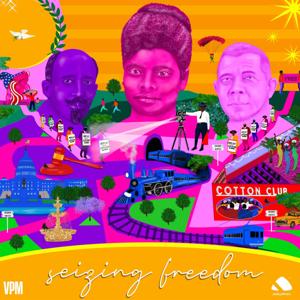
Episode Artwork by Lyne Lucien. Transcripts, resources and more available at seizingfreedom.com.
---
This episode of Seizing Freedom is supported by Home. Made., a podcast that explores the meaning of home and what it can teach us about ourselves and each other. Listen to episodes of Home. Made. at https://link.chtbl.com/homemade?sid=podcast.seizingfreedom
Kidada speaks with historian Blair L.M. Kelley about how segregation grew out of pushback against Black upward mobility, and how Richmond, VA serves as an example of how boycotts can be a powerful tool for collective success to combat issues of justice following the streetcar boycotts in the city at the turn of the 20th century.
They also discuss the role failure plays in laying the groundwork for future successes in social justice movements, encouraging current activists to look to history for examples of how to continue the fight even in the face of defeat.
Additionally, they look at the current political landscape with a new wave of voter suppression laws.
---
Episode Artwork by Lyne Lucien. Transcripts, resources and more available at seizingfreedom.com.
---
This episode of Seizing Freedom is supported by Home. Made., a podcast that explores the meaning of home and what it can teach us about ourselves and each other. Listen to episodes of Home. Made. at https://link.chtbl.com/homemade?sid=podcast.seizingfreedom
With white supremacist strategies for segregated societies solidifying in towns across America’s South, Black people needed to respond in ways that would ensure the freedoms their predecessors had fought to codify into law remained available to them.
Between 1900 and 1910, in more than two dozen cities, African Americans tried to stem the tide of their exclusion from public life by taking the fight to the streets, boycotting streetcars that divided Black and white passengers.
The pressure applied by these protests wasn’t successful in every instance, but the victories that were won inspired continued activism and pushback against the expansion of Jim Crow laws across the nation.
---
Episode Artwork by Lyne Lucien. Transcripts, resources and more available at seizingfreedom.com.
---
This episode of Seizing Freedom is supported by Home. Made., a podcast that explores the meaning of home and what it can teach us about ourselves and each other. Listen to episodes of Home. Made. at https://link.chtbl.com/homemade?sid=podcast.seizingfreedom
Kidada speaks with Kinshasha Holman Conwill, the deputy director of the Smithsonian’s National Museum of African American History and Culture; as well as writer, historian and curator at the Smithsonian’s National Museum of African American History and Culture, Paul Gardullo.
They reflect on The World’s Fair in Paris in 1900 and how they would curate a similar display of progress in 2022, alongside a discussion of the transformative power of museum exhibits, generally, and the value of African American exhibits, specifically.
Additionally, they share what the recent backlash against the teaching of Black history means for their work and the future of trusted institutions focused on telling more inclusive, complete stories of America’s past.
---
Episode Artwork by Lyne Lucien. Transcripts, resources and more available at seizingfreedom.com.
---
This episode of Seizing Freedom is supported by Home. Made., a podcast that explores the meaning of home and what it can teach us about ourselves and each other. Listen to episodes of Home. Made. at https://link.chtbl.com/homemade?sid=podcast.seizingfreedom
The 1893 World’s Fair in Chicago was an opportunity for the United States to showcase its spectacular growth and signal its arrival as a world power, but it failed to highlight Black Americans’ role in its development, and they took notice.
So when Paris hosted the Exposition Universelle in 1900, African Americans knew creating space to showcase their progress to the world was of major importance.
Among the exhibition’s attendees was W.E.B. Du Bois. He seized the opportunity to present factual evidence of Black achievement to dispel international stereotypes and convince world powers to apply pressure to the United States to dispel white supremacy and live up to its founding principles.
---
Episode Artwork by Lyne Lucien. Transcripts, resources, list of voice talent and more available at seizingfreedom.com.
---
This episode of Seizing Freedom is supported by Home. Made., a podcast that explores the meaning of home and what it can teach us about ourselves and each other. Listen to episodes of Home. Made. at https://link.chtbl.com/homemade?sid=podcast.seizingfreedom
Kidada speaks with Adam Serwer, staff writer at The Atlantic who covers race, politics and justice, about the role of the Black press in America, both historically and in the present.
They look at how conspiracy theories, misinformation and slander have been used as a form of media propaganda since the formation of the Ku Klux Klan, and how pioneering journalists like Ida B. Wells-Barnett laid the groundwork for identifying and calling out these campaigns.
Additionally, they discuss the evolution of legacy media outlets over time to include more diverse voices, and what it means to tell the truth objectively when reporting on American history as a Black journalist.
---
Episode Artwork by Lyne Lucien. Transcripts, resources and more available at seizingfreedom.com.
---
This episode of Seizing Freedom is supported by Home. Made., a podcast that explores the meaning of home and what it can teach us about ourselves and each other. Listen to episodes of Home. Made. at https://link.chtbl.com/homemade?sid=podcast.seizingfreedom
Black southerners and their allies were experiencing the brick and mortar of Jim Crow being installed in real time. Racial terror killings had been climbing, lynchings were becoming more shocking and segregation was gaining traction.
And through all this, Black people were still fighting to find a strategy for surviving the afterlife of slavery so they could achieve the Promised Land of their ancestors’ dreams. Black people had to decide what that strategy was going to be for them and for Black folk beyond their lifetimes. And they were not always in agreement.
Conservatives like Booker T. Washington, moderates like W.E.B. Du Bois, and radicals like William Monroe Trotter and Ida B. Wells-Barnett were each confident that they had the best strategy to secure black people’s future by dismantling Jim Crow. And they were each determined to have their own way.
---
Episode Artwork by Lyne Lucien. Transcripts, resources, list of voice talent and more available at seizingfreedom.com.
---
This episode of Seizing Freedom is supported by Home. Made., a podcast that explores the meaning of home and what it can teach us about ourselves and each other. Listen to episodes of Home. Made. at https://link.chtbl.com/homemade?sid=podcast.seizingfreedom
Coming February 1, 2022.
The promises of Reconstruction were left unfulfilled. The violent system of Jim Crow was being built in real time, brick by brick. And Black people had vibrant debates about how to make a way out of no way; about the best strategy for life after emancipation and Reconstruction; to continue to achieve their ancestors’ dreams.
Voice actors will use letters, diaries, newspapers, and autobiographies to bring you stories from luminaries like Ida B. Wells-Barnett and W.E.B. DuBois, as well as everyday freedom fighters forging their own paths forward.
Dr. Kidada Williams' interviews with artists, activists, thinkers and historians will bring the themes of these stories to the present day and give us visions for free Black futures.
Seizing Freedom is a production of VPM and Molten Heart. For more info about the series, visit seizingfreedom.com.
While we work on the next season of Seizing Freedom, we think you'll enjoy listening to the podcast, 1865. In its new season, Ulysses S. Grant takes the White House, intent on rooting out corruption, crushing the KKK and bringing peace to a troubled nation. He has to contend with a divided people, a dysfunctional congress and a fractured Republican Party. While abolitionists across the country celebrated their hard-fought win in the fight toward equality, the steadily growing Ku Klux Klan threatened to undo all the progress that Reconstruction had made. Not to mention, the political world of Washington was in complete disarray. The second season of 1865 is available now on Apple Podcasts, Amazon Music or wherever you listen to podcasts.
From the publisher's feed

42 Listeners

30 Listeners

851 Listeners
24 Listeners
57 Listeners