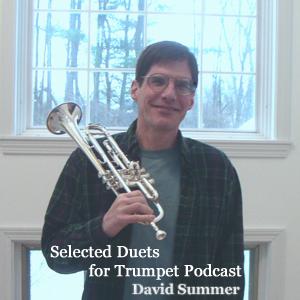
Selected Duets for Trumpet Podcast

Selected Duets for Trumpet Podcast

Download on the App Store

Selected Duets for Trumpet Podcast episodes

  • Page45 #11, Allemande
    Selected Duets for Trumpet, Page 45 Number 11, Allemande, performed by David Summer.
    This third duet in the series by Joseph Boismortier is an Allemande. An allemande is a moderate tempo dance form that was popular during the baroque. An allemande is generally the first or second part of a suite, with a "suite" being a collection of dances.
    Again there are several "question and answer" sections, as we’ve seen in previous duets. But this time the "answers" start before the end of the "questions". This may prove to be a rhythmic challenge for a student along with the 16th note runs in the second half of the duet.
    The metronome setting for this performance is quarter note = 84.
    2 min
  • Page44 #10, Gigue
    Selected Duets for Trumpet, Page 44 Number 10, Gigue, performed by David Summer.
    This second duet in the series of duets by Boismortier is another Gigue and again it's in 6/8 time at a fast tempo, played "in 2". The student may be challenged by the tied over dotted quarter notes in the last part of the piece. Once more, the student has to be able to hear continuous eighth notes in order to place all the eighths correctly. In this case, that's helped by the fact that the second trumpet part is playing eighths under the first trumpet dotted quarter notes.
    There are also several "question and answer" sections, as we've seen in previous duets. The duet is in the key of G with a brief foray in a minor in the middle and g minor at the end.
    The metronome setting for this performance is dotted quarter note = 88.
    2 min
  • Page43 #9, Allegretto
    Selected Duets for Trumpet, Page 43 Number 9, Allegretto, performed by David Summer.
    Joseph Bodin de Boismortier was a French composer active in the first half of the 1700s. Boismortier was one of the first composers to make an income from publishing his compositions rather than writing for a patron. Up until that time, financially successful composers wrote compositions, often on demand, for wealthy patrons. These patrons were usually royalty.
    Boismortier was the first French composer to use the Italian concerto form, in his six concertos for five flutes op. 15.
    For this performance, only the first repeat is taken and the metronome setting is eigth note = 112.
    2 min
  • Page42 #8, Maestoso
    Selected Duets for Trumpet, Page 42 Number 8, Maestoso, performed by David Summer.
    Maestoso, the defacto title of this duet, again means "march-like". Other synonyms include majestic, stately and dignified. This duet is also in 3/8 and includes some dotted 16th - 32nd note figures that are usually played with a slight detachment between the two notes.
    The range in the 32nd note runs may prove an insurmountable challenge for an inexperienced student. If that’s the case, the teacher may want to assign the trumpet two part, instead of the usual trumpet one part, for practice. The trumpet two part is actually a bit more rhythmically interesting in the second half of the duet than the trumpet one part is.
    The metronome setting for this performance is eigth note = 80.
    2 min
  • Page41 #7, Allegretto
    Selected Duets for Trumpet, Page 41 Number 7, Allegretto, performed by David Summer.
    This is another good duet for studying 6/8 played in 2. The student has to be able to hear continuous eigth notes in order to place all the eigths correctly. To help with this, the teacher might try playing the trumpet one part with all eigth notes for a line or 2 at the same time the student plays the part as written. This should help the student to understand how to subdivide 6/8 played "in 2".
    For this performance, the Poco meno (meaning "less motion" or to slow down) is ignored for the sake of students playing along with the trumpet 2 parts posted on the summersong.net website.
    The metronome setting for this performance is dotted quarter note = 92.
    2 min
  • Page40 #6, Andantino
    Selected Duets for Trumpet, Page 40 Number 6, Andantino, performed by David Summer.
    This duet is in a time signature that may be unfamiliar to a student, 3/8. It may take some time for a student to get used to seeing and playing the 32nd notes. The teacher should point out that the 32nd notes are grouped into groups of 4 notes, as a visual affordance for 4 16th notes being contained within one beat.
    Andantino, the simple title of this duet, is a tempo that is slightly faster than Andante but slower than Moderato, Andantino being the diminutive of the word Andante. The beginning of the duet is marked pianissimo and melodioso. The melodioso marking indicating that the piece should be played melodically, with much expression.
    The metronome setting for this performance is eigth note = 84.
    2 min
  • Page39 #5, Tamburin
    Selected Duets for Trumpet, Page 39 Number 5, Tamburin, performed by David Summer.
    Nicolas Chédeville was an 18 century French composer who wrote many pieces for the musette or hurdy-gurdy. This duet, with its many scale passages, was probably well suited to the amateur hurdy gurdy players who were the target audience of Chédeville.
    Many passages in this duet are musical echoes. Repeating one or two measures, with the repeated passage being played at a softer dynamic, manifests the echo quality.
    The title, Tamburin, probably refers to a tambourine. The tambourine is a percussion instrument that has been used for hundreds of years. It was probably last commonly used in western music in the 1960’s as part of pop-rock.
    The metronome setting for this performance is quarter note = 92.
    2 min
  • Page38 #4, Rondo
    Selected Duets for Trumpet, Page 38 Number 4, Rondo, performed by David Summer.
    Michel de la Barre, the composer of this duet, was also a famous flutist. He is credited with being the first composer to publish music for solo flute. This duet does have a somewhat delicate, flute-like quality to it.
    The duet is in the key of F# minor, with a brief foray into C# minor, and contains several E sharps and B sharps that should be pointed out to the student. This is a good opportunity for the teacher to review the concept of enharmonic notes.
    The held-over notes in lines 3 and 6 may also present a rhythmic challenge for a student. The teacher may want to assign both parts of this duet to a student since both parts are generally of equal melodic importance.
    The metronome setting for this performance is quarter note = 108.
    2 min
  • Page34 #1, Rondinetto
    Selected Duets for Trumpet, Page 34 Number 1, Rondinetto, performed by David Summer.
    The composer of this duet, Louis A. Saint-Jacome, was also a solo cornetist and musical arranger. Originally from Paris France, Saint-Jacome moved to London, England where he worked as a musical arranger for the Messieurs La Fleur Publishing Company. While there, Saint-Jacome wrote his famous Grand Method For Trumpet Or Cornet in 1870. This comprehensive trumpet or cornet method book is still in wide use today, having been edited by another famous trumpeter, Claude Gordon. Later in his life Saint-Jacome became cornet tuner and tester for the Besson brass instrument company in London.
    This duet begins in the key of Bb and then changes to Bb minor in the Trio section. Usually this section is played a bit slower than the rest of the piece, but while making this recording I've kept the tempo consistent for the sake of the play along track that accompanies this podcast.
    In this recording, there are no repeats taken except for the DS and the metronome setting for this performance is quarter note = 84.

    3 min
  • Page30 #5, Allegretto
    Selected Duets for Trumpet, Page 30 Number 5, Allegretto, performed by David Summer.
    This is the last duet in the series of 5 duets by French composer Pierre François Clodomir. The teacher should take the opportunity to point out the various scales and arpeggios that are clearly present here.
    The student may need to be cautioned not to let the tempo run away on the 16th note runs and to watch the key change on the second page. Again, a light tongue is helpful here.
    The metronome setting for this performance is dotted quarter note = 80.
    2 min

About Selected Duets for Trumpet Podcast

From the publisher's feed

David Summer plays Selected Duets for Trumpet.