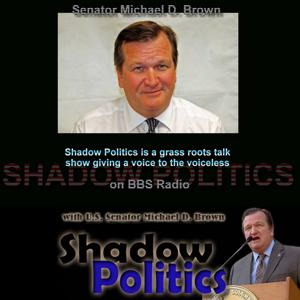
Shadow Politics with Senator Michael D. Brown and Co-host Liberty Jones
Across the Divide: Trump, Iran, Immigration, and the Search for Common Ground
A Conversation Meant to Make America Think Again
In this episode of Shadow Politics, host Former Senator Michael D. Brown opens the program with the show’s mission: to make America think again by listening to all sides before forming opinions. He introduces guest William Shelton, an arborist, small business owner in the DMV area, native Washingtonian raised in Fairfax, Virginia, political science graduate of Old Dominion University, libertarian, Christian, father, gun owner, and self-described patriot. The episode centers on why Shelton voted for Donald Trump in 2024 and how his views reflect a broader segment of American political opinion.
Why William Shelton Voted for Donald Trump
Michael begins by asking Shelton what leadership characteristics matter most to him and how Trump meets them. Shelton says voters often do not get to choose ideal candidates; instead, candidates are packaged and presented, leaving people to choose between the available options. He says he did not find Trump’s first presidency offensive enough to prevent him from voting for Trump again in 2024. Shelton points to Trump’s presence, his ability to speak to his base, his appeal to a certain understanding of America, and his support for lower taxes and reduced regulation as reasons Trump appealed to him as a small business owner.
Iran, War, and the Question of Intervention
Michael then asks about the war with Iran, arguing that Iran did not have nuclear weapons, that the United States spent heavily, and that the Strait of Hormuz was already open before the conflict began. Shelton responds by connecting the issue to broader Republican and libertarian debates about war, referencing Ron Paul and the Tea Party’s antiwar instincts. He says that if the public claims about Iran’s uranium enrichment, ballistic missile capability, and regional influence through groups such as Hamas and Hezbollah were accurate, then military action could be justified if it reduced a future threat with limited loss of life. Michael challenges that view, comparing the situation to the Bay of Pigs and arguing that the intervention may have backfired.
Liberty Jones Joins the Debate
Co-host Liberty Jones joins after technical issues and presses Shelton on the logic of intervention. She asks how this action would achieve its stated goals, how weapons could be kept from extremists if civilians were armed, and why critics should be dismissed as politically motivated rather than answered on the merits. Shelton answers by returning to the example of appeasement and by arguing that Iran’s leadership cannot be trusted. Liberty pushes back by questioning whether immigration, instability, and religious conflict are being oversimplified, especially when broader social, economic, colonial, and policy histories are involved.
Religion, Immigration, and Western Identity
The conversation broadens into religion, immigration, and national identity. Shelton argues that Muslim-majority nations such as Saudi Arabia, the United Arab Emirates, Kuwait, and Dubai should take in more Muslim refugees, asking why many migrants instead go to Western countries. Michael counters that religious nationalism is dangerous whether it comes from Islamic governments or Christian fundamentalists in the United States. Liberty adds that immigration problems cannot be reduced only to religion and must also be understood through policy, education, crime enforcement, opportunity, and historical power dynamics.
Trump, Race, and Immigration Claims
Michael raises questions about Donald Trump and race, saying Trump has a documented history involving racial discrimination in housing. Shelton pushes back by pointing to Trump’s support among some Black, Latino, and immigrant voters. Michael responds that most Black voters did not support Trump and that some immigrant families may oppose later immigration after becoming established themselves. Liberty asks directly whether Shelton accepts inflammatory claims made about Latino immigrants. Shelton avoids endorsing the broad claim and instead says desperate individuals may act in desperate ways, while Michael and Liberty press the point that political rhetoric can turn entire groups into targets.
Crime, Protest, and Conflicting Narratives
The discussion then turns to crime, protests, ICE, and public safety. Shelton argues that many people support Trump because they see Democrats as projecting chaos through protests, immigration fights, and constant social conflict. Michael responds that some violence attributed to protesters is misrepresented and argues that ICE and federal enforcement can also create violence. He cites crime statistics to argue that Republican-led or gun-friendly states often have higher violent-crime rates than cities or states frequently criticized by conservatives. Shelton counters by pointing to visible disorder, population flight, and concerns about Democratic governance in places such as California and Portland.
Corruption, Trump, Biden, and Political Retaliation
Michael raises concerns about corruption under Trump, including claims that Trump has profited from the presidency through coins, memberships, Bibles, and other products. Shelton responds by raising allegations about Biden family influence and Ukraine. The conversation becomes sharper as Michael argues that Trump’s opponents are being targeted because they challenged him, while Shelton argues that figures such as Adam Schiff, James Comey, John Brennan, and others should face consequences for their conduct. The exchange reflects a larger divide between those who view Trump as corrupt and retaliatory and those who see institutions as having unfairly targeted him.
A Caller Defends Trump and Legal Immigration
A caller named Steve, who identifies as Hispanic and a Trump voter, joins the conversation to wish Trump a happy birthday and say he voted for Trump because Trump puts Americans first. Steve emphasizes the importance of legal immigration and argues that people should come into the country through the proper process. Michael agrees that legal immigration is legitimate but notes that America’s immigration history has always included many people entering through irregular or imperfect systems. Liberty adds that some people who entered legally have still been deported or caught in enforcement actions.
Mass Shootings, Transgender Claims, and the Second Amendment
The conversation moves into gun rights, mass shootings, transgender claims, and public fear. Steve claims recent shootings involved transgender people, while Michael and Liberty challenge the accuracy of that statement. Shelton says that confusion around gender politics, DEI, and sexual identity has pushed some people toward Trump because they want less cultural chaos. Michael responds that violence against LGBTQ people has historically been far greater than violence from LGBTQ people, and he identifies himself as the father of an openly gay daughter. The discussion closes this theme with Michael arguing that love, not an AR-15, is what America most needs.
William Shelton’s Final View of America
Liberty ends with a broad question about how Americans can find common ground and build a country where people are free, safe, and happy. Shelton answers that America must stop dividing itself into smaller identity groups and refocus on a shared idea of the American promise: the chance to work hard, raise a family, mind one’s own business, worship freely, and pursue the American dream. He argues that children must be protected from the internet, exploitation, and what he sees as harmful social influences, including some public-school systems. Michael thanks Shelton for representing a sentiment held by many Americans, while also continuing to challenge his conclusions.
Ending With Love Instead of Division
The episode ends with Michael thanking Shelton, Liberty Jones, and the caller Steve. He frames the conversation as the kind of difficult exchange America needs, even when participants sharply disagree. For the closing song, Michael chooses “All You Need Is Love” by The Beatles, directing its message toward Shelton and the audience. The final tone is one of disagreement without complete disconnection: a recognition that America remains divided, but that dialogue, representation, and love still matter.



 View all episodes