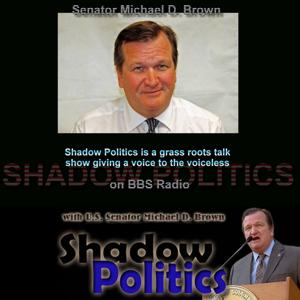
Shadow Politics with US Senator Michael D Brown

Shadow Politics with US Senator Michael D Brown

By Senator Michael D. BrownNewsGovernmentNews CommentaryPolitics
Download on the App Store

Shadow Politics with US Senator Michael D Brown episodes

  • Shadow Politics, October 25, 2026
    Shadow Politics with US Senator Michael D Brown
    GET OUT AND VOTE: Vote for India May!
    India May's Campaign for Iowa House District 58 | May for Iowa
    A Vote is a Terrible Thing to Waste!
    https://mayforiowa.com/
    https://www.facebook.com/groups/1590426035411235/
    https://www.instagram.com/mayforiowa
    https://www.youtube.com/@MayforIowa
    https://bsky.app/profile/mayforiowa.bsky.social
    Rural Health Care, Poisoned Water, and a Fight to Rebuild Trust in Politics with India May
    India May, a nurse, county library director, and county death investigator running for Iowa's District 58 seat, joins Senator Michael D. Brown and co-host Liberty Jones to talk about contaminated rural drinking water, a broken health care system, her opponent's finances, and what it takes to rebuild trust in politics.
    A Nurse Takes On Iowa Politics
    Senator Michael D. Brown opens Shadow Politics by welcoming India May, a first-time candidate for Iowa's District 58 seat, describing her as a registered nurse, county library director, and county death investigator who has personally knocked more than seven thousand doors alongside volunteers. May explains that in her district she has witnessed preventable deaths, cancer in people far younger than it should appear, and suicides among veterans and farmers, which pushed her toward public office. She tells Brown and co-host Liberty Jones that Medicaid, Medicare, and private insurance keep shrinking in coverage even as premiums, deductibles, and medication costs climb, while insurance company profits and executive bonuses rise every year. Brown notes that nurses are consistently ranked the most trusted profession in national surveys, calling it proof that May is running for the right reasons. May says one nurse explaining how healthcare actually works on the ground could help fix broken systems that politicians rarely understand firsthand.
    Poisoned Water And Preventable Disease
    Liberty Jones raises May's work connecting clean drinking water to cancer prevention, especially given new AI data centers. May responds that research already proves Iowa's water carries carcinogens well beyond nitrates and agricultural runoff, naming atrazine, glyphosate, paraquat, and PFAS forever chemicals as endocrine disruptors that affect every organ system, driving up autoimmune conditions like Parkinson's alongside cancer. She says Des Moines receives state-of-the-art filtration while rural Iowans drink the same contaminated water without it, calling it cruel to poison communities and then defund the healthcare that treats the resulting illness. May argues the problem extends across the Midwest and requires real regulation of corporate polluters rather than token penalties, along with a rewritten farm bill. Brown recalls covering the original farm legislation in college and agrees it is overdue for an overhaul, setting up a broader conversation about what rural communities actually need from Washington.
    An Opponent's Debt And Refused Debates
    Brown asks whether money is a problem against her entrenched opponent, incumbent Charlie Thomson, chair of the Iowa House oversight committee. May says Thomson has gone deeply into campaign debt to himself over the years, a legal but, she argues, unethical practice she has documented publicly, and that he has not received a district donation in over a year, relying instead on political action committees and wealthy donors from Des Moines and Chicago. She expects to be outspent but says he cannot outwork her, pointing to Republican yards now carrying her signs. May adds that Thomson has refused every debate and candidate forum, first citing his financial history and then accusing her of antisemitism for opposing what she calls the genocide in Gaza, a charge she rejects as absurd. Brown praises her authenticity, recalling her viral moment confronting Senator Joni Ernst on camera as evidence of the unscripted honesty he says Washington badly lacks.
    Reforming A Party That Talks Down
    Liberty Jones asks what legitimate criticism May has of her own party, and May says she spent her adult life as an independent until deciding Democrats need young, working-class voices the way MAGA reshaped the Republican Party. She criticizes a style of politics her mother calls noblesse oblige that offers half measures instead of asking people what they actually need, and says Democrats must stop enabling foreign conflicts funded by American tax dollars while domestic healthcare goes unmet. Brown agrees that lecturing voters, especially on guns, is the party's Achilles' heel. May recounts an Associated Press reporter's door-knocking question, has the Democratic Party neglected you, which left lifelong Trump voters in her district speechless, and says both parties take support without reciprocating. She argues rural Iowa was neglected by Democrats and that rebuilding trust means proving, door by door, that a vote will actually be returned with action rather than demands for money, loyalty, and yard signs.
    Third Parties, Bernie, And Burnt Trust
    Brown asks whether America needs a third party or whether Democrats can be reformed from within. May says she would prefer to run as an independent herself but believes the two-party system is too rigged for third parties to succeed without reforms like ranked choice, approval, or STAR voting, along with fairer primaries and bigger turnout. Brown recalls serving as a Democratic superdelegate at thirteen consecutive conventions and watching Bernie Sanders get shut out of the 2016 nomination despite chants of his name on the convention floor. May says her generation was burned by that experience, found comfort in Sanders's audiobook while door-knocking, and is now pushing to reform the party from inside, organizing with the Iowa chapter of Progressive Democrats of America to elect progressives to leadership and platform committees. Brown pivots to urge listeners to also support Minnesota's Peggy Flanagan, whom he trained early in her career, as another example of the young leadership he says the moment demands.
    Rural Needs, A Daughter, And A Closing Message
    Liberty Jones asks what conventional wisdom gets wrong about rural politics, and May lists healthcare, education, crumbling infrastructure, unsafe water pipes, and an agricultural system still locked into corn and soy monoculture that has stripped the soil and poisoned runoff. She points listeners to Chris Jones's plan for Iowa Secretary of Agriculture and criticizes the current secretary's background as a Bayer Monsanto lobbyist. Brown recalls covering farm subsidies that enriched corporations like Cargill rather than family farms, and praises Iowa's caucus culture before asking about May's thirteen-year-old daughter, who campaigns alongside her and focuses on children's civil rights. May says the fight can feel insurmountable but calls today's cruelty an extinction burst that does not reflect most Americans, urging listeners to stay engaged however they can. Brown closes by urging Iowa listeners to vote for May and dedicates Miley Cyrus's The Climb to her before signing off with Liberty Jones.
    58 min
  • Shadow Politics, October 18, 2026
    Shadow Politics with US Senator Michael D Brown
    Iran War Missteps, Depleted Military Stockpiles, and a Case for Negotiation with Admiral Joe Sestak
    Admiral Joe Sestak joins Senator Michael D. Brown to dissect the Iran war's shifting goals, its toll on military readiness and sailors, and the politics of fear in Washington, closing with a case for negotiation over endless conflict.
    A Senator Welcomes a Returning Admiral
    Senator Michael D. Brown opens Shadow Politics by welcoming listeners and explaining that his co-host, Liberty Jones, is away on assignment. He introduces Admiral Joe Sestak, describing him as a former United States congressman, Democratic presidential candidate, and admiral who once commanded a fleet in the Middle East, and thanks him warmly for his service. Brown asks directly why America went to war with Iran, noting that the Straits of Hormuz were open, oil was still flowing, and Iran had no nuclear weapon. Sestak calls the conflict a tragic misadventure, explaining that the President wanted a better deal than the existing nuclear accord, which had kept enriched material out of Iran under round-the-clock surveillance and which Iran had never violated. Sestak says the stated goals kept shifting, from removing nuclear capability to toppling the regime, violating the military maxim that armed force can stop a problem but never fix it, and he warns that any use of the military requires knowing the endgame before it begins.
    Iran's Vast Geography and Military Risks
    Senator Brown presses further, relaying claims from Trump supporters that ground troops could finish the job, and asks whether America has forgotten the lessons of Vietnam and the Soviet Union in Afghanistan given Iran's size of ninety-two million people across six hundred thirty-seven thousand square miles. Sestak replies that Iran is four times larger than Iraq and that its Revolutionary Guard is deliberately dispersed with its own generators, making the whole population effectively under its control rather than a single army to defeat. Brown turns to the sailors deployed nearly a year on one aircraft carrier, and Sestak describes five thousand crew with an average age of nineteen and a half living on what amounts to a floating city they cannot leave. He explains that losing the logistics hub in Bahrain forced supplies to route through the Indian Ocean, leaving food scarce at times, and that American minesweepers were rated ready only thirty percent of the time against Iran's five thousand mines.
    Depleted Stockpiles and China's Chokehold
    Sestak warns that the war has damaged broader national security, noting that a single six-hundred-drone-and-missile salvo from Iran consumed four years of Patriot missile production, which will not be replenished until 2033 even as Tomahawk output scrambles from sixty a year toward one thousand. He explains that China has used American tariffs as leverage, tightening its monopoly on heavy rare-earth metals like samarium that these missiles require, crippling production of vital systems even as the National Security Strategy names China the top military competitor. Sestak recalls that Lockheed Martin halted Tomahawk production last year until Belgium and France shared old stockpiles of the material, contrasting that isolation with Afghanistan, where fifty-two countries sent combat forces and eighty provided logistical support. He adds that the Middle East is now splintered, with the Houthis striking the Bab-el-Mandeb strait and threatening to close it much as Iran threatened the Straits of Hormuz, a narrower chokepoint he has personally passed through.
    Saudi Arabia, Israel, and Nuclear Risk
    Brown asks about America's balancing act between Saudi Arabia and Israel, and Sestak says he opposes current plans to help Saudi Arabia build a nuclear reactor, recalling that a U.S. resident journalist was dismembered in Turkey at the instigation of its leader, MBS, and that its oil pipeline has repeatedly been struck despite American-sold defenses. Sestak adds that declaring Israel over the top without consequence, as President Biden once did, weakens America's standing to criticize China's treatment of Uyghur Muslims. Brown raises rumors of a nuclear strike and asks who stops a president from ordering one; Sestak answers that the decision rests with one person alone, recalling a NATO nuclear wargame under Admiral Crowe where sixteen chiefs of defense and an acting President Baker reached a simulated nuclear decision so tense that Crowe ordered Sestak out of the room. Sestak says trust, not firepower, is America's biggest deficit, pointing to Iraq, where removing Saddam Hussein freed Iran from a check that had kept it from causing mischief across the region.
    A Secretary of War Under Fire
    Brown turns to the Secretary of War, calling him unqualified for mocking generals' weight and Marines' toughness, and asks whether this undermines morale. Sestak agrees, noting the Secretary addressed generals and admirals one day and signed a memo the same day cutting cybersecurity training, even as forty-three thousand Chinese factory floors supply American military microchips, forcing ships to pull compromised components. Sestak then recounts a strike mission off Afghanistan where a newly qualified female F-18 pilot, one of the first women in that role, broke protocol and dove repeatedly from twenty thousand feet into range of shoulder-fired missiles to cover eight ambushed special forces troops after four had already died, allowing the survivors to bring their comrades home. Sestak uses the story to argue that moral character, not testosterone, defines a warrior's strength, directly rebuking comments questioning women's and Marines' fitness for combat. Brown thanks him, adding that he has never met a veteran he did not consider exceptional.
    Socialism Myths and a Path to Negotiation
    Brown pivots to politics, arguing Democrats fail to rebut claims that socialism means Sharia law or communism when programs like Social Security and Medicare already exist. Sestak agrees, recalling thirty-one years inside what he calls the largest socialist organization in America, the military, with free healthcare, education, and housing, though he cautions that some social programs, like 1970s rent control, have failed while others, like subsidized childcare tested in North Carolina, proved successful decades later. Sestak compares claims that Haitians eat pets to Thomas Jefferson once calling Haitians cannibals to justify slavery after their revolt, calling both examples of a political dog whistle. Asked for a prescription on Iran, Sestak recommends negotiating a deal that keeps buried nuclear material inaccessible while reopening trade and the strait, as the original accord attempted, warning that repeated military action alone will otherwise repeat Vietnam. Brown closes by calling Sestak a voice of reason and dedicating Pink's "What About Us" to him as the show signs off.
    43 min
  • Shadow Politics, October 4, 2026
    Shadow Politics with US Senator Michael D Brown
    Brazil's Primary Vote, Martial Law Fears, and the Politics of Fear
    Michael D. Brown and co-host Liberty Jones use Liberty's Brazilian primary vote as a starting point to discuss misinformation about Sharia law and socialism, partisan division, fear-based politics, and the midterms.
    Sharia Law, Socialism Fears, and a Call to Calm
    Michael D. Brown opens the broadcast by welcoming listeners to Shadow Politics and introducing his co-host, Liberty Jones, whom he calls his favorite person in the whole wide world. He turns first to misinformation he sees on Instagram and Twitter, where a post asks whether President Trump wants to ban Sharia law. Brown explains that Sharia is a religious code rather than American law, that it cannot be banned under religious freedom, and that the claims are meant to frighten people about Muslims, who make up less than three percent of the population. He then addresses warnings about communists and democratic socialists. Brown reminds listeners that Social Security, Medicare, public schools, and the fire department are already socialist ideas, and he says democratic socialists simply believe government should work for the people. Brown asks Jones to move on, and she responds that both sides use fear to push misinformation during the midterms.
    Division Past and Present, from Jackson to the Internet
    Jones asks whether American politics has always been this dysfunctional or is simply more visible now, and Brown answers that both are true. He recalls Andrew Jackson's wife, who was hounded by the press over a brief, unconsummated arranged marriage and died the day before he was inaugurated, a story he uses to show that nastiness in politics has always existed. Brown says the 1960s were just as divided, with assassinations, a never-ending war in Vietnam, and a divided decade he lived through as a hippie. He argues that the internet is what feels new, because anyone can find thousands of people who agree with them. Brown adds that in the past, Americans had to do research to learn anything, while today a twenty-four-hour news cycle spans fifteen outlets with different prejudices. Brown concludes that the internet has made the situation more toxic than it has ever been before. He says he is an old guy, stuck in his ways, and that Jones's view as someone younger matters more than his.
    Brazil's Primary Vote, Television, and Who Profits
    Jones reports that she voted earlier that day in Brazil's primary elections, which Brazilian citizens living in the United States may join for the presidency. She names the top two options as Flávio Bolsonaro, the son of the former president, and the current president, Lula, whom she calls the leftist option. Jones describes Bolsonaro as a former military man who was found guilty of trying to incite a militaristic dictatorship and imprisoned, and she says President Trump defended him and helped him get out of prison. She describes Lula as the leftist choice she is leaning toward for his environmental laws, recalls the car wash corruption scandal, and says she voted for a third candidate, Ronaldo Caiado, to defend her people. The conversation then turns to television, with Brown recalling that the 1950s brought four channels that signed off at midnight and a single set in most homes. Jones ties that to today's phones and asks whether division grows from real disagreement or because institutions profit from it.
    Martial Law Fears and the Question of Who Decides
    Brown argues that both parties exploit fear, and he jokes that some liberals are "liberals against going along," just as rigid as the MAGA side. He also says most people did not pass through Ellis Island, pointing to his grandfather, who lived here ten years before becoming a citizen. Brown's biggest concern is that Republicans are trying to rig the midterms and may place ICE agents and National Guard at polling places. He says martial law, which he notes has been declared sixty-eight times in American history, frightens him because a declaration would suspend the right to vote. Brown says the Supreme Court would be the arbiter if the president did something Congress considered illegal, and he doubts the courts are as impartial as civics lessons suggest. He warns that a clash of that kind could throw things into chaos, and he admits he does not know what would happen next. Jones answers that if one man can annul the right to vote, America is no longer the land of the free.
    Fear, Hope, and the Politics of Words
    Brown asks what lesson Brazil holds for America, and he is baffled that a promised $5,000 for voting Republican is not called a bribe. Brown wonders whether a hierarchy of needs, like Maslow's pyramid, explains which priorities voters put first, such as immigration or the economy. He concludes that fear is the greatest motivator in politics, from fascism and communism to democracy itself. Brown contrasts fear with the message of King, Gandhi, Jesus, and Buddha, who he says talked about love rather than fear. He says he gets along well with his neighbors in Trumpland, which makes him wonder why people cannot do the same on an intellectual level. Jones says the phrase "good people in both camps" means different things depending on context, and she argues Democrats have been too focused on protecting themselves instead of moving forward with hope. Brown replies that change is the only constant in the universe, and that a democratic socialist like New York's mayor frightens him a little because people do not understand the label.
    Democracy's Future, Banquets, and Human Connection
    Jones says young people feel democracy may be outliving itself, and she mentions a student club at her college that was trying to create a new form of government. Jones agrees that people do not truly understand socialism, but she says she still loves democracy as the best system humanity has built, even though it has been failing. Jones asks what Brown thinks of Trump's banquets with Chinese leaders, and Brown finds it strange given the tariffs and the talk of China abusing America. Jones adds that tech executives attended the event and asks what is happening behind the scenes while people feel their voices go unheard. Brown observes that people see what they want to see, recalling his grandmother's stereotypes and how people look for evidence to support their beliefs. Jones argues that Americans need one another to be happy, and she links falling happiness scores and rising suicide rates to a lack of human connection. Brown closes with a Sheryl Crow line, "It's not having what you want, but it's wanting what you have."
    59 min
  • Shadow Politics, September 20, 2026
    Shadow Politics with US Senator Michael D Brown
    Trump's Falling Approval Rating, Tariffs, Greenland, and the Midterms with Steve
    Returning guest Steve, a self-described Trump supporter, tells host Michael D. Brown and co-host Liberty Jones that he is disappointed in the president over gas prices, the Kennedy Center, and the Iran war, launching a spirited back-and-forth over approval ratings, NATO, Greenland, media bias, abortion, and DC statehood.
    A Trump Supporter Returns, Disappointed
    Michael D. Brown opens the broadcast welcoming listeners to Shadow Politics and introducing his co-host, Liberty Jones, before turning to a returning guest he calls "our old friend Steve," a self-described Trump supporter he jokes is one of the bravest in America for coming back to defend his views. Brown starts with the numbers, noting President Trump's approval rating has fallen to thirty-four percent, the lowest on record, and asks why Steve still supports him. Steve admits he is disappointed, citing high gas prices, the ongoing conflict with Iran, and the push to rename the Kennedy Center, a place he has visited and loves, calling the naming fight a distraction from real problems. He adds that hamburger meat has climbed to nearly twelve dollars a pound, the highest he has ever seen, leaving him anxious heading into the midterms and unsure, as he puts it, what needs to change, only that something must.
    Socialism Fears and Midterm Warnings
    Brown argues that Trump seems "off the rails," questioning his mental acuity and criticizing him for campaigning heavily for Republican candidates despite his weak approval rating, when many of those candidates avoid appearing with him. Liberty Jones suggests much of Trump's behavior is performance, typical of a celebrity, and that moments of visible disappointment reveal character. Steve counters with a claim from that morning's Meet the Press, that Trump's approval rating mirrors past cycles when a predicted "blue wave" never materialized, and that the segment suggested voters dislike the Democratic Party's socialist wing even more than they dislike Trump. Brown pushes back hard, arguing that equating socialism with communism is as unfair as equating Republicans with fascists, and that only two members of Congress identify as democratic socialists, hardly a takeover. He recalls Michael Dukakis's disastrous tank photo as proof that image can sink a candidate, and predicts Republicans will likely keep the Senate but lose the House.
    Canada, Tariffs, and a Debate Over Who Plundered Whom
    Brown turns to Trump's trade fight with Canada, asking why the president would pick a quarrel with a friendly neighbor Steve himself calls "beautiful" with "lovely" people. Steve defends the tariffs as overdue payback for Canada taking advantage of American trade, though he admits it means paying more for his beloved Tim Hortons coffee. Brown counters that the United States has "plundered the world" far more than it has ever been cheated, creating what he calls banana republics in the Caribbean, and Liberty Jones agrees, calling herself "a firm believer in karma." She pivots to a weekend trip through Shenandoah, where "Vote No" campaign signs about marriage reminded her of a 1960s Virginia couple arrested for interracial marriage, and asks Steve what current Trump policies might look, in decades, like that old injustice; Steve says he has no opinion on gay marriage. Brown then dismantles what he calls red-herring fears about Sharia law and voter fraud, tracing similar tactics back to poll taxes and literacy tests from the civil rights era.
    Press Freedom, Activist Judges, and Disputed Facts
    The conversation turns to Trump barring CNN and MSNBC from press events despite promising transparency. Steve argues it "goes both ways" since Twitter and Facebook once banned Trump, and that the networks are relentlessly biased against him. Brown rejects the equivalence, arguing the press's job is to pursue truth rather than represent any side, and praises what he calls "activist judges" for correctly ruling that federal law bars new names on memorials, noting a special exception was passed only so a plaque could mark Dr. King's famous speech at the Lincoln Memorial. Brown lists claims he considers outright lies, including Trump's statement that Somali immigrants were eating people's cats and dogs and an unfulfilled promise of two-thousand-dollar checks during the pandemic. Steve dismisses the pets claim as old news from years back and shifts blame for a reflecting-pool mishap onto an Olympic athlete he calls a Washington activist, prompting Brown to defend the man as someone who has spent his career teaching children to kayak.
    Business Record, Fear, and a Terror Management Theory
    Liberty Jones asks whether Trump would be as successful today if he did not play the blame game and instead focused on the majority rather than singling out people and countries for criticism. Steve credits Trump's business success and famous last name; Brown counters that seven bankruptcies and a career built mostly on licensing his name to buildings hardly counts as building "half of New York." The pair then weigh Trump against Hillary Clinton, Brown noting Trump's resume would read only "TV celebrity" next to Clinton's decades as senator and First Lady, yet voters found her unlikable, a pattern Brown also traces through DC's late mayor Marion Barry, beloved for his personality despite Ward 8 seeing little improvement in decades. Liberty introduces "terror management theory," arguing Trump's rise came from Americans feeling lost and afraid, needing a protector, and asks what policies, beyond psychological reassurance, Steve wants enacted before Trump's term ends.
    NATO, Greenland, and a Closing Search for Common Ground
    Steve names immigration enforcement and cutting NATO spending among the Trump policies he still likes, arguing allies like Germany and the UK give little back during the standoff with Iran; Brown replies that allied spending has kept America safe since World War Two and recalls a grandmother's lesson about calling police for a neighbor. The two spar over Trump's new base on Greenland, which Steve calls a peaceful gift from Denmark and Brown likens to Vladimir Putin's justification for invading Ukraine, joking that Hitler also invented the Volkswagen without redeeming his record. Closing out, Steve names abortion and transgender athletes in women's sports, citing WNBA player Sophie Cunningham, as his sharpest disagreements with Democrats, while Brown invokes Hillary Clinton's line about men and abortion access. Both agree, unexpectedly, on DC statehood, with Steve admitting 2016 was a missed chance under one-party control. Liberty Jones and Brown close by urging unity, dedicating the Village People's "Macho Man" to Steve and Trump.
    58 min
  • Shadow Politics, September 13, 2026
    Shadow Politics with US Senator Michael D Brown and Liberty Jones
    Tribes, Kings, and the Seven Dictums of Left and Right Politics with Christopher Angle
    Philosopher and author Christopher Angle joins host Michael D. Brown and co-host Liberty Jones to trace the political left and right back to tribal leadership, monarchy, and revolution, sparking a pointed debate over the Second Amendment, ethics, and whether power inevitably corrupts any system built on it.
    A Philosopher Joins the Conversation
    Michael D. Brown opens the broadcast by welcoming listeners to Shadow Politics and introducing his co-host, Liberty Jones, before turning to his guest, Christopher Angle, a philosopher, author, and host of The Philosophical Angle podcast. Brown, who spent eighteen years working to end the disenfranchisement of the District of Columbia, says he is eager to hear Angle explain why the country feels so divided. Angle answers that he has identified a set of dictums, principles he says govern how the political left and right behave, and that understanding them requires starting with anthropology rather than modern headlines. He traces politics back to early human tribes, where a member with more knowledge, strength, or age would naturally emerge as leader. Angle argues that leadership brings with it a desire for more resources than others in the group receive, a pattern he says appears across human and animal societies alike, and the discussion that follows builds outward from that starting point.
    From Tribal Chiefs to Kings and Queens
    Angle expands his anthropological account into what he calls the second dictum, Saint Augustine's principle of libido dominandi, the idea that individuals within any society will strive to dominate others. He describes how successful tribes grow into kingdoms, with leaders morphing into kings and queens supported by aristocracies who help enforce their rule over everyone else. Angle says this created a permanent divide between the haves, who enjoyed wealth and status, and the have-nots, the slaves, serfs, and proletariats who worked the land for centuries. He argues that the haves came to believe they alone carried divine favor, a belief reflected in the "divine right of kings" found across Western and Eastern cultures alike, including imperial China. Brown interjects to ask about revolution, noting that eventually the oppressed groups reach a breaking point. Angle agrees that is exactly where the historical arc is heading, setting up the discussion of the uprisings that follow, from England's Civil War era through the documents that reshaped politics in the centuries after.
    Revolutions, Socialism, and the Rise of Totalitarian Control
    Angle walks through the American and French Revolutions, arguing that they permanently weakened royal power because rulers could no longer simply issue edicts and instead had to win votes. He points to the 1815 Congress of Vienna, where Europe's aristocrats, shaken by the French Revolution, struck what he calls the fourth dictum, noblesse oblige, a bargain promising the have-nots basic security in exchange for loyalty, which he identifies as the origin of socialism. Angle traces that thread forward to the 1848 Communist Manifesto and then to twentieth-century regimes he calls its descendants, including Stalin's Soviet Union, Hitler's Germany, Castro's Cuba, Pol Pot's Cambodia, and North Korea, all cases he characterizes as leftist because of their total control over society. He introduces a fifth dictum, Lord Acton's statement that power tends to corrupt and absolute power corrupts absolutely, arguing that unchecked leaders lose their sense of ethics and cooperation, leaving only an end-justifies-the-means mentality that, he says, let Stalin starve millions in Ukraine while believing he was doing right.
    Liberty Jones Challenges the Framework
    Liberty Jones pushes back, agreeing that humans carry an innate tribal instinct but rejecting the idea that society must gravitate toward power-centered tribalism. She argues for a more reciprocal model of leadership, in which a leader earns respect through what they do for the group rather than through domination, and she questions Angle's claim that humanity inherently falls short of the glory of God, suggesting that idea has historically served to keep aristocracies in power. She calls the swing between left and right an organic pendulum of politics, one she believes society can navigate without violence. Later, when Angle explains that power is a form of negative energy that can block a person's priorities, Jones presses harder, asking how the system avoids being fatally flawed if the same elected leaders who are said to crave control are also the ones entrusted to deliver freedom and ethics. She illustrates the point with the image of a fox left in charge of a henhouse, and Angle concedes that kings and queens throughout history behaved exactly that way.
    Ethics, Freedom, and a Clash Over the Second Amendment
    Brown asks how ethics can be restored to a political culture where neither side seems to respect the other, pointing to the hostility he observes on social media. Angle answers that ethics grows out of cooperation, and cooperation grows out of freedom, defined as the ability to form a priority and then effectuate it in reality, protections he credits to the Constitution and Bill of Rights. The conversation turns pointed when Brown challenges Angle's reading of the Second Amendment. Angle argues the amendment exists to let citizens defend themselves against an oppressive government, given thousands of years of disarmed populations under monarchs. Brown disagrees, arguing the amendment's language about a well-organized militia shows it was meant to protect the state itself, since the young nation had no standing army, and that the founders saw government and citizenry as one and the same. Brown also raises current gun laws, noting that a sixteen-year-old in Texas can buy an AR-15 rifle but not a handgun, asking how such priorities can be shaped by ethics instead of fear.
    Economics, Peace, and a Tribute to Close the Show
    Angle shifts to economics, describing every transaction as an exchange of sacrifice for reward involving time, knowledge, energy, and risk, and arguing that free-market exchange, exemplified by buying a fried-egg sandwich at a deli, is itself the nature of peace. He says competition naturally pushes people toward divergence rather than conflict, and that the more transactions a society allows, the more efficient and peaceful it becomes. Brown asks why, if this is true, the country still feels so divided under current leadership, and Angle attributes it to the permanent tug between those who want more control and those who want more freedom. Liberty Jones closes with a question about living with humanity's mix of selfishness and generosity, prompting Angle to define evil as an unethical action paired with an unethical objective. Before signing off, Angle points listeners to his book, The Nature of Political Left and Right. Brown closes the broadcast by marking the twenty-fifth anniversary of September 11th, urging listeners to thank firefighters and first responders, and dedicating P!nk's "What About Us" to the evening's conversation.
    58 min
  • Shadow Politics, September 6, 2026
    Shadow Politics with Senator Michael D. Brown
    The Price of Certainty: Monopolies, Political Tribalism, and the AI Crossroads with guest Chad Law
    Summary
    Corporate Consolidation and the Affordability Crisis
    The episode opens with Chad Law arguing that the country’s affordability problems cannot be understood only through the usual discussion of inflation. He distinguishes the cost of “living” from the unavoidable cost of “life,” pointing to food, housing, transportation, medicine, and insurance as essential expenses. Law says many essential industries have become vertically integrated into a small number of powerful companies, reducing meaningful competition. He argues that accumulated regulations can create protective “moats” around established corporations even when each individual rule may have had a legitimate purpose. His central economic claim is that lower inflation does not automatically mean lower prices, because price increases often become a new floor. The discussion frames competition, rather than political labeling alone, as the mechanism Law believes is necessary to restore consumer leverage.
    Antitrust, Regulation, and the Return of Competition
    The conversation then turns to antitrust, independent businesses, and the difficulty of entering regulated industries. Michael D. Brown recalls watching congressional testimony and the breakup of AT&T, using those experiences to describe how large institutions can dominate technical and political processes. Liberty Jones asks how consumers can recognize the illusion of choice when large companies market different identities and products to them. Law responds that citizens first need to understand how competition is constrained and stop treating antitrust action as automatic punishment for corporate success. He argues for a “common-sense test” based on whether an ordinary entrepreneur could realistically enter a market, and he uses independent pharmacies and beef processing as examples. Rather than calling for a single sweeping solution, he repeatedly favors incremental regulatory changes, pilot programs, and renewed public discussion.
    Housing, Social Media, and Changing Ideas of Success
    Housing becomes a major example of how economic regulation and cultural expectation can reinforce one another. Law argues that the United States has a starter-home crisis and says smaller, less elaborate homes on smaller lots have become difficult or illegal to build in many places. He describes his family’s experience of buying an inexpensive home, improving it gradually, building equity, and using that equity to support education. Liberty connects the housing problem to social media, where young people are constantly shown polished lifestyles and expensive homes that can distort expectations about what a first home should look like. Law agrees that social media plays a role but rejects the idea that it is the only cause, adding parenting, money education, vertical integration, and changing opportunity structures to the picture. The three speakers also question the older formula that automatically linked college, saving, home ownership, and career success.
    Political Tribalism and the Need to Think Again
    A central political theme is the danger of reducing people to partisan identities. Brown challenges the assumption that knowing someone is a Democrat or Republican tells you everything about that person, and Law argues that citizens should be able to criticize their own political side. Law praises Donald Trump’s marketing skill while also saying that a political figure who takes personal credit for success must accept blame when things go badly. He describes both left- and right-wing political movements as capable of becoming more radical when voters feel repeatedly disappointed by campaign promises. The speakers contrast today’s heavily politicized social identity with earlier experiences in which families could support different candidates and still socialize normally. Their shared conclusion is that democracy benefits when people take off their “political jerseys,” tolerate disagreement, and return to sustained civic conversation.
    Community, Government, and Civic Dependence
    The discussion of polarization expands into a debate about community and government responsibility. Brown describes the social connection he now experiences in a 55-plus community and contrasts it with a modern lifestyle in which banking, shopping, and daily routines can happen with little direct human interaction. Law says that some responsibilities once handled by neighbors, churches, and local communities have shifted toward government programs, which he believes can weaken expectations of mutual aid. Brown pushes back by pointing out that local communities have not always treated all people equally and that government can provide a broader mechanism for fairness and support. Both ultimately leave room for a mixed approach rather than arguing that either government or community should disappear. The exchange links economic pressures, social isolation, historical inequality, and civic participation as overlapping parts of the same problem.
    Artificial Intelligence, Data Centers, and Democratic Participation
    The final major topic is artificial intelligence and the lack of a clear national framework for handling its effects. Law argues that Congress has not provided enough leadership on misinformation, child welfare, labor disruption, state-by-state regulation, and other emerging AI issues. He distinguishes anxiety about AI itself from local opposition to data centers, saying that resistance to particular projects can be about environmental review, local process, and citizens feeling excluded from development decisions. Liberty asks workers to consider how they can participate in and benefit from AI rather than only fearing displacement. Law responds that AI should be treated as a tool and gives examples of employees using new tools to accomplish more work with fewer resources. The episode closes by returning to civic participation, with the speakers arguing that people from different political and economic interests showing up at local meetings is evidence that democratic engagement can still bring citizens together.
    55 min
  • Shadow Politics, August 23, 2026
    Shadow Politics with Senator Michael D. Brown
    The Warrior Behind the Spotlight: Hayden Panettiere's Legacy of Activism
    A Tribute to Hayden Panettiere, Actress and Advocate with special guests Senator Paul Eric Strauss & Jeff Pantukhoff
    Senator Paul Strauss, United States Senator, DC Shadow Congressional Delegation
    https://x.com/SenPaulStrauss
    https://www.instagram.com/senpaulstrauss/
    https://www.gfoa.org/bio/paul-strauss
    Jeff Pantukhoff is the founder, president, and driving force behind The Whaleman Foundation, a 501(c)(3) non-profit based in Lahaina, Hawaii, dedicated to the preservation and protection of cetaceans (whales, dolphins, and porpoises) and their ocean habitats. Pantukhoff is an award-winning underwater photographer, filmmaker, and marine conservationist.
    https://whaleman.org/
    Summary
    Remembering the Activist Beyond the Actress
    The episode is framed as a memorial conversation about Hayden Panettiere, with host Michael D. Brown emphasizing that her public legacy extended beyond acting. Brown, Liberty Jones, Senator Paul Eric Strauss, and Jeff Pantukhoff focus on her willingness to use celebrity visibility for causes she cared about. They describe her as unusually committed at a young age, particularly to marine-mammal protection, D.C. voting rights, and statehood. Throughout the discussion, the guests repeatedly distinguish between celebrity endorsement as a publicity gesture and the sustained, hands-on activism they say Panettiere practiced. The tone is personal and grieving, with all four speakers presenting memories intended to show the person they believed existed behind the public image.
    From Whales to Washington Statehood
    Senator Strauss recounts meeting Panettiere during the 2008 presidential campaign while D.C. superdelegates were preparing to meet Barack Obama. According to Strauss, she initially pressed him about marine-mammal legislation, and he answered that D.C.'s lack of full congressional representation prevented him from voting on such bills. He says that comparison between whales without a vote and District residents without full representation immediately drew her into the statehood movement. Strauss and Brown recall that she soon appeared in a D.C. statehood PSA and became the first celebrity face of what developed into the 51 Stars campaign. They portray her involvement as important not only for publicity but also for helping the movement understand how celebrity platforms could be used to reach wider audiences and younger voters.
    Direct Action for Whales and Dolphins
    Jeff Pantukhoff describes meeting Panettiere when she was fifteen on the set of Shanghai Kiss and recruiting her for the Save the Whales Again campaign. He says she traveled with him to see whales and other marine mammals and later joined a protest in Taiji, Japan, where she and others paddled into the water during a dolphin hunt. Pantukhoff recounts confrontations with fishermen, worldwide media coverage, and what he describes as an arrest warrant that was later resolved after meetings with diplomats. He characterizes her as a “true warrior” who was willing to place herself physically in difficult situations rather than serve only as a spokesperson. The discussion presents this direct action as the beginning of a long environmental partnership.
    Voting, Youth Participation, and Political Agency
    Liberty Jones asks what Panettiere's activism says about the relationship among courage, democratic participation, and advocacy. Strauss answers that Panettiere learned quickly that voting and political engagement were tools for advancing causes that young people already cared about. He says she used her first presidential election, youth-vote activity, and her public platform to connect political participation with environmental and social causes. Pantukhoff adds that she was inspired by other celebrities who used their visibility for humanitarian or environmental work and wanted to do the same. Together, the speakers portray her activism as an example of turning personal conviction into public agency rather than treating politics as separate from other forms of advocacy.
    From Protest to Diplomacy and International Programs
    Pantukhoff says Panettiere's work evolved from highly visible direct action toward diplomacy as well. He describes meetings with whaling nations' ambassadors, later discussions in Taiji, and work involving the International Whaling Commission and the Obama administration. He credits her with helping promote an international whale-disentanglement initiative and with lending visibility to efforts concerning fin whales and fishing-gear entanglement. His larger lesson is that activism requires judgment about when to confront and when to negotiate. The program therefore presents Panettiere's environmental work not as a single protest moment, but as a combination of media advocacy, direct action, diplomacy, filmmaking, and institutional engagement.
    A Legacy of Courage and Continued Action
    The final portion becomes increasingly personal as Brown, Jones, and Pantukhoff reflect on Panettiere's fame, the pressure she faced from childhood, and the warmth they say she showed in private interactions. Brown reads a PETA statement praising her marine-mammal advocacy and discusses a final campaign image centered on the confinement of whales and dolphins. Pantukhoff recalls her saying that an environmental award meant more to her than an acting award, while Jones urges listeners to “alchemize” the story by continuing the work she represented. Brown closes by describing her as a warrior with courage and by dedicating the program's final song to her memory. The episode's final message is that the speakers believe the best tribute is not only remembrance, but continued participation in the causes she championed.
    49 min
  • Shadow Politics, August 16, 2026
    Across the Divide: Trump, Iran, the National Guard, Immigration, and America’s Political Future
    Debating Trump Across the Political Divide
    Michael D. Brown and Liberty Jones welcome returning guest Steve after a last-minute cancellation and make clear from the beginning that Steve’s support for Donald Trump differs sharply from their own views. The hosts frame the conversation as an effort to hear both sides rather than avoid disagreement. The opening exchanges focus on Trump’s public branding, the Kennedy Center, other institutions and programs carrying his name, and disputes over a legal case connected with vandalism in Washington. Steve remains supportive of Trump, while Brown and Jones question whether the president’s conduct reflects excessive ego, inconsistent principles, or misuse of office.
    Iran, War, and the Limits of Military Power
    A large part of the episode centers on the U.S. confrontation with Iran. Steve argues that the United States may need to apply more military pressure and repeatedly emphasizes the strength of the American armed forces. Brown and Jones challenge that view, citing the continuing conflict, the Strait of Hormuz, nuclear material, military costs, weapons inventories, and what they see as shifting objectives. Liberty argues that a military strategy should be judged by whether it accomplishes clearly defined goals, while Brown invokes lessons from Vietnam, Afghanistan, Gaza, and other conflicts to argue that “boots on the ground” do not guarantee success.
    National Guard Deployment and Civilian Safety
    The speakers then clash over the deployment of the National Guard in Washington, D.C. Steve says the Guard makes him feel safer and strongly defends service members from protesters who insult or harass them. Brown agrees that individual soldiers should be treated respectfully but says military forces in civilian streets can create danger, invoking Kent State and other historical examples. Liberty emphasizes the symbolism of military power over a civilian population and argues that deployment is difficult to justify if crime was already declining. All three distinguish, to varying degrees, between criticizing policy makers and attacking troops who are carrying out orders.
    Democrats, Republicans, Leadership, and Term Limits
    The discussion shifts into election politics, Democratic moderates and progressives, Republican loyalty to Trump, and the public desire for decisive leadership. Steve worries that progressive policies can hurt Democrats in competitive states, while Brown says he is encouraged by moderate Democratic candidates. Liberty describes herself as a moderate Democrat and argues that both parties suffer from disrespect, ignorance, and lack of compassion. They also debate a hypothetical Trump third term, the 22nd Amendment, Franklin D. Roosevelt, George Washington’s two-term precedent, congressional term limits, and whether voters should be trusted to remove officials they no longer support.
    Immigration, Race, and Political Rhetoric
    The most heated part of the program concerns immigration, Somali communities in Minnesota, Islam, political demonstrations, and the slogan “Death to America.” Steve argues that people who openly express hostility to the United States should face consequences and defends Trump’s immigration enforcement. Brown counters that America is a nation of immigrants, criticizes rhetoric that portrays whole ethnic or immigrant populations as dangerous, and argues that immigrant workers are often among the hardest-working people in their communities. Liberty challenges the way alienation and enforcement can feed anger, while Brown connects current rhetoric to broader American histories of racism, discrimination, and exclusion.
    Free Speech, Democracy, and the Need to Listen
    The conversation closes on the tension between offensive speech and constitutional freedom. Brown invokes the ACLU’s defense of Nazi demonstrators in Skokie to argue that the First Amendment protects speech people deeply dislike. Liberty presses Steve on immigration enforcement and alleged harms to citizens as well as immigrants, but the show runs out of time before he can fully respond. Brown jokingly dedicates “Stand by Me” to Steve and Donald Trump, while also thanking Steve for appearing and reiterating that a functioning democracy requires people to hear opposing views. The final message combines strong partisan disagreement with an insistence that election outcomes, democratic process, open debate, and the next generation’s participation still matter.
    SEO Keywords / Key Phrases
    Donald Trump policies, Iran war debate, U.S. military strategy, National Guard deployment, immigration policy debate, political polarization, presidential term limits, First Amendment free speech, Democratic Party leadership, Republican Party future
    56 min
  • Shadow Politics, August 2, 2026
    Shadow Politics with Senator Michael D. Brown and Co-host Liberty Jones
    No Vote, No Tax: Kymone Freeman’s Fight for D.C. Statehood and Radical Accountability
    Michael D. Brown and Liberty Jones welcome Kymone Freeman for a wide-ranging conversation about D.C. statehood, tax resistance, Democratic Socialism, root causes of violence, poverty, food apartheid, housing justice, civic disengagement, and the urgent need for political courage in the nation’s capital.
    Guest Spotlight: Kymone Freeman
    Kymone Freeman is the guest on this episode of Shadow Politics and is introduced as the founder of We Act Radio, an activist, and a candidate running in the general election as a D.C. Statehood Green Party candidate. Michael D. Brown describes Freeman as a longtime friend of the show and someone who has made Washington, D.C. a better place through grassroots work, while Freeman presents his campaign as a challenge to corporate Democratic leadership, political complacency, and the continued denial of full representation for D.C. residents.
    Find out more about Kymone Freeman's Campaign at his website:
    https://www.freeman4congress.com/
    Shadow Politics Opens With a Grassroots Mission
    Michael D. Brown opens the episode by describing Shadow Politics as a grassroots talk show committed to making America think again. He explains that the show interviews people who are shaping politics and community life, often outside the brightest spotlight, and invites listeners to call in and engage. Liberty Jones joins as co-host, and Michael introduces Kymone Freeman as a returning guest whose activism, media work, and presence in Washington, D.C. have made him an important voice in the city’s political conversation.
    Kymone Freeman’s Campaign and the Statehood Green Party
    Freeman explains that he is running in the general election as a D.C. Statehood Green Party candidate after what he describes as a media blackout and resistance from the corporate leadership of the Democratic Party. He argues that progressive politics, Democratic Socialism, and challenges to the status quo are often excluded even within a party that claims to welcome a broad coalition. Freeman connects his campaign to the legacy of Hilda Mason, the D.C. Statehood Party leader and Democratic Socialist who once defeated a Democratic primary winner, suggesting that the current political moment may create another opportunity for history to repeat itself.
    “No Vote, No Tax” and Tax Resistance
    A major portion of the conversation centers on Freeman’s “No Vote, No Tax” position. He argues that D.C. residents should not have to pay federal income taxes while being denied voting representation and statehood, comparing the District’s situation to U.S. territories such as Puerto Rico and Guam. Freeman says he has personally been a tax resister for 30 years, both in support of D.C. statehood and as a war-tax resister. He presents tax resistance not only as protest, but as a pressure tactic that could move the statehood conversation forward if enough D.C. residents reached a critical mass.
    Root Causes of Violence, Poverty, and Food Apartheid
    Michael asks Freeman about addressing the root causes of poverty, and Freeman reframes the issue as addressing the root causes of crime and violence, with poverty as one of the central causes. He argues that poverty is man-made and maintained through policy, then connects violence to child poverty, illiteracy, food apartheid, lead pipes, poor nutrition, and public priorities that favor stadium spending over basic infrastructure. Freeman contrasts the number of grocery stores in wealthier Ward 3 with the lack of access in poorer Ward 7 and argues that D.C. must treat food, education, housing, and health as violence-prevention issues rather than relying only on police and prisons.
    Education, Chess, Housing, and Alternative Models
    Liberty asks what could help heal the roots of violence, and Freeman points to policy change, youth development, and structural investment. He discusses teaching chess to children as a way to build critical thinking and conflict-resolution skills, while also criticizing the difficulty of getting D.C. Public Schools to adopt chess more broadly. He also calls for grocery-store regulation, municipally owned supermarkets, community co-ops, and housing models inspired by places such as Vienna, Austria, where he says social housing and stronger safety nets help reduce poverty and crime. Freeman frames these ideas as part of a top-bottom political problem rather than a left-right divide.
    Democratic Socialism, Foreign Aid, and Civic Resistance
    The conversation broadens into Democratic Socialism, Zohran Mamdani, Israel, Netanyahu, diplomatic immunity, U.S. foreign aid, and the way narratives become normalized through political pressure. Freeman argues that intimidation and civic discouragement are designed to make people give up, pointing to low voter participation in D.C. as evidence of disconnection and resignation. He invokes Martin Luther King Jr.’s question, “Where do we go from here: chaos or community?” and argues that people must remain awake through major social change instead of sleeping through revolution. The hosts also discuss voter ID, the SAVE America Act, and how the term “woke” became a political weapon.
    D.C. Leadership, Campaign Priorities, and the Closing Call to Imagine
    Near the end of the episode, Michael asks Freeman about D.C.’s incoming mayoral leadership, Muriel Bowser’s record, Janice’s potential approach to Trump, and whether new leadership might better support statehood. Freeman says he expects change but will judge leadership by whether it stands ground or capitulates. He also promotes an upcoming town hall at Busboys and Poets, gives his campaign website, and explains additional priorities including a 30-percent cap on housing plus utilities and banning private equity from owning homes. Michael closes by dedicating John Lennon’s “Imagine” to Freeman, describing him as someone who thinks big and imagines a better tomorrow.
    56 min
  • Shadow Politics, July 26, 2026
    Shadow Politics with Senator Michael D. Brown and Co-host Liberty Jones
    Policy Decoded: A Young Voice Teaching America to Think Again
    Michael D. Brown and Liberty Jones speak with Shubh, founder of Policy Decoded, about youth civic education, short-form policy videos, nonpartisan engagement, immigration, health care, political identity, and the next generation’s role in restoring thoughtful democracy.
    Guest Spotlight: Shubh Bachkethi
    Shubh is introduced as a high school student and founder of Policy Decoded, a youth-led nonprofit focused on raising civic awareness among young people. Through short, accessible policy videos on YouTube and Instagram, he aims to help youth understand state and federal policies that affect their daily lives, while building a nonpartisan platform that encourages both awareness and civic engagement.
    A Grassroots Conversation About Making America Think Again
    This episode of Shadow Politics opens with the show’s theme of democracy, representation, overlooked voices, and civic participation. Host Michael D. Brown welcomes listeners to the grassroots talk show, describing its mission as helping “make America think again” by giving people information rather than telling them how to feel or vote. Alongside co-host Liberty Jones, Brown introduces Shubh as only one of a few high school students featured on the program, noting that Shubh has earned the invitation because of the originality and promise of his civic project.
    What Policy Decoded Is Trying to Do
    Shubh explains that Policy Decoded is a youth-led nonprofit dedicated to educating young people about the policies that shape their daily lives. Its goal is to reach more than one million youth with clear explanations of state bills, federal policy, and other civic issues. Brown is especially impressed by the format: one-minute, sixty-second vignettes designed for the attention patterns of young people raised on social media. Shubh says the organization shares content on YouTube and Instagram, is considering TikTok, and has already gathered significant viewership across both platforms.
    From Medicine to Public Policy
    Liberty asks Shubh what inspired him to create Policy Decoded, and he explains that for a long time he thought he wanted to become a doctor, possibly a pediatrician, because he wanted to help children and people his own age. But as national politics and policy became more visible in daily life, he realized that public policy made him feel more engaged and purposeful. He started Policy Decoded because he wanted people his age, and people of all ages, to access policy in a way that is easy to understand, engaging, and connected to what is happening in their state and at the federal level.
    Making Policy Accessible Across Political Lines
    The hosts press Shubh on whether policy education can help people vote based on issues rather than personality. Shubh says Policy Decoded focuses on topics such as health care, housing, affordability, taxes, and other issues that matter to people’s lives. He explains that young people may not always see why something like health care matters until it touches someone close to them, such as a grandparent, relative, or friend with illness or disability. Liberty asks about feedback, and Shubh says the project has expanded into more than ten states and received positive responses from people across races, age groups, colleges, and political perspectives, including people connected to both the Heritage Foundation and High School Democrats of America.
    Nonpartisanship, Interviews, and Humanizing Politicians
    A major theme of the episode is whether Policy Decoded can remain nonpartisan while covering contested issues. Shubh says the organization tries to present both sides of policy arguments, explaining what supporters and opponents say so viewers can decide what they believe and whether they want to take action. He also interviews politicians, former politicians, and candidates, explaining that one goal is to show that politicians are human beings rather than only media caricatures. Brown agrees that politics contains both good and bad people, quoting the idea that “the cream always rises to the top, but so does the scum.”
    College Goals, Law, Health Care, and Immigration
    Shubh shares that he hopes to attend a top East Coast university, naming schools such as Harvard, Yale, Georgetown, and others as part of the environment he finds intellectually exciting. He plans to study political science and public policy, possibly minor in a language or U.S. history, attend law school, work as a lawyer, and eventually enter politics with a deeper understanding of his community. When Liberty asks about his bigger dream, Shubh says he is especially passionate about health care and immigration. He connects health care to the loss of his grandmother in India and explains that better access might have allowed him more time with her.
    Immigration, Identity, and Misconceptions
    Shubh also speaks personally about immigration. He says he was born in India, moved to the United States as a baby, later became a naturalized American citizen, and still has family ties in India. He remembers wanting to be president as a child and feeling disappointed when he learned the office is limited to people born in the United States. He also pushes back against the idea that being born elsewhere makes someone less American, explaining that he loves the United States while also keeping Indian traditions. Brown then broadens the conversation to global nationalism, religious fundamentalism, racism, and the search for scapegoats, while Shubh argues that many social divisions come from misconceptions, stereotypes, and lack of interaction between groups.
    Compromise, Technology, and the Next Generation
    Toward the end of the interview, Brown asks Shubh about compromise, democracy, and the frustrations of working in politics. Shubh describes participating in Model UN and a simulated U.S. Senate committee, where he learned how frustrating it can be when legislation is blocked. Still, he says compromise matters because if everyone clings too tightly to their own position, nothing gets done and the country moves toward chaos. Liberty closes by asking what Shubh’s generation brings to politics, and Shubh points to technology, artificial intelligence, social media, political awareness, and a rising desire for effective leadership. He says young people can use modern tools to mobilize, inform, organize, and help bring change to the United States.
    PolicyDecoded.org and the Closing Message
    The conversation ends with Brown praising Shubh’s maturity, civic ambition, and ability to explain complex issues. Shubh directs listeners to PolicyDecoded.org, where they can find the organization’s videos and learn more about its work. Brown offers to be interviewed by Shubh, thanks Liberty Jones, and closes the program by dedicating Pink Floyd’s “The Wall” to the guest. The episode ends with the Shadow Politics outro, returning to the themes of representation, open questions, unheard voices, and democracy as a conversation that depends on public participation.

    54 min

About Shadow Politics with US Senator Michael D Brown

From the publisher's feed

Shadow Politics is a grass roots talk show giving a voice to the voiceless. For more than 200 years the people of the Nation's Capital have ironically been excluded from the national political…

More shows like Shadow Politics with US Senator Michael D Brown

Adama Speaks by Adama Alaji

Adama Speaks

42 Listeners

Sound Healing with David Gibson by David Gibson

Sound Healing with David Gibson

29 Listeners

Cosmic LOVE with Dr Christopher Rudy by Dr. Christopher Rudy

Cosmic LOVE with Dr Christopher Rudy

2 Listeners

The Metaphysical Hour with Julia Cannon and Tracie Mahan by Julia Cannon

The Metaphysical Hour with Julia Cannon and Tracie Mahan

66 Listeners