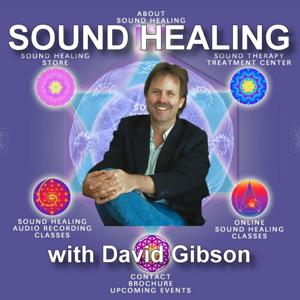
Sound Healing with David Gibson

Sound Healing with David Gibson

Download on the App Store

Sound Healing with David Gibson episodes

  • Sound Healing, September 26, 2026
    Sound Healing with David Gibson
    The Harmonic Structure of Sound: Odd and Even Harmonics From Guitar Strings to Galaxies
    David Gibson devotes the hour to the harmonic structure of sound, tracing odd and even harmonics from a plucked guitar string and the singing voice through gongs, crystal bowls, planetary distances, and the golden mean, closing with a live sound meditation for peace.
    Inside the Sound Healing Center
    David Gibson opens the broadcast with a tour of the Sound Healing Center's four branches: the Globe Institute, the Sound Healing Store, the Sound Therapy Center, and the Sound Healing Research Foundation. He describes Globe Institute as the only state-approved sound healing college in the United States, offering two sound healing certificates and an audio recording certificate, in person in Sausalito and online, with the online certificate program able to start September 29th and the recording program already underway. He walks through the Store's four hundred instruments and technologies, from crystal bowls and Tibetan bowls to Brainwave Assessment and voice analysis software, and mentions the contract bringing eight sound protocols into Northern California's largest dementia care company. He also describes the Research Foundation's library of over a thousand clinical papers, the Medical Sound Association's bimonthly treatment-plan meetings, and a $100,000 grant funding sound curriculum in Montessori schools, before inviting listeners to an October 4th open house in Sausalito.
    The Harmonic Structure of Sound
    Turning to the day's subject, Gibson explains the harmonic structure of sound, the mathematics behind why one instrument or voice feels different from another. He sings a single sustained "ah" and tells listeners they just heard over a hundred notes and frequencies stacked inside that one sound, since nearly every sound in nature is built from many frequencies at once rather than just one. Demonstrating on a guitar, he plucks the open E string at what he simplifies to 80 Hz, calling it the fundamental or root frequency, then rests a finger lightly on the twelfth fret to isolate the second harmonic at 160 Hz, an octave higher. He shows how the string is simultaneously vibrating in two, three, four, and dozens of smaller sections at once, each producing a frequency that is a whole-number multiple of the root, and explains that the voice's vocal cords generate roughly a hundred such vibrations in exactly the same mathematical pattern.
    Odd Harmonics Versus Even Harmonics
    Gibson then divides instruments and voices into two families based on which harmonics they emphasize. Metal instruments with bumps, reed instruments, and bagpipes, he explains, produce mostly odd-numbered harmonics, forming a dissonant, edgy chord that he calls activating, evident in gongs, Tibetan bowls struck with a wood stick, clarinets, and heavy metal guitar distortion. Instruments built from nylon string or wood, such as the harp, classical guitar, and wood tongue drum, produce even-numbered harmonics instead, forming a warmer, sweeter chord that calms the nervous system. He carries the same odd-even split into vowels, contrasting the tense, effortful "e" with the relaxed, resonant "oo," and into singers, naming Janis Joplin, Axl Rose, and Bob Dylan as odd-harmonic voices and Barry White and Norah Jones as even-harmonic ones, adding that Adele carries a slight edge of her own.
    Matching Sound To The Nervous System
    Gibson maps out when to reach for each family of sound. Odd harmonics, he says, break up stuck energy and emotion, energize a room, and help ease people out of depression once introduced gradually, and can speed blood flow for people in early-stage dementia. But he warns they can trigger panic attacks, overwhelm anyone fragile, freshly out of surgery, or living with advanced dementia, where even a Tibetan bowl must be handled carefully and gongs are off limits entirely. He lays out his spectrum of instruments running from most activating to most calming, gongs, noisemakers, the ocean drum, and wood-struck Tibetan bowls at one end, softening through rattles, drums, and frosted bowls, down to soft shakers, handpan, FreeNote xylophone, RAV drum, sansula, and koshi chimes at the other. He notes his own taste shifts through the day, favoring warm even harmonics in the morning, more activation in the afternoon, and calm again by evening.
    Harmonics Across Nature And The Body
    Zooming out, Gibson traces the same harmonic mathematics through the rest of the body and the cosmos. He describes alchemy crystal bowls carrying the vibrational signature of whatever gemstones or metals are embedded in them into every water droplet of the body, and recounts a visitor who had mapped harmonic chords for each organ, explaining that a person's voice takes on the harmonic structure of their weakest organ, fear-holding kidneys sounding one way, an angry liver another. He extends the pattern to the solar system, describing the distance from the Sun to Mercury as a root frequency multiplied outward through Venus, Earth, Mars, and the asteroid belt, a structure some spiritual teachers, he notes, associate with love. He adds that electron shells, vertebrae, and, in Fabien Maman's view, the human aura all follow the same one-times, two-times, three-times series, which is why acoustic instruments map to the body more precisely than electronic ones.
    The Golden Mean And Closing Meditation
    Gibson closes by setting the harmonic series against a second pattern, the Fibonacci sequence and its golden mean ratio of 1.618, which he calls nature's spiral, visible in the proportions of the fingers, hand, arm, and face and in shells and galaxies alike, and which he associates with the heart's own resonance when generating love. He calls the harmonic series the masculine structure of the universe and the golden mean its feminine counterpart. To let listeners feel the contrast directly, he plays his own recorded piece "Angelica," built on the odd, edgy harmonics of a tanpura, followed immediately by a mellow, even-harmonic piece he composed for sleep. He then leads listeners live in making the calmest, warmest sound they can manage with their own voice, and sends them off asking them to hold that peaceful state through the evening, the weeks, and the months ahead.
    58 min
  • Sound Healing, September 12, 2026
    Sound Healing with David Gibson
    Dynamic Curves: Shaping Sound Baths and Treatments From Activation to Stillness
    David Gibson devotes the hour to dynamic curves, the practice of building and breaking down sound in baths, treatments, and his own recordings to carry listeners from activation into deep, healing stillness.
    Inside the Sound Healing Center
    David Gibson opens the broadcast from Sausalito with a tour of the Sound Healing Center's four branches: the Globe Institute, the Sound Healing Store, the Sound Therapy Center, and the Sound Healing Research Foundation. He describes the Institute as the only state-approved sound healing college in the United States, offering two sound healing certificates and an audio recording certificate, both in person and online, with a new online semester starting September 14th and a recording program beginning September 22nd. He walks through the Store's four hundred instruments and technologies, from crystal bowls and didgeridoos to Brainwave Assessment and Voice Analysis software, and mentions a contract bringing eight sound protocols into Northern California's largest dementia care company. He also describes the Sound Healing Research Foundation's library of clinical papers, the Medical Sound Association's bimonthly treatment-plan meetings, and a $100,000 grant funding sound curriculum in Montessori schools. He points listeners to the Sound Healing Center's website for further details.
    Introducing the Dynamic Curve
    David Gibson introduces the day's main topic: dynamic curves, the shaping of a sound bath, concert, or treatment so it builds and breaks down rather than simply floating in one mood. He explains that most practitioners create a pleasant atmosphere on a single instrument, like a crystal bowl, and never go anywhere with it, while a true curve intentionally moves in intensity, pitch, and volume over time. He calls this an advanced skill, one that makes sound work far more effective than staying flat. Demonstrating live, he tones and plays a singing bowl in what he calls a mountain curve, starting mellow, rising in loudness and pitch until it feels intense, then settling back down. He credits his own introduction to the idea partly to listening to Pink Floyd's Dark Side of the Moon, noting how the album opens with alarm clocks and gradually mellows before building again, and to the Grateful Dead, whose slow-building live jams keep audiences engaged for long stretches without ever moving so slowly that listeners lose interest.
    Naming the Curves in Practice
    Gibson walks through several named curve shapes he uses in practice. The floating curve, he says, is a beautiful but flat sacred space where nothing really builds, fine for a gentle sound bath but less transformative. A curve for treatments meets people where they are, often keyed up or anxious, brings them steadily down into deep calm, then lifts them gently back to alertness so they can drive home afterward. The mountain curve builds intensity before breaking down, useful for showing people they can handle more energy, though he warns it can overwhelm anyone fragile, freshly out of the hospital, or living with advanced dementia. His personal favorite is what he calls the mellow out curve, which grows quieter and slower through an entire session until, by the end, almost nothing is moving. He describes this profound stillness as the safest option in a room full of strangers, since no one knows in advance who might be too delicate to handle a gong or other intense sound.
    Mapping Instruments From Activating to Calming
    Gibson lays out a spectrum his program has mapped from most activating to most calming. Bagpipes, gongs, ocean drum, and Tibetan bowls struck with a wood stick sit at the activating end, followed by drums, djembe, frosted and alchemy bowls, flutes, and crystal harp, while soft shakers, handpan, free-note xylophone, sansula, and Koshi chimes sit at the mellow end. He recommends moving step by step through this list rather than jumping straight from a gong to Koshi chimes, so listeners are carried along smoothly. He then details the qualities that make any sound more calming or activating: even harmonics, complex tones, soft volume, low frequency, slow or absent tempo, sustained notes, simple melodies, and repetition all calm the nervous system, while odd harmonics, loud volume, high frequency, fast tempo, rhythm, harmony parts, and unpredictable change tend to activate it. He adds that lyrics engage the analytical left brain and judgment more than wordless vowel sounds, and that unfamiliar instruments bypass stylistic labeling altogether.
    A Sound Bath and a One-On-One Treatment
    Gibson maps his own sound bath, which opens fairly activating with gongs and large bowls, moves through rattles and drums, then settles into a three-bowl harmony chord before he demonstrates a binaural beat by singing slightly off pitch against a bowl. From there he layers Tibetan bowls, melodic instruments like the free-note xylophone and crystal harp, and finally Koshi chimes before letting a bowl fade into five or ten minutes of silence, which he says lets everyone arrive at stillness together. He then outlines his one-on-one treatment format: clients lie on a sound table for fifteen or twenty minutes, he opens with an invocation calling in guides and ancestors, moves through drums, rattles, a large Tibetan bowl, tingshas, and tuning forks, and closes with the frosted bowl and the words "may the healing continue, as appropriate for your highest good," then leaves the room so the person can rest in the stillness alone, sometimes falling asleep on the table.
    Closing With Music and the Fibonacci Curve
    Gibson closes the hour by playing examples of dynamic curves built into his own recorded music. He plays "Unconditional Love" as a mountain curve, adding octaves and higher frequencies until it peaks before mellowing back down, then "Uplift," a slow, building Stairway to Heaven style track he says is used in the integrative therapy department at Massachusetts General Hospital to help lift people out of depression without overwhelming them. He explains that the smoothest curves follow the Fibonacci sequence, one plus one is two, two plus three is five, and so on, calling it the pattern behind all growth in the universe. He notes that activation before mellowing helps the body feel fully present in the calm that follows. The broadcast ends with "Pure Light," a piece that slows to half speed and settles into deep stillness, after which Gibson tells listeners to carry that stillness through the evening, the weeks, months, years, and lifetimes ahead.
    57 min
  • Sound Healing, August 29, 2026
    Frequency Keys: Exploring Resonance from the Body to the Soul
    The Sound Healing Center and Its Programs
    The episode begins with a promotional overview of the Sound Healing Center and its related organizations, including the Globe Institute, Sound Healing Store, Sound Therapy Center, Sound Healing Research Foundation, Medical Sound Association, and Sound Education Association. The introduction describes certificate programs in Sound Healing and audio recording, a physical and online educational presence, hundreds of instruments and sound technologies, research materials, therapeutic resources, and vibroacoustic equipment. It also highlights dementia-related protocols, treatment plans, educational curricula for children, and several websites through which listeners can learn more. David Gibson then introduces upcoming sound baths, open houses, certificate programs, online classes, and recording courses. The institutional material establishes the broader context for the episode: sound is presented not only as music but as a tool for education, relaxation, research, therapy, and personal exploration.
    Where Frequencies Come From
    David Gibson frames frequencies as “keys” capable of opening different physical, mental, emotional, and spiritual doors. He begins with the broad distinction that high frequencies tend to activate the mind while low frequencies tend to calm the body, then describes several ways people derive or identify frequencies. These include numerology, scientifically measured vibration, mathematical formulas, and intuitive methods such as muscle testing or pendulum work. He discusses Solfeggio frequencies, planetary frequencies, the Schumann resonance, tuning forks, tone generators, and the use of numbers such as 111 and 432. Gibson repeatedly distinguishes between methods that have clear physical measurements and those based on symbolism, numerology, intuition, or spiritual interpretation. His central point is that frequencies come from many different systems, and listeners should understand where a claimed frequency came from before assuming it has a particular meaning or effect.
    Learning Frequencies Through the Body
    A substantial section of the program becomes an experiential tour through audible frequencies. Gibson plays or describes frequencies beginning around 40 hertz and progressing through 45, 100, 111, 136.102, 200, 250, 300, several Solfeggio frequencies, 432, 528, 639, 741, 852, 1,000, 3,000, 5,000, 10,000, and 15,000 hertz. He encourages listeners to sing along where possible and notice where each tone resonates in the body. Along the way, he recounts claims and anecdotes involving bone density, cat purrs, hummingbirds, migraines, sacred sites, chakras, the Great Pyramid, water patterns, babies’ cries, the Sun, DNA, intuition, and speech intelligibility. Gibson emphasizes that some of these associations are scientific, some symbolic, some anecdotal, and some intuitive. His practical goal is for listeners to stop thinking of frequency only as an abstract number and begin recognizing how different ranges feel physically.
    The Problem With Healing-Frequency Lists
    Gibson then turns to one of the episode’s most skeptical themes: the lack of agreement among lists that claim particular frequencies for organs, illnesses, vitamins, minerals, or therapeutic effects. He discusses frequency work attributed to Peter Guy Manners, Rife-related frequency lists, GreatDreams.com, Electro-Herbalism.com, and other collections of proposed therapeutic frequencies. Although Gibson believes frequency can be useful, he repeatedly questions how specific numbers were derived, whether the methods involved scientific study, intuition, muscle testing, or only a small number of subjects, and why different sources often disagree dramatically. He argues that organs such as the heart contain many different kinds of vibration, including mechanical, cellular, atomic, electromagnetic, photon, and what he calls quantum or emotional frequencies. Because every person and every biological level may vary, he says a single universal number for an organ or condition may be an oversimplification.
    Research, Measurement, and the Need for Better Evidence
    The episode develops this skepticism into a broader discussion of research design. Gibson argues that identifying the “best” frequency for a condition is extraordinarily difficult because researchers would have to compare enormous numbers of possible sound, electromagnetic, light, and other frequencies. He discusses claims associated with Anthony Holland, cancer frequencies, 528 hertz, pollution research, and various frequency devices while cautioning that showing one frequency has an effect does not prove it is uniquely or optimally suited to that target. Gibson proposes that pure frequencies may often seem beneficial simply because they provide stable, consistent vibration rather than chaos or irregularity. He says stronger evidence would come from testing devices or techniques across hundreds or thousands of people and measuring the percentage helped for a specific condition. Ultimately, he envisions individualized measurement capable of identifying a person’s own frequencies rather than relying entirely on generalized charts.
    Intuition, Personal Resonance, and the Frequency of Source
    The final section moves from research back into experiential and spiritual territory. Gibson guides listeners through an exercise in which they focus on an uncomfortable area of the body, intuitively search for a tone associated with its healthier state, and then silently “send” that frequency to the area through breath and visualization. He describes personal frequencies associated with heart rate, brainwaves, respiration, metabolism, the soul, love, the universe, and ultimately Source. Gibson says peace and stillness make intuitive perception easier and compares the process to a shaman listening for the song of a plant. He closes by asking whether Source, if understood as containing all frequencies, might nevertheless possess a fundamental “home note,” while also recognizing the interplay of order and chaos throughout the universe. His final message is that individual frequencies are only one layer of a larger matrix that also includes relationships and flows among bodies, emotions, souls, planets, and the universe as a whole.
    SEO Keywords / Key Phrases
    sound healing frequencies, Solfeggio frequencies, 432 Hz resonance, frequency therapy, vibroacoustic therapy, healing sound technology, chakra frequencies, Rife frequencies, sound meditation, frequency research

    59 min
  • Sound Healing, August 15, 2026
    Sound Healing with David Gibson
    Transforming Negative Beliefs Through Sound, Resonance, and Self-Love
    David Gibson explores how negative beliefs influence relationships, work, money, health, self-worth, and spiritual growth, then guides listeners through affirmations, vocal-toning practices, and embodied truths designed to replace limiting patterns with love, confidence, emotional balance, and a deeper sense of personal wholeness.
    Sound Healing Center Resources and Programs
    The episode opens with an overview of the Sound Healing Center and its related organizations, including Globe Institute, the Sound Healing Store, the Sound Therapy Center, and the Sound Healing Research Foundation. The introduction describes certificate programs, sound-healing instruments, vibroacoustic tools, research papers, treatment-plan resources, educational projects, and online information for listeners interested in sound therapy and related training.
    How Negative Beliefs Shape Everyday Life
    David Gibson identifies transforming negative beliefs as the central topic of the episode. He says limiting beliefs affect relationships, employment, income, health, self-image, and the ability to love oneself and others. He attributes these beliefs to sources such as mass consciousness, culture, religion, parents, education, advertising, and personal experiences, explaining that people often carry beliefs about not being intelligent, attractive, spiritual, emotional, successful, healthy, or worthy enough.
    Replacing Limiting Beliefs With Believable Truths
    Gibson teaches that a negative belief should be replaced with an affirmation the listener can believe completely, rather than with a statement that feels exaggerated or only partially true. For example, instead of claiming to be loving at all times, he suggests affirming, “My core essence is love.” He encourages listeners to speak or tone these truths aloud so they are felt physically and emotionally, not merely understood as intellectual ideas.
    Self-Worth, Appearance, Emotion, and Sensitivity
    The teaching addresses beliefs such as being unintelligent, undeserving, unattractive, too old, too emotional, insufficiently spiritual, overly critical, or too sensitive. Gibson reframes mistakes as part of human growth, the body as a vehicle for spirit, emotional awareness as something worthy of acceptance, and sensitivity as a strength that allows people to perceive subtle energy. Throughout the segment, he leads vocal-toning practices centered on intelligence, worthiness, physical acceptance, loving discernment, and the affirmation that sensitivity can be a superpower.
    Belonging, Relationships, Judgment, and Abundance
    Gibson also explores beliefs involving not fitting in, relationship difficulties, feeling unlovable, fearing other people’s opinions, being invisible, lacking patience, and not deserving financial abundance. He encourages listeners to view relationships as opportunities for learning, recognize their own value without depending entirely on outside approval, and replace competition with collaboration. His discussion of wealth emphasizes caring for oneself first and allowing resources to move through a person in ways that may benefit others.
    Health, Self-Healing, and the Closing Self-Love Practice
    The final teaching section addresses beliefs about chronic health problems, aging, limited time, declining energy, and the perceived inability to heal oneself. Gibson encourages listeners to imagine themselves healthy, send sound toward areas of the body that need attention, and affirm that they are worthy of health, wealth, harmonious relationships, and other positive experiences. The episode concludes with a music segment combining “Loving Yourself” and “Overcoming Fear,” followed by an invitation to hug oneself, say “I love you” aloud, send that loving sound toward the heart, and continue carrying the practice forward. These healing statements reflect Gibson’s views and should not be treated as medical advice or established scientific conclusions.
    58 min
  • Sound Healing, August 1, 2026
    Sound Healing with David Gibson
    Healing Modes: Finding Frequencies and Resonating What Is Right
    David Gibson explains sound-healing methods for identifying physical, emotional, mental, and spiritual frequencies, then explores how frequency sweeps, intuition, muscle testing, pendulums, voice analysis, binaural beats, phase cancellation, homeopathy-style resonance, and Source connection may be used in healing work.
    Sound Healing Center, Training, and the Episode’s Focus
    In this Sound Healing — Healing Modes episode, David Gibson introduces the Sound Healing Center’s broader work, including the Institute, Sound Healing Store, Sound Therapy Center, Sound Healing Research Foundation, Medical Sound Association, and Sound Education Association. He also shares updates about programs, an open house, certificate training, recording classes, and voice-analysis software. The central focus of the episode is how to find the frequency of a body part, organ, emotional issue, disease pattern, or healthy state, and then what to do with that frequency once it is identified. The transcript notes that medical and healing claims are preserved as the host’s statements and should be reviewed before being presented as health guidance.
    Two Healing Paths: What Is Wrong and What Is Right
    David frames the teaching around two major approaches: finding the frequency of what is “wrong” and working to disrupt it, or finding the frequency of what is “right” and resonating that healthy state. He gives examples such as cancer, stuck emotion, chronic pain, and organ resonance to show how a practitioner might either break up a problematic vibration or strengthen the frequency of a healthy body part. Throughout the episode, he returns to the idea that stable, consistent sound, positive intention, and resonance may help bring a system back toward balance.
    Frequency Sweeps, Intuition, Muscle Testing, and Pendulums
    David describes several ways to locate frequencies. One method is a frequency sweep, where a person moves the voice up and down on a vowel until a body area vibrates most strongly. For parts of the body that cannot easily be felt, he suggests intuitive listening, where the right tone may arrive as a knowing, inner sound, or subtle signal. He also discusses muscle testing, balance testing, listening for chills, using a pendulum to narrow frequency ranges, and playing the twelve notes while observing which note strengthens the body.
    Timbre, Vowels, Musical Flow, and Frequency References
    The episode expands from single tones into timbre, which David describes as the combination of frequencies that make up an organ, cell, or body system. He explains that organs may have multiple layers of frequency, including material, cellular, atomic, photon, electromagnetic, and quantum levels, and he compares these combinations to vowel sounds. He also introduces the idea of listening for the “song” or musical flow of the nervous, circulatory, or digestive system. David mentions frequency charts, Rife-related sets, Qigong organ notes, and other references, while acknowledging that different sources often disagree.
    Devices, Voice Analysis, and Scientific Measurement
    David also discusses device-based methods for assessing or exploring frequency. He mentions galvanic skin response, HeartMath, voice-analysis tools, NES, QXCI, Zyto, Asyra, GDV/Kirlian photography, EKG, EEG, Chinese pulse reading, microscopy, spectroscopy, and MRI-related measurement. His own voice-analysis program is described as mapping notes connected to organs and physical or emotional issues, while also requiring interpretation to determine whether a frequency is excessive or deficient. This section presents technology as another pathway for exploring resonance, coherence, and body-system response.
    Breaking Up Imbalance and Transforming Chaos
    Once a problematic frequency is found, David outlines several possible methods for working with it. He describes a homeopathy-style approach in which a low dose of the problem frequency may bring the issue to the body’s attention, as well as techniques that match, meet, disrupt, or transform chaotic vibrations. He discusses binaural-beat-like differences, going slightly above and below a target frequency, crystal bowls, tone generators, destructive resonance, phase cancellation, reciprocal frequencies, and the use of chaotic sounds such as rattles or white noise to break up stuck energy. He also connects these ideas to emotional release, such as transforming painful relationship energy into peace.
    Resonating Health, Balance, and Source
    David ultimately emphasizes resonating what is right as the preferred direction. This includes singing, breathing, or playing the healthy frequency of a body part, balancing missing or excessive frequencies, working with a home note or brainwave rhythm, and using sound to support states such as sleep, creativity, presence, focus, and bliss. He closes by moving beyond specific frequencies into higher vibration, gratitude, joy, universal love, and Source, saying that connection to Source allows spirit to know what the body needs. The episode ends with an affirmation-like closing, sustained tones, repeated healing phrases, and music fading out.
    58 min
  • Sound Healing, July 18, 2026
    Sound Healing with David Gibson
    Voice Analysis
    Voice Frequencies, Missing Notes, and the Sound Path Back to Balance
    The Sound Healing Center’s Four-Part Mission
    In this episode of Sound Healing, host David Gibson begins with a broad introduction to the Sound Healing Center’s work, including the Institute, the Sound Healing Store, the Sound Therapy Center, and the Sound Healing Research Foundation. The program overview describes sound-healing certificates, audio-recording training, sound-healing instruments, vibroacoustic tools, dementia protocols, clinical and student papers, medical sound treatment plans, and educational programs for children. The transcript notes that promotional, instructional, spiritual, wellness, and product-related claims are preserved as speaker commentary and should be independently verified before being treated as medical or scientific advice.
    Classes, Retreats, Open Houses, and the World of Sound
    David then outlines upcoming Sound Healing Center offerings, including the in-person semester, online classes, a weekend intensive, the Mount Shasta retreat, an open house, and a recording program focused on recording, mixing, and producing. He presents sound as something that works across levels of reality, combining education, sound baths, sound tables, heart-opening meditations, and experiential learning. The opening positions the Institute not just as a school but as a practical environment where people can experience sound, instruments, and healing technologies directly.
    Voice Analysis and the Template of Perfection
    The main teaching centers on voice analysis, which David describes as the process of studying the frequencies in a person’s voice to understand what may be happening in that person’s system. He teaches that the voice carries a “template of perfection” people are born with, along with the imprints of physical, emotional, parental, social, and environmental influences that affect the body over time. According to David, trauma, constant background sounds, parental vocal patterns, and other experiences may cause certain frequencies to become reduced or missing from the voice.
    Missing Frequencies, Tomatis, and Sound as Nutrient
    David connects his explanation to research associated with Alfred Tomatis, saying that when a person does not hear a frequency, the voice may stop naturally producing it. He compares sound frequencies to vitamins: if a frequency is missing, the person can listen to it, hum it, or tone it back into the system. He explains that his team spent years researching people in hospitals and therapy centers to map missing frequencies to different organs, emotional issues, physical conditions, and overall “frequency landscapes,” while repeatedly noting that the system is not presented as a formal diagnostic tool.
    Voice-Analysis Tools, Scalar Fields, and the IQube
    The episode then surveys the broader field of voice-analysis technologies. David mentions Sherry Edwards and Sound Health Options, Bio-Well, Zyto, scalar scanning, and Quantum Sound Therapy. He describes the IQube as a device involving Tesla-like coils, inert noble gases, scalar fields, music, and voice-analysis remedies that, in his view, harmonize an environment and deliver missing frequencies through sound and scalar waves. He also discusses Robert Loye, Helena, and how the Sound Healing Center uses and sells certain technologies, including its own system at VoiceAnalysisHarmony.com.
    Demonstrating the Voice Analysis Harmony Software
    David demonstrates the new version of his VoiceAnalysisHarmony software by entering his name, testing his microphone, and recording three voice samples: a neutral baseline walk-through of his home, a stress-oriented sample, and a future-focused positive sample. He explains that the software tracks the fundamental note of each spoken syllable and compares the notes to an ideal bell curve. In his own results, David identifies several notes slightly above or below the curve, including C, D-sharp, F, G, G-sharp, A, and B, and then shows how the program connects those notes to organs, potential issues, emotional patterns, lifestyle suggestions, foods, juices, songs, flower essences, essential oils, nutrients, colors, and stones.
    Toning, Remedies, and the Closing “Awakening” Demonstration
    The episode closes with David explaining the remedy process: tone, hum, or sing along with songs in the missing note, ideally for short daily sessions, to help bring that frequency back into the system. He demonstrates how the software’s toning companion helps users match a target note visually rather than only by ear. He also explains how essential oils, foods, colors, vibroacoustic tools, sound tables, sound lounges, pillows, and other devices can be tested or used as part of a sound-balancing routine. Finally, he plays his song “Awakening” in the key of C, invites listeners to tone along with any vowel, and holds the intention that everyone’s emotional, physical, and mental systems become balanced, peaceful, and healthy.
    52 min
  • Sound Healing , July 4, 2026
    Sound Healing with David Gibson
    Sound for Issues Part 2
    Sound as Medicine: Peace, Frequency, and the Healing Power of Vibration
    The Sound Healing Center’s Expanding Work
    This rerun episode of Sound Healing opens with a broad overview of the Sound Healing Center, including the Globe Institute, the Sound Healing Store, the Sound Therapy Center, and the Sound Healing Research Foundation. The introduction describes the center’s sound-healing certificates, audio-recording certificate, online and in-person programs, books by David Gibson, sound-healing instruments, vibroacoustic tools, research resources, dementia protocols, and educational curriculum for children. It positions the center as a hub for sound healing, sound therapy, research, education, and consciousness-raising technologies.
    Peace as the Foundation of Sound Healing
    Host David Gibson begins by announcing upcoming programs and then continues a teaching on sound, music, and vibration as treatments for mental, physical, and emotional issues. He explains that the previous episode covered the importance of bringing people into peace, and he returns to that theme as the foundation for nearly every condition discussed. According to Gibson, sound can create peace through frequency, tone, timbre, musical intervals, chords, flow, stable vibrations, and instruments such as crystal bowls, tuning forks, vowels, sound lounges, and sound tables.
    Pain, Trauma, and the Body’s Response to Sound
    The first treatment areas discussed are pain, PTSD, and trauma. Gibson says sound may help pain by distracting the mind, creating bliss, reducing stress, filling nerves with vibration, and calming the body enough for natural healing responses to work more effectively. He also discusses tuning forks, frequency CDs, vibroacoustic devices, bass straps, and sound pillows. For PTSD and trauma, he stresses caution, trust-building, peace, slow exposure, call-and-response sound work, emotional expression through sound, and techniques for staying peaceful in the midst of triggering memories.
    Dementia, Parkinson’s, Autism, and Nonverbal Connection
    Gibson then describes sound-based protocols for dementia, including finding music patients love, using familiar songs to “wake them up,” identifying instruments they enjoy, organizing jam sessions and sound baths, applying tuning forks, using sound lounges, and exploring 40 Hertz sound and infrared light. He emphasizes that sound can help create connection when words become difficult. For Parkinson’s, he discusses a sound-lounge study using his song “Water of Life,” brainwave work, tremor rhythms, and the possibility of frequency-based alternatives to invasive stimulation. He also compares autism work to dementia protocols, stressing the need to watch each person carefully, especially if they are highly sensitive to sound.
    Addiction, Schizophrenia, and Emotional Stabilization
    The episode next covers addiction and schizophrenia. For addiction, Gibson describes peace, sleep support, brainwave entrainment, emotional sound expression, vibroacoustics, sound lounges, holding-frequency techniques, connection to source energy, universal love, lifestyle changes, and vision boards as possible supports. For schizophrenia, he says the work is especially tricky because the same sound may calm a person one day and destabilize them another day. He focuses again on peace and then moves into more metaphysical territory, discussing entities, spiritual clearing methods, Archangel Michael, Christ energy, Neptune energy, and group toning as approaches he says he has encountered or used.
    Organs, Blood Clots, Heart, Digestion, Cancer, and COVID
    Gibson also discusses sound approaches for thyroid, adrenals, blood clots, heart conditions, digestion, cancer, and COVID. He describes using frequency sweeps, tone generators, voice analysis, chakra associations, somatic recordings, and sound around the body. He gives a strong warning not to apply physical vibration directly to blood clots because of the danger of dislodging them, instead emphasizing movement and activation. For heart conditions, he focuses heavily on love, heart-opening meditations, universal love, and music such as “Unconditional Love” and “Water of Life.” For digestion, he distinguishes stress-related issues from infections or parasites that may require other treatment. For cancer, he emphasizes peace, immune support, empowerment, emotional clearing, visualization, and emerging frequency or ultrasound-related approaches. He briefly says COVID might one day be addressed by identifying and disrupting its frequency.
    “Water of Life” and the Closing Visualization
    Near the end, Gibson plays “Water of Life,” presenting it as music connected to universal love, peace, and empowerment. After the sound/music segment, he returns to the core message that love and peace are central to healing. He encourages listeners to tune into whatever physical, mental, or emotional issue they are carrying, imagine it completely gone, feel what that would be like, and make the sound of that healed state. He closes by asking listeners to hold that energy into the night, the weeks ahead, and beyond.
    58 min
  • Sound Healing, June 20, 2026
    Sound Healing with David Gibson
    How to Work with Sound to Heal Disease
    Peace, Activation, and the Sound-Based Path Through Anxiety, Depression, Anger, and Grief
    Sound Healing Center Projects and Upcoming Programs
    In this episode of Sound Healing, David Gibson briefly outlines the broader work of the Sound Healing Center, including Globe Institute, the Sound Healing Store, the Sound Therapy Center, the Sound Healing Research Foundation, the Medical Sound Association, and the Sound Education Association. He also announces upcoming programs, including a June 28 open house in Sausalito, in-person and online sound healing certificate programs, a recording program, a Mount Shasta retreat, and voice analysis software training. He points listeners to SoundHealingCenter.com and related project websites for classes, research, instruments, dementia protocols, treatment plans, and sound education resources.
    Treating Disease as Chaos and Returning the Body to Peace
    The main episode focuses on how sound may be used to support healing for common diseases and emotional conditions. David explains that the Medical Sound Association has developed detailed treatment plans for issues such as anxiety, depression, grief, trauma, dementia, addiction, pain, autism, cancer, anger, sleep, schizophrenia, thyroid problems, traumatic brain injury, adrenal issues, blood clots, heart conditions, digestion, suicide, end of life, ADHD, and strokes. His central idea is that disease often represents chaos or loss of coherence, while drones, vowels, crystal bowls, Tibetan bowls, tuning forks, gongs, and other stable vibrations create peace and coherence that may support healing.
    The Hierarchy of Vibration and the Many Layers of Peace
    David describes sound healing through a hierarchy of vibration: frequencies, timbre, musical intervals, musical flow, and energy. He explains that pure frequencies, low calming tones, archetypal frequencies, home notes, warm instruments, smooth musical flow, slow rhythms, breath-based chord movement, and stable energetic presence can all help create peace. He also discusses using dissonance when needed to break up stuck emotional or physical energy before returning the system to coherence. For David, peace is not only relaxation; it is the state where the immune system, organs, creativity, and deeper connection to source can function more fully.
    Sound, Diagnosis, and the Role of Belief
    A major theme is the danger of fear after a diagnosis. David shares his own experience with blood clots and says he had to stay disciplined about not collapsing into fear, because fear can weaken the immune system and interfere with healing. He contrasts discouraging responses with supportive ones, preferring people who affirm that healing is possible. He argues that doctors should not only present statistics but also guide patients toward positive intention, affirmation, and the belief that healing can happen. He repeatedly frames sound healing as a way to help the body return to peace so it can function better.
    Sleep, Anxiety, Panic Attacks, ADHD, Brain Injury, and Depression
    David gives condition-specific examples. For sleep, he recommends delta brainwave entrainment tuned to the individual and also returning to peace repeatedly throughout the day so the nervous system is not wired at bedtime. For panic attacks, he warns that many instruments can be too intense and says stillness, low calm vocal tones, loving presence, and silent chakra-toning can be more effective. For general anxiety, some instruments or sound tables may help if the person is not too fragile. For ADHD and traumatic brain injury, he emphasizes individualized brainwave entrainment. For depression, he recommends activation rather than only calming, using high frequencies, faster rhythms, activating sounds, sound tables, playlists, movement, drumming, gongs, and music that gradually builds from low mood into uplift.
    Anger, Boundaries, Compassion, and the Seed Beneath the Reaction
    David then turns to anger, saying many people become angry because they are exhausted, stressed, undernourished, sleep-deprived, or overwhelmed. He says peace can expand a person’s capacity to handle life, while expression can help those who have been stuffing anger for years. He suggests intense sound, guitar, gong, or physical release when appropriate, but cautions that expression alone does not remove the seed of anger. He recommends finding the trigger, setting firm boundaries while still running love, ratcheting down exaggerated language, and using compassion as the strongest antidote. In his view, many people act harmfully because they are lost, stressed, or conditioned by society, and compassion can help prevent anger from escalating.
    Grief, Gratitude, and Letting the Heart Feel
    The final major teaching centers on grief. David says people who are grieving should not be rushed into cheerfulness; if they are crying, he encourages them to continue and let the grief move naturally. If someone is shut down and not feeling, sound and loving presence may help them reconnect with emotion. He distinguishes healthy grief from complicated grief that continues all day, every day, for years. His main antidote for grief is gratitude: recognizing the blessing of having loved someone deeply. He closes with a personal story about a woman whose friend died at the beach, a healing song played by David’s roommate, and later that roommate’s own death in Kauai, which David says he first felt as “okay.” The episode ends with his uplifting depression piece and a closing intention for peace and relief from depression.
    58 min
  • Sound Healing, June 6, 2026
    Sound Healing with David Gibson
    Musical Intervals and The Music of Relationship:
    David Gibson on Intervals, Harmony, and Dissonance
    David Gibson Opens Sound Healing
    In this episode of Sound Healing, host David Gibson opens with updates from the Sound Healing Center, Globe Institute, and upcoming programs, including open houses, summer intensives, online certificate training, recording classes, the Mount Shasta Sound Healing Retreat, and voice-analysis software training. He then introduces the central topic of the episode: musical intervals, or the relationship between two notes, as a model for understanding the relationship between every kind of thing in the universe.
    Musical Intervals as States of Consciousness
    David explains that musical intervals are not only musical structures, but also feelings or states of consciousness. He walks through several intervals, including unison, octaves, perfect fifths, perfect fourths, major thirds, major seconds, minor seconds, sixths, and sevenths. He describes unison and octaves as deeply harmonious, the perfect fifth as calming, sweet, healing, and movement-oriented, the perfect fourth as spacious and suspended, and more dissonant intervals as activating rather than inherently bad. His point is that each interval carries a specific emotional or energetic quality.
    Ratios, Frequencies, and Sacred Geometry
    David then connects musical intervals to mathematics. An octave is a two-to-one ratio, a perfect fifth is three-to-two, a perfect fourth is four-to-three, a major third is five-to-four, and a minor third is six-to-five. He explains that these ratios can also appear in sacred geometry, such as the relationship between the lengths of sides in a triangle. For David, this means intervals are not just sounds; they are measurable relationships that can appear in space, form, vibration, and proportion.
    Timbre, Harmonics, and Sound Healing Instruments
    David distinguishes between musical intervals created by two separate notes and the hidden intervals inside a single sound. When a person sings one note, or when an instrument such as a gong, harp, Tibetan bowl, or piano produces a sound, that single sound contains many frequencies and harmonic relationships. He explains that activating instruments such as gongs, bagpipes, saxophones, and clarinets may contain more dissonant internal relationships, while instruments such as harp, acoustic guitar, and wood drum can contain warmer, sweeter relationships. This helps explain why different instruments affect the body and emotions differently.
    Intervals in Nature, Color, Geometry, and the Planets
    The episode expands from music into nature and cosmology. David says atoms, molecules, elements, colors, geometries, planets, moons, and orbital relationships can all be understood through interval-like relationships. He gives examples such as hydrogen and oxygen forming water, colors that harmonize or clash, and planetary relationships connected to the ancient idea of the music of the spheres. He also discusses Jupiter’s moons and the Earth-Sun relationship as examples of cosmic ratios and vibrational relationships.
    The Body as a Harmonic Structure
    David applies the same idea to the human body, saying every cell, organ, and medical system has frequencies and relationships. He suggests that health may be understood as harmonious interval relationships among the parts of the body, while illness may involve disrupted or dissonant relationships. He speculates that if researchers could identify the musical-interval “template of perfection” among cells, organs, and body systems, sound could potentially be used to support healing across many conditions.
    Emotions, Thoughts, Souls, and Relationships
    David also applies musical intervals to inner life. He describes emotional conflicts, such as loving and hating someone at the same time, as dissonant relationships. Positive emotions such as gratitude, compassion, love, and joy are described as more coherent frequencies that can move together in harmonious ways. He extends this to thoughts, soul relationships, twin flames, soul groups, and romantic or personal chemistry, suggesting that people may experience each other as harmonious or dissonant based on deeper frequency relationships.
    Musical Intervals Across Every Subject
    Near the end, David explains that the Sound Education Association is building curriculum for children that brings frequency, musical flow, and interval relationships into subjects such as math, physics, chemistry, biology, psychology, communication, social science, history, economics, environmental science, art, engineering, computer science, physical education, ethics, philosophy, and medicine. His larger vision is that every subject can be understood as a study of relationships, and every relationship can be experienced as a kind of musical interval.
    Moving Toward Harmony While Honoring Dissonance
    David closes by playing part of his song “Awakening,” which he says is built largely around the musical fifth. He encourages listeners to notice harmony and dissonance in their lives, but not to judge dissonance as bad. Just as water hitting rocks or waves crashing into shore can create beautiful turbulence, dissonance can activate movement and help break up stuck energy. The final message is to move toward harmony whenever possible while recognizing that all relationships, even challenging ones, can serve a purpose in the larger music of life.
    58 min
  • Sound Healing, May 23, 2026
    Sound Healing with David Gibson
    Awake and Coherent: Using Sound, Music, and Frequency for Activation and Focus
    Introducing the Sound Healing Center and David Gibson
    In this episode on sound healing, host David Gibson begins with an overview of the Sound Healing Center and its connected programs, including the Globe Institute, the Sound Healing Store, the Sound Therapy Center, the Sound Healing Research Foundation, and the Sound Education Association. He discusses certificate programs, instruments, vibroacoustic tools, sound-healing resources, voice-analysis software, dementia-related protocols, and educational efforts involving children and schools. David then announces upcoming classes, an open house, a summer intensive, a Mount Shasta retreat, and voice-analysis training before introducing the episode’s central topic: how sounds and music can create activation, wakefulness, focus, and coherent energy.
    Activation Is Not the Opposite of Peace
    David explains that sound healing is not simply about becoming calm or sleepy. In his view, a person may need to be highly alert, energized, and focused while still remaining peaceful and coherent. He contrasts chaos, which he associates with stress, fear, anxiety, depression, and PTSD, with stable and consistent vibration, which he describes as coherence. According to David, coherent sound can support a person whether they are deeply relaxed or fully activated. His goal in this episode is therefore to demonstrate sound approaches that help people become more awake without pushing them into agitation or overwhelm.
    “Uplift” and Gradually Moving Out of Depression
    David introduces a song he created called “Uplift,” which he says was designed for depression and appears on the album Healing Lights. He explains that the composition begins in a subdued emotional space in order to meet a depressed listener where they are, then gradually increases its activating qualities over approximately ten minutes. He describes the use of higher frequencies, faster rhythms, rising chord progressions, and rain sounds to steadily increase energy and wakefulness. David emphasizes that someone experiencing depression may reject music that begins too intensely, whereas a gradual musical progression may help the listener move toward activation more comfortably.
    What Makes a Sound Activating
    David provides an extended explanation of the musical and sonic qualities he believes contribute to activation. He says edgy or overtone-rich sounds such as gongs, Tibetan bowls, reeds, and certain pure tones can be stimulating, as can louder volume, more instruments, higher frequencies, faster tempos, percussion, complex melodies, layered harmonies, changing song structures, and powerful nature sounds such as crashing waves or waterfalls. He also discusses studio effects, lyrics, higher-pitched vocals, improvisational or channeled vocalization, and rapidly changing music as additional activating elements. In contrast, he describes lower frequencies, sustained tones, repetition, mantras, chant, and vowel sounds as generally more calming.
    Focus, Brain Rhythms, and Dementia-Related Sound Work
    David then introduces several sound demonstrations connected with focus and brain activation. He plays “Find Focus,” describing it as an energizing composition that uses soft sounds and angelic-style voices to make fast rhythms and higher frequencies easier to tolerate. He discusses “temporal awareness,” suggesting that very fast musical or vocal patterns may help challenge the brain and support alertness, and briefly introduces a rapid light-language recording by Judy Satori as an example. David also discusses his work with dementia-related sound approaches, saying that activation may be appropriate for earlier stages but could overwhelm people in later stages. He introduces a 40-hertz composition that he says was designed around rhythms and frequencies associated with dementia research, while presenting these uses as part of his own sound-healing approach.
    Sound Demonstrations for Depression, Focus, and Intention
    Toward the close, David introduces an “Antidepressant” song, describing it as incorporating a sweep of frequencies, higher tones, rhythms, and cello to combine activation with emotional warmth. He also plays excerpts from a depression-relief recording containing activating frequencies that he associates with mood, concentration, and sympathetic and parasympathetic balance. His final demonstration is “100% Focus,” which he says was created while thirty people held an intention of complete focus for approximately nine minutes. David concludes by inviting listeners to tone along with the sound and to hold the intention of being fully awake when needed while remaining at peace and coherent.
    59 min

About Sound Healing with David Gibson

From the publisher's feed

Study the effects of sound on the body, psyche and spirit LIVE with the Founder and Director of Globe Sound Healing Institute. Using the Voice for Sound Healing, Inner Sound Awareness and…

More shows like Sound Healing with David Gibson

Adama Speaks by Adama Alaji

Adama Speaks

42 Listeners

Cosmic LOVE with Dr Christopher Rudy by Dr. Christopher Rudy

Cosmic LOVE with Dr Christopher Rudy

2 Listeners

Shadow Politics with US Senator Michael D Brown by Senator Michael D. Brown

Shadow Politics with US Senator Michael D Brown

2 Listeners

The Metaphysical Hour with Julia Cannon and Tracie Mahan by Julia Cannon

The Metaphysical Hour with Julia Cannon and Tracie Mahan

65 Listeners