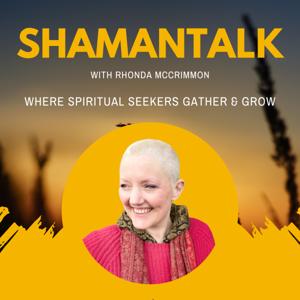
ShamanTalk

ShamanTalk

Download on the App Store

ShamanTalk episodes

  • 70. Drama Triangle Series | Part 1: The Victim
    What is the Drama Triangle?

    The Drama Triangle is a model of the connection between personal responsibility and power in conflicts, and the destructive and shifting roles people play.

    The Drama Triangle refers to a dysfunctional model of human interaction.

    The three roles are Victim, Saviour (Rescuer) & Perpetrator (Persecutor)

    In this podcast series, we will explore each of these archetypes or roles. From this series, I invite you to explore these roles both within your Self and within others.


    43 min
  • 69. How to create, build & maintain a Sacred Altar
    Space has power.
    It either resonates with you, or it doesn’t. Like everything in life, the spaces around us are imbued with energy.
    Space supports and empowers you, or it undermines and drains your energy. In other words, if the energy of a place supports the idea of sacredness, the person in that room will find it much easier to resonate with their own sacredness. It is easy to see why creating your own sacred space is essential.
    Sacred spaces make us feel comfortable, welcomed, supported and loved. Sacred spaces are also vital containers of positive intention and action.
    In this podcast, we will establish a regular spiritual practice and create your own sacred altar space.
    The benefits of creating an altar include:
    Having a physical expression of your commitment, personal goal or desire
    Having a symbolic collection/meeting place of tools to enhance your spiritual practice
    Enjoying a sacred space dedicated to your work
    Making your deepest spiritual needs a physical part of your life
    Gaining a spiritual centre in your life that you can work with every day
    Having a source of positive energy that fills your home
    Feeling a sense of empowerment through creativity & connection
    Step 1. Choose a place that feels right but try not to overthink it!
    If you have the option for a quiet place to dedicate to your altar space, then fantastic!
    Many of us don’t have that option. For years, my altar was in my bedroom in a small corner. My husband and daughter were always very respectful when I was sitting at my altar space.
    Step 2. Cleanse the space.
    In all the usual ways, sounds, smoke, intention or with light (such as a candle)
    Step 3. Begin to gather objects that are meaningful to you.
    Here are some things people tend to include on their altars:
    – Objects that represent your spirit guides
    – Objects that represent a spiritual teacher
    – Objects that reflect yin/yang, light/dark, masculine/feminine
    – Objects that represent the body, mind, heart, soul, and spirit
    – Objects that represent the elements of fire, water, earth, & air
    – Objects that represent qualities that one most wishes to embody (e.g. freedom, love)
    – Objects that represent your inner child
    – Objects that represent the cycle of life, death, and transformation
    – Objects that amplify energy (e.g. your sacred objects)
    – Any other objects that are inspiring, powerful or helpful
    Here is a list you may find helpful:
    – candles
    – statues
    – feathers
    – stones
    – crystals
    – decorative stands
    – inspiring quotes
    – a journal
    – written notes
    – prayer books
    – rosary beads
    – skulls or bones
    – alive plants
    – water
    – shells
    – flower petals
    – symbols
    – sand
    – salt
    – photos
    – oracle or tarot cards
    – pebbles
    – essential oils
    You can include on your altar anything you wish. Just make sure you design it the way you would like it, not how you think it should look or that other people tell you is correct.
    Step 4. Arrange your altar.
    Once you have found your sacred space, cleansed it, and got an idea of what objects to include, you’ll need to arrange your altar.
    You are free to arrange your altar in any way you wish.
    I set my altar up using the four sacred directions, in the form of a Medicine Wheel. I use a compass and ensure my North faces directionally North etc.
    You can set your alter however you feel drawn to. Perhaps you can journey to the Spirit of your Altar and ask for guidance, as suggested in the Journeys section below.
    Step 5. Maintain your altar
    Keeping an altar clean and tidy is essential for me: it shows respect for your practice. After all, it is supposed to be your sacred space. Do this as regularly as you feel necessary.
    Your altar doesn’t need to stay the same! I change mine regularly. You are free to change it, adjust it, add to it, or take away from it whenever you choose. As your inner work develops, you might find that certain items on your altar a
    33 min
  • 68. Why it’s a good idea to avoid New Year’s Resolutions....
    ..and how to easily make LASTING change this New Year.
    ​I hope you had a restful festive period and are feeling energised to embrace the incoming year.
    ​
    ​In this week's podcast, I talk about New Years resolutions and why they never work.
    ​
    We all have the urge at this time of year to follow the crowd and set some resolutions.
    I know I used to get all fired up with my list. I’ll do it this time! Eat better, exercise more or learning something new were among my top resolution themes.
    But it never worked.
    I ended up failing and falling into shame and self-loathing.
    How could I have failed again? I had so much drive and determination.
    After decades of the same cycle, I decided to step away from this strange cultural phenomenon. I was shown in a journey that this particular ceremony (and it is a ceremony) is cursed by a cultural story of failure.
    And this just the start of the problems with resolutions!
    ​Join me this week as I discuss the toxic energy behind new years resolutions and some viable, long term alternatives to this story of perpetual failure.
    We will also meet Janus, the Roman God of beginnings and endings, after whom the month of January was named.
    39 min
  • 67. Scott interviews Rhonda
    The Holidays are almost upon us, and this will be the last Podcast until the New Year! 
    I thought it would be fun to end the year with a slightly different episode. 
    So, I invited my husband Scott to interview yours truly! 
    I didn't know what the questions were going to be and I was really nervous! 
    Was this going to be light-hearted or a deep conversation? 😬😬😬
    Did Scott have any unexpected curveballs for me? 
    It turned out to be quite a vulnerable sharing, but very cathartic. 
    It did get me to thinking though. 
    I'd love to get to know YOU a bit better. 
    So this week's podcast competition post is this: 
    Answer these five questions for me:
    ·  What is your earliest memory?
    ·  What are the first words you remember being spoken to you?
    ·  Are there any images or symbols that have seemed significant at many points throughout your life?
    ·  If you were to transform into any animal, what would you be?
    · Clichéd questions! You are on a Desert Island - food and shelter is available, what one item do you choose to have with you?
    In the announcements section of the Facebook group (join here) there is a podcast competition post. 
    Just pop your answers in the comments section to be in with a chance to win a really GREAT prize. 
    Well done on making it through this year. It's been hard for us all. 
    I hope you have a wonderful Holiday season.
    Blessings,
    Rhonda
    32 min
  • 66. What does doing Spiritual Work actually mean?

    Many people confuse seeing multiple practitioners, clearing chakras, taking courses and reading books as doing Spiritual Work. Although important – this is only one aspect of it.

    One of the key fundamentals in Spiritual Growth is taking Radical Personal Responsibility.

    This is the aim of what we call Radical Self Responsibility (RSR). It is taking the ‘radical‘ step into full (100%) responsibility  for all we see, feel, think and do. From that foundational belief, we take back our power and sow the seeds of our own transformation, maturity and ultimately inner freedom

    In this episode I introduce you to the Sacred Triangle, which will help you on your quest for Spiritual growth and Radical Personal Responsibility.

    Here are some ways that I discuss to help you  take responsibility and stay at the top of your triangle.

    1. Take responsibility for your thoughts, feelings, words and actions.
    2. Stop blaming
    3. Stop complaining
    4. Refuse to take anything personal
    5. Make yourself happy (and not rely on others to do that for you)
    6. Live in the present moment
    7. Use the power of intention
    8. Look for the good in people (while maintaining strong boundaries)
    9. Shamanism can help massively with this list – journeying to ask guides what work is needed for your continued growth is key. Working with a trusted shaman as part of your sacred triangle to get help and support is also necessary. We are tribal people and are not meant to work alone – our fragile human ego implodes on itself if left to its own devices with no safe external support system.

      But you drive the work – you drive the change. It’s all within you.

      Don’t know how to Journey? No worries. I got you.

      You can sign up for my free monthly live online introduction to Shamanism training here.

      38 min
    10. 65. Shamanic Guides & Messages: Everything you need to know

      I was new to Shamanism, and about to embark on one of my first journeys to meet a power animal.

      I couldn’t wait to find out what my power animal was.

      I had grand visions of Wolves, Owls, Eagles and Stags.

      You know the score.

      I began my Journey and, much to my devastation, I was met by…

      A slug.

      Yep. A slug.

      I was gutted.

      My hopes for an elegant power animal that I could tell people about were dashed.

      And my ego was thoroughly bashed.

      Spirit has a sense of humour after all.

      That slug actually turned out to be one of my most powerful allies and taught me to slow down and be patient.

      The point of this story is to illustrate that your guides, power animals and messages can come in many forms – all as powerful as the next.

      Some people never ‘see’ their guides.

      You have guides that you don’t know about and may never meet.

      Your messages can come in strange forms.

      It takes practice to learn the language of Spirit and to build confidence in your intuition.

      Rather than Googling the meanings of your Journeys and Guides, It’s important to divine your own meaning. 


      When you ask others what your Guides or journeys mean, you are giving away your power and missing the real message that Spirit has for you.

      It’s important to learn to deeply connect with our Guides and messages.

      Different ways to connect with your Guides outside a Shamanic Journey.

      1. Ask to connect with your Guides. Make it a habit. Only call in Guides who are there for your best and highest good. This is especially helpful if you don’t cognitively ‘know’ your Guides. You can call and connect with your Guides anytime – you don’t need to be in Journey state.
      2. Learn to listen. We need to slow down and quieten our minds enough to ‘hear’ the messages we are given.
      3. Try writing. When you feel that you are missing a message – sit down and allow your pen to flow over the page. See what comes through for you.
      4. Omen Walking and asking for signs is a great way to connect with Guides.
      5. It’s one thing to ask for guidance. It’s another thing to witness it, to really take it in and relish in the presence that’s supporting you.

      6. The practise of paying attention to guidance isn’t about demanding. You don’t go around all day asking, “Where’s my guidance? Where’s my guidance?”

        Instead, you simply allow yourself to be open to the wonder of that guidance.

        Your guidance may show up in unexpected ways,. Your guidance can show up as a song on the radio, or somebody saying to you exactly what you needed to hear.
      7. Shift the way you talk to your guides and be in a space of GRATITUDE. If you find yourself thinking things like, “Guides, why haven’t you given me this yet?” or “Guides, I don’t believe in you. Why haven’t you shown up for me faster?” — you’re showing your distrust of them. You’re telling them you’re not really open to their guidance and that you want to be in control. Instead, you want to be thanking your guides, appreciating them, and feeling deep love and gratitude for them.
      8. Don’t know how to Journey? No worries. I got you.

        You can sign up for my free monthly live online introduction to Shamanism training here.

        27 min
      9. 64. Your shamanic worries & how to solve them

        I put a post in the Facebook group this week asking you listeners what your main worries are when it comes to practising Shamanism.

        As always, you provided me with some great responses, some that I’ve heard before and some that I’ve not personally experienced.

        Some of your worries were:

        • Not having confidence in your abilities.
        • Attracting other peoples pain.
        • Making it all up in your head.
        • Cultural appropriation.
        • Getting lost and led astray in your journeys.
        • Interpreting journeys and messages.
        • What is ethical and safe?
        • Getting it ‘wrong’.
        • There seem to be so many rules to follow and people telling you what’s right and what’s not.
        • How to get started in the first place.
        • In this episode, I’ll be covering all these worries and how to overcome them. 


          Links mentioned

          The Apprenticeship


          Ep 47 – Enslaved Empath vs Empowered Empath

          Ep 52 | Stepping Out of Saviour Mode

          Ep 22. Key tips for Interpreting your Shamanic Journeys effectively

          How to effectively Interpret your Shamanic Journeys Workshop.

          Getting started with Shamanism – Free offerings from The Centre for Shamanism

          Don’t know how to Journey? No worries. I got you.

          You can sign up for my free monthly live online introduction to Shamanism training here.

          37 min
        • 63. How to Overcome Feeling Like You're Not 'Good Enough'

          When it comes to our spiritual path, it can be hard to commit to it when you have self-limiting beliefs that are holding you back. 


          You find yourself saying things like:

          • “I’ll never know enough”
          • “I don’t have what it takes.”
          • “I’m scared I’ll fail.”
          • “I don’t trust myself.”
          • “I’m not worthy of a more Spiritually connected, happy life.”
          • Sound familiar?

            All of the excuses you make up in your mind as to why you can’t do something all boil down to the same feeling:

            I’ll never be good enough.

            But what does ‘good enough’ mean to you?

            Compared to who?

            ‘Good enough’ is an imaginary line that you’ve drawn in the sand of your own mind.

            If you’ve decided that ‘good enough’ means:

            • Knowing the most
            • Being the best
            • Being fearless
            • Being the perfect mother/daughter/wife
            • Being an enlightened being who floats through life in a state of spiritual bliss
            • Then you’ll NEVER feel good enough because no one is perfect.

              You’re stuck – not because you don’t feel good enough.

              You’re stuck because ‘good enough’ is an impossible standard that you’ve set for yourself.

              It’s not your fault. You live in a world where you’re bombarded with images of greatness on TV & Social Media and anything less than perfect is an unacceptable goal.

              When the goal is perfection, then the fear of failure sets in because deep down you know that you’ll never be perfect (and that’s OK by the way).

              Drop the impossible standards. They are not serving you.

              As a human being on this earth, you’re already good enough.

              But if you need a standard to measure yourself by, then make it this:

              Trying your best every day, no matter what.

              Even if your best isn’t that great.

              Even if you fail.

              Even if you’re scared.

              Seven Reasons that might cause your self-limiting belief that you’re Not Good Enough

              1. You have hidden core beliefs that are ‘running the show’
              2. Your inner voice is critical and judgemental
              3. You surround yourself with critical people.
              4. You had critical, demanding or aloof parents,
              5. Your main caregiver couldn’t offer you stability or safety
              6. You didn’t get enough attachment as a child
              7. You’ve experienced strong traumas in the past
              8. Activities & Journeys

                1. This Journey will help you to understand your Inner Voice more clearly so that you can begin to make changes to your inner narrative.
                2. Journey with your Guide and ask to meet your Inner Voice. What does your Inner voice look like? What does it sound like? What do you think needs to change here?

                  1. Begin to turn your negative thoughts into positive mantras. If you find yourself being critical of your inability to speak up for yourself, perhaps try a mantra ‘I have the right to speak up and be heard’
                  2. Over time, these positive affirmations will change the neural pathways in your brain and you will begin to naturally think differently.

                    Don’t know how to Journey? No worries. I got you.

                    You can sign up for my free monthly live online introduction to Shamanism training here.

                    25 min
                  3. 62. Why Discomfort is an Important Part of our Spiritual Lives

                    Many of us, especially at the beginning of a spiritual path, try to avoid discomfort like the plague.

                    We might have the idea that avoiding discomfort and always feeling good is the point of a spiritual path; unfortunately, that isn’t the case and is only saving up problems for a rainy day.

                    Learning how to embrace our discomfort and turn it into an ally is a crucial step on a spiritual path.

                    So listen this week for my thoughts on discomfort, why it’s important and how to work with it effectively.

                    Activities & Journeys

                    This week I invite you to go on a Journey with your Guides and ask to be shown why discomfort is so significant to you. What can it teach you?

                    If you don’t journey in this way, go on an Omen Walk or meditate on the question.

                    I’d love to hear how you get on in our Facebook Community.

                    Don’t know how to Journey? 

                    You can sign up for my free monthly live online introduction to Shamanism training here.

                    21 min

                  About ShamanTalk

                  From the publisher's feed

                  Hosted by Rhonda McCrimmon, a Celtic Seer and Shaman from Scotland, ShamanTalk is your gateway to reclaiming your indigenous Celtic roots and restoring a consciously connected spiritual life. From the ancient Celtic concept of the Three Cauldrons Power Centres to the Scottish folk magic practice of Saining, expect a range of soul-stirring topics that resonate with your spiritual quest. SUBSCRIBE NOW to embark on a transformative journey back to your roots and into a life of simple connection, wisdom and resilience.