
Sign up to save your podcasts
Or



Send us Fan Mail
Shelley sat down in 1993 for an interview with Jim Porter, a member of the Board of Directors of the NRA. The arguments have not changed for the past 30 years, yet the problem of gun violence persists and, in fact, continues to grow in 2023. Shelley explores the challenges that existed in 1993 and compares them to today.
Support the show
Follow us and continue the conversation on Facebook, Instagram, and LinkedIn.
Send us Fan Mail
This episode concludes our series on youth gangs and drug dealers with an interview of a young man who began dealing drugs at the age of 16.
He was brought into a gang at the age of 10 and exposed to the life of a drug dealer. During that time, he’d seen fellow gang members killed and maimed. He even shares a harrowing description of mutilation that happened to a fellow gang member. Listener discretion is advised.
He finally realizes what he missed and what he lost, and he shares a message for other young people.
Support the show
Follow us and continue the conversation on Facebook, Instagram, and LinkedIn.
Send us Fan Mail
Today’s episode reaches back to 1986 and was part of a series of interviews Shelley did on Open Mic with drug dealers and youth gangs.
This individual had a promising career as a backup drummer for the well-known blues musician Bobby “Blue” Bland.
Unfortunately, the lure of easy money pulled him into the world of dealing cocaine, Although he didn’t start dealing drugs until he was 44 years old.
He shares stories about how, at that time, cocaine was cut with laxatives and even embalming fluid, and how the cutting agents were often more dangerous than the drug itself.
He finishes his story by recounting the death of his cousin and fiance at the hands of three drug users.
Stay tuned and learn from his life as we continue this series on youth gangs and drug dealers.
Support the show
Follow us and continue the conversation on Facebook, Instagram, and LinkedIn.
Send us Fan Mail
In 1989, two gang members from the Birmingham area approached Shelley and asked to be on his show, "Open Mic." They wanted to share their experiences about the myths and realities of gang life and share their regrets over the youth they lost while acting as members of a gang. Ironically, the mother of one of the gang members heard her son on the show and came in the following morning to share her feelings and warnings with other parents.
While the nature of gang life has changed between 1989 and 2023, there are a surprising number of things that are still in common. In fact, you might be surprised to discover the backgrounds of many gang members are not what you think.
Support the show
Follow us and continue the conversation on Facebook, Instagram, and LinkedIn.
Send us Fan Mail
Historically Black Colleges and Universities (HBCUs) have advantages such as fostering a sense of community and pride, providing a supportive environment, and offering diverse faculty and notable alumni. However, HBCUs may also face challenges such as limited resources, stigma, potential limitations in academic programs, and persistent inequalities. Recognizing the strengths and limitations of HBCUs is crucial in promoting access and success for Black students in higher education while addressing the challenges to ensure equitable opportunities for all students, regardless of their race or background.
In this episode, Shelley replays an interview with Carol Watkins and Leslie Prawl from October of 1991. He covers the pros and cons of HBCUs and shares insights and opinions on their value. Listen and learn more at [link].
Support the show
Follow us and continue the conversation on Facebook, Instagram, and LinkedIn.
Send us Fan Mail
Hate crimes have devastating impacts on individuals, communities, and society and fuel fear, division, and mistrust within communities, contributing to social inequalities and damaging social cohesion. They erode trust in law enforcement and the justice system and have negative implications for economic development. Additionally, hate crimes perpetuate harmful stereotypes and attitudes toward targeted groups.
This episode features an interview from March 1993 with Attorney Rodney Max, a member of the Coalition Against Hate Crimes. They discuss the trial of a hate crime killing of a homeless person in Birmingham in 1993. He offers positive solutions to the problem, suggesting, "Before I prejudge you, let me get to know you."
Have a listen and share your thoughts at https://www.shelleysplumbline.com/podcasts
Support the show
Follow us and continue the conversation on Facebook, Instagram, and LinkedIn.
Send us Fan Mail
Homelessness affects a diverse range of individuals. It is not limited to a particular demographic, but can impact people of different ages, genders, races, and backgrounds. Among those who are homeless are individuals experiencing mental health issues, addiction, domestic violence survivors, veterans, youth, families with children, and individuals facing economic challenges such as unemployment or poverty. Homelessness can also disproportionately affect marginalized communities, including people of color and LGBTQ+ individuals. Understanding the diverse range of people who experience homelessness is essential in developing effective strategies and policies to address the complex and multifaceted issue of homelessness.
In this episode, Shelley replays an interview from April 6, 1993, where he meets with a former professional football player who has become homeless. WARNING: The episode also features a harrowing excerpt from his memoir, The Road South, which depicts traumatic events and abuse from his youth (listener discretion is advised). The podcast concludes with a powerful lesson Shelley learned in a bar while working in St. Louis as the disc jockey, "Shelley the Playboy."
Support the show
Follow us and continue the conversation on Facebook, Instagram, and LinkedIn.
Send us Fan Mail
Dr. King's legacy inspired generations of activists and leaders, and his contributions continue to be recognized and celebrated today as a beacon of hope and progress. But Dr. King had a premonition about his death, and he warned the members of his inner circle to beware of the tactics external forces would use to break the movement apart after he was gone.
As a member of the King's inner circle, Hosea Williams served as the advance man, organizing some of the most important events in the movement. Williams traveled to cities throughout the South, recruiting and organizing volunteers, paving the way for appearances by King, Jesse Jackson, and Andrew Young. Williams and John Lewis led the "Bloody Sunday" march in Selma, Alabama, in 1965.
This episode features an interview from September of 1994 with Shelley Stewart and Hosea Williams. Hosea reveals the dire warning King had for the members of his inner circle.
Was Hosea Williams right? Did the Dream of Dr. Martin Luther King Become a Nightmare? Listen and let us know what you think.
Support the show
Follow us and continue the conversation on Facebook, Instagram, and LinkedIn.
Send us Fan Mail
Black History Month has been celebrated for decades as a time to honor and recognize the contributions and achievements of Black individuals throughout history. However, some argue that relegating Black history to a single month perpetuates segregation and fails to fully integrate it into the mainstream curriculum. Ending Black History Month could be beneficial, as it would emphasize that Black history is an integral part of American history that should be incorporated into educational curricula throughout the year.
The podcast features an interview with Dr. Horace Huntley in February 1991 and suggests that by ending Black History Month, we might celebrate Black culture and history throughout the year.
Support the show
Follow us and continue the conversation on Facebook, Instagram, and LinkedIn.
Send us Fan Mail
Episode #1: Internalized Racism
Internalized racism refers to the subtle yet pervasive ways in which individuals from marginalized racial or ethnic groups internalize negative societal messages about their own race or ethnicity. Overcoming internalized racism requires self-awareness, education, and conscious efforts to challenge and reject negative societal messages and embrace positive aspects of one's cultural heritage. It is a complex and ongoing process that necessitates collective efforts to combat racism at both individual and societal levels.
This episode of Shelley's Plumbline discusses the pervasive problem of internalized racism with Brother Ezekweh.
Support the show
Follow us and continue the conversation on Facebook, Instagram, and LinkedIn.
From the publisher's feed
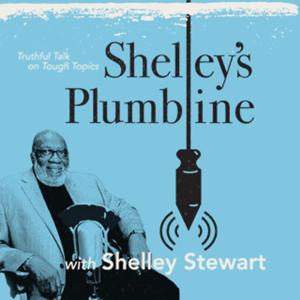
In construction, a plumbline is a weight suspended from a string used as a tool to find the true reference line. A plumbline will always find the vertical axis pointing to the center of gravity,…
Pulling from a library of more than 3,000 shows from his storied career in broadcasting, Shelley's Plumbline leads us in a search for the truth, opening the channels of communication and understanding on tough social topics that are as relevant today as they were 40 years ago.
Join us as we explore the past, compare it to today, and craft a better future.