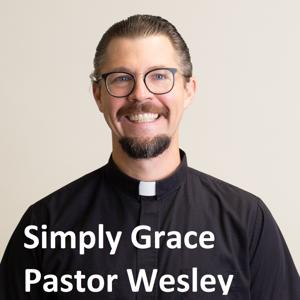
Simply Grace

Simply Grace

By Rev. Wesley MenkeReligion & SpiritualityArts
Download on the App Store

Simply Grace episodes

  • Verbo de Dios 10 febrero 2021
    Estudio bíblico para el Domingo de Transfiguración. Gracias a Dios por la oportunidad de aprender de pastores latin@s un mensaje para toda la humanidad. Los textos están llenos de imágenes y símbolos poderosos para animarnos en el camino de la cuaresma: el camino a la Santa Cruz. Gracias al Pastor Cesar presentar sobre el evangelio.
    2 Reyes 2:1–12
    El tema de discipulado y maestro como Eliseo aprendió de Elías. Es doloroso decir “adiós” a un tiempo de ser internado, y empezar en el liderazgo. El Espíritu Santo nos ayuda en llamar estudiantes nuevos.
    Salmo 50:1–6
    Dios llama a creyentes fieles. No sólo decir con la voz, sino también con acciones. Cuando Dios viene, viene ruidosamente. 
    2 Corintios 4:3–6
    La luz de Jesus brilla en nosotros como vela sagrada. Nosotros no debemos poner velo en frente de al vela de Cristo, sino compartir la luz de Jesú con todos.
    San Marcos 9:2–9
    La experiencia grande arriba de la montaña con Jesús, Jacobo, Pedro, y Juan, pero también con Moises y Elías. El hijo del hombre es el hijo de Dios y sigue en las tradiciones de la ley y los profetas para caminar a la cruz.
    https://youtu.be/RZI5l8NGCQ0
    1 hr 10 min
  • Vaccinating is an Act of Faith
    Vaccinating is an Act of Faith
    When I was a boy just knee high to a grasshopper my friend and I would go fishing in Oak Creek. We used to try to dig up worms until my neighbor, Lee, a man originally from Oklahoma taught us how to catch grasshoppers. The trick was pinching off their back “jumping” legs. Without the powerful hind legs the couldn’t get too far so you didn’t have to worry about them escaping from the jar, and they were excellent bait for catching fish.
    The prophet Isaiah compares human beings to grasshoppers. In the long perspective we have short life spans, and like swarms of locusts we have the tendency to mindlessly consume, grow until we cannot be sustained and then crash into famine and death. Sound familiar? Living the Covid 19 pandemic is a sobering reminder that we are mortal creatures too. But it doesn’t have to be this way.
    Isaiah said that even though young people can grow faint and weary, anyone who waits upon the Lord can have their strength renewed and soar like an eagle. The psalmist writes in 147 that God doesn’t delight in the strength of a horse, or in the speed of a runner, but in those who fear the Lord; those who have faith. So the difference between being a mindless grasshopper and a powerful eagle is faith. Faith makes all the difference in the world. 
    Consider the mother in law of Simon Peter. She was sick in bed with a fever according to Mark chapter one. Jesus come to the house with the disciples. What did she do? Did she jump out of bed like a grasshopper to serve her guests? No. She remained in bed until Jesus healed her. She was a woman of faith, and to be a woman of faith means to wait on the Lord. Ironically as soon as she is healed she begins to wait on the Lord serving him and the disciples. It is a good thing because soon the whole town gathers outside the house to be healed by Jesus. God bless Simon’s mother in law for giving sustenance to Jesus and for having faith!
    On the big problems with the Covid 19 pandemic, and why it is so hard for us to get better, is because it is hard to have faith, and to rest like we should. Furthermore the real problem is that we think that we are individuals who get sick and fail to understand that we are not just individuals but we are part of a larger body. Just like our body is made up of cells, each one of us is like a cell in the body of Christ. In this way the whole Earth can be thought of a living being. The Covid 19 pandemic doesn’t just affect individuals it affects us as a globe, the whole Earth is sick. The body of Christ is sick. 
    So how do we move forward? How do we let Jesus heal us like Simon’s mother in law? How do we become more like an eagle than a grasshopper? We must have faith that we are not lone individuals, but members of the body of Christ. Only until we each listen to God in faith will we together rise up like an eagle and fly!
    One great way to have faith is to get vaccinated! Receiving the Covid vaccine from Moderna, Pfizer, Johnson and Johnson, or perhaps even others is an act of faith. You have to have faith that the mystery of God’s love for you could work through the cold steel and glass of scientific laboratories. Getting the vaccine means trusting that God could work through leadership of various political parties and countries to create a healing serum. Faith in God means even though you may not completely understand what is in the vaccine, you allow it into your body with the hope that it will protect you. That is an act of faith! I hope that everybody who is able to will get vaccinated. When it is my turn I surely will! If you aren’t sure I hope you consult with your doctor.
    The reason cells in our bodies are able to cooperate, work together,
    23 min
  • Theology Thursday 4 Feb 2021
    Bible Study for Thursday 4 February 2021 preparing for Sunday 7 February 2021, the fifth Sunday after Epiphany.
    https://youtu.be/n9LKr0Eli0I
    Theology Thursday 4 February 2021
    1 hr 15 min
  • Artichokes and the Heart of Truth
    What is going on with truth and lies? What is going on with all of the conspiracy theories? Why is it that you can watch one channel of news turn to another channel of news and hear a total contradiction from the one to the other? Why are there some social networks that support a perspective of reality, and why are there other technologies that support a totally different view of reality? 
    Sermon 4 February 2021
    Artichoke courtesy Flickr Camila
    It is also hard to know what is the right thing to do sometimes. The truth and moral perfection of God is so demanding that we as human beings can hardly stand it. The Jewish people experienced this when they left Egypt during the time of Moses and spent time in the wilderness. They found that if the presence of God came and dwelled among the people in the camp, that it was simply too much and people would die. God’s righteousness just too much. So the people asked if there could be an intermediary between God and the people. And God said, “Yes.” Moses became the go between. Moses was a bridge between God and the people. Moses' body and face would be so supercharged from being in God’s presence that he had to wear a veil over his face otherwise it growed so brightly that the people would be blinded. 
    There was a catch. God would only provide prophets under two conditions. The first is that the people had to listen to the prophet, otherwise there would be consequences. You couldn’t blow of the words of the prophet as if they didn’t come from God. You have to take those prophetic words seriously. The second condition is that if anyone ever presumed to be a prophet that wasn’t, that person would suffer terrible consequences. To utter falsehoods in the name of God would carry severe punishment from God: death. 
    My parents were like prophets to me. They taught me the truth in a way that I could understand it. It all began with artichokes. My mother would steam artichokes, then drizzle them with butter. As a family we would gather round and pick the leaves off of the artichoke and dip them in butter. It was wonderful. At the end, the artichoke looked hairy and leaves were small, white and pokey. It looked gross. I asked my father, “Is the artichoke heart good?” He would say, “No. You wouldn’t like it.” My sister and I would run off and he would enjoy eating the artichoke hearts with my mother. Now we all know that actions speak louder than words. My dad was a smart man because he had a sense of humor and took that opportunity to enjoy the best part with my mom. In doing so he taught us that indeed the heart is delicious. And as soon as I wised up and asked for some of the heart he and my mother generously obliged. My parents were prophets to me, they taught me the truth in a way I would understand and accept on my own. 
    Therefore, if food is a cause of their falling, I will never eat meat, so that I may not cause one of them to fall. 1 Corinthians  8:13 
    The practical advice of Saint Paul continues. Two weeks ago we read from Paul that Christians should avoid participating in prostitution. Last week, however, Paul said that we should not cling too tightly to that which we love on earth, even spouses, so that we can love God first. This week Paul has words about diet and eating meat. Don’t do it! Paul says, “I will never eat meat.” What is that about?
    I myself am not a vegetarian nor a vegan, however, I try to not eat a lot of meat. There are good reasons not to eat a lot of meat. A diet that fo
    23 min
  • Theology Thursday 28 January 2021
    Bible Study from Grace Lutheran Church for the Fourth Sunday after the Epiphany 2021. Together we study:
    Deuteronomy 18:15-20
    Psalm 11
    1 Corinthians 8
    Mark 1:21-28
    To see the liturgy and accompanying video for this Sunday visit the worship webpage.
    https://youtu.be/yy9OokywQWI
    YouTube Video of Bible Study
    Theology Thursday January 28, 2021
    1 hr 10 min
  • Verbo de Dios 27 de enero de 2021
    Verbo de Dios 27 de enero de 2021
    Disfruta el estudio bíblico en español preparando para la alabanza en 31 de enero de 2021, el cuarto domingo después de la epifanía.
    https://youtu.be/0O9AyLZynfI
    El video del estudio Verbo de Dios para 27 de enero de 2021
    55 min
  • The Kingdom of God is at Hand
    “I mean, brothers and sisters, the appointed time has grown short; from now on, let even those who have wives be as though they had none.” 1 Corinthians 7:29
    Photo courtesy Vanderbilt photo Ramon FVelasquez
    Is there a stranger command in all of the Bible? Why would Paul write this? Does Christianity as a religion promote marriage and traditional family values? I mean think about it for a moment. What would happen if every single person who has a wife all of a sudden be as though they had none? It sounds like the premise of a comedy movie starring Adam Sandler! Were you paying attention when Ralph read this out loud, all the wives that here this morning shoved the Bible passaged up to their nose to take a closer look at what was really printed. All the, ahem, those who have wives stuck  their heads up and began to look around. Isn’t there a term for this these days. I think they call it a “hall pass,” right?
    Talk about an evangelism strategy. Word of this is going to spread like wildfire. Can you imagine the talk around the neighborhood? “Hey honey, all the guys were saying there’s a great little Lutheran church on 21st street. I think you’re gonna love it. They preach great family values!”  
    When I was a chaplain I visited with a woman who had just successfully come out of surgery. She would soon be going home, and despite all of this she had a sad look on her face. I asked her what was the matter. Here eyes focused on her feet whose toes pointed up under the hospital sheets and blanket. The blanket was tucked under her arms, her hands held onto the hem. Her chest swelled and then contracted, she sighed. “It’s my 60th wedding anniversary,” she said flatly.
    “Oh wow congratulations, that’s wonderful!” I said. She stared at me with a long face. It wasn’t the reaction I was expecting. “Or not?” I asked. Looking back I wish I would have thought about this Bible verse. Can you imagine? “You know ma’m the Apostle Paul encouraged couples to just pretend they aren’t married after all.” The poor woman would have probably falled out of her bed. Then she’d be having the other hip replaced. 
    But that is the point of this passage. Paul is trying to rattle us awake. To make us fall out of bed. To read closely what he is talking about. Yes to even lift up your head and scan the perimeter to see who and what is out there. Paul says that the present form of this world is decaying. Paul is like Jonah finally walking into Nineveh telling them to repent or else God is going to wreak havoc.
    The end of the world. The funny thing about the end of the world is that even atheists believe that the world is going to end. The sun will not last forever. Even if we could make it to another planet, eventually all the stars in the universe will die out, and the universe itself would collapse into itself destroying all matter and energy forever. And before any of that happens, each one of us will have our world end too. So it is interesting that Paul talks about this. He says that those who mourn shouldn’t. If you have lost a loved one pretend as though you haven’t. This is also a very strange verse. The point is to not place trust in the temporary conditions of this earth.
    Did you believe the truth or did you put your trust in lies? He will judge you and examine you to see if you are righteous. How will you measure up? Will stand before God as a person that lived a holy and righteous life? Keep it mind that there is precisely one thing that God will care about more than anything. He will want to to know if you did the one thing you were supposed to do. You have one job to do. You have one task to complete. Faith. Did you have faith?
    That is exactly what Jesus call
    21 min
  • The Occasional Theology of Doctors King and Luther
    The sun shines brightly in Berkeley, California, but perhaps not as intense as it does in southern California. I stood outside of the chapel at the Episcopalian Seminary with the sun gently warming my face. Professor Carol and doctoral candidate Kyle set forth to explain to me what made Luther a theologian unlike many others. They explained that Luther was an “occasional theologian.” This does not mean that he was only occasionally theological! No. It means that occasions would arise that demanded Luther to write, teach, and explain what was the appropriate Christian response. For example, the practices of indulgences, was an occasion that elicited Luther to write the 95 theses. Luther was not a systematic theologian. He wasn’t like Calvin, or Barth, or Aquinas, who set out to explain in systematic harmony all the components of Christian faith with scripture and philosophy. Luther wrote with such commanding theological brilliance that systematic theologians all around him chased after his line of thinking attempting to make order out of it. 
    Occasional Theologian Dr. Martin Luther King Junior
    Four hundred and fifty years later another occasional theologian rose to the occasion. Ironically, or perhaps serendipitously he was named Martin Luther King Junior. His father named him after the German theologian. True to his namesake Dr. King set about articulating faithful Christian responses to the challenging situations of his day most notably Jim Crow segregation, but also questions of war, poverty, and more. MLK did not write a systematic theology either, but the depth and power of his writings, speeches, and sermons were so potent that indeed theologians have chased after his words too, attempting to systematize his thinking.
    These two Christian pastors and theologians are linked through history not merely by the fact that they are both occasional theologians, or what many simply call “prophets” but the heart of their message resonates together with the sound of God’s saving Word. On this seventeenth day of January, the eve of MLK day, two thousand and twenty one let us consider the indelible connections these men share in the prophetic tradition of faith.
    “The word of the LORD was rare in those days; visions were not widespread.” 1 Samuel 3:1. 
    There are times in history in which corruption and injustice appear to be widespread. During such times a powerful word from God or a vision seems to be lacking. This was the situation in which young Samuel found himself as a child. His mentor, Eli the priest, had failed to live out his faith ethically nor apply it to his own children. Eli’s children took advantage of their status and exploited the temple for their personal gain. God spoke to the boy Samuel, giving him words and vision to address the injustice of that time in history. 
    Martin Luther in the 1500’s was also moved by the Spirit of God with a word about the injustice of indulgences. An indulgence was a religious artifact a person could earn or purchase to give them additional time in heaven. An entire system was put in place between the church and state that kept people oppressed. No matter how hard a person worked they could not get ahead. If any material wealth was accumulated by a person, rather than save it, the church gobbled it up with the promise of more time in heaven. At the heart of this injustice is what Luther called, “works righteousness.” Working and doing something constructive is a gift of God. But it was turned into an idol to be worshiped. People became more focused on doing “good deeds” rather than focusing on God from whom all good things flow. Luther identified this problem and dared to lift his head and voice to address. Of course he was aided
    24 min
  • You are Beloved!
    In those days Jesus came from Nazareth of Galilee and was baptized by John in the Jordan. Mark 1:9
    Baptism of Jesus
    Did you hear the one about the pastor who went for a hike? He met a hungry and angry bear. The bear chased him, and the pastor ran for his life. Finally the pastor tripped on a log and there was no chance for escape. As he lay on the forest floor he prayed that the this would be a loving Christian bear. Then he pastor heard a voice, it was low and rumbly it was the voice of the bear that was kneeling with its front paws together in prayer it said, “Dear God, thank you for this food you have provided for me. Amen.” Ha ha ha. The moral of the story is, you may call yourself a Christan, but if you devour others around you, you might think about what it means to be a Christian.
    About five thousand people violently stormed and vandalized the United States Capitol this past Wednesday January 6, 2021. Many of them Christian flags, crosses, t-shirts, etc. It is said that the last time this happened was during the British Invasion in which they went so far as to burn the capitol. That was 1814. I am so very deeply sorry and saddened by what has happened. It was wrong for people to storm the Capitol building, vandalize, and wreak havoc. Vandalism and looting are not God's will for any group of people.
    Not long after the time of Jesus, the Jewish temple was destroyed for the second time. There was a Jewish revolt against Roman authority. The revolt failed, and the Romans burned down the Jewish temple. About 700 years before the Romans burned the temple, it was the Babylonians. The strategy of such an action is to demoralize a perceived enemy, to strike fear in their hearts, so that they may be overtaken. 
    Then again, sometimes destructive behavior is done not because there is any animosity toward the victim, but rather because the perpetrator just wants something and they are willing to crush anyone who is in their path to get what they want. Just the other day one of our members was robbed at gunpoint in our parking lot. The criminal didn’t see our church as it’s enemy, but as a means to get what they want, money. What is troubling is that they would use a weapon, like a gun, to get what they want. Thankfully our member is okay, and the police have been helping us to secure our campus. 
    What I can’t help thinking about, however, is how the very same member who was robbed had just finished building the beautiful cross tower we have been enjoying. How could it be that as soon as a faithful follower of Jesus completes an act of faith and devotion they suffer. It makes me think of the old adage, “No good deed goes unpunished.”   
    Jesus himself spent his whole life loving, healing, teaching, and caring for others. What happened to him? He was crucified! Doing good and being good are not guarantees that you will not suffer. If could even be the opposite. Doing good in some twisted way arouses persecution. So what can you do?
    You can evangelize. As Christians we are called by Jesus to love our enemies. This includes people who have hurt us, and people who have done hurtful things. Loving someone is not enabling them. Love has boundaries. Love is not about being foolish or unwise so that others may victimize you. No. Loving an enemy includes justice. It includes a reckoning of what has been done that was wrong. It includes atoning for wrongs made. But as Christians we are to see beyond retribution and work toward the evangelization of our enemies. We are to love our enemies. 
    The apostle Paul was a genius at evangelism. We read about his evangelistic missionary journey in the book of Acts chapter nineteen. He finds so

    22 min

About Simply Grace

From the publisher's feed

A collection of thoughts, ideas, and interpretations of the Gospel