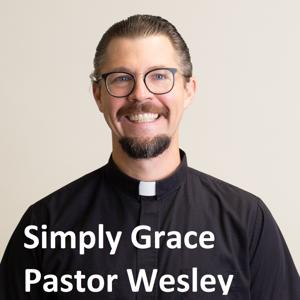
Simply Grace

Simply Grace

By Rev. Wesley MenkeReligion & SpiritualityArts
Download on the App Store

Simply Grace episodes

  • Keep Awake
    How do you care for people at Christmas? The holidays can be a challenging time. Human interaction is intense with parties and social engagements that intersect with work, family, friends, and church. Over four weeks we will explore how to be “Caring During Christmas.” In this Advent sermon series you will learn four practical things based on Biblical wisdom that you can do be caring. These four weeks in December, called “Advent,” are a traditional time to prepare for Christmas spiritually. So dive in with us and prepare to celebrate the birth of Jesus Christ!
    Constant Distractions
    Constant distraction keeps us from caring. We occupy ourselves with things that prevent us from having to deal with people. We take things that aren’t necessarily bad and use them to distract ourselves from people. There are tons of examples. If you think about it you can identify what you use to distract yourself. It could be a dependence on work, social media, or substances like drugs and alcohol. These distractions can keep us from caring for others. They can keep us from having to feel emotions that come along with interacting with people.
    Think about the story of Noah. In those days people were terrible toward one another. They robbed and cheated one another, and were incredibly violent. God was angry and decided to flood the entire world. God spoke to Noah and instructed him to build an ark in order to preserve life. Noah didn’t keep this information a secret! Others heard the warning of a flood. But they continued to distract themselves. Jesus said, 
    “For as the days of Noah were, so will be the coming of the Son of Man. For as in those days before the flood they were eating and drinking, marrying and giving in marriage, until the day Noah entered the ark, and they knew nothing until the flood came and swept them all away, so too will be the coming of the Son of Man.” Matthew 24:37-39
    The people in Noah’s time were so distracted that they were oblivious to a massive flood that would destroy everything around them. Maybe they distracted themselves from a painful and uncomfortable truth.
    We Distract Ourselves Because We Don’t Feel Good
    Noah and his family survived the flood. When the water subsided they returned to the Earth to create a new civilization. Noah was probably traumatized by all that he had seen. It wasn’t all unicorns and rainbows! According to the book of Genesis, Noah promptly got drunk after leaving the ark. He was trying to distract himself from his feelings. Imagine what he must have felt after seeing such things! He must have felt: sad, happy, angry, peaceful, confused, hopeful, and more. 
    Have you ever felt intense and mixed emotions? It isn’t easy. It makes sense why distractions can be such a big part of our life. We have complicated feelings to deal with. But distractions don’t help us deal with difficult feelings. They are only a temporary fix. 
    God Knows How We Feel
    We might be able to distract ourselves from how we feel for a long time. We cannot, however, prevent God from knowing ho
    18 min
  • Deliberate Unity
    A lack of understanding threatens unity. Jesus deliberated deeply on the cross about what it means to be human and God. He unites us with God. We have hope of unity as people too. The key is to deliberate. Deliberate unity!
    Unity Divided
    “Woe to the shepherds who destroy and scatter the sheep of my pasture! says the LORD.” Jeremiah 23:1
    Jeremiah was a prophet who lived during a time of division and conflict for God’s people in Jerusalem around 600 BCE. Assyria had conquered the northern tribes and made Jerusalem a vassal state. But things were going from bad to worse. Babylon conquered Assyria and had its eye on Jerusalem. The people became divided.
    One camp of people in Jerusalem devoted themselves to the king and the temple. They believed that a line of kings descended from David would rule Jerusalem forever, and that God favored Jerusalem over all other nations. The key to maintain favor and power with God was to worship God in the temple according to the sacrifices prescribed by the priests. 
    Another camp of people felt differently about Jerusalem’s place and security with God. They felt that the key to having power and maintaining security was through a faithful adherence to the law. They looked to Moses as a great prophet who revealed God’s law to the people. There would be blessing and abundance if the people followed the law and lived ethically. If the people didn’t follow the law then their situation would get worse, God would judge them, and despair would be assured.
    While the people in Jerusalem grew more divided, they became an easier target for Babylon. The leaders were exiled to Babylon, the city captured, and the temple destroyed. This exile ruptured the belief that Jerusalem would live in favor and peace forever.
    Lack of Understanding Divides
    Destroying unity and sewing division is an ancient strategy for weakening an opponent. One way to sew division is to keep people uninformed. The people are fearful when uninformed. Fear leads people to divide themselves and be suspicious of groups who appear different. 
    We are currently living in a time of division. Bishop Emeritus Murray Finck mentioned last week that social issues seem to have driven a wedge between people on issues ranging from the economy, to immigration, foreign policy, and the environment. A lack of deliberate understanding fuels division during our own time. 
    Sometimes we choose to be uninformed, because we feel as though we lack any power to make a difference. Lots of people have lost faith in elections so they don’t bother putting in the work to deliberate on issues or candidates. Lack of understanding increases when people get stuck inside “echo chambers.” They only listen to the media outlets they agree with and don’t take the time to understand different points of view. 
    When Jesus was dying on the cross three different people asked the same question showing a lack of understanding during their time too. They asked, “Why doesn’t this Jesus save himself?” They thought that a leader had to be powerful by taking power from others and keeping it for themselves. While Jesus was suffering on the cross during his crucifixion he looked out and saw a divided people who didn’t understand. He said,
    “Father forgive them, for they do not know what they are doing.”
    22 min
  • Hold Fast to the Traditions
    You might fear the future because you don't know what it holds. The future, however, belongs to God. Traditions connect past present and future to God. So hold fast to the traditions.
    Fear of the future, a need for tradition
    We were driving in the middle of the road. The tires of the minivan symmetrically straddled the double yellow lines. I white knuckled while the driver, a member of the church, was squarely in the lane of oncoming traffic. The driver suddenly realized what he was doing and calmly moved back into the lane. “Sorry," he said, "I’m getting used to driving in California.”
    My look of profound confusion prompted him to say more, "For the past year we were living on my in-laws farm and nobody really cared that I drove in the middle of the road...ever since I was discharged from the Army and came home from Iraq.” I must have looked confused. He laughed and simply said, “I.E.D.s You know, Improvised Explosive Devices. You were more likely to get blown up if you drove on the side of the road . When I came back to the U.S. I was on the farm and I just kept driving in the middle of the road. Now that I’m in California I have to figure out how to drive like a civilian again.”
    My friend went on to share with me his fear of the future, immediately down the road and beyond. He wasn’t sure what job he would find, and how he would provide for his family. He needed to hold fast to the traditions.
    You Don’t Know What the Future Holds
    Perhaps you have some fear of the future too. Trauma in particular can trigger fear, but the fact is no matter who you are you do not know what the future holds. In Jesus’ day some people believed in life after death and others did not, such as the Sadducees. If you do believe in life after death, then there are some interesting questions to ponder. What will marriage and love be like in heaven? The Sadducees give an extreme example: 
    Some Sadducees, those who say there is no resurrection, came to him and asked him a question, "Teacher, Moses wrote for us that if a man's brother dies, leaving a wife but no children, the man shall marry the widow and raise up children for his brother. Now there were seven brothers; the first married, and died childless; then the second and the third married her, and so in the same way all seven died childless. Finally the woman also died. In the resurrection, therefore, whose wife will the woman be? For the seven had married her." Luke 20:27-33
    This example illustrates a basic fact. We don’t know what the future holds. We don’t know what heaven will be like, and we don’t know what tomorrow will be like. Jesus didn’t go into detail as to what exactly the resurrection will be like. He did, however, make a point that the future belongs to God. Whether you think about the future on Earth, or in Heaven, all ages belong to God: past, present, and future. That's why we hold fast to the traditions.
    The Future Belongs to God
    Job is a tremendous person of faith from the Bible, and the journey of his life and faith illustrates the power of God’s presence in every age. Job had a large family, was very wealthy, and was very faithful to God. Satan tested Job to see if he truly loved God arguing that Job only appeared to love God because of his material po

    19 min
  • Be a Part of the Movement
    Be a part of something bigger than yourself.
    Life doesn't always go according to plan. Neither did Jesus' life. But your life can be full of power and purpose. Be a part of the movement!
    Unfinished Business
    Reformation Themed Worship at Claremont School of Theology October 2019
    This past Tuesday I had the pleasure of having dinner with John Cobb Jr. He is perhaps the greatest theologian, a Christian thinker and writer, to have taught at Claremont School of Theology, my Alma mater. It was a bittersweet time. We were commemorating the last Reformation Day remembrance at Claremont School of Theology in Claremont. In May 2020 the school of Theology will be decommissioning the chapel and school buildings as they sell the land pull up stakes and move to Oregon as they merge with Willamette University. All over the United States seminaries and schools of theology are selling their land and looking for academic institutions to merge with as they are unable to sustain themselves with low student enrollment. For thinkers like John Cobb and for scores of alumni such as myself it is a difficult reality to face because there is so much unfinished business. There is so much work to be done to interpret the wisdom of our faith to new and challenging times. 
    What unfinished business do you have? There are big dreams and projects that you probably wish to see happen in your lifetime like writing a book, learning a new skill, or an experience you wish to share with a friend or loved one. Don’t forget about the mundane laundry list of things to do too: like cleaning the garage, making home improvements, and...well...doing the laundry. I am sure that you too have unfinished business.
    Life Doesn't Go According to Plan
    You have unfinished business because life doesn’t go according to plan. Things happen that disrupt your best laid plans and visions for what you hope to accomplish. Jesus warns us about this when he said,
    24 "But woe to you who are rich, for you have received your consolation. 25 "Woe to you who are full now, for you will be hungry. "Woe to you who are laughing now, for you will mourn and weep. 26 "Woe to you when all speak well of you, for that is what their ancestors did to the false prophets. Luke 6:24-26
    In other words it doesn’t matter how secure you might think your future or your present is, you cannot stop disruption to your plans and the upheaval of the landscape of your life.
    Today on All Saints Sunday it is pointedly and poignantly clear that disruption and loss are a painful part of life. Today we pause to remember those who have died in the past year. Death is the ultimate sobering reality that you have unfinished business because life doesn’t go according to plan. 
    Jesus Life Didn't Go According to Plan
    21 min

About Simply Grace

From the publisher's feed

A collection of thoughts, ideas, and interpretations of the Gospel