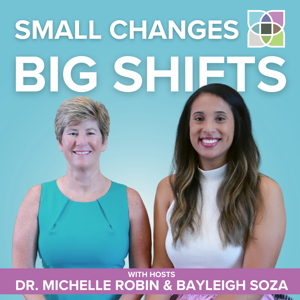
Small Changes Big Shifts

Small Changes Big Shifts

By Dr. Michelle RobinAlternative HealthHealth & Fitness
Download on the App Store

All Small Changes Big Shifts episodes

  • Kindness: How a 31-Day Journey Changes Our Vision About the Everyday Life

    We've had a great month celebrating kindness thanks to this year's sponsor, City Wide Facility Solutions. Today, Dr. Michelle Robin welcomes Andrea Allison-Putman and Lori Bennett on the show to share their experience participating in the 31-Day Kindness Campaign. Join us to hear about the power of kindness and what they have learned kindness really looks likes in our everyday lives. Sometimes kindness can be as simple as listening with an open heart.

    Memorable Quotes:

    • "You are not listening to what the answer is. You are listening for what's really going on in their lives."
    • "Moments matter. Memories matter."
    • "It's much easier to be kind when you feel good."
    • "Everybody is fighting a battle. Either you are throwing gasoline on their situation, or you are throwing water on their situation."
    • "Listen. Look people in the eye. Those things go a thousand miles. So many problems in our world could be solved if people step back and listen."
    • "A simple smile goes a really long way."

    What You'll Learn:

    How the 31-Day Kindness Campaign makes it easier to learn about our community, what leaders should know about kindness and culture, and how self-care makes a difference in our ability to be kind to others.

    This Episode Includes:

    • How the Kindness Campaign helps companies and organizations bring \ their culture together.
    • The importance of pausing and being present in our life.
    • What leaders should know about kindness and culture.
    • What future generations should know about kindness.
    • How we can be better in corporate America – and what validation looks like for teams.
    • How listening to the non-verbal things people say is different than what people are really saying with their words.
    • Why connecting with yourself matters.

    Three Takeaways from Today's Episode:

    1. Everything in our world roots back to how we give and receive kindness.
    2. We experience life better – the good and the tough – when we realize we are part of a bigger story going on behind the scenes.
    3. A simple smile goes a long way.

    Mentioned In This Episode:

    • 31-Day Kindness Campaign
    • 100 Rad Virtues by Lori Bennett
    • Somewhere Over the Rainbow song by Israel Kamakawiwo'Ole
    • Let It Go song by Idina Menzel
    • Just Fine by Mary J. Blige
    • Magic of Surrender book by Kute Blackson
    • The Servant book by James C. Hunter
    • Power vs. Force book by Dr. David R. Hawkins
    • Maya Angelou quote
    • Small Changes Big Shifts
    • City Wide Facility Solutions

    Connect:

    • Facebook
    • Instagram
    • LinkedIn
    • Twitter
    • YouTube
    28 min
  • Kindness: The Power of Kindness to Heal Suffering

    Steve Gross is the Chief Playmaker at Life is Good Kids Foundation. The mission at Life is Good is to spread and harness the power of optimism to help kids heal from the impact of childhood trauma. The way that they do that is by partnering with the frontline men and women who dedicate their lives to building, healing, and creating life changing relationships with kids.

    Memorable Quotes:
    • "We have problems. We have challenges. There is suffering. But we can never lose sight of the opportunities that exist amidst the obstacles if we want to make things better."
    • "But just being alive, we are going to suffer. And when we're suffering, nothing soothes that suffering more than somebody seeing us, valuing us, and treating us with love and kindness."
    • "Our emotions are going to get the best of us from time to time, but when we become aware of it, we can take action to try to mitigate the response and to try to make things better."
    What You'll Learn:

    Why kindness is so important to cultivate, how to use kindness to impact those around you, and how kindness affects children specifically.

    This Episode Includes:
    • The origin and mission of the Life is Good Kids Foundation.
    • Professionals who interact with children need to have a "kind human disposition" as much as their professional skill set.
    • We will have suffering in this life but the power of optimism and kindness has the strength to get us through the suffering.
    • Steve's father was the chief influencer in his life and continues to influence how he treats other people.
    • Kind people are never unhappy people.
    • Adverse childhood experiences, sometimes referred to as ACES, are overwhelming and frightening events that leave children feeling powerless. The most common are abuse, neglect, witness to violence, and severe household dysfunction.
    • Almost every single human has some sort of childhood trauma.
    • Childhood trauma can impact the way our brain develops.
    • Kindness and love can soothe suffering.
    • Getting to know others, seeing them, and truly valuing them means being curious and not judgemental.
    • We can use the resources, privileges, and opportunities that we have to help others.
    Three Takeaways From Today's Episode:
    1. Nobody cares how much you know, until they know how much you care.
    2. It's not about perfection. It's about connection.
    3. Practice changing your "I have to's" into "I get to's."
    Mentioned In The Episode:
    • No Hard Feelings by the Avett Brothers
    • Life is Good Kids Foundation
    • 31-Day Kindness Campaign
    • Small Changes Big Shifts
    • CityWide Facilities Solutions
    Connect:
    • Facebook
    • Instagram
    • LinkedIn
    • Twitter
    • YouTube
    26 min
  • Kindness: Intentional Kindness Through Positive Relationships
    Matt is a former special education teacher and spent the majority of his educational career as an elementary principal. Under his leadership two elementary schools went from Low Performing schools to Top Ten High Performing schools in the State of Missouri.

    Matt contributes this increase in achievement to the power of positive relationships. When organizations are focused on people – great things happen … and it's the little things that make a big difference.

    Matt currently serves as a Senior Consultant with Franklin Covey, a Room Tilter for Limitless Minds, and Lead Coach for John O'Leary LIVE INSPIRED.

    Matt is also the President of Miller Consulting, serving a wide variety of clients in the St. Louis area.

    He has been a Director for the West County Fire and EMS District for the past 18 years, serves on the YMCA Board, and is highly involved at St. Vincent DePaul Church in downtown St. Louis.

    Memorable Quotes:
    • "I've never been more truly convicted to know that the most important thing we can do is to hook on to others and just say, hey, I'm here and be that person for them when they need us the most."
    • "If we get the personal side right, there's an ROI on the professional side, but too many times, people are only focused on that professional side. We're proving that when you make sure you're taking care of self and you're putting family first in the schedule, there's an ROI on that professional side as well."
    • "The main thing is to keep the main thing, the main thing."
    What You'll Learn:

    Strategies to create a balanced life that leads to positive relationships and sustainable kindness towards others.

    This Episode Includes:
    • Matt Miller grew up in a small town and he attributes his propensity to pursue positive relationships to growing up in a close-knit community.
    • Be the person that sees something in somebody that they don't see in themselves.
    • If you want to change the world, you have to start with your own.
    • Don't waste time on things you can't control.
    • Stay in your circle of control, learn how to do simple better, and take the next right step.
    • When you put yourself and your family first there is a return on investment in your professional life as well.
    • Protect your psychological immunity by monitoring what you're putting inside your head, like the ideas, thoughts, and beliefs.
    • Recognize that everyone has four letters written on their forehead: MMFI, or make me feel important.
    • Learn how to create soul to soul connections with others.
    • Being positive often starts with being less negative.
    • Be intentional and give yourself grace.
    Three Takeaways From Today's Episode:
    1. If there's somebody that's been hovering around your awareness, send them a text, pick up the phone, write them a nice note, snail mail or an email. Don't put it off because you never know what someone else is going through.
    2. Practice being more intentional as you go about your day by speaking with and connecting to others.
    3. Think of one good thing that's happened to you today and share with a significant other in your life.
    Mentioned In The Episode:
    • Community America Credit Union
    • City Wide Facilities Solutions
    • Advent Health
    • 31-Day Kindness Campaign - SIGN UP HERE
    • Small Changes Big Shifts
    • Wheel of Support
    • John O'Leary LIVE INSPIRED
    • Hysteria by Def Leppard
    • Leader In Me
    Connect:
    • Facebook
    • Instagram
    • LinkedIn
    • Twitter
    • YouTube
    22 min
  • Kindness: How Kindness Helps Overcome Loneliness

    Susan Mettes is the author of the brand-new book coming out November 2 called, "The Loneliness Epidemic – Why So Many of Us Feel Alone and How Leaders Can Respond."

    Susan has been studying people and their decisions for over a decade. She has experience in behavioral economics, writing, research, survey design and analysis, travel, journalism, public policy, and teaching.

    Susan is currently working as an Associate Editor at Christianity Today magazine. Her family alternates between living in East Africa and Washington D.C.

    Memorable Quotes:
    • "Loneliness is really when we're disappointed with our relationship. So sometimes that takes the form of missing a specific person. Sometimes we wish we had friends, more friends, different friends, a specific friend. But it's always that gap between the relationships we want to have and the relationships we actually have."
    • "In the United States, the older you are, the less likely you are to be lonely. It is a young person's problem in our country."
    • "But sometimes people who are very glamorous are also insecure and also feel lonely. And I think it's really important to me to remind people that when somebody looks like they have a good life to you, don't assume that they're emotionally feeling great all the time."
    • "You have to start. You have to be somebody who's kind. You have to be somebody who is willing to reach out. You have to be somebody who's asking somebody else if they want to do something with you."
    What You'll Learn:

    Research and facts on the loneliness epidemic in the United States and how to overcome loneliness with kindness.

    This Episode Includes:
    • Loneliness occurs when we're disappointed with our relationship.
    • Most people are in the middle of the loneliness spectrum where they feel bad about it and wish it were different, but don't find it excruciating. Others find it excruciating.
    • Quality friendships help defend against loneliness.
    • The loneliest population is young people who are going through transition periods in their lives.
    • The loneliness epidemic started before the pandemic.
    • Even if someone's life looks appealing from the outside, they may be struggling emotionally on the inside.
    • Kindness is a tool that we can use, or a building block, to help people get out of their feelings of loneliness.
    • A variety of relationships is important for people dealing with loneliness.
    • Kindness is part of the foundation of belongingness.
    • If you pour gasoline on a fire of loneliness, you get more loneliness. But if you put kindness on loneliness, you can actually transform it.
    Three Takeaways From Today's Episode:
    1. Practice kindness this week by starting a conversation with your neighbor.
    2. Consider the quality of your relationships and if you're substituting or supplementing your social life with social media.
    3. Choose one person to deepen your relationship with by cultivating mutual regard through acts of kindness.
    Mentioned In The Episode:
    • Community America Credit Union
    • City Wide Facilities Solutions
    • Advent Health
    • 31-Day Kindness Campaign - SIGN UP HERE
    • Small Changes Big Shifts
    • The Loneliness Epidemic, Why So Many of Us Feel Alone—and How Leaders Can Respond by Susan Mettes
    • Till We Have Faces By C.S. Lewis
    Connect:
    • Facebook
    • Instagram
    • LinkedIn
    • Twitter
    • YouTube
    31 min
  • Kindness: How To Tell Others They Matter

    Vicki O'Grady is a Florida Licensed Mental Health Counselor, author, and accomplished workshop presenter.

    She has worked in the fields of mental health, addictions, eating disorders and personal growth since the late 70's.

    Vicki has traveled throughout the United States and Israel presenting personal growth workshops and seminars.

    She is the former President and founder of Personal Power and Prosperity, a personal growth organization.

    In 2014, Vicki started the You Matter Compassion Project, which involves giving out YOU MATTER cards.

    Upward of 2 million have been given out by people in the US, Israel and other countries.

    Memorable Quotes:
    • "We're all seeking through outside experiences and through other people to validate our specialness, our goodness. We're trying to feel that unconditional love from a person that gives our life meaning. And one of the things that I found is that we all seek things outside of ourselves to try and give us that, whether it's an addiction or a person or a job or exercise."
    • "People say you can't love other people until you love yourself. And I don't believe that's true. I know that I loved and gave love before I loved myself. But the difference was when I really did love myself, I trusted your love."
    • "I don't want to be a person who causes harm in the world. I want to be a person who does kind acts. And I want to make this distinction because I think it's really important. I still think mean thoughts. I still shook my fist at somebody who pulled out in front of me yesterday. Twice. I still think these things, but I don't give myself permission to act on them. That's the difference today."
    What You'll Learn:

    The importance of telling other people that they matter and how to love others in spite of your own healing journey.

    This Episode Includes:
    • How Vicki started the You Matter movement by writing signs to show people while in her car. Signs like "sorry" and "your tail lights are off" turned into a sign that said, "You Matter."
    • Different reasons why people need to hear that they matter.
    • The "feel-good" hormones like serotonin and dopamine are released when we create connections with others.
    • Telling people they matter is a great way to build connections and spread kindness.
    • The origins of the You Matter Marathon movement.
    • A lot of people grow up not realizing how special they are. They look for meaning in other things that are not fulfilling.
    • When people feel like they matter, they stop looking for validation from outside sources.
    • We don't have to be perfect to be kind, we simply have to refuse to act on mean impulses and choose kindness instead.
    Three Takeaways From Today's Episode:
    1. Choose one person today and tell them, "Hey, you matter."
    2. Identify one act of kindness you can perform, either for yourself or someone else.
    3. Comfort, connection and compassion are vital to our growth and happiness, and all need to come from an outside source.
    Mentioned In The Episode:
    • Citywide Facilities Solutions
    • Kindness Campaign
    • You Matter Marathon
    • You Matter Compassion Project
    • Getting the Love You Want by Harville Hendrix
    • Baby Got Back by Sir Mix-a-lot
    • Make You Feel My Love by Adele
    Connect:
    • Facebook
    • Instagram
    • LinkedIn
    • Twitter
    • YouTube
    21 min
  • Kindness: Creating A Culture of Kindness in Your Company and Life

    Linda Cohen is known as the Kindness Catalyst. She has been a nationally recognized kindness expert and professional speaker for over a decade. Linda works with a wide variety of businesses and associations on the ROI of Kindness.

    She is the author of two books. Her first book is called, "1,000 Mitzvahs: How Small Acts of Kindness Can Heal, Inspire and Change Your Life."

    Her new book is called, "The Economy of Kindness: How Kindness Transforms Your Bottom Line," and will be published in October 2021.

    She lives in Oregon with her husband of 28 years. They have two spirited young adult children and two Cavalier King Charles Spaniels, Ginger and Remy. She loves practicing yoga and meditation and will never pass up a good cup of Earl Grey tea!

    Memorable Quotes:
    • "If you see what needs to be repaired and how to repair it, then you have found a piece of the world that God has left for you to complete. But if you only see what is wrong and what is ugly in the world, then it is you yourself that needs repair." - Rabbi Menachem Schneerson
    • "When you're full you can give from your overflow and you're not continually depleting yourself."
    • "Let's get back to putting our arms around each other, no matter who we are."
    What You'll Learn:

    How to create a culture of kindness in your organization and methods to give and receive kindness in your own life.

    This Episode Includes:
    • Kindness is happening every day, everywhere.
    • People were reaching out and supporting each other during the first part of the pandemic. Let's get back to that.
    • Focusing on kindness has amazing benefits physically.
    • When an organization can focus on kindness, they are helping their employees in more ways than one.
    • When a company has a culture of kindness it affects the reputation of the company.
    • Keeping and retaining good employees is another measure of a culture of kindness.
    • Managers are the leaders who can help create that culture of kindness.
    • Kindness is an inside and outside job. There are ways you can be kind to yourself, which then helps you be kind to others.
    • If you want to see more kindness in the world, make sure your media diet is limited.
    • The size of the kindness isn't that important, it could be small.
    • There is a ripple effect when one person is kind to another.
    • Giving and receiving kindness are both important. Be open to receiving kindness and allow others to be the giver.
    Three Takeaways From Today's Episode:
    1. Add a gratitude practice by taking a moment to think about what you are grateful for each day and add it to your morning or evening routine.
    2. There's a lot we can't control, but we can always control how we react.
    3. You don't have to have a certain job title to be a kindness catalyst.
    Mentioned In The Episode:
    • Advent Health
    • Community America Credit Union
    • City Wide Maintenance
    • Kindness Campaign
    • Finding Your Tribe
    • Unwritten by Natasha Bedingfield
    • Simple Abundance
    • Pocketful of Miracles
    • The Economy of Kindness: How Kindness Transforms Your Bottom Line
      • Virtual Book Event Today Wednesday, October 20th at 3pm PST on Zoom Meeting ID: 704 838 6202 Passcode: MITZVAH
    Connect:
    • Facebook
    • Instagram
    • LinkedIn
    • Twitter
    • YouTube
    25 min
  • Kindness: Why It Matters - From Personal Stories to Company Culture

    City Wide is the largest management company in the building maintenance industry, facilitating janitorial and more than 20 additional maintenance services for every client.

    They do more than just manage maintenance services for commercial facilities, they pride themselves on being a partner that helps you save time and solve problems!

    We spoke with three members of the City Wide Team:

    Jeff Oddo, the CEO and owner of City Wide Facility Solutions and City Wide Franchise.

    Lisa Greco, the director of People and Culture at City Wide Facility Solutions.

    Tom Bridgeforth, a present owner of a City Wide Facility Solutions franchise in central New Jersey.

    Memorable Quotes:
    • "And for me, Michelle, the ripple is all about kindness, treating others like they matter. It's like treating people like someone else's precious child, someone that deserves respect, and is worthy of love and kindness." - Jeff Oddo
    • "Whether that's walking the halls, whether that's bringing in new talent, whether that's enriching the lives of the employees that I work with each and every day, I would hope that each and all of those little small interactions and actions really add up at the end of the day to something meaningful for each and every employee that works at City Wide." - Lisa Greco
    • "There's a kindness to yourself. Self-care. It's hard to give to others when your bucket is empty." - Dr. Michelle Robin
    • "We've got to make time for our families and to spend more time together, because again, the pandemic made that point to us." - Tom Bridgeforth
    What You'll Learn:

    Personal stories on kindness and how to create the ripple effect from one small act of kindness.

    This Episode Includes:
    • The legacy left by Jeff's father on City Wide employees from his one small act of kindness each day.
    • How the people in Jeff's life have cultivated a desire in him to spread kindness.
    • Strategies for creating small acts of kindness within one's own family.
    • The importance of making time for yourself and your family.
    • Three individual's different reasons and motivations behind kindness.
    • Motivation and inspiration to start implementing small acts of kindness in your own community.
    • Tom Bridgeforth's moving story about his daughter's brain tumor and how his community stepped in to care for his family.
    • Real life examples of how we can all be kinder to each other.
    Three Takeaways From Today's Episode:
    1. Kindness creates a ripple effect so try and do one small act of kindness for someone else today.
    2. Practice thinking of other people as human beings, as if they were part of your family, rather than as a means to an end.
    3. Don't be scared to receive kindness from others.
    Mentioned In The Episode:

    Many of you know we have a serious mental health crisis happening this year because of the pandemic and creating a ripple of kindness has the power to change that.

    Small Changes Big Shifts and City Wide Facilities Solutions are launching a 31-day Kindness Campaign on October 14th, so we're inviting all of our listeners to go sign-up for free so we can all take part in this movement.

    Visit https://www.smallchangesbigshifts.com/kindness/ to join us!

    Connect:
    • Facebook
    • Instagram
    • LinkedIn
    • Twitter
    • YouTube
    46 min
  • Finding Your Tribe: Build Relationships Through Self Awareness

    Edie Varley is a speaker, advisor, educator and the founder of The Varley Group which focuses on developing the skills of Emotional Intelligence to transform human potential into constructive contribution.

    From the boiler room to the board room, Edie helps people find the meaning in their work and the value in their contribution. Her work has benefited individuals and corporations – from privately held to Fortune 500 alike.

    Prior to founding The Varley Group in 2000, she served for 25 years in the business of chemical manufacturing where she started in sales and ultimately led the company as CEO and owner.

    During her tenure, Edie helped people find the meaning in their work and as CEO led the company to double-digit net operating profit.

    Memorable Quotes:
    • "When we change the way we look at things, the things we look at change."
    • "Think about the way you're speaking because words create worlds."
    • "You're hard wired with gifts that you think everybody has, but they're really gifts unique to you."
    • "When you're aware you're halfway there."
    • "Community is people and that's what we need. But you start with a community of one, loving and liking yourself so you can give yourself away to others."
    What You'll Learn:

    How to use self-awareness to find your life's purpose and build stronger relationships with those in your community.

    This Episode Includes:
    • Emotional intelligence is being intelligent about YOUR emotions.
    • Emotional intelligence is the one set of skills we can actually develop by creating new neural pathways.
    • Resilience is a choice and acquired skill, and so is emotional intelligence.
    • You can practice emotional intelligence because you've chosen a life of abundance.
    • You have to love and like yourself first. You can be alone and not lonely when you love and like yourself.
    • Increasing your self-awareness helps you identify your purpose in life and better understand your emotions.
    • Even if you're feeling isolated, think about the gifts you bring that add value to the world, your own world, and those around you.
    • One of the best ways to get out of loneliness is by helping someone else in their need.
    • There are three universal questions we all ask at various times in our lives - identity, importance, and impact.
    • Start by answering those three questions in an effort to understand your strengths, what you value most in life, and in what environment you best perform.
    • Don't leave the house without a smile.
    • There are so many ways you can start to establish your purpose in living. Don't get caught up in the next ten years, start today.
    Three Takeaways From Today's Episode:
    1. Find your purpose by starting small. For example, think about it today in this moment rather than for the next ten years.
    2. Consider introducing the individuals on your Wheel of Support to each other and strengthening your community by being a relational leader.
    3. Use phrases like "I want to" or "I get to" rather than "I have to" to change the way you view the world.
    Mentioned In The Episode:
    • Wheel of Support
    • Kindness Campaign
    • Emotional Intelligence 2.0
    • What the World Needs Now Is Love by Jackie DeShannon
    Connect:
    • Facebook
    • Instagram
    • LinkedIn
    • Twitter
    • YouTube
    30 min
  • Finding Your Tribe: Workplace Relationships & Building a Diverse Tribe

    Dr. Sheila Robinson is the owner and publisher of Diversity Women Media. She is a keynote speaker on leadership, entrepreneurship, and diversity and inclusion.

    She's written two books "Lead by Example: An Insider's Look at How to Successfully Lead in Corporate America and Entrepreneurship" and "Your Toolkit for Success: The Professional Woman's Guide for Advancing to the C-Suite."

    Dr. Robinson mentors women in business and trains companies on how to transform their culture around equity and belonging. She is no stranger to adversity and has overcome many career challenges.

    As a result of her journey, she found her passion to help other business leaders achieve leadership success in their careers. She's turned her personal achievements into a means of giving back to the community.

    Memorable Quotes:
    • "What people say or do is a reflection of who they are and what I say and do is a reflection of who I am."
    • "Freedom is when your mind, body, and spirit don't get in the way."
    • "We are only as great as the least among us."
    • "Always choose people that are better than you. Always choose people that challenge you and are smarter than you. Always be the student." - Sandra Bullock
    What You'll Learn:

    How to manage relationships with others in the workplace and community and how to build a more diverse tribe.

    This Episode Includes:
    • Robinson teaches that mindset helps you overcome adversities.
    • Building intentional relationships involves finding like-minded people who will lift you up and amplify you where you are.
    • Setting boundaries around relationships that are not mutually beneficial is important for personal growth and health.
    • Managing relationships is a part of life.
    • Empathy for others helps you communicate and respond in any situation.
    • Define what success means for you and make sure it doesn't include your job title.
    • Everyone is diverse.
    • Incorporating the principles of inclusiveness allows everyone to reach their full potential helps us all.
    • An authentic way to build a more diverse tribe is to make sure you do it where you feel comfortable.
    • There may be a time where you can not control loneliness, like the pandemic, and you must learn how to be okay being alone.
    Three Takeaways From Today's Episode:
    1. Invite one person to lunch this week and get to know them on a personal level.
    2. Consider joining an organization, club, or association that includes a diverse range of people.
    3. If you are lonely, find a trusted confidant or healthcare provider who can help you learn how to not feel alone when you are by yourself.
    Mentioned In The Episode:
    • Wheel of Support
    • Redefining your DIET: Transform how you look, feel, and perform (Sheila's new book)
    • Different by Micah Tyler
    • Your Wellness Connection
    Connect:
    • Facebook
    • Instagram
    • LinkedIn
    • Twitter
    • YouTube
    38 min
  • Finding Your Tribe: Healing Through Food & Community

    Qiana Thomason has dedicated her career to the improvement of health and wellbeing across the region. As the CEO of Health Forward, she focuses on communities over-represented in health injustice and those living in marginalized conditions.

    While Qiana has an impressive career repertoire, it's her health journey that is the highlight of her story.

    After years of suffering from intense skin issues, self-isolation, and joint and gut pain, Qiana found the answer. It took stepping away from conventional medicine and discovering the root cause of her symptoms through a functional approach.

    The problem? An overgrowth of Candida albicans in her gut created an autoimmune response in the rest of her body.

    Through listening to her body, building relationships with her healthcare providers, and relentlessly pursuing wellbeing Qiana was able to find healing.

    Memorable Quotes:
    • "There's the food you get through what you eat, and the food you put on your body, and the food you put in your mind and your soul."
    • "I've always eaten healthy, I eat well. She goes, according to whom? That's when it clicked. My body is the source of truth."
    • "Slow down, check on your people, and check-in with yourself."
    • "God is in the midst of her, she shall not be moved." Psalm 46:5
    • "Keep your head above the crowd."
    What You'll Learn:

    Why you should listen to your body to pursue optimal health & the importance of food and relationships to that journey.

    This Episode Includes:
    • Well-being is critical to our ability to create connections with others.
    • Well-being starts by listening to your own body first.
    • A nutritarian is someone who focuses on nutrition and how your personal body experiences it.
    • The difference between conventional food advice and a functional medicine perspective.
    • Qiana's health crisis with skin, joint, and gut pain and how she overcame those symptoms by addressing the root cause.
    • Poor health causes you to self-isolate and can lead to anxiety and depression.
    • You can't be your best self and live out your purpose when you don't feel well.
    • Listening to the people who are speaking into your life is critical to finding healing.
    • It's important to find a practitioner with cultural proximity and form relationships with your medical providers.
    • The inequality created by an insurance model that doesn't pay for functional medicine.
    • How to be present and intentional in order to form connections that support mental health and overall wellbeing.
    • Living Vitality and the upcoming LIV Conference Oct. 1st on Empowering Women.
    Three Takeaways From Today's Episode:
    1. Create margin in your life by taking time to slow down and practice self-care. For example, invest in intentional conversations that bring you joy.
    2. Consider what you can do to listen to yourself more and what it is that your body is telling you.
    3. Think of three ways you can pursue greater wellbeing and put your health first this week.
    Mentioned In The Episode:
    • "People need People" by Maddie & Tae
    • Big Shifts Foundation
    • Small Changes Big Shifts
    • "Out of the Rat Race: A Practical Guide to Taking Control of Your Time" By Susan Gregory
    • Advent Health
    • Living Vitality Liv Conference
    • HealthForward
    Connect:
    • Facebook
    • Instagram
    • LinkedIn
    • Twitter
    • YouTube
    32 min