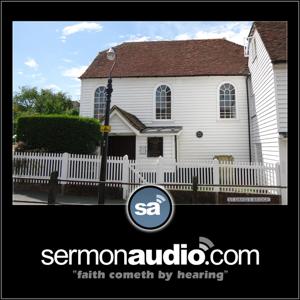
St David's Bridge Strict Baptist Chapel

St David's Bridge Strict Baptist Chapel

Download on the App Store

St David's Bridge Strict Baptist Chapel episodes

  • God perfecting that concerning us
    The LORD will perfect that which concerneth me: thy mercy, O LORD, endureth for ever: forsake not the works of thine own hands. (Psalms 138:8) *1/ David's persuasion concerning himself. 2/ David's knowledge of the LORD's mercy. 3/ David's prayer.* **Sermon Summary:** The sermon explores the assurance of salvation found in Psalm 138:8, emphasising that God will perfect the work He begins in the lives of His people. It identifies three key components of this experience: a personal persuasion that God will complete His work, a knowledge of His enduring mercy, and persistent prayer that he does not forsake His handiwork. Using examples from David, Joseph, and Jesus Christ, the message illustrates how faith looks beyond present circumstances to the certainty of God's promises. The tone is pastoral and encouraging, urging believers to rest in the character of God rather than their own efforts, while maintaining a vibrant life of prayer and expectation for eternal glory.
    44 min
  • The Gospel Trumpet and the authority to blow it
    And it shall come to pass in that day, that the great trumpet shall be blown, and they shall come which were ready to perish in the land of Assyria, and the outcasts in the land of Egypt, and shall worship the LORD in the holy mount at Jerusalem. (Isaiah 27:13) ~~~~ This sermon was preached at Oakington Baptist Chapel on a Wednesday evening. ~~~~ *1/ The Gospel Trumpet and the Authority to blow it. 2/ Those who shall hear it and it become effectual to - which were ready to perish and the outcasts. 3/ The effect upon them - And they shall come, And shall worship the LORD.* **Sermon summary:** The sermon explores the theological significance of the 'gospel trumpet' as depicted in Isaiah 27:13, emphasising that the proclamation of the Gospel carries divine authority rather than merely human effort. It draws parallels between Old Testament trumpet uses, such as the Jubilee and war calls, and the New Testament preaching of Christ's finished work, arguing that this message is effectual because it is sent by God. The text identifies the intended audience as those who are 'ready to perish' and 'outcasts,' highlighting that the Gospel is good news specifically for sinners who recognise their helplessness and need for mercy. Finally, the sermon outlines the dual effect of this proclamation: the conversion of the hearer, who comes to Christ, and the subsequent worship of the Lord in the holy mount, urging believers to recognise the power and authority inherent in the preached Word.
    55 min
  • The restorer of souls
    He restoreth my soul: he leadeth me in the paths of righteousness for his name's sake. (Psalm 23:3) ~~~~ This sermon was preached at West Row Baptist Chapel on a Tuesday evening. ~~~~ *1/ The restorer of souls - Jehovah the Shepherd of Israel. 2/ What he does - restoreth and leadeth. 3/ The reason he does this work - for his name's sake.* **Sermon Summary:** The sermon explores the theological theme of divine restoration, centring on Psalm 23:3 and the concept of God as the Restorer of souls. It examines the necessity of humility and the conviction of sin as preparatory steps for spiritual renewal, using examples from David, Israel, and the New Testament to illustrate how God removes spiritual decay before leading believers in paths of righteousness. The message emphasises that this restoration is not based on human merit but is accomplished for God's own name's sake, highlighting the sufficiency of Christ's work and the grace that restores the believer's first love and dependence on God.
    56 min
  • Receiving help of God
    My help cometh from the LORD, which made heaven and earth. (Psalm 121:2) ~~~~ Remembrance Sunday ~~~~ *1/ Asking help of God. 2/ Receiving help of God. 3/ Giving thanks and acknowledging the help of God.* **Sermon Summary:** This sermon explores the believer's relationship with the living God through the lens of asking for, receiving, and acknowledging divine help, grounded in Psalm 121:2. The message emphasises that true reliance on God begins with recognising one's own insufficiency and helplessness, a state that drives the soul to seek assistance through prayer. It illustrates this principle with biblical examples such as Jacob, David, Hezekiah, and Daniel, as well as historical references to national deliverance during wartime, demonstrating that God often answers prayer through providential means. The preacher urges the congregation to discern God's hand in these answers, moving beyond natural explanations to recognise the spiritual grace at work. Ultimately, the sermon calls for a response of deep gratitude and worship, directing praise not merely to the gift received but to the Giver, thereby glorifying God in both temporal and spiritual deliverance.
    38 min
  • He is able
    Wherefore he is able also to save them to the uttermost that come unto God by him, seeing he ever liveth to make intercession for them. (Hebrews 7:25) ~~~~ This sermon was preached at Providence Chapel East Peckham on a Lord's Day afternoon. ~~~~ *1/ To whom "he is able." 2/ Why "he is able." 3/ What "he is able" to do.* **Sermon summary:** This sermon examines the declaration in Hebrews 7:25 that Christ is able to save those who come to God through Him to the uttermost. The exposition begins by identifying Melchizedek as a type of Christ, highlighting the union of kingly and priestly offices and the eternal, unchangeable nature of His priesthood which supersedes the Levitical law. The message emphasises that this ability is grounded in Christ's incarnation, sinless life, and substitutionary death, which qualified Him to be the perfect advocate for believers. It further explores the practical implications of this truth, assuring believers that Christ is able to succour them in temptation, keep their souls secure, and ultimately resurrect their bodies. The tone is pastoral and encouraging, urging the audience to rely on Christ's sufficiency rather than their own strength, as He is able to do exceeding abundantly above all that can be asked or thought.
    42 min
  • And he arose
    **And he arose**, and rebuked the wind, and said unto the sea, Peace, be still. And the wind ceased, and there was a great calm. (Mark 4:39) *In each case note:* ~~~~ 1/ Who arose. 2/ Why they arose. 3/ What they arose to do. ~~~~ *1/ The Lord Jesus arose, Mark 4:39 2/ A prodigal arose, Luke 15:20 3/ One called arose, Matthew 9:9 4/ One healed by the Lord arose, Matthew 9:7 5/ A servant of the Lord arose, Acts 8:27* **Sermon Summary:** The sermon explores the theological significance of the phrase "and he arose" as a marker of divine intervention and human response to God's call. It begins with the calming of the storm in Mark 4, illustrating how Jesus' arising demonstrates His authority over nature and His expectation of faith from His disciples. The message expands to include the Parable of the Prodigal Son, where the son's arising represents genuine repentance and a radical change of life, contrasting with the elder brother's static righteousness. Further examples, such as Matthew the tax collector and the paralytic, highlight that God's call requires active obedience and visible evidence of grace. The sermon concludes with the example of Philip and Stephen, emphasising that God's servants must arise to fulfil their specific ministries and that Christ stands ready to receive believers, urging the congregation to move from passive belief to active, faithful engagement with God's will.

    50 min
  • But grow in grace - Peters closing word
    ~~~~~ No 36 in the series - The Epistles of Peter. ~~~~~ **Considering 2 Peter 3:17-18** Ye therefore, beloved, seeing ye know these things before, beware lest ye also, being led away with the error of the wicked, fall from your own stedfastness. But grow in grace, and in the knowledge of our Lord and Saviour Jesus Christ. To him be glory both now and for ever. Amen. *1/ A warning given and why. 2/ An exhortation. 3/ To whom be the glory.* **Sermon Summary:** The sermon centers on the closing exhortation of 2 Peter 3, urging believers to remain steadfast against the error of the wicked while actively growing in grace and the knowledge of Jesus Christ. It warns against complacency and the subtle drift into false teaching, emphasizing that true spiritual maturity involves a deepening dependence on God's unmerited favour rather than self-reliance. Drawing heavily from Romans 5, the message illustrates that where sin abounds, grace abounds even more, leading to a life of humility and reliance on Christ's righteousness. The tone is pastoral and instructional, encouraging the congregation to view their spiritual growth as a progressive journey of knowing Christ more intimately. Ultimately, the sermon directs all glory to the Lord, affirming that the believer's purpose is to reflect God's grace and share in His eternal glory.
    40 min
  • He spake and it was done - The power of His word
    For he spake, and it was done; he commanded, and it stood fast. (Psalms 33:9) *Introduction - God speaking in creation.* *1/ God speaking in Old Testament times. 2/ Jesus speaking on earth with the same power. 3/ Jesus speaking in Gospel days. 4/ Jesus speaking at the end of the world.* **Sermon summary:** The sermon explores the consistent theme of God working through His Word, tracing this principle from the creation of the heavens to the final resurrection. It highlights how divine authority was demonstrated in the Old Testament through figures like Noah, Abraham, and Moses, and how Jesus Christ evidenced the same power during His earthly ministry by healing and commanding nature with a single word. The message emphasizes that in the current age of grace, salvation is exclusively accomplished through the preaching of the Gospel, as faith comes by hearing the Word of God. This theological framework culminates in the expectation of the Second Coming, where the voice of the Lord will again effect a final division between the saved and the lost. The tone is instructional and exhortative, urging believers to value the Scriptures as the sole and sufficient means of spiritual life and eternal hope.
    53 min
  • The inseparable love of Christ
    Who shall separate us from the love of Christ? shall tribulation, or distress, or persecution, or famine, or nakedness, or peril, or sword? (Romans 8:35) *1/ The love of Christ set before us in the Gospel. 2/ The love of Christ felt and evidenced. 3/ The inseparable love of Christ - the comfort of God's people.* **Sermon summary:** The sermon explores the unbreakable bond between God and His people, anchored in the text of Romans 8:35-39. It argues that the love of Christ is not merely an abstract concept but a sovereign, sacrificial reality demonstrated through the atonement and the new birth. The preacher emphasizes that this divine love is evidenced in the believer's life through a genuine affection for God's Word, the people of God, and obedience to His commandments. Despite the presence of tribulation, distress, and persecution, the central message is one of profound assurance: no external force or internal failure can sever the believer from the love of God. This inseparable love serves as the ultimate comfort, guaranteeing the believer's eternal security and glorification.
    35 min
  • Made free by the Son
    If the Son therefore shall make you free, ye shall be free indeed. (John 8:36) ~~~~~ Lord's Day afternoon service at Milward House Pilgrim Home with some 20 residents and several staff. ~~~~~ *1/ Who Jesus is speaking to - Believers, Abrahams seed. 2/ What he is speaking of - freedom. 3/ How freedom is found.* **Sermon summary:** The sermon explores the theological concept of true freedom as presented in John 8, arguing that genuine liberty is not merely a social or political state but a spiritual deliverance from sin, condemnation, and error. By drawing a parallel to the Israelites' exodus from Egypt, the message emphasizes that only the shed blood of Jesus Christ, the Passover Lamb, can break the bondage of sin. The text distinguishes between nominal belief and authentic discipleship, urging listeners to examine whether their faith is rooted in personal trust in Christ rather than religious heritage or self-righteousness. Freedom is found through continuing in God's Word, knowing the truth, and relying on the Son who has redeemed His people. The sermon concludes with the assurance that those whom the Son sets free are truly free to serve God, having been purchased by His grace.
    23 min

About St David's Bridge Strict Baptist Chapel

From the publisher's feed

The newest sermons from St David's Bridge Strict Baptist Chapel on SermonAudio.