
Sign up to save your podcasts
Or



October 9, 2019 | Dear Eric, My home was found at last with a school and way called Stoic. You never knew this journey, I think. We both missed it back then. What a difference this thinking and living may have made. The terms of Temperance, Fortitude, Limits, Apathy and Indifference may alone have saved your life.
I'm sorely tempted to slip my humble book under the door of the house called Stoic. I wonder if it'll fit through so gaping a crack?
This isn't because my story is so much, but that it may be too much. Could I not have said the same thing with far fewer words? Could not a greater economy of expression have conveyed these ideas better? Or more concisely? Or with greater accuracy towards the mark? How can I align my Objectives and Principles with a discipline of which I am such a novice? Should I not instead place my little guide upon some other shelf, or at the edge of my desk or better still into the desk drawer? Wouldn't this be the more modest and reserved thing to do? How much better to answer Stoic principles with Stoic modesty and ways? Perhaps... Yet, I must also answer to my own judgement and call to arms. And my judgement declares my work Stoic. And my call to arms demands I seek alignment with this tribe.
And so, I will call my work Stoic. And I will share it as such. And speak of it as such. And live my Objectives and Principles as though they were Stoic objects. And thus, I will live my life and share my story. A Stoic life and story. The story of Going Alone and the story of The Good Life.
Blog post post: https://www.goingalone.org/post/a-hou...
-----
My website: https://goingalone.org
My email: [email protected]
October 8, 2019 | Dear Eric, And what of the fearful things of this world...? You knew some of these, and yet you fell at the first major encounter of life's deeper danger, and, dare I say, terror. Yes, it must have been a terror to you, though I know you put on a strong face. But yet, you fell. And I know that you were likely stronger than I was then, and that I too might have fallen just the same.
I too will fall. And I too do fear. And I will also likely know real terror before this living is complete. And what of it? What's to be done about the fact that life is dangerous, and fearful and even terrible sometimes?
One very good thing to be done is to prepare and to stand ready for the fall; to set aside supporting resources and to create a safe place of retreat, and to cultivate family and friends who can help catch us when we fall and who we can catch when they fall. This is humanity at its best... This is society and the bonds which make us strong and resilient and as a species able to weather come what may. Our social manner is why we are still here. It's an essential part of being human to want and embrace and to care for others. We survive in this way - not individually - but as a whole. Humans care for one another. It's how we manage the fear, and keep back the terror and dispel the colder night which is always out there and sometimes swirling close.
Be safe...
But not too safe
It is folly to ignore safe practices and behaviors and to sometimes leave the tribe behind in order to do things and to go places where there is no one to catch us should we fall. Why do some of us do this then? Why are there those among us who willingly let loose the holding hand, who open the garden gate and then step out into the wild? And why do some of us do this alone? And why do some leave no word with others where they will be or just when they might return? Why do we go alone into the scary world? Why do we sneak out of the sanctuary and into the night? What are we looking for out there in the cold and dark and howling?
I am one such person. Here's my reason:
I go because I am curious. I want to see and discover what isn't here. It's because we don't know all the answers - let alone the questions - and I want to find and ask, and attempt to answer some good questions while I yet have a chance. I want to ask and try to answer questions which I might not even know how to share with you. That's why you can't come with me. Because you and I are stuck with the same questions and answers. It's that safe and sane glue and fabric of society that mucks things up. The same safe stuff which binds and keeps us secure and which also holds us behind the velvet rope of agreement and convention. It's our common bond and concern for one another that reminds us to keep back from the No Trespassing sign. It's what makes us behave well and good and sane when others are looking. And I want to go to the places I'd go if I knew that no one was looking. And I want to think the thoughts I'd think when I have no one to talk to. And I want to ask the questions I'd ask when there is no one to hear and answer. And so, I go alone.
And so, I accept that I may fall alone, and that I may face my fear alone, and that I may even encounter terror with no one there to hold me. This is a price we must pay in the form of accepted risk which must be balanced with the life responsibilities we choose to assume. But, what a worthwhile risk. And what a worthwhile balance.
Full blog post: https://www.goingalone.org/post/be-safe-but-not-too-safe
Website: https://goingalone.org
Email: [email protected]
October 7, 2019 | Dear Eric, Every genuine adventure ends in a new life. How many lives can be lived in a lifetime? One is enough...as long as we die alive.
I realized tonight that The Path of Wildness has many points of egress yet just a single point of ending. For this reason, I'll walk a little slower tonight, though I know that neither haste nor restraint will make much difference in the end.
Death will take me in any condition. For death is the single point of ending of every life story and the doorway is always open. But you can't fit through the door. None of us can. We must leave everything behind, including ourselves. Death only accepts nothing. Death only waits for nothing. Death is nothing.
With nothing ahead and everything on hand why not choose the story of adventure while we have a chance? Every next footstep then is a potential start... Every decision a worthy point of departure. What story will it be told in these next moments? What story will we live and share and tell and show our kids? What story will death take from us to fade like the afterglow of embers in life's wake?
The adventures of youth may differ from those of older age. Gross impulse and stimulation giving way to measured exercise and restraint—a very different kind of impulse and reward. Experience matters most when we are young, until we've had enough of the novelty and excess of living and turn to discover the more meaningful adventure of discipline and self-control. And then the fun begins, though our face might only rarely belie this sage endeavor. The best times are when the adventures of youth are passed, and when the hard lessons of middle-age are largely complete, and when the final series of options are before us and we recognize our sober opportunity of self-discipline and measured restraint. And we choose then to die well when the time comes so sooner than we'd thought. We choose then, to die alive.
Full blog post: https://www.goingalone.org/post/die-alive
Website: https://goingalone.org
Email: [email protected]
October 6, 2019 | Dear Yumiko, There's investment in adventure which yields return throughout our remaining days. For me, this is wilderness adventure and life adventure and the adventure of the mind. Each sort of exploration takes something from me in the process of living—directed living, living directed towards the outer edges of the territory I know, and the places I trust, and the life which is safe and sane and contented—and then returns something back, usually some time distant in the future, something more valuable than what I gave up, even if that value is less tangible or seemingly real. This is why I always go back to the wild. This is the reason I always return to the mountains or the desert and to adventure. And this is also one of the reasons I married you.
You and I are alike in this way, as we both are adventurers. I knew this of you the first day we met and after you told me the story of your coming to America. I knew then that we were kin. I understood that you were someone with whom I could make life itself an adventure. And so, we ventured out together then, thirty-years back, and what a journey it's been... So many places together. So many lives together.
You and I agree that when we push past our limits into new life we always lose something along the way, some part of us is expended and consumed by virtue of the decision and effort to step outside the garden gate, to climb over the sheltering wall, to let go of our community and friends and the warm hands which comfort and hold our own—not always forever, not even for very long sometimes, but just long enough to once again get dirty, bruised and bloody and to remember what it means to explore while there's still light in the sky. There is...still light in the sky.
We have now before us yet another opportunity of life adventure, me and you. Yet another life adventure. Not my adventure of the mountains and the desert. But our adventure of life itself. The opportunity before us today is a good one - though risky. But we like risky, don't we? Though what a change this would be! A new job—a better job—in a new city a few hours away. The transition would be big. The challenges many. But mostly, it's the challenge of the unknown. That unknown which always warns us to stay back and to close and lock the current safe doors. That ridiculous fear which cautions of risks which are indeed real, and which have already cost us so much—everything perhaps—but which are also the very risks we agree this life is all about. For the return on such investment is also real. And it is this intangible return which we really want from life. We've always desired the splendid return on the engagement of risk - though if we're honest, we've also always appreciated the loss that's always incurred along the way—no matter what the cost. The loss has always somehow been the best, even though it never feels that way at the time.
So, do we go again now into life adventure? Is it worth the challenge and the risk? What are we really after at this late stage of our lives?
We are not so young anymore—we're nearly empty-nesters—and our most important work is mostly almost done. What's our aim now after parenting besides being good people and living lives which are more gain and less drain for others for the fact of our having been alive? What's next in the time remaining? What's a good use of our remaining time?
Besides doing the good things we've already talked about and planned, I think It's still the adventure that we both really want... It's still the return that we're still after—and that cost along the way. The return which always comes later, and which is the fruit and blessing of our welcoming and venturing together into the unknown. It's the thing which comes of going where the road ahead isn't clear; again, into the thorns and across the rocks and through the cold waters into a darkening wood. The cost along the way is what it is, and is...
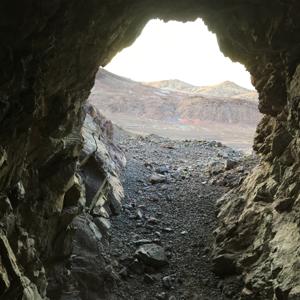
October 5, 2019 | Dear Eric, There's a place I go to work. It's way out in the desert - almost two-hundred miles from my current home by the sea. It's a bridge over a flash-flood channel along Route 66 near the ruins of a railroad water-stop called Siberia. I found this place for reasons other than work, by way of adventure, never intending necessarily to return, let alone find work in such a place. Yet, find work I did. Work of a very good and useful sort. Work sifting and sorting thoughts and words and sentences and paragraphs. It's interesting how such a place is an aid to such endeavor; being both a retreat for a focused mind and a catalyst for improved perception and resolve. I find thoughts there below the bridge that might not come to me anywhere else. There's a subtle necessity and resolve there below the road, down in the shadows, in the thick heat of summer and the biting cold of winter, and the halcyon days in-between; a resolve which awakens something akin to necessity and an urgent need to create while there's still time. Time may be the key out there, where it's clear to me we have so little.
Made it to the bridge
Very nice below
Like coming in from a storm
Now I can get to work...
I always come to the bridge in the same way; first at night, and then again by day. This is because I always arrive at Siberia at, or very near, sundown. And I use the waning hour of nightfall to set up camp and get situated ahead of the dark. I arrive on my motorcycle from the west, riding along Route 66 from Ludlow and always arriving just around 8:00 PM. In the summer, there's still half an hour of sunshine left above the horizon, and I watch the burning solar face dip slowly towards, and then into, the Bouillon Mountains while I pound in my tent stakes, eager for the coming respite from the heat which only nighttime or the deep shadows beneath the bridge can provide. Nighttime or shadow are my only shields and escape from the roasting summer oven at Siberia. Such intensity! Darkness, please come now. Sunlight, please go beyond the hills and give up, for a few hours, your murderous oppression of life. I cannot survive very long exposed in the summer desert. I need the darkness of night or the shadow of the bridge to stay alive. Perhaps this is the reason the writing goes so well then—in the shadow or after dark? Maybe it's the fact and reminder of my quite immediate mortality that causes me to choose my words very carefully after the sun is gone, and fosters the muse that might otherwise never speak. Perhaps this is the reason my muse lives there under that bridge... My grasping, lonesome sanctuary from what is truly real. My front-row seat to the awful spectacle of what is true. My face-to-face encounter with the fact of eternal death. The summer writing at Siberia and under the bridge is borne of the close proximity of death and made buoyant of my own animated will to live. My writing under that bridge at Siberia in summer is the perspective of a delirium of life against a backdrop of the sobriety of death. Summer is a very good season for writing at Siberia, though the heat does perhaps madden my mind and bring out words only a wounded and hiding thing might be driven to think.
I also write under the bridge during the in-between months of October and November, and April and May. These are the periods when summer and winter are in transition. And when life is given some chance to rest and come out and live even for a while in the light. The sun is always just passed when I arrive on my motorcycle at these times. And I hear crickets and see the first stars appear and the moon come up all brilliant and cold sometimes over the black volcano to the east. This is a good time. A restful time. A time to remember and love life. A time maybe even to forget about death which is otherwise the desert's perpetual theme and subject of study. I go then to the bridge after dark, and then again during the...
October 4, 2019 | Dear Eric, Do we borrow from tomorrow when we live in an imagined better day? Maybe not. Perhaps this is how we make way into that better day? Isn't this what we do when we go to school? Or when we work hard to improve at our job? Or when we have children? Or write a book or tell a story or share a dream? In all these things we are borrowing some imagined future life in order to help ourselves or others begin to live better now. So, it seems we can borrow from the future just a bit. Just a little bit.
But the future is an intangible something that really isn't. We can't truly go to or even know what will come until it is here. What's out there, possibly ahead, are just imagined mirage on the horizon which we make real through our efforts of approach. The wavy, shimmering dreams slowly materialize before our eyes as we get close. Others—those who have gone before—may tell us of some worthy dream oasis to be found in the wastes if only we go this way or that and provision ourselves sufficiently—and correctly—for the journey. They caution us to not miss our chance at discovery, warning that opportunity will pass like a desert caravan missing a sanctuary of life. Keep our eyes forward then on the wavy thing shimmering in the heat. March forward towards the dream. The safety of that dream. That place where dreams are real.
When we make the mark—when we reach the place we were after, or where we were told to be after—and we've caused the oasis to appear from nothing, from a simple dream into something real—what then of the journey? Did we live well along the way? Were we truly alive while we trudged through the sand in search of this place? Did we neglect the moments of desert travel? What unspoken treasures did we pass by along the way—scattered on the ground or glimmering in the hillsides of seemingly forsaken lands we never thought or knew we could visit—as we trudged along to the sanctioned lands? What mysteries and wonders of living did we bypass along the way, along a course we can never truly retrace, even if we followed our own footsteps back to the very places we once stood? And so, we sit at the blessed oasis and sip sweet water and eat honeyed bread and witness the approved life around us. There are others here as well. Others—like us—directed to this place by sage council of the past. We'll talk with them and compare notes. What a place this oasis is! How splendid we all arrived. It's a pity those out there in the desert. Those who wander still. Those who remain in the wastes. The sun is going down now... Shall we sit together and watch the final rays disappear behind the sand and water? It's good we came here, is it not? We did the right thing, did we not? Never mind... Let's watch the sun go down.
Full blog post: https://www.goingalone.org/post/life-at-an-oasis
Website: https://goingalone.org
Email: [email protected]
October 3, 2019 | Dear Eric, I think you could have rested quite comfortably upon a log, or a big rock, or on the sand, or a seat at the college library, or a park bench. This is because you sought your rest only when you needed it. And were glad of whatever device or setting might accommodate your body without too much discomfort. You simply desired to rest.
There was a time in my own life when I had seemingly everything. I was just beyond the end of youth and making ready for middle-age, and I didn't have much idea about what it meant to live well, and so I employed my seeming abundance towards making a good show of living well. I made my life into a theater. And I produced a display to communicate to myself and others that I was a successful actor.
My first performance was the purchase of a nice home, which I began to furnish nicely. Then, I started inviting people over to see what I had done. That was easy... And it felt pretty good—as long as I kept busy—as long as I didn't have time to think.
The production of this show of my life was a good way to stay distracted; a good way to not hear the little voice that was trying to speak to me of other things. I was so busy for more than a year that I could barely hear the little voice asking me what I was doing? But eventually I ran out of space to prepare and decorate. I had put things everywhere. In particular, I had a lot of chairs...
Many places to sit
Nowhere to rest
My show-house had an enormous yard, over an acre of land. And we had a pool. And lovely landscaping all around the pool with fruit trees of many sort. Each day, on my way home from work, I stopped at a big nursery to look at and buy plants for the yard. I also bought chairs—a lot of chairs. I purchased patio chairs, garden chairs, benches and all sorts of antique garden seating which I could place all over the yard. I put these items around the pool, and out in the garden, and next to a big tree and around an especially nice spot at the edge of a hill overlooking a picturesque valley view. The centerpiece for all of this was a quite expensive collection of wrought-iron patio furniture just outside the back door, which I'd arranged below a redwood arbor I'd had built. So many places to sit. Just nowhere to rest.
I only remember forcing myself to ever sit in any of those chairs. I'd tell myself to sit down and try a seat out when I first moved it into the yard, though I'd never sit in it again once I had in place and adjusted just so, and had the view from the seat just right, and the position next to the little table to place one's coffee was perfectly set. Done! I was done with that setting and seat. And I'd move on to the next showpiece place of rest.
The Stoic emperor Marcus Aurelius was satisfied with "a plank bed and skin" and wrote that "it is possible for a man to live in a palace without wanting either guards or embroidered dresses, or torches and statues, and such-like show" which speaks to not only a simple life, but a life of spartan outward wants; a life in which the satisfaction of living comes less from external display or comforts and more from some inner fulfillment. This was the point I was missing with my show-house of many chairs. For, I had created a personal palace displaying the outward trappings of rest and peace before first cultivating an inner-man of such character. I had no place to sit as I was then incapable of rest.
Eventually, I gave up my seats, and my possessions, and my home, and that life. But I kept my family. But I kept my values—as confused and unidentified as they were at that age. And I kept my movement and inability to sit and rest. And I took that restless show on the road, on a Great Life Adventure with my wife and daughter. And I stopped trying to quiet the little man speaking to me from within. I began to listen then to what he was trying to say.
Full blog post:
October 2, 2019 | Dear Eric, What is the cost of yesterday? The cost is now. What is the value of yesterday? The value is maturity—but only when we possess the fortitude to maintain or adjust our course in accord with the lessons we've learned—only if we remember to just glance back sometimes, and not to stare too long at yesterday.
There's a quicksand of complacency
In every backwards glance
There's a giving up of now
In remembering yesterday
It's not a bad thing to look back...
Though looking behind
Is never free
Imagine a sailor crossing the sea while looking at where they'd been... A man or woman at the rudder of a small boat, adjusting course, while gazing over their shoulder at the past. Look too long behind and they'll not see the rocks ahead until they're ruined and going down. No matter how wonderful the places we'd been, we must always, and soon, adjust our attention forward. We should also plan and chart a course into the sea. We should steer and tack and make our way forward. Even in open water the wise sailor attends their forward progress and sets a watch at every hour and season. Where we are now, and where we are headed next, is what matter most. Our past adventures are no longer any real living, and should only serve as reference and remembrance for the benefit of now and what is to come. I'd remember yesterday always if I had no wish to live well today. I'd linger long in the past only if I was too tired or hurt or done with the present.
It's alright to give up when we've had enough... When the journey's been long and we're ready to go lost with the wind while gazing behind at the sea. To wait for the open waters to swallow us soon while looking happily back at where we've been and lived. Or even to linger with our past pain until the great ocean takes it all away.
But let's not willingly lose ourselves too soon to the sea through gross mis-attention of the past while we're still fit to sail on. Let's keep our eyes forward with just periodic glances to memory for as long as we desire to go on—and then a little further still for safe measure. Let's save the backwards gazing for old age and our readiness for the end. Let's look back quick now for reference and then turn forward to scan the horizon ahead and all around. There are storm clouds out there and wind. There's sunrise and sunset and fine days and breezes to be had. Look again behind, quick, and then forward and all around. Get up and grab the rope and the tiller. There's time yet to attend the sea.
It's time to sail.
Full blog post: https://www.goingalone.org/post/sailing-backwards
Website: https://goingalone.org
Email: [email protected]
October 1, 2019 | Dear Eric, Good and evil never crossed our minds; and we certainly never attempted to define these concepts or what constitutes right or wrong. What a good chat that might have been...
I only attempted to address right and wrong late in life. I lived all the way into my forties without any sound idea about what good or bad thinking and behavior were. I only took on this challenge when I found myself in need of a definition of life meaning, and when I decided this meaning would be the pursuit of virtue, and I didn't know what virtue was.
I decided then that virtue was the pursuit of well-being, which in turn is defined as the objective improvement of the welfare and circumstance for any living thing. I know that this is a very broad definition, though my principle aim in virtue is the well-being of my fellow humans, with an understanding that improvement of well-being of other creatures, as well as the ecosystem as a whole, creates an overall betterment which raises the relative well-being of all life. But what's this to do with right and wrong or good and evil? And how do these two concept-sets differ?
What is right is simply whatever makes things better for the many without unreasonable compromise to the well-being of the few. Wrong then is the corresponding opposite and that which makes things worse for the many with unreasonable improvement of the few. Good and evil in turn describe the overt intent of the actor in performing right or wrong behaviors. In this sense, someone who is ignorant of the harm their behavior causes to the many is guilty of doing wrong, while their intent may not be evil. Yet, if they understand the harm they cause yet they choose to do it anyway, then they are guilty of evil. On the other hand, someone who makes the world better by their choices and actions performs right, and is also good if they understand the positive impact of what they do. The pursuit of virtue then is nothing more than seeking first to understand the potential impact of our decisions regarding well-being (right and wrong) and then resolving to make the choices which knowingly make things better (good over evil). Making the decision for right and good often takes work and is rarely easy...though this is the way to virtue...this is how to live The Good Life.
We "go into evil" when we first collect the facts we need ahead of an important decision, and then weight and consider these facts in light of the pros and cons and assumption about what will happen if we make a choice. The critical path is the way forward that seemingly leads towards virtue and the improvement of well-being for the many. We "go into evil" if this path takes away from our preference in pursuit of the good. Going into evil begins with ourselves; this fight starts with a resistance to our own unworthy desire and want. We engage the fight with temperance and simplicity and apathy and a decision to do right and perform good in spite of the discomfort it may cause to our own desire or even our own well-being. We go into evil when we choose The Good Life first.
Full blog post: https://www.goingalone.org/post/go-into-evil
Website: https://goingalone.org
Email: [email protected]
September 30, 2019 | Dear Eric, Looking back now from the vantage point of three-decades, I can see that we both lived and portrayed lives which were rather stereotypical of young men caught up in the atmosphere and experience of academia. What other lives did we know then? What other way could we have possibly imagined? Our demonstrations of living at that time were certainly genuine, as it's no false charade when there's just a single mask to wear. Still, isn't the fact of the mask something of a charade?
Maturity beyond the teenage years brings opportunity to change and become the someone we might set out to be; or to become the someone we've settled for; or perhaps the someone we think others imagine for us. Our demonstration of success in this endeavor of becoming is made evident through our portrayal of life by arrangement of the artifacts we collect within the context and circumstance of our living. We decorate and adorn ourselves and our surroundings with outward messages of who we are, or who we want others to think we are. And we use these same messages to remind ourselves to be and become the person of either our settling or of our dreams. This is the life we live...and the life we portray.
The life we live
Rather than,
The life we portray
But it's easy to become so hung-up on the life we portray that this effort of display becomes our living more than the life we might actually live. This occurs when the impression we seek to make becomes more important to us that the life from which the impression should be but an artifact. Like a homeowner obsessed with their yard at the expense of the family within their home. Or a student aiming their energies so squarely at a prestigious degree that they fail to make broad use of their time at school. Or a senior citizen who curates the safety of their golden years at the expense of their last chance to live. Such endeavors are energies towards the impression of an end rather than the end itself; and while such work and focus may certainly contribute to the successful achievement of such desired results, their engagement alone should not become the end itself.
Full blog post: https://www.goingalone.org/post/selecting-the-right-picture-frame
Website: https://goingalone.org
Email: [email protected]
From the publisher's feed