
Sign up to save your podcasts
Or

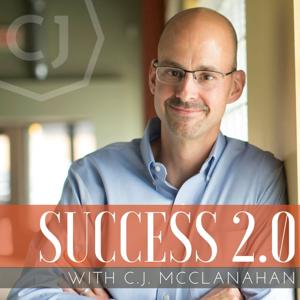


Get real and get vulnerable with CJ McClanahan as we talk about living in the post-COVID-19 era.
In this episode of Success 2.0, CJ McClanahan (@cjmccoach) explores the simple tactics you can practice to thrive and decrease stress, even during times of uncertainty.
Mentioned in this episode:
In a time of stress, the brain screams to 'go faster.' Most of us are working from home right now and are pressed to move faster and do more. That constant activity and stress leads to bad decisions which actually increases our stress level.
Keeping your routine does not mean keeping it perfectly. Keeping your routine means keeping it as closely as you can.
We can behave irrationally and in a reactive fashion during a crisis like COVID-19. Instead, we need to act in a rational and intentional fashion. However, in a crisis it's hard to be completely rational. Everything seems to be changing right now. Our responsibility is to lay out as many predictable events as possible.
You can handle uncomfortable situations for one day. If I asked you what is worrying you today, you would probably give me a scenario that is two week, two months, down the road. What can you do about this today? What is the best effort I can do today, based on all the information I have right now?
In this episode of Success 2.0, CJ (@cjmccoach) explores the concept of "saying no" and how embracing it is a must if you want to grow your business, transform your career, or get greater satisfaction out of life.
Mentioned in this episode:
CJ's tactics for mastering the art of no
Recommended resources
A former consulting actuary to Fortune 100 companies – such as Sony Music, Proctor & Gamble, and Exxon – David Wood (@SolutionBox) left his cushy Park Avenue job 20+ years ago to explore both the outer world, and his own inner world.
What We Discuss with David Wood:Like this show? Please leave us a review here — even one sentence helps! Consider leaving your Twitter handle so we can thank you personally!
(Download Episode Here)
(Subscribe to the Podcast Here)
(Connect with CJ)
(Are you secretly coaching, but not getting paid for it? from David Wood via YouTube)
Please Scroll Down for Full Show Notes and Featured Resources!The Two Rule Foundation helps inspire professionals to live gratefully and commit more of their resources to help those in need. The foundation can help you determine who you should give your money to and how.
More About the ShowUnhappy in his marriage, David and his now ex-wife turned to a personal development program with the hope of learning more about themselves, what they wanted out of life and their marriage.
They freaked me out initially. They're all smiling way too much… I'm going to just get in and out, and I'm not drinking the Kool-aid." David says.
"But what happened is that they cracked my cynicism. I thought they were just out for my money, but I realized they actually cared about people."
From that point on, David was hooked. Vowing to never another course, David found himself in the second level of the program, where he naturally started to coach people.
If they were stuck, he'd ask 'what's it gonna take for you to get unstuck?'
"I think I changed a woman's life overnight in that course. It was such an amazing feeling to watch her walking on air after 10 years in an unhappy marriage, have her and her husband to have a massive breakthrough, I'm 'I want more of that!'" Woods says.
So he took the third program because it was promised he'd be trained to become a coach.
He knew he wanted to move back to Australia (from New York), so he quit his job, giving himself six months to discover if there was anything else he'd like to do. If he didn't find anything he'd look for a position with a familiar role.
During his self-funded sabbatical, he wanted to work as an entertainer, frequenting local restaurants, bars and resorts, while beginning a coaching practice. After six months, he decided to spend all his energy on coaching, and soon realized an opportunity to use his technical capabilities to gain clients through search engine optimization. "I was ranked number 1 4, 7 & 9 on the search engine [for life coaching]." Wood says.
From there, he started creating products to help clients, then moved into helping other coaches build their business and recently has pivoted back to coaching individuals at a high-level. Thanks, David Wood!If you enjoyed this show with Life Coach David Wood, let him know by clicking on the links below and sending him a quick shout out on LinkedIn, Facebook, or Instagram.
Click here to connect with David on LinkedIn
Like Play For Real on Facebook
Visit David's Website
Follow David on Instagram
Click here to let CJ know about your number one takeaway from this episode!
Mentioned in This Episode:Art Barter (@Art_Barter) is the CEO of Datron World Communications, Inc., Founder of the Servant Leadership Institute, and author of the books Farmer Able, The Servant Leadership Journal, and The Art of Servant Leadership II
What We Discuss with Art Barter:Like this show? Please leave us a review here — even one sentence helps! Consider leaving your Twitter handle so we can thank you personally!
(Download Episode Here)
(Subscribe to the Podcast Here)
(Connect with CJ)
(Art Barter Full Keynote / 2016 Servant Leadership Conference from Servant Leadership Institute via YouTube)
Please Scroll Down for Full Show Notes and Featured Resources!The Two Rule Foundation helps inspire professionals to live gratefully and commit more of their resources to help those in need. The foundation can help you determine who you should give your money to and how.
More About the ShowStarting as a "sweeper" at Disneyland in Anaheim, California while studying Business and Finance at Cal State Fullerton, Art moved into character wardrobe and then into the accounting and finance division, which lead to a full-time position after graduating.
"Disney was a great place to work, a lot of fun,... but it takes you a long time to get ahead there. I was a young guy out of college and wanted to get ahead real fast." says Barter.
Not long after graduating, Art left Disney and took a job with a company that manufactured check printers.
"I fell in love with building things,... and I've been in manufacturing ever since." Barter says. After spending 10 or so years there, Art transitioned to a company that made specialized motors for everything from bonesaws to NASA observatory telescopes to F18 fighter jets for the U.S. military.
After another ten years, Art learned about a defense contractor called Datron that made telecommunications equipment for foreign militaries. Having been exposed to international travel in his previous positions, he was very excited when his first assignment took him to Zimbabwe to help the finance $15MM in high-frequency radios for the local military to support upcoming elections.
It took two years to raise the capital, and although the Zimbabwean government was (and is) known for corruption and violence, the country had the lowest levels of election-related violence in its history.
"It was an opportunity to help save lives," Barter says. "All the generals I deal with and all the militaries around the world, they just want to provide sovereignty for their country and security for their citizens… they don't want to attack anybody, they just want to protect."
In 2004, after a year of intense investigation by the Department of Justice into the company's relationships with foreign powers, Art learned that it had been triggered by a company that wanted to drive Datron's value down in order to purchase it at rock-bottom pricing.
It was then that Art decided to make an offer to buy the company instead. Long story short, he got it, at a purchase price of $4.7MM. With Art's leadership, he grew the company to over $200MM in just six years.
"We decided to run the business a different way - create a great purpose, give people a way to live that purpose."
That difference was servant leadership.
Thanks, Art Barter!If you enjoyed this show with Servant Leadership Institute founder Art Barter, let him know by clicking on the links below and sending him a quick shout out on LinkedIn, Twitter, Facebook, or Instagram.
Click here to connect with Art on LinkedIn
Thank Art on Twitter
Like Servant Leadership Institute on Facebook
Follow Servant Leadership Institute on Instagram
Click here to let CJ know about your number one takeaway from this episode!
Mentioned in This Episode:Paul Churchill (@PaulChurchill) is the Founder/Host of Recovery Elevator, an alcohol recovery and sobriety podcast and online community. Since launching the podcast in 2015, Recovery Elevator has amassed over 3-million downloads and is in the 95-percentile of all podcasts on iTunes.
What We Discuss with Paul Churchill:Like this show? Please leave us a review here — even one sentence helps! Consider leaving your Twitter handle so we can thank you personally!
(Download Episode Here)
(Subscribe to the Podcast Here)
(Connect with CJ)
From the omni-channel marketing and multi-million dollar sponsorships to major sporting events and happy hour, modern society would have you think that alcohol is a harmless beverage that leads to good times, deep connections, and career advancement. Yet, for tens of millions of Americans, and hundreds of millions globally, alcohol has a much darker, life-altering side.
In this episode, we talk to Recovery Elevator host Paul Churchill about his path to sobriety and how his personal accountability method created an online recovery community that has since helped thousands of alcoholics across the globe gain the upper-hand on their addiction, get their lives back, find meaning and joy, and much more. Listen, learn, and enjoy!
(I've Been Duped by Alcohol from Paul Churchill via YouTube) Please Scroll Down for Full Show Notes and Featured Resources!The Two Rule Foundation helps inspire professionals to live gratefully and commit more of their resources to help those in need. The foundation can help you determine who you should give your money to and how.
More About the ShowA lot has changed since Paul Churchill got sober and published the first episode of the Recovery Elevator podcast.
"When I was in Spain I started DJ-ing clubs, and those were mega clubs," says Paul. "I was DJ-ing until 7-8am. I'd close my bar at 3am, then go DJ at a club until 7 or 8am."
"It was the best and worst time of my life. It's what propelled me forward on what I'm doing now [Recovery Elevator]. Basically what happened is I became addicted to alcohol – I was blacking out 5-7 nights per week. But at the time I was telling myself it was normal. I was 25, 26 years old – that's what people my age do."
"Eventually, I ended up walking away from the bar in Spain. My body was physically shutting down – mentally, physically the signs were there – it got kind of scary there at the end."
Shortly thereafter, Paul decided to sell his bar and move back home with his parents, thinking he'd be able to leave the drinking behind him in Spain. He saved up some money, got into grad school, but found the drinking continued to follow him. On January 1, 2010, Paul decided to get sober. Long story short, it only lasted 2.5 years before he was back "field testing" (i.e. relapsed).
During this time, Paul was DJ-ing weddings, parties, and school events. By happenstance, he got into operating arcade games at bars and business was booming. "All these businesses just fell into my lap," says Paul, "there were opportunities that if you just walk around life with your eyes open, they will just show up."
In mid-late 2014, Paul had gotten sober again, but wasn't interested in joining AA. Instead, he had the idea of starting a podcast focused on sobriety and recovery to help him with his accountability.
"I knew if I didn't create accountability, it was going to be rough."
On February 12, 2015, Paul uploaded his first podcast to iTunes, where he revealed his struggle with alcohol on the world wide web. In that first show, Paul explains that his motive is selfish–it was his way of creating accountability for himself–and that if he were to relapse, he'd make it known.
Thankfully, as of this recording, Paul has uploaded a new episode every week without fail, maintained his sobriety. In the process, he's built a community of people seeking the means to address their issues with alcohol and addiction, culminating in a 700+ member online recovery community and has hosted more than 10 sober travel retreats, with more planned and in the works.
Thanks, Paul Churchill!If you enjoyed this show with sobriety advocate and Recovery Elevator podcast Host (and Founder) Paul Churchill, let him know by clicking on the links below and sending him a quick shout out on LinkedIn, Twitter, Facebook, or Instagram.
Click here to connect with Paul on LinkedIn
Thank Paul on Twitter
Like Recovery Elevator on Facebook
Follow Paul on Instagram
Click here to let CJ know about your number one takeaway from this episode!
Mentioned in This Episode:Lee Caraher (@LeeCaraher) has been in PR and Communications her entire career. She is the founder, President and CEO of San Francisco-based integrated communications company Double Forte and is the author of The Boomerang Principle and Millennials & Management.
What We Discuss with Lee Caraher:Like this show? Please leave us a review here — even one sentence helps! Consider leaving your Twitter handle so we can thank you personally!
(Download Episode Here)
(Subscribe in iTunes Here)
(Connect with CJ)
Please Scroll Down for Full Show Notes and Featured Resources!The Two Rule Foundation helps inspire professionals to live gratefully and commit more of their resources to help those in need. The foundation can help you determine who you should give your money to and how.
More About the ShowLee started Double Forte in 2002 determined to create a culture that fully supports its talent, even when they choose to move on. After failing miserably at retaining Millennials, Double Forte went back to the beginning and created a culture where all generations thrive; as a result, turnover is low, and when employees do leave, overwhelmingly they stay loyal to the firm – sometimes even returning.
With her foundational work, Lee shows leaders how to create the best possible workplace culture so their employees will stay longer than they intend, and when they do leave, advocate for the company, defining a new loyalty contract and a new model of business sustainability.
The Come UpAfter graduating with a degree in Medieval Studies (go figure), she transitioned in communications working for the Weber Group. A few years went by and she took a VP position at The Bohle Company, a small communications firm out of Los Angeles. Another few years there, and she was recruited for a similar role, but at a much larger company called MSLGroup.
At MSL, she was in charge of the team working with one of the world's largest companies in video games, SEGA of America. SEGA liked her so much that within 10 months of being at MSL, she was offered asked to come on as the VP of Corporate & Consumer Communications, overseeing the work of over 700 people. Five years later, just before the launch of the DreamCast, Lee was asked back to Weber Group (now Weber Shandwick), but this time in an Executive Vice President role.
Another five years past, and Lee decided it was time to venture out on her own. In September 2002, Double Forte was formed. Now nearly 17 years later, Double Forte has offices in San Francisco, New York and Boston and employs dozens of people full-time.
The Shift to a Millennial WorkforceWhen Lee started Double Forte she already had extensive experience recruiting and retain top-talent. At the time, they were looking for senior leaders with 10+ years of experience. However, during the time of the Great Recession (2007-2010), Lee recognized a lack of new talent making their way to the field.
Lee realized that there was no way they'd be able to find the perfect candidates to fill the company ranks, so they decided to take inexperienced millennials and give them on-the-job training.
Lee's first millennial was a 22 year old woman named Stephanie. Little did Lee and the rest of the company know, Stephanie was also the owner of an emotional support animal, who would come to work with her under ADA mental health laws.
Despite the added fur to the team, Stephanie was a rockstar, and Lee decided to go all in on hiring millennials. The following year, the company hired six millennials within eight weeks of each other, and after three months, all of them were gone.
Lee was flabbergasted. In all her years, never had something like this ever happened.
"In my career – hundreds, thousands of people that worked for me – I had never 100% failure… in people," Lee recounts. "There's no way, in 25 years of hiring great people, that it was bad here. We didn't hire people wrong, we kept them wrong. One person could've been a bad hire, but all of them couldn't have been."
It was then that Lee set out to understand what was going on with millennials; where was the disconnect? How do you motivate them?
Thanks, Lee Caraher!If you enjoyed this show with communications executive and author Lee Caraher, let her know by clicking on the links below and sending her a quick shout out on LinkedIn, Twitter, Facebook, or Instagram.
Click here to connect with Lee on LinkedIn!
Thank Lee on Twitter!
Connect with Lee on Facebook!
Follow Double Forte on Instagram!
Click here to let CJ know about your number one takeaway from this episode!
If you'd like to ask a question with a chance of having me answer it on the show, please leave me a voicemail by clicking below:This is a great way to cross-promote your blog or website because if I use your question on the show, I will link to it in the show notes!
Mentioned in This Episode:Bob Dusin (BobDusin) is Partner at HPWP Group, a Georgia-based leadership development and training company, and the co-author of the book Creating the High Performance Workplace: It's Not Complicated to Develop a Culture of Commitment. Bob spent much of his career in engineering, but it wasn't until he got cherry-picked for a role in Human Resources that he really found his passion.
"I was a pretty good engineer, [but] I was probably more miscast as an engineer to begin with, and then I got into what's more of my true calling" – Bob Dusin
What We Discuss with Bob Dusin:How an engineer becomes leadership consultant
Identifying the five-percent of employees that cause 95-percent of the headaches
Building trust and respect as a leader
Creating a work environment that employees enjoy and want to be apart of
Like this show? Please leave us a review here — even one sentence helps! Consider leaving your Twitter handle so we can thank you personally!
(Subscribe in iTunes Here)
(Connect with CJ)
Please Scroll Down for Full Show Notes and Featured Resources!The Two Rule Foundation helps inspire professionals to live gratefully and commit more of their resources to help those in need. The foundation can help you determine who you should give your money to and how.
More About the ShowStarting out as a project engineer, every few years Bob made a jump up in the org chart; becoming project manager, then sales manager at Ceco Concrete Construction.
In the mid 90s, Bob started his own construction business, but just after two years into business, his old company made him an offer to manage the Human Resources department. It not only meant a significant pay raise and great benefits, he found a passion for recruiting and developing highly effective teams.
For 11 years, Bob lead the charge for growing the team that was Kansas City's largest construction company. During those years, Bob fell in love with building people and elevating their work. After more than a decade at the helm, he decided to take his talents on the road, founding a business management consultancy.
While guest speaking at a leadership conference, Bob met Ken and Sue Bingham. They had started a leadership training organization called the High Performance Workplace, and they thought Bob would be a great fit.
It didn't take long for Bob to get onboard. In 2011, Bob joined Ken and Sue and has since become a prominent speaker, coach, and recently co-authored a book with Sue entitled "Creating the High Performance Workplace" available now on both Amazon and Barnes & Noble marketplaces.
Thanks, Bob Dusin!If you enjoyed this show with leadership consultant and engineer Bob Dusin, let him know by clicking on the links below and sending him a quick shout out on LinkedIn, Twitter, Facebook, or Instagram.
Click here to connect with Bob on LinkedIn
Thank Bob on Twitter!
Connect with Bob on Facebook!
Follow HPWP Group on Instagram!
Click here to let CJ know about your number one takeaway from this episode!
This is a great way to cross-promote your blog or website because if I use your question on the show, I will link to it in the show notes!
Mentioned in This Episode:"One big thing that came out of it is a greater sense of purpose – why do I want to pursue the things I want to pursue?" – Michael O'Brien.
What We Discuss with Michael O'Brien:Like this show? Please leave us a review here — even one sentence helps! Consider leaving your Twitter handle so we can thank you personally!
(Download Episode Here)
(Subscribe in iTunes Here)
(Connect with CJ)
(We Go Where Our Eyes Go- TED X Las Vegas from Michael O'Brien via YouTube)
Please Scroll Down for Full Show Notes and Featured Resources!The Two Rule Foundation helps inspire professionals to live gratefully and commit more of their resources to help those in need. The foundation can help you determine who you should give your money to and how.
More About the ShowMichael was in New Mexico for a big company meeting that would last several days.
He had it all planned out. Instead of resorting to the lack-luster hotel gym, he'd bring his bike, and cross a state off his cycling checklist.It was July 11, 2001, and Michael discovered a two-mile loop originated at the hotel that he could ride before the day's meetings began.
Three laps went smooth as planned. Michael was enjoying the sunshine and dry roads. On his fourth lap, as he rounded a bend in the road, an SUV going the opposite direction crossed over into his path, hitting Michael head on at 40 mph–himself going around 20 mph.
In an instant, his life would forever change.As the SUV made contact with Michael's body, his momentum hurled him over the hood and face-first into the windshield, then coming down in a thud, while sliding several feet on the asphalt.
The accident shattered the bones in face, snapped his scapula, cracked ribs, broke his arms and wrists, and shattered his left femur. As he was being medevaced to the nearest hospital for emergency surgery, he learn he'd severed his femoral artery and was bleeding out.
He was given 34 units of blood, and spent dozens of hours in surgeries to mend his broken everything.
"The doctors told my wife... if I was 10 years older or not in good shape, I would have certainly passed around before he'd gotten to the hospital." O'Brien recounts.
Get Michael O'Brien's book SHIFT: Creating Better Tomorrows. All the profits go to support girls in Africa through World Bicycle Relief.
THANKS, Michael O'Brien!If you enjoyed this show with management change leader Michael O'Brien, let him know by clicking on the links below and sending him a quick shout out on LinkedIn, Twitter, Facebook, or Instagram.
Click here to connect with Michael on LinkedIn
Thank Michael on Twitter!
Connect with Michael on Facebook!
Follow Michael on Instagram!
Click here to let CJ know about your number one takeaway from this episode!
This is a great way to cross-promote your blog or website because if I use your question on the show, I will link to it in the show notes!
Mentioned in This Episode:Dave Neff (@DNeff84) is the Founder and CEO of EDGE Mentoring, a faith-based intergenerational mentoring organization focusing on bridging the professional engagement gap. EDGE spans 40+ states and multiple countries and gathers thousands of professionals annually for its EDGE|X leadership conference.
"We've created a third space that's outside the home. It's not where you go to work or church. It's a third place, like Starbucks, for millennials to engage in whole-life, intergenerational mentor relationships." – Dave Neff
What We Discuss with Dave Neff:Like this show? Please leave us a review here — even one sentence helps! Consider leaving your Twitter handle so we can thank you personally!
(Download Episode Here)
(Subscribe in iTunes Here)
(Connect with CJ)
Please Scroll Down for Full Show Notes and Featured Resources!The Two Rule Foundation helps inspire professionals to live gratefully and commit more of their resources to help those in need. The foundation can help you determine who you should give your money to and how.
More About the Show Dave Neff's career started by working for the Indiana Pacers after graduating from Ball State with a degree in Sports Administration. At first we worked in ticket services, sales, then the sold the suites at Bankers Life Fieldhouse. In 2011, Dave switch careers at taking a position in marketing for ExactTarget (now a subsidiary of Salesforce) in downtown Indy. While working for the Pacers, Dave sold a suite to an animal health company called Elanco that operated under Eli Lilly. what started out as a business relationship between Dave, Jeff Simmons and the company he lead turned into a mentoring relationship. In 2009, Dave was asked to join a twice-a-month mentoring call Jeff was starting with 3 other young professionals. But this wasn't some bible study, it was whole-life, touching on the spiritual, personal habits and discipline, and career. As time went on, they added more mentees with various backgrounds and they quickly became very close, taking trips and networking, even participating in each other's weddings. After the acquisition of ExactTarget by Salesforce, Dave was faced with a choice – either stay and ride out the transition, or try something different. He looked to his mentors in the company, and nearly all of them were leaving. So he decided to go a different direction too. In 2014, Dave founded EDGE Mentoring, a young professionals mentoring organization aimed at connecting faith-driven professionals with like-minded peers. Dave had a deep upbringing in the Christian faith. He grew up in a very conservative Evangelical household, attended a prestigious private Christian high school in Indy, and was involved in CRU in college. "While there was a some great merit [to my church], and I learned the Gospel,... you didn't hear the word grace a lot about grace," Neff says. "It was sort of this very prideful 'this is my faith, and if we don't line up on every jot and tittle, then we aren't on the same team.'" Instead, leading his faith-based mentoring organization, Dave strives to seek out and surround himself with people that don't believe exactly what he believes. Now in its fourth year, EDGE is quickly becoming the go-to resource for young professionals of faith to to explore deep connections with like-minded peers and learn from mentors they can look up to. Want to become EDGE Mentor? Click Here to Apply!Interested in being the newest EDGE Mentee? Click Here to Apply! Thanks, Dave Neff!If you enjoyed this show with management change leader Aaron Levy, let him know by clicking on the links below and sending him a quick shout out on LinkedIn, Twitter, Facebook, or Instagram.
Click here to connect with Dave on LinkedIn
Thank Dave on Twitter!
Connect with EDGE on Facebook!
Follow EDGE on Instagram!
Click here to let CJ know about your number one takeaway from this episode!
If you'd like to ask a question with a chance of having me answer it on the show, please leave me a messageThis is a great way to cross-promote your blog or website because if I use your question on the show, I will link to it in the show notes!
Mentioned in This Episode:From the publisher's feed