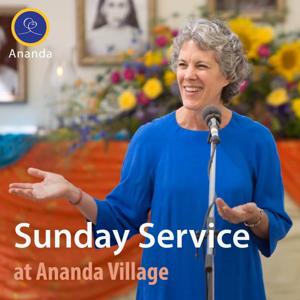
Watch this inspiring Sunday Service with Sundara Traymar recorded at Ananda Village on May 24th 2026.
Sundara shares that he had to grow into the word "worship" which felt too formal and mechanical growing up. He offers a broader definition drawn from Yogananda: worship is where our attention, devotion, and energy flow — so the real question is "what are we worshiping?" True idolatry, per Kriyananda, is honoring anything man-made over what God made, while enshrining an image of Christ or Krishna to recall divine qualities is not. He notes that worship naturally progresses from outward and ritualistic toward inward, calm, wordless yearning met in silence and meditation.
The heart of his inspiring talk is his mother Joan, who grew up poor among ten children yet planted "seeds of God's presence" throughout her life and prayed for people rather than criticizing them. Just diagnosed that week with a terminal illness, she calmly declined treatment and so moved her doctor that he told her he loved her — showing that God's grace needs only a small crack to enter, even in someone who wasn't a formal meditator. Sundara closes by reading her beautiful vision of Mary and the child Jesus.
The reading for this week from Swami Kriyananda's book Rays of the One Light is
The Best Way to Worship
Truth is one and eternal. Realize oneness with it in your deathless Self, within.
The following commentary is based on the teachings of Paramhansa Yogananda.
In Chapter 4 of the Gospel of St. John, the woman of Samaria asks Jesus, Where is the best place to worship? This question might be expanded to include: What is the best church? What is the best religion? Is it important to go on pilgrimage to holy shrines? What is the best ritual? What is the best mantra or prayer?
Jesus cut across all such questioning with his reply:
The hour cometh, and now is, when the true worshippers shall worship the Father in spirit and in truth: for the Father seeketh such to worship Him.
God is a Spirit: and they that worship him must worship him in spirit and in truth.
It was not that outer considerations of place, church, ritual, etc., are irrelevant. Each person should find those practices and observances which are compatible with his own nature – one might say, with his own vibrations. Not everyone’s natural path is the same. God sent different religions into the world to satisfy different human needs.
The overarching concern, however, considering that the goal is to find God, is to include in one’s worship daily, inner communion with the Lord. God is Silence: He must be sought, therefore, in inner silence. God is Absolute Love: He must be sought, therefore, in the silence of love. God is Spirit, and thus immaterial: He must be sought, above all, in the expanding peace of deep meditation.
Thus, the Bhagavad Gita states in the sixth Chapter:
Sequestered should he sit,
Steadfastly meditating, solitary,
His thoughts controlled, his passions laid away,
From every craving for possession freed.
Wherever you are, whatever your outward beliefs and observances, seek God in the silence of your own soul.
Thus, through holy Scripture, God has spoken to mankind.