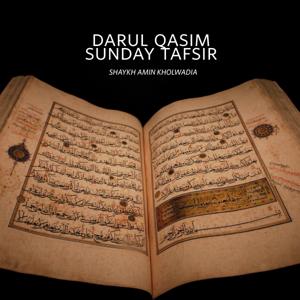
Sunday Tafsīr with Shaykh Amin Kholwadia

Sunday Tafsīr with Shaykh Amin Kholwadia

By Darul Qasim CollegeReligion & SpiritualityIslam
Download on the App Store

Sunday Tafsīr with Shaykh Amin Kholwadia episodes

  • Surah Al-Ankabut - Session 9
    Surah Al-Ankabut (29:48-51). The Quran informs us that one component of the seerah that is often-overlooked is that the prophet (S) never read, and never wrote. Yet he went on to produce a civilization that read and wrote. The prophet (S) is the mu'jizah manifesting Allah's ability to create something from nothing. In this lecture: rationale for the unlettered prophet; the subtle irony in being the people of the book; wahy as the basis for prophethood; 'ulama as inheritors of the prophets; the piety of an 'aalim lies in his learning and his dispensation of knowledge; reading precedes understanding. The need of the hour is for Muslims to distinguish between the hukm and the hikmah.
    53 min
  • Surah Al-Ankabut - Session 8
    Surah Al-Ankabut (29:46-47) It is part of our belief to prepare ourselves to partake in discussions of theism with members of other faiths. In this lecture: maintaining a level of readiness for religious interchange; the prophetic model for such preparedness, the training behind the success; the need for an academic response to whatever the challenge of the hour is; an exemplar of verse 46; the acceptance and affirmation of all wahy as a Muslim civilizational value.
    43 min
  • Surah Al-Ankabut - Session 7
    Surah Al-Ankabut (29:44-45). This session has tremendous insights into prayer (salaat) as the ultimate vehicle that will carry the believer to unimaginable heights. In the list lecture: the order of ibaadah, and its comparability to the natural order in all creation, wahy as a foundation of salaat, aligning salaat with individual najaat, salaat as proof of submission, the body and spirit of salaat.
    53 min
  • Surah Al-Ankabut - Session 6
    Surah Al-Ankabut (29:38-43). These verses call out the eight categories of men condemned for their rejection of the messenger sent to them. In this lecture: the effects of oppression; the obscure yet real injustice committed in denying Allah (S) and the imbalance it creates in the cosmos; the similitude between those who take other than Allah and the house of the spider, an intricate construction with a strong source yet weak manifestation; insights into the Islamic theory of economics being rooted in the fiqh of it. The breath of nubuwwah demolishes the intricate plans of those who reject it, no matter how strong its foundation may be.
    45 min
  • Surah Al-Ankabut - Session 5
    Surah Al-Ankabut (29:26-37). The tests of the prophets are varied, but all difficult and severe. In this lecture: the blessed offspring of Ibrahim (AS), the tribulations of Lut (AS), the mission of Lut (AS), what is legal is not necessarily moral, the mission of Shu'ayb (AS). Lut (AS) was sent to address an aberration in the understanding of human nature. Shu'ayb (AS) was sent to address an aberration in the understanding of the nature of wealth. Their mission is compared and contrasted with that of Ibrahim (AS) and Nuh (AS) who were sent to address an aberration in the understanding of the nature of the Divine.
    56 min
  • Surah Al-Ankabut - Session 4
    Surah Al-Ankabut (29:16-25). Truth evades those who submerge themselves in the pursuit of worldly pleasures. In this lecture: worshipping Allah (S) as a means of thanking Him, the pervasive phenomena of death and resurrection, the supreme intellect of prophets ('alayhimusSalaam), the inevitable meeting with Allah (S), the violent reaction of an intellectually defeated people, adopting a worldview of tauheed, Ibrahim (AS), as a shining example of one who was born into a community steeped in polytheism yet making the conscious choice of ascertaining and believing in Allah's Oneness. Allah (S) does not need to punish, but He has the prerogative to do so. It is from the Absolute and Sovereign essence of what makes God worthy of worshipping, unfettered by the limitations of human imagination and the impositions of finite thought.

    55 min
  • Surah Al-Ankabut - Session 3
    Surah Al-Ankabut (29:11-15). Allah (S) wants believers to expose their belief and the manifest the Islamic code of conduct. In this lecture: the two levels of hypocrisy, the tafsir and wisdom behind the age of Nuh ('alayhisSalaam) and the vast knowledge he accumulated during his lifetime, the mu'jizah of Quranic brevity, the magnitude and quality of Nuh's ('alayhisSalaam) knowledge of Zoology, the ark as a marvel of engineering, individual accountability, and the role of society as an aid to life and living. Moral decadence is the flood of our times.
    45 min
  • Surah Al-Ankabut - Session 2
    Surah Al-Ankabut (29:7-10). There is no obedience to creation in disobedience to the Creator. In this session, beauty and grace in dealing with parents, drawing the line between obedience and non-conformance, conclusive knowledge as critical to avoiding confusion in matters of religious and social obligation, recognizing our role in the distortion of social practices, a corollary example in the need to take a collective stance on facilitating marriage, the appropriate sense of al-saliheen, the fallacy of freedom in light of the violation of Divine rights. It is for Muslim society to create an ambience wherein Muslims can be Muslim.
    54 min
  • Surah Al-Ankabut - Session 1
    Surah Al-Ankabut, verses 1 through 6. This surah was revealed at a time when Muslims (barely one hundred in number) were being persecuted for their beliefs. In this session: Surah Al-Qasas as a preface to this chapter, and Al-Qasas as a prelude to the hijrah; the need for faith despite trials; the fallacy that faith removes all trials, and that worldly success is a sign of God's pleasure with you; tribulation as preparation for what is to come; the understanding of mujahadah as a prerequisite to the understanding of jihaad; the sahabah as role models for the ansaar. Historically, no nation has thrived that has not engaged in mujahadah.
    51 min
  • Surah Al-Qasas - Session 14
    Surah Al-Qasas, verses 86 through 88. Conclusion and conclusory comments. Wahy is delivered to a nabi with no effort on the part of the recipient towards such Divine attraction. Wahy is from the grace and predestination of Allah (S), it is all about rahmah and has nothing to do in essence with social and moral standing or otherwise. In this lecture: a prophet's supremacy over human beings is by virtue of the intellectual abilities given to him by Allah (S); only a prophet can plan for eternity; the minor signs of Allah's creativity, rahmah and compassion that are accessible to all human beings, and the greater signs that are revealed only to His anbiyaa (such as the mi'raaj); the similarities between Musa (AS) and Muhammad (S), and Al-Qasas as a vehicle of Divine kalaam that bridges one story with the other; the universal code of Tauheed and the path to Allah; the preservation of man and his good deeds in Jannah; the deficiencies of poetry in contrast with the perfection in Kalaam-ul-Allah. The moral of The Story is "Lahu al-Hukmu" - that all authority belongs to Allah.
    50 min

About Sunday Tafsīr with Shaykh Amin Kholwadia

From the publisher's feed

The Sunday Tafsīr is a weekly tafsīr session with Darul Qasim College Director, Shaykh Mohammed Amin Kholwadia. This course is open for all to join at Darul Qasim College campus every Sunday at 11 AM Central Time. Course is also live streamed on YouTube.