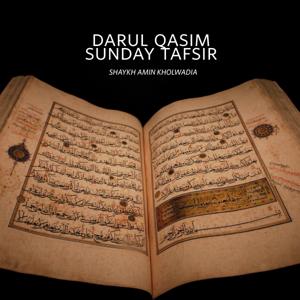
Sunday Tafsīr with Shaykh Amin Kholwadia

Sunday Tafsīr with Shaykh Amin Kholwadia

By Darul Qasim CollegeReligion & SpiritualityIslam
Download on the App Store

Sunday Tafsīr with Shaykh Amin Kholwadia episodes

  • Surah Al-Qasas - Session 13
    Surah Al-Qasas, verses 83 through 86. These verses sum up everything Muslims need to understand about political authority. Authority comes from Allah (S) and cannot be assumed by force. In this lecture: the fallacy of Islamic rule being essential to Islamic practice; the accessibility to taqwa with or without Islamic rule; the incomparable vastness of Jannah contrasted with this limited world; fanaticism and fundamentalism as consequences of attempting to render divine justice on earth; the indispensable message in Al-Qasas for those who strive to make sense of the grave crisis Muslims face today; the mission of the prophet (S) was guided by wahy, not human emotion; the authority of the prophet (S) over Makkah was purely for the fulfillment of the five pillars, political dominion was just a side effect. If you seek supremacy on earth, Allah (S) will deprive you of any authority in Jannah.
    57 min
  • Surah Al-Qasas - Session 12
    Surah Al-Qasas, verses 78 through 82. This session contrasts the example of Qaroun as a hoarder of wealth with that of Musa as a custodian of knowledge. In this lecture: Qaroun's false claim to knowledge as the source of his good fortune; the staggering amount of Qaroun's wealth is little compared with those who perished before him; limited wealth and lasting knowledge; wealth as a means for knowledge; the impact of a nabi upon the mindset of a disenfranchised people; the short-sighted beliefs of the disbeliever; the distribution of wealth as a Divine prerogative. Our wealth does not make us, rather we make our wealth. If we are good, then our wealth will be good. If we are consumed by our pursuits, then we will be drowned in them (much as Qaroun was swallowed up). We must strive to be free men and women, worshiping Allah free from the weight of our worldly pursuits.
    44 min
  • Surah Al-Qasas - Session 11
    Surah Al-Qasas, verses 71 through 80. Allah (S) is the Lord and Guardian of all who are subordinate to Him as well as those who are insubordinate to Him. In this lecture: Divine mercy in the alternation of day and night; using sensory perception to exercise shukr as the basis for loving Allah (S); the result of shukr and the result of arrogance; the wealth bestowed on Qaroon and his arrogance on account of it; the implicit command to speak out against social vices; the authority of prophets over their people; nobility in speech as the way of Allah (S) and the way he recommended to his prophets. If you have authority, then make sure you don't let your authority bring you disgrace.
    44 min
  • Surah Al-Qasas - Session 10
    Surah Al-Qasas (28:62-70). Human prerogatives are very limited while Allah's prerogatives are supreme. In this lecture: Allah's (S) ruboobiyyah extends to all creation, even the rebellious; Fir'aun was granted ample opportunity for repentance; human will, although free, is limited by what Allah (S) has ordained, this is embodied in the word Rabb; Allah (S) has a personal affiliation with every individual in the capacity of being one's Rabb; Allah (S) alleviates the intense sense of loss felt by the prophet (S) at Abu Talib's demise through the verses of this surah that present the many tribulations of Musa (A); the prophet's (S) love for Allah (S) increased in times of tribulation. True worship is independent of what the worshipped does, therein lies tauheed whereby the sources of good and bad are one and the same. Fluctuating in our love for Allah (S) subject to our times of ease and difficulty is a sign of shirk, i.e. perceiving separation in the source of all things.
    53 min
  • Surah Al-Qasas - Session 9
    28:57-61. It is only through the institution of prophethood that mankind still exists on this planet. In this lecture: Allah (S) being in total control of provisions for all creatures; the Kaaba as a source of security and economic prosperity for the Quraysh; the consequences of igniting the fire of shirk and rebellion against Allah's authority; Divine rules that govern the destruction of a people; faith and good deeds as the currency of the Hereafter; remembrance in the dunya yields fruits in Paradise. Allah's Rahmah overrides the angelic assessment of mankind's ineligibility for mercy.
    45 min
  • Surah Al-Qasas - Session 8
    28:51-56. Shaykh Amin discusses several practical ramifications of these verses applicable in our times of free speech and expression. In this lecture: the mindset of a believer, submitting to the ruboobiyyah of Allah (S); acknowledging you have a Rabb is a prerequisite to believing; rejection by the world not reason enough to reject the truth; the twofold reward of sincere believers: firstly for their belief, and secondly, for their resilient persistence in it; repelling evil with good from a position of strength; refrain from vain discourse as an attribute of steadfast believers; example in Musa (A) engaging Fir'awn in debate from a position of strength. The passion of the believer is to honor the prophet (S), follow his example, and hold true to the believer's code of conduct. The greatest insult one can levy against the prophet (S) is to deny he is the last Messenger.
    58 min
  • Surah Al-Qasas - Session 7
    28:43-49. Allah's Rahmah is ubiquitous, but it takes a discerning eye to recognize instances of it. In this lecture: the story of Musa (AS) as a backdrop to the mission of Muhammad (S); guidance as a consequence of correct observation; story-telling as an effective tool of the oral tradition; time-shift into the story of Shu'aib (AS), contrasting the economically-challenged Madyan that Musa encountered with its past glory; the daunting mission of Musa (AS) as a source of comfort for the last Messenger. Prophets are highly intellectual human beings and their intelligence was further enhanced by prophethood.
    46 min
  • Surah Al-Qasas - Session 6
    28:36-42. The signs of Musa (AS) are mu'jizaat that truly disarm his opponents as they reflect the very nature of the message he bore for Fir’awn. In this lecture: the limited authority of Fir'awn contrasted with the unlimited authority of Allah (S); Nubuwwah further elevates the supreme intellect of a Nabi; Fir'awn's rationale behind the tower, and the relevance of Haman; the Divine order in creation, and the consequences of disturbing it; the fate of those who lead astray and the dangers of seeking leadership for the dunya; insights into Islamic Political Science, and the need to include the Hereafter in such discourse. The prophet (S) said: The best form of jihaad is to speak the truth in the face of a tyrant.
    46 min
  • Surah Al-Qasas - Session 5
    28:29-35. After fulfilling his appointed term, Musa (AS) travels with his ahl (his wife) towards Egypt when he perceives a fire in the distance. Shaykh Amin dwells on the reference to the “right side” and Musa’s (AS) etiquette in his approach to the fire, among other things.Part of the symbolism in throwing down his staff lay in discarding any object or idea that Musa (AS) deemed a source of protection for himself. There is no other protector when in the presence of Allah (S). The reaction of Musa (AS) at the sight of the serpent is in line with the adab of being human. When a danger is perceived, then precautions must be taken, which is evident from Musa’s (AS) immediate attempt to flee from the reach of the serpent. A dub made without due preparation is futile. But when the command is explicit, the nabi obeys without fear or reservation, as manifested in Musa’s (AS) behavior when Allah (S) commands him to grab hold of the serpent, as described in a different ayah.

    45 min
  • Surah Al-Qasas - Session 4
    28:22-28. Shaykh Amin paints a mental state of Musa's (AS) mental state soon after his flight from Egypt. It is not possible for a Nabi to be pessimistic, and Musa (AS) puts his trust in Allah (S), acknowledging his own strengths and abilities even as he makes his way towards Madyan. His conversation with the two young ladies by the well stems from genuine concern, not from idle curiosity. Musa (AS) reflects the adab characteristic of a Nabi in that after he assists people, he turns aside from them and seeks help from Allah (S) instead. Prophets also separate Allah's fadl from their actions. They do not ascribe any good to themselves, rather they attribute all good to Allah (S) alone.
    49 min

About Sunday Tafsīr with Shaykh Amin Kholwadia

From the publisher's feed

The Sunday Tafsīr is a weekly tafsīr session with Darul Qasim College Director, Shaykh Mohammed Amin Kholwadia. This course is open for all to join at Darul Qasim College campus every Sunday at 11 AM Central Time. Course is also live streamed on YouTube.