
Sign up to save your podcasts
Or

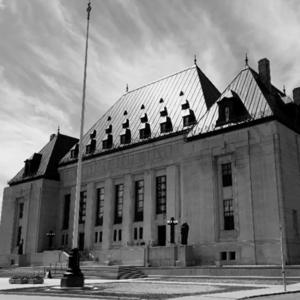


The appellants, the Attorney General of Quebec and His Majesty the King, obtained leave to appeal to the Supreme Court from the declaration of unconstitutionality made by the Quebec Court of Appeal pursuant to s. 52(1) of the Constitution Act, 1982 with respect to the mandatory minimum sentences of 12 months’ imprisonment provided for in s. 163.1(4)(a) and (4.1)(a) of the Criminal Code. According to the majority of the Court of Appeal, these provisions violate s. 12 of the Canadian Charter, namely, the guarantee provided against cruel and unusual punishment, and cannot be justified in a free and democratic society under s. 1 of the Canadian Charter. That declaration of unconstitutionality resulted from appeals filed notably in respect of two decisions rendered by the Court of Québec regarding the sentences to be imposed on the respondents, Mr. Naud and Mr. Senneville. Mr. Naud was convicted of two counts relating to possession and distribution of child pornography. Sentences of 9 months’ imprisonment for possession and 11 months’ imprisonment for distribution pursuant to s. 163.1(4)(a) and (3) of the Criminal Code were imposed on him, along with various consequential orders. Mr. Senneville was convicted of two counts relating to possessing and accessing child pornography. Sentences of 90 days’ imprisonment to be served intermittently for possession and 90 days’ imprisonment to be served intermittently for accessing child pornography pursuant to s. 163.1(4)(a) and (4.1)(a) of the Criminal Code were imposed on him, also along with various consequential orders.
Argued Date
2025-01-20
Keywords
Charter of Rights — Cruel and unusual treatment or punishment — One-year minimum sentences — Child pornography — Counts relating to possessing and accessing child pornography — Whether s. 163.1(4)(a) of Criminal Code, R.S.C. 1985, c. C-46, violates s. 12 of Canadian Charter of Rights and Freedoms — If it does, whether it is reasonable limit prescribed by law that can be demonstrably justified in free and democratic society under s. 1 of Canadian Charter of Rights and Freedoms — Whether s. 163.1(4.1)(a) of Criminal Code, R.S.C. 1985, c. C-46, violates s. 12 of Canadian Charter of Rights and Freedoms — If it does, whether it is reasonable limit prescribed by law that can be demonstrably justified in free and democratic society under s. 1 of Canadian Charter of Rights and Freedoms — Canadian Charter of Rights and Freedoms, ss. 12 and 1 — Criminal Code, R.S.C. 1985, c. C-46, s. 163.1(4)(a) and (4.1)(a).
Notes
(Quebec) (Criminal) (By Leave)
Language
Floor Audio
Disclaimers
This podcast is created as a public service to promote public access and awareness of the workings of Canada's highest court. It is not affiliated with or endorsed by the Court. The original version of this hearing may be found on the Supreme Court of Canada's website. The above case summary was prepared by the Office of the Registrar of the Supreme Court of Canada (Law Branch).
(PUBLICATION BAN IN CASE)
Following their trial, the appellants, Mikhail Kloubakov and Hicham Moustaine, were convicted of obtaining a material benefit from sexual services (s. 286.2(1) of the Criminal Code) and of procuring, as parties (s. 286.3(1) of the Criminal Code). However, after entering the convictions, the trial judge determined that the provisions in question were overbroad and that they deprived certain sex workers of the right to security without being in accordance with the principles of fundamental justice, thereby infringing s. 7 of the Canadian Charter of Rights and Freedoms. She held that the infringements were not justified under s. 1 of the Charter, and she accordingly declared ss. 286.2(1), (4) and (5) and 286.3(1) unconstitutional and suspended the declaration of invalidity for 30 days. She entered a stay of proceedings as a remedy. The Alberta Court of Appeal allowed the appeal, set aside the declarations of invalidity concerning ss. 286.2 and 286.3 and the stay of proceedings, and entered convictions against Mr. Kloubakov and Mr. Moustaine. It referred the matter back to the Court of King’s Bench for sentencing. In its view, the impugned provisions did not infringe s. 7, and a s. 1 analysis was therefore unnecessary.
Argued Date
2024-11-12
Keywords
Constitutional law — Charter of Rights — Right to security of person — Criminal law — Commodification of sexual activities — Accused challenging constitutionality of Criminal Code provisions concerning offence of obtaining material benefit from sexual services and offence of procuring — Whether Court of Appeal erred in determining purpose of legislation and of relevant provisions — Whether Court of Appeal erred in finding that provisions were not overbroad in relation to their purpose, contrary to s. 7 of Canadian Charter of Rights and Freedoms — Whether it is possible to displace presumption that purposes articulated by Parliament are valid — If it is possible, whether presumption is displaced in this case — Whether ss. 286.2(1), (4) and (5) and 286.3(1) of Criminal Code infringe rights guaranteed in s. 7 of Canadian Charter of Rights and Freedoms — If so, whether these infringements can be justified under s. 1 of Canadian Charter of Rights and Freedoms — If infringements are not justified under s. 1, what remedies are most appropriate in this case — Canadian Charter of Rights and Freedoms, ss. 1, 7 — Criminal Code, R.S.C. 1985, c. C-46, ss. 286.2, 286.3.
Notes
(Alberta) (Criminal) (As of Right) (Publication ban in case) (Sealing order) (Certain information not available to the public)
Language
Floor Audio
Disclaimers
This podcast is created as a public service to promote public access and awareness of the workings of Canada's highest court. It is not affiliated with or endorsed by the Court. The original version of this hearing may be found on the Supreme Court of Canada's website. The above case summary was prepared by the Office of the Registrar of the Supreme Court of Canada (Law Branch).
The appellants are owners of a residential property in the City of Toronto. They sought an order for adverse possession of a parcel of City parkland that their predecessors in title had fenced off with a chain link fence and enclosed into their backyard. The City acknowledged that the appellants’ evidence satisfied the traditional test for adverse possession. The issue was whether the disputed land was nevertheless immune to a claim for adverse possession by virtue of being City land. The application judge found that a private landowner could not acquire title by encroaching on public land and fencing off portions for their private use. This decision was upheld on appeal.
Argued Date
2025-01-16
Keywords
Courts — Jurisdiction — Property — Real property — Adverse possession — Home owner fencing off part of municipal parkland for their own use and subsequent owners seeking to acquire that land by way of a claim for adverse possession — Does the statutory scheme or existing case law support the Court of Appeal’s decision to exempt municipal parkland from the real property limitations legislation? — Did the Court of Appeal have the jurisdiction to use the common law to provide that municipal parkland is exempt or immune from the real property limitations legislation? — If so, was it appropriate for the Court of Appeal to amend the law of adverse possession to find that municipal parkland is exempt or immune from claims of adverse possession? — Real Property Limitations Act, R.S.O. 1990, c. L.15, ss. 4, 15, 16.
Notes
(Ontario) (Civil) (By Leave)
Language
Floor Audio
Disclaimers
This podcast is created as a public service to promote public access and awareness of the workings of Canada's highest court. It is not affiliated with or endorsed by the Court. The original version of this hearing may be found on the Supreme Court of Canada's website. The above case summary was prepared by the Office of the Registrar of the Supreme Court of Canada (Law Branch).
The respondent, Dov Markowich, is a shareholder of the appellant, Lundin Mining Corporation (“Lundin”). He sought leave under s. 138.8 of Ontario’s Securities Act, to bring a statutory cause of action against Lundin and its officers and directors for Lundin’s alleged failure to make timely disclosure of pit wall instability and a subsequent rockslide at a mine in Chile (“events”). He also sought to certify the action as a class action under s. 5 of the Class Proceedings Act, 1992, S.O. 1992, c. 6, advancing claims on behalf of certain shareholders of Lundin.
Lundin did not publicly disclose the events at the time they occurred on October 25 and October 31, 2017, respectively. It advised investors about them approximately a month later, on November 29, in its regularly scheduled update. The next day, the price of Lundin’s securities fell 16 per cent on the TSX.
The issue at the heart of the appeal involves the competing interpretations of whether there is a reasonable possibility that Mr. Markowich’s action will be resolved in his favour at trial based on his claim that Lundin’s lack of disclosure was contrary to its obligations to disclose forthwith a “material change” in its “business, operations or capital”.
Argued Date
2025-01-15
Keywords
Securities — Civil procedure — Commencement of proceedings — Statutory cause of action for failure to make timely disclosure — Leave to proceed — Mining company disclosing occurrence of pit wall instability and subsequent rockslide in periodic disclosure rather than at time of occurrence — Shareholder seeking to institute class action for company’s failure to make timely disclosure — Commencement of action requiring leave of the court based on whether there is reasonable possibility that the action will be resolved in favour of the plaintiff at trial — Motion judge dismissing motion for leave — Court of Appeal allowing appeal and granting motion for leave — What is a “material change” for the purpose of Canadian securities law? — Should the leave requirement modify or lessen the burden to show a “material change”? — Securities Act, R.S.O. 1990, c. S.5, ss. 138.3(4) and 138.8.
Notes
(Ontario) (Civil) (By Leave)
Language
Floor Audio
Disclaimers
This podcast is created as a public service to promote public access and awareness of the workings of Canada's highest court. It is not affiliated with or endorsed by the Court. The original version of this hearing may be found on the Supreme Court of Canada's website. The above case summary was prepared by the Office of the Registrar of the Supreme Court of Canada (Law Branch).
Section 4.1(2) of the Controlled Drugs and Substances Act, S.C. 1996, c. 19, provides that no person who seeks emergency medical or law enforcement assistance because that person, or another person, is suffering from a medical emergency is to be charged or convicted of the offence of simple possession of a controlled substance if the evidence in support of that offence was obtained or discovered as a result of that person having sought assistance or having remained at the scene of the medical emergency. Mr. Wilson was with three other people when one overdosed on fentanyl and one of them called 911. Police responding to the 911 call arrested Mr. Wilson for simple possession of a controlled substance at the scene of the overdose. Police conducted a search of the group’s truck and, in a green backpack, discovered modified handguns, parts for firearms, ammunition and identification papers. Later at a police station, Mr. Wilson admitted he was the owner of the green backpack, the guns and the ammunition. He admitted that the identification papers did not belong to him. Mr. Wilson was charged with possession of identity documents, fraudulent impersonation and a number of firearms offences. He was not charged with possession of a controlled substance. The trial judge dismissed an application for a declaration that the evidence should excluded for breaches of ss. 8 and 9 of the Charter of Rights and Freedoms and admitted the evidence. Mr. Wilson was convicted of firearms offences. The Court of Appeal allowed an appeal and entered acquittals on all counts.
Argued Date
2025-01-14
Keywords
Charter of Rights and Freedoms — Search and seizure — Arbitrary detention — Good Samaritan law — Police responding to 911 call reporting an overdose and arresting accused for simple possession of a controlled substance at the scene of the overdose — Police conducting search incident to arrest and discovering evidence of firearms offences and false identity offences — Whether police had authority to arrest accused for simple possession of a controlled substance — Whether arrest and search were unlawful and in violation of Charter of Rights and Freedoms?
Notes
(Saskatchewan) (Criminal) (By Leave)
Language
Floor Audio
Disclaimers
This podcast is created as a public service to promote public access and awareness of the workings of Canada's highest court. It is not affiliated with or endorsed by the Court. The original version of this hearing may be found on the Supreme Court of Canada's website. The above case summary was prepared by the Office of the Registrar of the Supreme Court of Canada (Law Branch).
(PUBLICATION BAN IN CASE)
The appellant, an Indigenous man with significant cognitive difficulties, repeatedly sexually assaulted a worker at the group home where he resided. He remained in custody pending trial, including a period of detention in a psychiatric facility while temporarily unfit to stand trial. After resiling from three agreements to plead guilty, the appellant did so the fourth time. From charge to conviction, nearly four years elapsed.
The sentencing judge imposed a nine-year custodial term. This term was lengthier than the one requested by the appellant, in part because his cognitive difficulties increase the amount of time required for rehabilitative programming. The sentencing judge considered the appellant’s repeated abandonment of agreements to plead guilty to be wrongful conduct and disallowed enhanced pre-sentence custodial credit for part of the appellant’s detention. The sentencing judge also relied on the relatively favourable conditions of detention in the psychiatric facility as a basis to deny enhanced credit.
The Court of Appeal allowed an appeal in part, due to an error in calculating the number of days the appellant spent in custody, but otherwise dismissed the appeal. It found that the length of time required to complete rehabilitative programming was one of multiple factors that the sentencing judge considered, and that she was entitled to do so. Furthermore, there was an evidentiary basis to conclude that the appellant’s repeated abandonment of guilty pleas was wrongful conduct, and that the appellant’s conditions of detention did not warrant enhanced credit for his entire period of pre-sentence custody.
Argued Date
2024-12-03
Keywords
Criminal law — Sentencing — Whether anticipated time to complete rehabilitative programming may be considered when determining length of custodial sentence outside of dangerous offender regime — Whether delay caused by offender is wrongful conduct justifying denial of enhanced custodial credit — Whether offenders detained in mental health facilities prior to sentencing entitled to enhanced credit for those periods
Notes
(Ontario) (Criminal) (By Leave) (Publication ban in case)
Language
Floor Audio
Disclaimers
This podcast is created as a public service to promote public access and awareness of the workings of Canada's highest court. It is not affiliated with or endorsed by the Court. The original version of this hearing may be found on the Supreme Court of Canada's website. The above case summary was prepared by the Office of the Registrar of the Supreme Court of Canada (Law Branch).
(SEALING ORDER) (CERTAIN INFORMATION NOT AVAILABLE TO THE PUBLIC)
The appellant, Tammy Marion Bouvette, was babysitting a 19-month old baby who died while having a bath. An autopsy was conducted by Dr. Evan Matshes. The appellant was charged with second degree murder. The appellant pleaded guilty to criminal negligence causing death. The British Columbia Court of Appeal concluded that a body of relevant information was within the possession of the Crown and/or police and was not disclosed to the appellant’s counsel. Most significantly, the undisclosed evidence pertained to the reliability of the evidence and opinions of Dr. Matshes. The Court of Appeal held that the conviction must be set aside as the product of a miscarriage of justice, as the evidence and circumstances establish a reasonable possibility that the appellant would not have pleaded guilty to criminal negligence causing death had full disclosure been made. The Court of Appeal admitted the fresh evidence, allowed the appeal, vacated the guilty plea, set aside the conviction and entered a stay of proceedings.
Argued Date
2024-11-14
Keywords
Criminal law — Appeals — Powers of the Court of Appeal — Setting aside guilty plea when there has been a miscarriage of justice — Scope of appellate courts’ remedial discretion under s. 686(2) of the Criminal Code, R.S.C. 1985, c. C-46, to enter an acquittal — Did the Court of Appeal err in finding that the entirety of the record as amplified on appeal admits the reasonable possibility of a conviction on a theoretical retrial? — If there remains a reasonable possibility of a conviction on a retrial, does s. 686(2)(a) nevertheless permit a court of appeal to enter an acquittal and, if so, in what circumstances?
Notes
(British Columbia) (Criminal) (By Leave) (Sealing order) (Certain information not available to the public)
Language
Floor Audio
Disclaimers
This podcast is created as a public service to promote public access and awareness of the workings of Canada's highest court. It is not affiliated with or endorsed by the Court. The original version of this hearing may be found on the Supreme Court of Canada's website. The above case summary was prepared by the Office of the Registrar of the Supreme Court of Canada (Law Branch).
The appellant, Opsis Airport Services Inc., is a federal company that operates the emergency call dispatch centre at Pierre Elliot Trudeau International Airport. The respondent the Director of Criminal and Penal Prosecutions charged Opsis with operating an enterprise that carried on private security activities without holding an agency licence of the appropriate class, contrary to ss. 4 and 114 of the Private Security Act, CQLR, c. S-3.5 (“PSA”). Opsis admitted that, without holding an agency licence, it was carrying on activities related to electronic security systems, which are normally subject to the PSA. However, it challenged the PSA’s constitutional applicability.
The Court of Québec held that the PSA applied to Opsis and therefore accepted the guilty pleas, convicted Opsis of the offences as charged and imposed fines on it. The court found that the PSA did not intrude on the core of a federal head of power because the PSA had no impact or only a very small impact on Opsis’s operations. The Superior Court allowed Opsis’s appeal, declared the PSA inapplicable to Opsis’s activities related to the operation of the emergency call centre pursuant to the doctrine of interjurisdictional immunity, quashed the convictions and acquitted Opsis of the offences charged. The judge held that the PSA intruded on the core of the federal aeronautics power, which included airport security, and that the intrusion constituted an impairment of the core of the federal power. A majority of the Court of Appeal allowed the appeal, set aside the Superior Court’s judgment and affirmed the convictions entered by the Court of Québec. Although Opsis’s activities fell within the core of Parliament’s aeronautics power, the application of the PSA did not cause any actual impairment. A purely speculative or hypothetical impairment did not suffice. Ruel J.A., dissenting, would have dismissed the appeal and affirmed the Superior Court’s judgment. He was of the view that if the PSA were applicable to Opsis’s operations, the provisions would impair the core of federal jurisdiction over aeronautics safety and security.
Argued Date
2024-12-11
Keywords
Constitutional law — Interjurisdictional immunity — Impairment — Evidence — Federal paramountcy — Conflict of purposes — Provincial offences — Licences — Application of provincial statute to airport security activities — Whether Private Security Act must be declared constitutionally inapplicable to appellant pursuant to doctrine of interjurisdictional immunity on ground that it impairs Parliament’s exclusive jurisdiction over aeronautics — Whether Private Security Act must be declared constitutionally inoperative in relation to appellant pursuant to doctrine of federal paramountcy on ground that there is conflict of purposes between it and federal legislative scheme relating to aeronautics — Whether Private Security Act and associated regulations apply to appellant’s airport security activities, which are essentially public and governmental in nature — Private Security Act, CQLR, c. S-3.5.
Notes
(Quebec) (Criminal) (By Leave)
Language
Floor Audio
Disclaimers
This podcast is created as a public service to promote public access and awareness of the workings of Canada's highest court. It is not affiliated with or endorsed by the Court. The original version of this hearing may be found on the Supreme Court of Canada's website. The above case summary was prepared by the Office of the Registrar of the Supreme Court of Canada (Law Branch).
(PUBLICATION BAN IN CASE)
Mr. Kinamore, when he was 22-years old, and the complainant, when she was 16-years old, met at a motorcycle shop and they exchanged messages for a few months. They met for dinner and a movie at Mr. Kinmore’s apartment. Afterwards, Mr. Kinamore was charged with sexual assault. Both the complainant and Mr. Kinamore testified at trial. The complainant described a sexual assault. Mr. Kinamore described a consensual sexual encounter. Both the Crown and the defence tendered evidence of prior messages between the complainant and Mr. Kinamore. In many text messages, the complainant repeatedly stated that she did not intend to have a sexual relationship with Mr. Kinamore. However, the defence led evidence of communications of a sexual nature and some prior communications entered into evidence by Crown counsel contain content that was sexual in nature or that the defence argued was sexual in nature. No voir dire was held to determine the admissibility of any evidence led by Crown counsel and no application was made pursuant to s. 276 of the Criminal Code, R.S.C. 1985, c. C-46, to determine the admissibility of any evidence led by the defence. Mr. Kinamore was convicted of sexual assault. The Court of Appeal dismissed an appeal.
Argued Date
2024-12-05
Keywords
Criminal law — Evidence — Admissibility — Complainant’s sexual activity — Text messages — Accused charged with sexual assault — Whether prior text messages between accused and complainant were of a sexual nature — If so, whether voir dire was required to determine admissibility of any evidence of prior communications of a sexual nature that was led by Crown counsel — Whether application under s. 276 of Criminal Code was required to determine admissibility of any evidence of prior communications of a sexual nature that was led by defence counsel — Whether complainant’s prior text messages were relevant to whether she consented to sexual activity?
Notes
(British Columbia) (Criminal) (By Leave) (Publication ban in case)
Language
Floor Audio
Disclaimers
This podcast is created as a public service to promote public access and awareness of the workings of Canada's highest court. It is not affiliated with or endorsed by the Court. The original version of this hearing may be found on the Supreme Court of Canada's website. The above case summary was prepared by the Office of the Registrar of the Supreme Court of Canada (Law Branch).
The parties were married in June 2015. They lived in Japan until 2016 when they moved to the United Arab Emirates. They separated for a period in 2017, but reconciled in 2018 and then lived together in Oman until March 2020 when they travelled to Ontario for a number of reasons, including to visit Mr. Dunmore’s parents. They had planned to return to Oman in early April 2020 however, the pandemic precluded them from doing so and they stayed with Mr. Dunmore’s parents in Ontario until January 2021. In the meantime, Ms. Mehralian became pregnant and their son M was born in Ontario in December 2020. The parties and M returned to Oman in January 2021 but came back to Ontario in April 2021. The parties then separated in May 2021. Mr. Dunmore moved to the United Arab Emirates and later Oman, while Ms. Mehralian remained in Ontario with M.
Ms. Mehralian commenced proceedings in Ontario in June 2021, seeking a divorce, corollary relief and equalization of property. At the same time, Mr. Dunmore commenced a court proceeding in Oman seeking a divorce and joint custody. Ms. Mehralian contested the jurisdiction of the Omani courts, but in March 2022, the Omani Court of Appeal found that Oman had jurisdiction. In subsequent litigation in which both parties participated, an Omani lower court as well as the Omani Court of Appeal found that the parties had been validly divorced in accordance with Omani law and awarded primary custody of M to Ms. Mehralian.
Mr. Dunmore brought a motion in the Ontario Superior Court seeking an order recognizing the validity of the Omani divorce in Ontario and an order returning M to Oman. The two issues were heard separately by two different judges. One judge found that the Omani divorce should be recognized in Ontario. The second judge found that M should not be ordered returned to Oman. Ms. Mehralian appealed the first order and Mr. Dunmore appealed the second. Both appeals were dismissed.
Argued Date
2024-12-09
Keywords
Family law — Custody — Habitual residence — How should Canadian courts determine the habitual residence of children allegedly abducted from or withheld from a non-Hague Convention signatory state — How should courts balance the countervailing policy objectives outlined in s. 19 of Ontario’s Children’s Law Reform Act — Whether the statutory definition of habitual residence should apply to cases involving non-Hague Convention signatory countries or should the reformulated hybrid test for habitual residence set out in Office of the Children’s Lawyer v. Balev apply — If the statutory definition applies, whether shared parental intention should be the focus of the analysis — Whether the lower courts erred in finding that Ontario has jurisdiction — Whether the lower courts erred in law in exercising jurisdiction over the child in the face of the respondent’s attornment to the jurisdiction of the Omani courts — Children’s Law Reform Act, R.S.O. 1990, c. C.12.
Notes
(Ontario) (Civil) (By Leave)
Language
Floor Audio
Disclaimers
This podcast is created as a public service to promote public access and awareness of the workings of Canada's highest court. It is not affiliated with or endorsed by the Court. The original version of this hearing may be found on the Supreme Court of Canada's website. The above case summary was prepared by the Office of the Registrar of the Supreme Court of Canada (Law Branch).
From the publisher's feed
0 Listeners