
Sign up to save your podcasts
Or

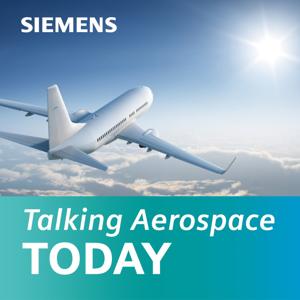


As the aerospace and defense industry seeks to increase its production volumes, new tools and technologies will be needed. If manufacturers want to build complex, modular aircraft at the numbers they want, factories will need to be updated to be more adaptive and automated. Smart manufacturing technology can be crucial to achieving these goals.
In the latest episode of Talking Aerospace Today, Todd Tuthill, Vice President of Aerospace, Defense, and Marine for Siemens Digital Industries Software, continues the introduction to the digital transformation of A&D manufacturing from the previous episode. Here, he discusses what smart manufacturing is, the role automation plays, the impact on the workforce, and more.
In this episode, you will learn:
Manufacturing for the aerospace and defense industry is undergoing a process of transformation. As companies seek to drive down costs and get products to market faster, they are also looking increase their production volumes, especially for particular aircraft such as drones. To enable factories and manufacturing processes to meet these demands, smart manufacturing is becoming an invaluable tool.
In this new series of episodes, Todd Tuthill, Vice President of Aerospace, Defense, and Marine for Siemens Digital Industries Software, will explore the rise of higher-volume production in A&D and how smart manufacturing can help companies reach their goals. This introduction delves into the root causes behind A&D’s manufacturing transformation and the key challenges hindering the journey to higher-volume production.
In this episode, you will learn:
Batteries are being presented as the power source for many designs of advanced air mobility vehicles being developed, and improving the effectiveness of those batteries is key to increasing AAM range. Yet batteries have their own design complexities that only add more to the complexity of AAM vehicles. Navigating them quick enough to bring AAM to market will require digital transformation.
In this episode, Todd Tuthill, Vice President of A&D for Siemens Digital Industries Software, is joined again by Puneet Sinha, Global Head of the Battery Industry for Siemens Digital Industries Software. In addition to exploring more unique design considerations for improving AAM safety, they dive deep into how digital transformation and tools like the digital twin are key to creating safe, optimized, long-ranged AAM vehicles.
In this episode, you will learn:
Connect with Todd Tuthill:
Connect with Puneet Sinha:
Connect with Patty Russo:
Resources:
Many companies in the advanced air mobility sector plan to power their aircraft with batteries. These future aircraft are estimated to have an operational range of 100 miles, enabling rapid transit through cities. Yet there is great potential for AAM to travel beyond and between cities, and to accomplish this as a viable mode of transportation, operational range will likely need to be increased, and that requires innovating the batteries that power AAM.
In this episode of Talking Aerospace Today, Todd Tuthill, Vice President of Aerospace and Defense for Siemens Digital Industries, is joined by Puneet Sinha, Global Head of the Battery Industry for Siemens Digital Industries Software. Together, they highlight the need for longer ranges for AAM and how companies can improve battery technology to enable that.
In this episode, you will learn:
Connect with Todd Tuthill:
Connect with Puneet Sinha:
Connect with Patty Russo:
Resources:
The key infrastructure behind advanced air mobility (AAM), vertiports, must not only efficiently recharge air taxis and similar vehicles that make use of them, but also provide passengers with quick, quality service and be environmentally friendly. There are many design factors to consider in achieving these goals, but digital transformation can help companies find
solutions to them, nonetheless.
In this episode, Todd Tuthill, Vice President of Aerospace and Defense for Siemens Digital Industries Software, and John Nixon, Vice President of Energy, Chemicals, and Infrastructure, conclude their conversation about AAM infrastructure. They discuss additional ways vertiports can be built for sustainability, as well as highlight the digital tools companies can use to make vertiports function at their peak performance.
In this episode, you will learn:
Connect with Todd Tuthill:
Connect with John Nixon:
Connect with Patty Russo:
Resources:
A lot of work needs to be done to build the infrastructure that can support advanced air mobility fleets. Ensuring there are enough vertiports in a city, as well as guaranteeing their reliability and
maintainability, will be key to making AAM a convenient and profitable mode of transportation. What are some ways the developers behind AAM can achieve this?
In this episode, Todd Tuthill, Vice President of Aerospace and Defense for Siemens Digital Industries Software, is joined again by John Nixon, Vice President of Energy, Chemicals, and Infrastructure, to continue their discussion on AAM infrastructure. They dive into different methods of powering vertiports, the ideal places to build vertiports, how the digital twin can optimize AAM serviceability, and more.
In this episode, you will learn:
Connect with Todd Tuthill:
Connect with John Nixon:
Connect with Patty Russo:
Resources:
Advanced air mobility is a new classification of aircraft that offers new ways to transport cargo and passengers across short distances in forms such as air taxis. However, most air taxis are projected to be bigger than most cars and cannot just land on streets or lawns. AAM will require its own infrastructure to provide places to land, recharge, and take off from.
These places will be known as vertiports, but what exactly will they look like?
In this episode, Todd Tuthill, Vice President of A&D for Siemens Digital Industries Software, is joined by John Nixon, Vice President of Energy, Chemicals, and Infrastructure for Siemens Digital Industries Software. Together, they discuss what vertiports are, their interactions with the energy grid, and how sustainability plays a factor.
In this episode, you will learn:
Connect with Todd Tuthill:
Connect with John Nixon:
Connect with Patty Russo:
Resources:
Making advanced air mobility (AAM) vehicles autonomous can transform short-ranged aerial transportation as we know it. Of course, implementing autonomous systems onto such aircraft introduces new challenges to design and operation, on top of the existing mechanical, electrical, thermal, and more considerations. Managing all these decisions will require new methodologies, namely digital transformation.
In this episode, Todd Tuthill, Vice President of Aerospace and Defense for Siemens Digital Industries Software, returns with Nand Kochhar, Vice President of Automotive and Transportation for Siemens Digital Industries Software. They conclude their discussion on autonomous AAM by exploring how digital transformation is the key for creating autonomous vehicles, as well as what can motivate people to use autonomous AAM in their lives.
In this episode, you will learn:
Connect with Todd Tuthill:
Connect with Nand Kochhar:
Connect with Patty Russo:
Resources:
Autonomous advanced air mobility (AAM) vehicles are a goal for multiple companies working in the sector. Some are planning to phase it in after using human pilots for some time, while others are jumping straight in to make AAM vehicles uncrewed from launch. In any case, making aircraft like AAM capable of autonomous flight raises new concerns regarding safety and
regulations, especially if they are expected to transport people.
In this episode, Todd Tuthill, Vice President of Aerospace and Defense for Siemens Digital Industries Software, and Nand Kochhar, Vice President of Automotive and Transportation for Siemens, continue their discussion on what AAM companies can learn from automotive when making AAM autonomous. They focus on cybersecurity, the importance of redundancy for AAM, and how to ensure timely product releases while meeting certification standards.
In this episode, you will learn:
Connect with Todd Tuthill:
Connect with Nand Kochhar:
Connect with Patty Russo:
Resources:
One of the most exciting aspects of advanced air mobility (AAM) is the potential for innovation in air freight, particularly with autonomous, highly efficient aircraft. Innovating in this field comes with technological, regulatory and cultural challenges. However, companies like Natilus are making significant strides, offering valuable insights for the industry and paving the way for advancing technologies such as immersive engineering.
In this episode, Todd Tuthill, Vice President of Aerospace and Defense for Siemens Digital Industries Software is joined by Aleksey Matyushev, Founder and CEO of Natilus, a company transforming the global air freight sector with their unique blended wing body aircraft. Together, with host Patty Russo, they discuss the vision and technological advancements driving success at Natilus and the broader implications for the AAM industry.
In this episode, you will learn:
• The role of Siemens digital transformation technology and immersive engineering capabilities in aircraft design
• Why innovating in air freight is crucial for the aerospace industry
• The key enablers Natilus is adopting to develop this groundbreaking aircraft
Todd Tuthill
Todd Tuthill is the Vice President of Aerospace & Defense for Siemens Digital Industries Software.
Connect with Todd on LinkedIn
Aleksey Matyushev – Speaker
Aleksey Matyushev is the Founder and CEO of Natilus.
Connect with Aleksey on LinkedIn
Patty Russo – Host
Patty Russo is a Global Marketing Manager for Siemens Digital Industries Software.
Connect with Patty on LinkedIn
From the publisher's feed
0 Listeners

0 Listeners

0 Listeners
0 Listeners

0 Listeners

0 Listeners
0 Listeners

0 Listeners

0 Listeners

0 Listeners

0 Listeners

0 Listeners

0 Listeners

0 Listeners

0 Listeners

0 Listeners

0 Listeners

0 Listeners

0 Listeners