
Sign up to save your podcasts
Or


Podcast Packets
Illustrations
Lead Sheets
Play Alongs
Forums
Jazz Piano Skills Community
Keywords
jazz piano, music education, harmony, melody, improvisation, chord voicing, jazz standards, Tangerine, music theory, piano skills
Summary
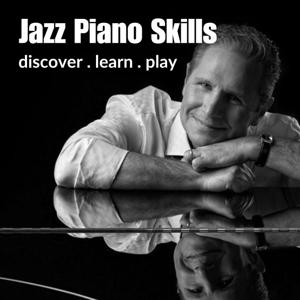
In this episode of Jazz Piano Skills, Dr. Bob Lawrence introduces the essential skills needed for jazz piano, emphasizing a structured approach to learning tunes. The discussion covers the importance of harmony, melody, and improvisation, framed within the seven facts of music. The episode focuses on the classic jazz standard 'Tangerine,' exploring its harmonic analysis, unique chord changes, and voicing techniques. Listeners are encouraged to practice harmonic motion patterns to develop muscle memory and improve their playing. The episode concludes with an invitation to join the Jazz Piano Skills community for further learning and support.
Takeaways
Skill-centric is the key to learning jazz piano.
Tunes illuminate our weaknesses in playing.
Understanding music requires articulating its fundamental concepts.
The seven facts of music provide a framework for learning.
Circle motion is the most common harmonic movement in jazz.
Only two notes move in a circle motion progression.
Tangerine follows an A, B, A, C form structure.
Practice harmonic motion patterns to develop muscle memory.
Hearing tonic is essential for understanding harmonic movement.
Block voicings are effective for supporting melody and improvisation.
Titles
Unlocking Jazz Piano Skills: A Comprehensive Guide
Mastering Harmony, Melody, and Improvisation
Sound bites
"Skill-centric is the key."
"Tunes illuminate our weaknesses."
"Tangerine has an A, B, A, C form."
Support the show
 View all episodes
 By Dr. Bob Lawrence

4.6
2828 ratings
Podcast Packets
Illustrations
Lead Sheets
Play Alongs
Forums
Jazz Piano Skills Community
Keywords
jazz piano, music education, harmony, melody, improvisation, chord voicing, jazz standards, Tangerine, music theory, piano skills
Summary
In this episode of Jazz Piano Skills, Dr. Bob Lawrence introduces the essential skills needed for jazz piano, emphasizing a structured approach to learning tunes. The discussion covers the importance of harmony, melody, and improvisation, framed within the seven facts of music. The episode focuses on the classic jazz standard 'Tangerine,' exploring its harmonic analysis, unique chord changes, and voicing techniques. Listeners are encouraged to practice harmonic motion patterns to develop muscle memory and improve their playing. The episode concludes with an invitation to join the Jazz Piano Skills community for further learning and support.
Takeaways
Skill-centric is the key to learning jazz piano.
Tunes illuminate our weaknesses in playing.
Understanding music requires articulating its fundamental concepts.
The seven facts of music provide a framework for learning.
Circle motion is the most common harmonic movement in jazz.
Only two notes move in a circle motion progression.
Tangerine follows an A, B, A, C form structure.
Practice harmonic motion patterns to develop muscle memory.
Hearing tonic is essential for understanding harmonic movement.
Block voicings are effective for supporting melody and improvisation.
Titles
Unlocking Jazz Piano Skills: A Comprehensive Guide
Mastering Harmony, Melody, and Improvisation
Sound bites
"Skill-centric is the key."
"Tunes illuminate our weaknesses."
"Tangerine has an A, B, A, C form."
Support the show
78,717 Listeners
316 Listeners
151 Listeners

113,515 Listeners
34 Listeners
1,992 Listeners

51,144 Listeners

58,552 Listeners
687 Listeners

9,276 Listeners

2,171 Listeners

6,251 Listeners

32 Listeners