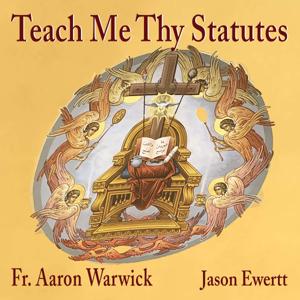
Teach Me Thy Statutes

Teach Me Thy Statutes

Download on the App Store

Teach Me Thy Statutes episodes

  • Listener Q&A: Salvation
    Today we focus on listener questions related to salvation, both what it means and what it is we are being saved from. Father Aaron explained that salvation is comprised of the Final Judgement, where we will receive either a guilty or not guilty verdict (while discussing the important distinction between being "not guilty" and "innocent"). The other component of salvation is that we are continually being spiritually healed. This healing is a process and not a one-time event. We then discussed the relationship between baptism and salvation. We concluded our discussion with a question regarding the assurance of our salvation.
    16 min
  • Listener Q&A: Forgive & Forget? How To Deal With Pride?
    This is the first of two episodes answering listener-submitted questions. We begin by discussing the topic of forgiveness, specifically if a crime is committed against us and our participation in the trial of the accused. We also discussed that by not forgiving others, we are allowing them to remain in control of our lives. We further explored the biblical concept that the only reason we have to forgive others is because God first forgave us. Finally, on this topic, we discussed if "forgetting" is part of the process of forgiveness. We then concluded the episode by turning to questions regarding pride.
    19 min
  • Simon, Son of Jonah, Do You Love Me?
    We begin by addressing the significance of the threefold repetition of Jesus’ question to Peter, “Do you love me?” This repetition restores Peter from his previous threefold denial of Christ. We then turned to Jesus’ referral to Peter as, “Son of Jonah,” which Father Aaron explained as a deliberate comparison of Peter to Jonah the Prophet. Like Jonah, who resisted taking God’s message to his enemies, Peter also was resistant to Jesus’ command to reconcile with his Roman enemies and to accept the Gentiles. In both cases, Jonah and Peter were compelled by God to be obedient. We then closed our discussion of this passage from John by addressing the beloved disciples conclusion to his Gospel. Father stressed that John is not providing us with an invitation to speculate on those things which are not written in the Gospels. Rather, John is setting a seal on the four Gospels. As John writes in Chapter 20, “but these are written that you may believe that Jesus is the Christ, the Son of God, and that believing you may have life in His name.”

    19 min
  • Jesus Tempted in the Wilderness
    We discuss the tempting of Jesus in the wilderness. Unlike the first Adam who was tempted and failed the test, Jesus, the new Adam, shows us that God has empowered us with the ability to say “no;” to show us that we can resist and overcome the tempter. We also discussed the use of Scripture by the devil to ensnare Jesus. Fr Aaron explained that knowing Scriptural verses does not necessarily mean that Scripture is being accurately represented. We were reminded of the importance of understanding Scripture as a whole. Unlike the devil, Jesus responds with a correct understanding of Scripture in his rebuttal. Finally, we were given an understanding of the significance of the wilderness in this passage. While most people used the walls of the city for protection, in the wilderness they were not provided for naturally, but by God alone. And through a correct understanding of Scripture, we are to understand that we are eternally protected only by God’s Law and by His Providence.
    15 min
  • Sell All You Have
    Starting from Jesus' teaching in Mark 10 that we should "sell what [we] have," we discussed the central tenet of Jesus’ teaching in the Gospels: that our own righteousness must be laid aside, so that we might put our trust solely in God. Fr Aaron referenced a passage from Philippians where St. Paul, in very strong terms, tells us that we are to despise our own righteousness. To put it another way, every Christian must sell their own righteousness and accept that Christ alone is righteous, and that our salvation, our entrance into eternal life, comes through putting our trust in Him and His teachings, which is summed up in taking care of the (spiritually and materially) poor. Christ teaches us in simple and direct language here that, “No one is good but God alone.”
    17 min
  • The Road to Emmaus
    We discuss the underlying meaning of the story commonly referred to as “The Road to Emmaus” from Luke 24. While saddened over the recent death of Jesus, the disciples anguish was primarily focused on the fact that Jesus, whom they believed to be the Messiah, the one who would deliver them from Roman occupation, had been utterly defeated. Looking to take matters into their own hands and fight back against the Romans as the Maccabees 150 years earlier, the two disciples headed down the road and encountered Jesus along the way. Jesus teaches them that the Messiah did not come to push back against the Romans with force, but rather to convert them through the peaceful message of the Gospel.
    19 min
  • Seven Husbands
    Today’s episode provides clarity on the differences between three Jewish groups (the Sadducees, Pharisees, and scribes). Our discussion then turned to the Sadducees and their scenario of the woman with seven husbands. We highlighted how this story helps us realize we must begin living our eternal life in the here and now. By following God’s commandments in our earthly life, we will be better prepared to continue in our life eternal to experience the joy and peace that comes with obedience to God.
    20 min
  • For You Are All One in Christ Jesus
    We discuss St. Paul’s declaration of equality and what it means to be sons of God by adoption. Fr Aaron explained that we will be judged only by whether we followed the law of Christ and not preferentially based on our social status, our gender or ethnicity. In breaking down the barriers between Jew and Gentile, we were reminded that Christ brought His message so that all might be saved. To be a son of God by adoption, we are to be like Him in all things; to be gracious to all people; and to not allow our prejudices to cause us to stumble. And finally, in discussing Paul’s reference to our faith and our baptism, we were reminded that baptism is an act of grace. It is received, not acquired. It is symbolic of Christ offering us salvation, of a washing of our sins, of a spiritual death; all so that we may be raised to walk in newness of life.
    19 min
  • Because You Have Been Faithful In A Little
    In today’s episode we examine the Parable of the Talents and how it is often misunderstood. While Jesus refers to money in the parable, money is actually used as a metaphor for mercy. Jesus is instructing us to use the mercy he has given us and to spread that mercy to others. In doing so, he will provide us with even greater mercy. But to those who squander that mercy they have been given by Christ, and keep it to themselves, they will have that mercy taken from them, unto the resurrection of condemnation. For this is the basis of the final judgement: did you or did you not show mercy? For the Kingdom of God is a kingdom of mercy.
    21 min
  • I Desire Mercy, Not Sacrifice
    In today’s episode we discuss tax collectors in Jesus’ time and why the Pharisees were offended with Jesus sitting at table with them. In examining the passage, “I desire mercy and not sacrifice,” we learned that this teaching is actually found throughout the Old Testament. Yet, as is the case today among Christians, the Pharisees narrowly focused on their own external traditions with little attention paid to caring for the poor and showing mercy. Finally, we unpacked the quote of Fr John Romanides that, “Authentic Christianity is the cure to the sickness of religion.”
    20 min

About Teach Me Thy Statutes

From the publisher's feed

Each week, Fr. Aaron Warwick and Jason Ewertt meet to discuss biblical readings from the Orthodox lectionary.