
Sign up to save your podcasts
Or

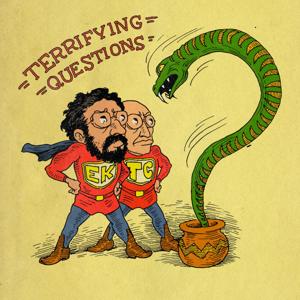


Eric Kaplan and Tao Ruspoli ask about how entertainment may or may not be "true". Tao substitutes for Taylor for the next several episodes. We've also just introduced video to the podcast! Let us know what you think.
This week Julia Moskin, Pulitzer Prize winning food reporter for the New York Times, joins Eric and Taylor to ask whether food is (or can be) art, and how it manages to do that while also just being yummy. Should great food taste like nothing you’ve ever tasted before or should it taste like the best ever version of its ingredients? Is culinary quality subjective or objective? Why do critics write reviews? Tune in and find out.
Another chestnut. Am I a self? Am I myself? Am I yourself? And if there is no such thing as the self, do I not exist? The Buddha and David Hume thought so – were they right? Join Taylor and Eric as they explore the conceptual labyrinth that is ourselves.
A command performance of a classic. Are we our bodies? Do we have sould? Do we have minds? Do haircuts diminish our true selves? Can our selves be hit by a bus or uploaded onto The Cloud? The French phenomenologist Maurice Merleau-Ponty's body could’t be with us for this episode, but he joins us in spirit to tell us why we only meet people in the flesh.
Can we build a meaningful life on the shifting sands of irrational belief? Or if we refuse to make an infinite commitment, are we wasting our life, dog-paddling in a weak tea without hope or meaning? Is faith necessary or insane – or both? This week Eric and Taylor record their first ever episode before a live studio audience, namely the annual meeting of the American Society for Existential Phenomenology in Albuquerque, New Mexico. Tao Ruspoli, Iain Thomson, Mark Wrathall, Patricia and John Benner, Kaitlyn Creasy, Justin White, and B. Scot Rousse huddle together with them and ask, Is faith good? Tune in and find out.
Another command performance. (Okay, rerun.) Are we utterly dependent on others or should we look inward and try to be true to ourselves? Can we do both? Or neither? This week Eric and Taylor look to Ralph Waldo Emerson for some help with this deeply unsettling question.
Some things are obviously horribly bad and wrong. Is it possible to make them right? Do some people deserve satisfaction while others deserve punishment or mercy? When juries deliver verdicts and judges impose sentences, are they speaking the truth or just fumbling in the dark and settling on the least bad outcome? This week Taylor and Eric reflect on the possibility, the impossibility, and the necessity of justice.
Do we owe it to anyone (even ourselves) to be thin? Is being thin always healthier, sexier, better looking, or somehow more praiseworthy? Is it easier to be a great philosopher or to get into heaven if you’re thin? This week Eric and Taylor are joined by philosopher Kate Manne, whose new book examines diet culture and fatphobia. The truth, as it often does, might surprise you.
Does the lure of fame and fortune necessarily get in the way of making great music? Or is it okay to make some fun ear candy as a way of putting food on the table? This week Taylor and Eric chat about artistic integrity and the temptations of popularity and money with singer, songwriter, philosopher, violinist, and attorney at law, Andrew Choi – also known by musical nom de plume, St Lenox. As a bonus, find out how Bob Marley was inspired by the Banana Splits.
Synesthesia! A weird thing experienced only by unusual people, or by ordinary people on unusual drugs, or – is it something everybody has all the time? Are very low musical notes literally “dark”? Can food sound like something, like hot peppers going “ping” on your tongue? Why does it make sense to call a fork a “zrickrick” and a pillow a “baobwab”? Or does it? In 1688 William Molyneux asked John Locke whether a blind person who regained her vision would be able to distinguish a square from a circle by sight. Locke said no. Leibniz said yes. Who was right? This week Eric and Taylor puzzle over Molyneux’s question and a variety of other related and unrelated matters to do with musical temperament, linear perspective, and octopuses.
From the publisher's feed