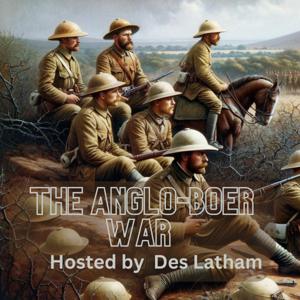
The Anglo-Boer War

The Anglo-Boer War

By Desmond LathamEducation
Download on the App Store
  • Favorites

    41

    Followers

  • Typical duration

    19 min

    per episode

Based on Podcast App listening data

The Anglo-Boer War episodes

  • Episode 53 - An IED on a Transvaal railway line & London Times Shipping Records.
    We are up to episode 53 and this week we’ll take a closer look at the use of Improvised Explosive Devices or IEDs in the war. While not a new invention, a Scotsman fighting for the Boers used a new remote triggering mechanism which is illuminating. Nothing brings out innovation in humans more than creative techniques to kill and maim each other.
    The war at this point in the third week of September 1900 appeared to be in one of those natural lulls, where small skirmishes were reported, and a bridge or two was blown up. But the Boers were planning a long term strategy which the British were only now beginning to fully understand. And the IED was symptomatic of the new guerrilla war.
    We know that the British in South Africa were totally reliant on the railway lines that had been built through the 19th century. The British army needed these to transport men and material to the two main battle fronts in the Free State and Transvaal - and also to transport the injured back to the various ports in order to be shipped back to their home countries.
    That’s because the alternative to these railway lines, the paths, dirt roads and tracks, were unpredictable and susceptible to the seasonal conditions. Also, mechanised equipment was in its infancy - there were steam driven vehicles which the British used for example, but these were few and far between.
    Oxen and horses were expensive to ship and these supplies were not always easy to come by - we’ve heard for example how Argentina, Canada, the USA, Arabia, India and other parts of Africa had been tapped for supplies of mules, horses and oxen. More about this when we hear about the shipping lists in a while.
    It took months to source these animals, then load them aboard ships which would sail or steam to Cape Town, Durban, Port Elizabeth, East London and even Beira in Portuguese East Africa.
    17 min
  • Episode 52 - Politics in a time of war and Freda’s brother survives a storm of bullets
    This episode features what’s known as the Khaki election of 1900 in England, German mercenaries, Portuguese East Africa, and another update from the teenage schoolgirl called Freda who’s unique view of this war continues through her diary.
    It also the point at which Lord Roberts makes another proclamation after his September 1st declaration that the Transvaal Republic is now officially part of the Queen’s dominion.
    As we know, that was somewhat presumptuous as the British did not control the territory within South Africa, only the main railway line and cities.
    The veld remained unconquered.
    Transvaal President Paul Kruger and his government had been pushed inexorably towards the Portuguese EAst African territory and were based in Nelspruit, only 85 kilometers from the border.
    The British under Lord Roberts were about to strike at the town and a meeting of Boer leaders including President Steyn of the Free State had decided that Kruger would have to make a sea journey to Europe in an effort to beef up diplomacy.
    It was also to protect Kruger.
    Had he been captured its clear that most of the Boers would have surrendered so his leaving Africa would be both strategic and tactical.
    He bowed to the decision apparently as the sentence of God and on the 11th of September he bid farewell to his friends and his government at Nelspruit. Though he was really only taking leave for six months, most wondered if they’d ever see him again.
    He entrained for Delagoa Bay and while the Portuguese government received him with full diplomatic honours as he awaited his ship to Europe, he must have realised that this was symbolic of a circle which began with the Dutch colonising the Cape in the 1600s, leading to the Great Trek, the war, and now he was to return to the Netherlands amongst other European countries.
    19 min
  • Episode 51 - The Australian view of an African war and President Kruger prepares to leave
    This episode will focus on Australia - their troops had already had a major impact on the war particularly as they joined the Canadians in the relief of Mafikeng.
    When the Anglo-Boer war broke out in October 1899 most corners of the empire were convinced these handful of Boers would be brought under control within a few weeks.
    However, it was black week in December 1899 that shook the empire and its commonwealth. Remember those battles - Colenso, Stormberg and Magersfontein. After this, in Australia for instance, speakers toured the towns particularly in the South East of the country promoting the imperial cause and the demonisation of the Boers in the regional press was complete by February 1900.
    They were now “treacherous savages” who fired on hospitals, convoys of the wounded, women and children; they poisoned water, used dum dum bullets, buried their own critically wounded and robbed the dead.
    Membership of what were known as rifle clubs jumped after Black Week,where mainly urban Australians rediscovered their roots by training in the use of rifles. New clubs were formed, including some formed by women.
    But were the rifle clubs capable of defending their ownb colony in the event of an invasion?
    Apparently not, according to Yackandandah’s Councillor Beatty. In February 1900, he called for the establishment of units of Mounted Rifles or Rangers in every town and district. Although he had no criticism to make of the rifle clubs, he claimed, he believed that they would be virtually useless in the face of an invasion. It of course was not entirely clear who would be invading but the war in South Africa had applied Australian minds.
    Councillor Beatty had a son in uniform in South Africa and he reflected a long-standing demand in the region for local defence units that could defend both hearth and home.
    Beatty’s call sparked a number of public meetings across the region supporting his call for the establishment of Mounted Rifle or Ranger units.
    The government’s response, however, was cool.
    While this was the official reaction, in small towns across Australia contingents of men began to show up for assessment in order to be shipped off to the Anglo-Boer war — along with their horses.
    21 min
  • Episode 50 - The Canadians repulse an attack while Uitlanders commit a war crime
    The beginning of September 1900 is characterised by small skirmishes that continue to plague Lord Robert’s army in South Africa.
    It’s also the start of Spring - which came as a relief for the men who’d slept under the stars with winter temperatures slipping well below zero in many parts of South Africa.
    But they’d forgotten what happened in mid-Summer as the blazing sun bleached the bones of the dead and powerful thunderstorms lashed the living.
    September and October 1900 also revealed the limitations of the political will. Remember there’s been an uprising called the Boxer Rebellion in China which has occupied the minds of the citizens, whereas this show in Africa is receding in the public consciousness. The government of John X Merriman was to face more criticism shortly.
    Think about contemporary wars - the UN and American campaign in Iraq and Afghanistan for example. After initial reports from imbedded journalists with their dramatic stories, then the audience begins to wane particularly if the effect of the war is not immediate. Think too of how badly the Russians fared in Afghanistan after they invaded in 1979 - the result of which accelerated the decline of the Soviet Union.
    Unlike the first world war where people in England could actually hear the Western Front artillery barrages at times, or were bombed by Zeppelins, and in the Second world war where tens of thousands of civilians were killed in Britain, in the Anglo-Boer war the hospital ships limped into harbours with fanfare but no direct effect was felt.
    So the Anglo-Boer war drifted into the background, to be manipulated by political parties as they argued back and forth about ethics, empire and cost. Something like the American experience where the left and right grapple with internal issues through the lens of distant wars.
    For the Boers, however, this life and death struggle was very much front and centre, as it was for all South Africans. The Transvaal’s political leaders were now compelled to retreat further eastwards, towards the Portuguese East Africa border, while the Orange Free State President Styen had joined Transvaal President Paul Kruger as they moved inexorably towards Delagoa Bay.
    Portuguese East Africa was neutral territory, and Delagoa Bay was a short-term bolt hole that beckoned both political leaders.
    Steyn had arrived at Waterval Onder in the final stages of the battle of Bergendal which we heard about last week. He wanted to confer with Ooom Paul Kruger and the remnants of the Transvaal government. Both were forced out of this town and headed further east to Nelspruit, only 85 kilometers from the Portuguese East Africa border.
    A meeting was held on the 28th August in Nelspruit and apparently this was a memorable occasion. A number of decisions were made including the crucial approval of the new method of war espoused by both General De Wet in the West along with General Koos de la Rey, and General Louis Botha in the East.

    23 min
  • Episode 49 - Total War destroys the ZARPS at Bergendal
    We’re in the Eastern Transvaal where Lord Roberts large army mobilised once more in late August 1900 in order to march on Boer General Louis Botha.
    Robert’s had been joined by General Redvers Buller who’d made his way north from the Natal Colony, pushing the Boers before him. On the 13th Buller took possession of Ermelo. His advance was steady and led to the Standerton commando numbering 182 men surrendered to Clery.
    Buller’s men continued skirmishing with the Boers, for instance on the 15th, his men were at Twyfelaar, and had taken possession of Carolina.
    Here and there a distant horseman riding over the olive-coloured hills showed how closely and incessantly he was watched and snipers continued to fire on his flanks.
    Buller's column had come nearer to the main army led by Lord Roberts, but it was also nearer to the main body of Boers who were waiting in that very rugged piece of country which lies between Belfast in the west and Machadodorp in the east.
    A note here about the feud between Lord Roberts and General Buller. When the war began in October 1899 Buller had been the commanding officer of the entire British army in South Africa. He was demoted when Roberts had arrived in early 1900 and both neither liked the other.
    Curiously, they feuded from a distance, their first face to face meeting was on the 7th July. So when Buller joined Roberts in the Eastern Transvaal in August 1900 it was significant for it all boiled to a simple fact. Buller was in charge of what was known as the African British experience, and Roberts was the Indian British experience. Two worlds clashed along with these two men.
    Louis Botha’s army had grown - there were now 7000 men dug in along the edge of the escarpment and from this rocky stronghold they had thrown out mobile bodies to harass the British advance from the south, and every day brought Buller into closer touch with these advance guards of the enemy.
    On August 21st he had moved eight miles nearer to Belfast, French operating upon his left flank. Here he found the Boers in considerable numbers, but he pushed them northward with his cavalry, mounted infantry, and artillery, losing between thirty and forty killed and wounded, the greater part from the ranks of the 18th Hussars and the Gordon Highlanders.
    18 min
  • Episode 48 - Boer emissaries find it cold in Russia while de Wet scrambles up the Magaliesberg
    This episode is dominated by a failed attempt by the Boers at international diplomacy, the continued zig zagging of General Christiaan de Wet, and Lord Roberts setting out his stall to attack Louis Botha in the Transvaal.
    So it was then that on the afternoon of Wednesday 15th August 1900, a train pulled into Moscow Station in Russia. It was carrying Boer emissaries led by Willem Leyds, who had been criss-crossing the world trying to drum up support for the Boers in their battle against the British.
    We’re heard in earlier podcasts how Leyds failed in both the USA and Holland - despite sympathies and even citizens of both countries fighting for the Boers. However the political situation was not in their favour.
    So Leyds and three other Boer emissaries, Fischer, Wessels and Wolmarans were on board the train in Moscow and looked out of their carriage. They were gratified to see hundreds of Russians cheering their arrival.
    But that was the only really warm welcome they received. It was quickly clear to these Boer emissaries that the Russian authorities regarded them as uninvited guests. Russian newspaper editors were ordered by the Tsar’s officials to avoid writing stories about the Boers arrival, or even interview the men.
    At the same time, Leyd’s was informed that the Tsar was unavailable. He was apparently on a tour of his military bases and had been gone for weeks.
    The Boers said they’d wait.
    While public coverage was limited and the Russian formal welcome was lukewarm, Leyds did eventually manage to secure a meeting with the Tsar along with Russian Foreign Minister, Count VN Lamsdorff.
    The meeting was accorded full diplomatic honours without Fischer, Wolmarans and Wessels. Count Lamsdorff made it clear that Leyds was the only real Boer diplomat and that the other three were not welcome.
    This was a bitter pill to swallow. The team had travelled the globe and now made the long trip to Mosco only to be told Fischer, Wolmarans and Wessels were persona’s non grata.
    In the meantime the ever resourceful Leyds printed 100 copies of the letter he’d received from the Russian government and had them distributed to media across the world.
    20 min
  • Episode 47 - General Buller reappears, Louis Botha plots and "Johnny" Hamilton bungles.
    In this episode General Buller makes a return and some of his slow moving tactics start paying off. Lord Kitchener complains after de Wet makes his escape with 2500 burghers, and the Canadians prepare to attack Louis Botha in the Eastern Transvaal.
    This war which was supposed to be over in a matter of weeks has now dragged on for 10 months and shows no signs of ending soon. This conflict is a precursor to many in the 20th Century where the civilians are part of the logistic support network for the defending national army. The Boers were receiving food, ammunition and transport from their countrymen and women across the length and breadth of South Africa
    Others, however, were cooperating with the British. Like Piet de Wet, Christiaan de Wet’s brother. Christiaan was a hero in the eyes of the Boers determined to fight on, and had led his division of 2500 men across the Vaal River into the Transvaal Republic. General Kitchener and Hunter were tracking him down, while Lord Methuen’s force was also searching for the fast moving Boer leader.
    The Canadians are attacked 11 times in 21 days east of Pretoria at a place called Nooitgedacht, and Louis Botha gets ready to relaunch his war against the British.
    19 min
  • Episode 46 - A German is executed and the Australians hold off Koos de la Rey.
    In July Lieutenant Hans Cordua who was a German, had led a plot to overthrown the British once they’d arrived in the Transvaal capital.
     
    Lieutenant Cordua had fought for the Boers and was captured but later released on parole. He’d barely gained his liberty before he hatched a plot to assassinate Major Carl Barchard who as an officer of the West York Regiment. He also apparently planned to kill Lord Roberts who commanded the British army in South Africa.
     
    The English were tipped off by a British agent who said Cordua would be dressed in British army uniform when he tried to kill Barchard, and that there would possibly be other assassins.
     
    After a lengthy court martial, the German was found guilty and sentenced to be shot.
     
    Cordua was brought before a ten-man firing squad after he’d written the last letter to his family. He preferred no blindfold, staring straight at his executioners.  Ready .. Aim .. Fire. After the execution it was found that seven of the ten rounds had penetrated his heart, so much for the theory that in a firing squad, only one rifle has a round - the rest blanks. It’s also to be noted that in shooting terms, this was quite an accurate grouping.
     
    I found a San Francisco Call newspaper report into this incident published later, in 1903, which featured the headline “War Romance has sad ending” Court Martial Robs a Boer girl of her sweetheart…”
     
    The story doesn’t quite end there. Apparently the sweetheart hired a hitman in Pretoria to climb through Major Blanchard’s window one night to kill him. Unfortunately for the sad Boer maiden, the hitman was expected and was shot dead by Blanchard who woke up with his window being raised, firing at the man at point blank range. Major Blanchard ended up in the USA and spent some time traveling about, spinning many a yarn about his experiences in South Africa.
    16 min
  • Episode 45 - De Wet drinks a cup of bitterness while Lord Roberts’ wife upsets Queen Victoria
    That’s 45 weeks since the start of the war in October 1899. And this podcast series is following the weeks, so to speak.
    Right now, we’re in an interregnum. Not a dormant period and definitely not an hiatus.
    Boer General Christiaan de Wet still appears to have the initiative in the Free State, although only because he’s still free. But appearances can be deceptive because de Wet has a paltry 2500 men riding with him across the veld, while he’s being pursued by Lieutenant General Hunter with over 20 000.
    But Hunter is squaring off against a highly motivated and skilled enemy. The Boers regard the large British force as an illegal army, their families are adrift as refugees moving from place.
    Historically armies like this are notoriously difficult to overcome quickly, unless the invading force resorts to extreme tactics, such as those used by Genghis Khan. This is not possible in the modern era for obvious reasons.
    De Wet had retreated into the range of hills called the Rhenosterpoort dominated by a large Boer farm, which lies 35 kilometers away from the town of Potchefstroom. He had rested there for a few days while the English reinforcements marched steadily towards his lair.
    Meanwhile, Lord Roberts' wife, Nora, has arrived in Pretoria with their two children which was not what Queen Victoria had expected when she let it be known she preferred no "camp followers"...
    21 min
  • Episode 44 - The Mist of war descends on the Dragon Mountains and de Wet fights with his brother
    This is episode 44 and comes with a smattering of snow, ice and a little about what’s known as the Dragon Mountains - the Drakensberg. It’s also called the Barrier of Spears because the lava flow which created the escarpment 160 million years before has weathered away revealing sharp spear like peaks that ascend to over 10 000 feet.
    These are real mountains, and both British and Boer were rightly respectful of their power.
    Free State commander General Christiaan de Wet was based west of this barrier, and decided to break his force of 5000 men into 4 distinct groups. De Wet then headed off north west on the 15th July with the largest division, and President Steyn in tow, along with the specialist mercenary unit under command of Danie Theron.
    This cold foggy weather seeped westwards towards the Caledon and the Brandwater Basin. It was through one of these deep mists on the 19th July two of the Lovats Scouts, who were colonial troops being used by the British, managed to slip through Retief’s Nek.
    What they saw on the other side of the Brandwater Basin mountains was that the grass was burnt for miles. This could have been linked to the Boers who burned the grass in front of their trenches and defensive walls making it more difficult for the British troops advancing to use the vegetation as cover. Or it could just be nature, or the local Basutho people setting fire to the grass to increase the fertilisation of the harsh terriain before the rains of summer fell.
    Hunter couldn’t be sure what was behind this great burning. However, the two Scouts he’d dispatched had more information that was vital. They saw what they reported was a large Boer division at Naaupoort. We know that it wasn’t the entire Boer army, in fact General Christiaan de Wet had purposefully left what he thought was a relatively insignificant part of his army behind so that the British wouldn’t waste their time attacking what he called “such a paltry force” .
    He would also face off against his brother Piet and the confrontation did not end well...
    20 min

About The Anglo-Boer War

From the publisher's feed

The Anglo-Boer War 1899-1902 saw the British Empire at the height of its power facing a small band of highly mobile Boers in South Africa. The war introduced the world to the concentration camp and…

Best of The Anglo-Boer War

Ranked by our users in the last 21 days

More shows like The Anglo-Boer War

The History of WWII Podcast by Ray Harris Jr

The History of WWII Podcast

3,982 Listeners

No Such Thing As A Fish by No Such Thing As A Fish

No Such Thing As A Fish

4,816 Listeners

Dan Snow's History Hit by History Hit

Dan Snow's History Hit

4,771 Listeners

The Daily by The New York Times

The Daily

111,829 Listeners

The Battle of Stalingrad by Des Latham

The Battle of Stalingrad

123 Listeners

The Rest Is History by Goalhanger

The Rest Is History

15,589 Listeners

History of South Africa podcast by Desmond Latham

History of South Africa podcast

116 Listeners

British Scandal by Audible

British Scandal

2,499 Listeners

Short History Of... by NOISER

Short History Of...

2,832 Listeners

The Rest Is Politics by Goalhanger

The Rest Is Politics

3,039 Listeners

The Tucker Carlson Show by Tucker Carlson Network

The Tucker Carlson Show

15,908 Listeners

The Rest Is Classified by Goalhanger

The Rest Is Classified

1,095 Listeners

The Boer Wars by Inception Point AI

The Boer Wars

0 Listeners